Loading...
Please wait for a bit
Please wait for a bit
Click any word to translate
Original article by Jakub Krupa (now); Yohannes Lowe and Adam Fulton (earlier)
Ukrainian opposition MP Inna Sovsun was just speaking on RTÉ radio, explaining the importance of Pokrovsk to Ukraine’s defence of the Donetsk region.
She called the Russian claims that it’s taken over the city “overexaggeration,” even as she admitted that the situation there was difficult for the Ukrainian forces.
She stressed that “if the Russians capture Pokrovsk – which they have not … – they would have pretty easy access to other parts of both the Donetsk region and also to move forward to the Dnipropetrovsk region.”
But she said that the Ukrainian forces “have been protecting those cities for 11 years now,” and the Russians “still couldn’t get the whole territory.”
But asked about Russia’s attempt to create a narrative of inevitability on the battlefield, she said she was also concerned about the collective west – and the US in particular – buying into this logic to put more pressure on Kyiv.
“What we’re seeing over the last week is … America primarily pushing Ukraine towards making a deal, but they’re not pushing Russia so much. They are not actually putting pressure on them to make sure they are willing to compromise,” she said.
She repeatedly urged European leaders to speed up their decision on the use of frozen Russian assets, which she called “the strongest leverage that Europe has.”
“That is why Ukraine’s position right now in the negotiations is, of course, weak … but it’s not only because of the situation the front line, but because of what our friends and allies are doing or not doing to help,” she said.
Asked about the upcoming US-Russia talks in Moscow, she expressed concerns about Witkoff’s reputation as “being on super friendly terms with the Russians.”
She added:
“I’m worried that we have to negotiate our sovereign rights with the Americans, with the country that is supposed to be holding [up] … he rule based order, that is the major problem here.”
Ahead of Putin-Witkoff meeting in Moscow, lots of attention is focusing on the Ukrainian city of Pokrovsk, an important logistics hub in the eastern Donetsk region, which Moscow claimed to have captured, AFP noted.
But the Ukrainian military says the fighting in the city continues, with Ukrainians reportedly controlling the northern part of the city, and Russians – the souther part.
“Search and assault operations and the elimination of the enemy in urban areas continue in Pokrovsk,” the Ukrainian military’s eastern command wrote on social media, claiming Russian troops that planted a flag in the town’s centre had been beaten back.
The fight over the city comes amid Russian attempts to argue that its forces are making inevitable progress on the battlefield, putting more pressure on Kyiv to agree to a peace deal.
Reuters noted that Russia wants to take the whole of the Donbas region, which comprises the Luhansk and Donetsk provinces. Ukraine still controls about 10% of Donbas – an area of about 5,000 sq km (1,930 sq miles) in mostly northern Donetsk.
Capturing Pokrovsk and Kostiantynivka to its northeast, which Russian forces are also trying to envelop, would give Moscow a platform to drive north towards the two biggest remaining Ukrainian-controlled cities in Donetsk – Kramatorsk and Sloviansk.
The agency noted that Pokrovsk would be Moscow’s most important single territorial gain inside Ukraine since it took the ruined city of Avdiivka in early 2024.
But Russia has been threatening Pokrovsk for more than a year. Instead of its full-frontal assaults in earlier battles, such as the bloody campaign for the similar-sized city of Bakhmut, Russia’s military has been using a pincer movement to gradually encircle Pokrovsk and threaten Ukrainian supply lines, Reuters noted.
Deputy prime minister and finance minister Simon Harris stressed the significance of Zelenskyy’s visit for the Ukrainian community in the country.
He told RTÉ:
“There is many, many tens of thousands of people from Ukraine – 125,000 over the duration of the war so far – who’ve come to Ireland to seek refuge here.
Our communities have opened their hearts, they have opened their homes.
Many Ukrainian people are making a really important contribution to our economy today, working in many sectors of the Irish economy. Many Ukrainian children in our schools today and making a positive contribution to our schools as well, and for them today, for the Ukrainian people living in Ireland, it must be an emotional and significant day too.”
Irish prime minister Micheál Martin briefly chatted with reporters this morning ahead of his meeting with Ukraine’s Volodymyr Zelenskyy this lunchtime.
He told them that Zelenskyy’s visit is “an opportunity to get an update in terms of the current state of the negotiations in relation to a ceasefire and to a peace settlement in Ukraine,” Irish public broadcaster RTÉ reported.
He also stressed the need for the EU’s unity in talks, adding that Ireland has “supported Ukraine from the outset.”
In parallel to Witkoff’s meeting in Moscow, we will also follow Volodymyr Zelenskyy’s first visit to Ireland.
He has arrived in Dublin last night, and has a busy schedule today, paying a brief visit to the country’s new president Catherine Connolly, before meeting with key government figures including the taisoeach, Micheál Martin, and addressing both chambers of the Irish parliament in the afternoon.
He will also take part in some economic side events to mark the cooperation between the two countries.
Welcoming him at the airport last night, Martin stressed that “our support for the people of Ukraine as they defend their freedom and democracy remains unwavering.”
I will follow his visit and bring you the key lines here.
It’s Tuesday, 2 December 2025, it’s Jakub Krupa here, and this is Europe Live.
Good morning.
Vladimir Putin’s invasion of Ukraine has resulted in Russia taking Ukrainian children out of their country so that they can be raised as Russian.
The Associated Press documented the seizing of Ukrainian children in 2022, after which the international criminal court said it had issued an arrest warrant for Putin for war crimes, accusing him of personal responsibility for the abductions of children from Ukraine.
During a high-level meeting in Paris yesterday, Ukraine’s first lady Olena Zelenska said that, as part of Zelenskyy’s Bring Kids Back UA initiative, Ukraine has returned 1,859 children who were abducted and taken to Russian-held territory.
Ukraine’s foreign minister, Andrii Sybiha, said that nearly 700 children have been killed by Russia since the full-scale invasion was launched in February 2022. He said over 19,000 have been deported or forcibly transferred and 2,245 remain missing (see Ukraine’s national “Children of War” database for more information).
“Russia’s forced deportation of Ukrainian children is one of the most painful crimes of this war,” Sybiha wrote in a post on X.
Updated
Volodymyr Zelenskyy said that after revisions the plan to end the war – that has been circulating between Ukraine, Russia and the US – “looks better” and the work will continue on it.
But he maintains that the “territorial issue is the most difficult” element of the deal as Russia wants Ukraine to give up territory in the east it still controls, something Zelenskyy says he won’t agree to.
Speaking on Monday, the white house press secretary Karoline Leavitt said the draft deal had “been very much refined”, adding: “I think the administration feels very optimistic.”
Updated
Vladimir Putin has hailed what his commanders told him was Russia’s full capture of the eastern Ukrainian town of Pokrovsk as an important victory after a prolonged campaign, saying it would help Moscow fulfil its wider war aims.
The town’s fall, if confirmed, gives Moscow a platform to drive north towards the two biggest remaining Ukrainian-controlled cities in the Donetsk region: Kramatorsk and Sloviansk.
Reuters reports there was no immediate comment on Pokrovsk from Ukraine, which has said in recent weeks it has been holding back Russian forces in the town’s north. And the news agency could not immediately independently verify the assertions of either side, though maps from both have long shown the town under intense Russian pressure, with Moscow’s forces deep inside it.
Russia, which uses the Soviet-era name of Krasnoarmeysk to refer to the town, has faced fierce Ukrainian resistance in its battle since mid-2024 to capture Pokrovsk, once a strategic logistics hub for the Ukrainian army.
“I want to thank you,” Putin, dressed in military uniform and sitting in a command centre, told the army’s top brass in a video released by the Kremlin late on Monday. “This is an important direction. We all understand just how important.”
Updated
Finland and Sweden have announced increased collaboration between the neighbouring Nordic countries including on defence, civil preparedness and cyber security.
In a joint statement, the Swedish prime minister, Ulf Kristersson, and his Finnish counterpart, Petteri Orpo, said they would be deepening bilateral cooperation in response to “Russia’s offensive war against Ukraine and increasing geopolitical and economic challenges”.
The statement said:
This work is done with a clear focus on interoperability and being able to act jointly in the face of external threats.
Since last year, Sweden has also assumed the role of the framework nation for Nato’s forward-looking ground force FLF Finland [Nato’s forward land forces], a step in our joint commitment to security in the region.
Who is Steve Witkoff? The American property developer turned loyal envoy to the US president has had a friendship with Donald Trump dating back to a late-night encounter in a New York deli.
Now Witkoff is key to Trump’s efforts to secure a deal to end the war in Ukraine – and earlier helped broker the ceasefire in the Israel-Gaza war.
Witkoff and Trump go back nearly 40 years. And as Julian Borger writes in this Witkoff profile early in the year, that is what gives the 67-year-old businessman his clout. America’s interlocutors know he is the genial emissary of a volatile leader capable of swinging from fulsome support to public vituperation in a heartbeat, depending in large part on who has Trump’s ear.
You can read the full profile here:
Updated
Today’s talks between Vladimir Putin and Trump envoy Steve Witkoff come as Russian forces control more than 19% of Ukraine – or 115,600 square km – up one percentage point from two years ago, according to Reuters.
And Russian forces have advanced in 2025 at the fastest pace since 2022, according to pro-Ukrainian maps.
As mentioned earlier, Russian military commanders told Putin on Monday that Russian forces had captured the frontline Ukrainian towns of Pokrovsk and Vovchansk.
Pokrovsk has been dubbed the “gateway to Donetsk” and has been in Moscow’s sights for more than a year as it pushes to control the whole eastern Donetsk region.
Ukrainian officials have issued no confirmation that either town has fallen into Russian hands.
US officials say more than 1.2 million men have been killed or injured in the near four-year-old war. Neither Ukraine nor Russia discloses their losses.
Updated
Amid the intensified diplomatic push to end the Ukraine war, Volodymyr Zelenskyy has said the Kremlin’s claims of battlefield advances are exaggerated and that Kyiv’s priorities remain security guarantees, sovereignty and territorial integrity.
The Ukrainian president also insisted that Russia must not get rewards for its aggression on Ukraine.
As Warren Murray reports in today’s Ukraine war briefing, Zelenskyy said in Paris that he hoped to have talks with Donald Trump to discuss next steps once Steve Witkoff was back from his talks in Russia.
Zelenskyy also said that after revisions the peace plan circulating between Ukraine, Russia and Washington “looks better” and the work would continue.
But as mentioned, the European Union is warning that the Putin-Wifkoff talks will again pile pressure on Ukraine to make concessions. The EU’s foreign policy chief, Kaja Kallas, said:
In order to have peace, we shouldn’t lose focus that it’s actually Russia who has started this war and Russia that is continuing this war and Russia that is really targeting civilians, civilian infrastructure every single day to cause as much damage as possible.
You can read the full war briefing here:
Updated
The Kremlin has said Vladimir Putin will meet Steve Witkoff for their talks on Tuesday afternoon. It’s now approaching 9.10am local time in Moscow.
Their meeting would take “in the second half of the day”, Kremlin spokesperson Dmitry Peskov said, while refusing to be drawn on Russia’s red lines, saying megaphone diplomacy was not helpful.
As a reminder, the talks also come against the backdrop of Witkoff coming under fire recently after reportedly advising a Kremlin official that achieving peace in Ukraine would require Russia gaining control of Donetsk and potentially a separate territorial exchange, according to a recording of their conversation obtained by Bloomberg.
In the 14 October phone call with Yuri Ushakov, the top foreign policy aide to Putin, Witkoff said he believed the land concessions were necessary while advising Ushakov to congratulate Trump and frame discussions more optimistically.
As Joseph Gedeon and Hugo Lowell reported, the recording provided a direct insight into Witkoff’s negotiating approach and appeared to reveal the origins of the controversial US 28-point peace proposal that emerged earlier in November.
Their story can be seen here:
Updated
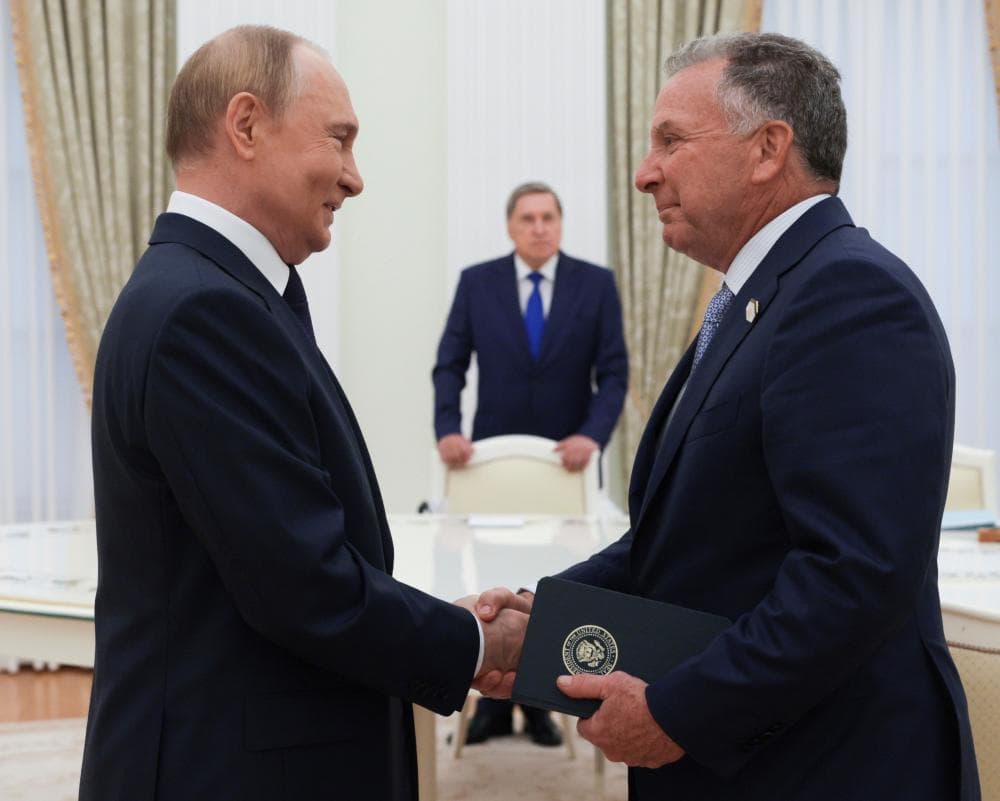
Hello and welcome to our live coverage of war in Ukraine as Donald Trump’s special envoy Steve Witkoff is to meet Russian president Vladimir Putin in Moscow amid Washington’s push to reach a peace deal.
Witkoff’s trip comes after he led a US delegation in talks with Ukraine at the weekend in Florida, three and a half years after Russia’s full-scale invasion.
The US has been upbeat about the prospects of reaching a deal to end the war, with White House press secretary Karoline Leavitt telling reporters on Monday: “I think the administration feels very optimistic.”
But Kyiv’s European allies have expressed concern that the US peace plan gives too much to Moscow’s maximalist demands. The EU’s foreign policy chief, Kaja Kallas, said she feared the Putin-Witkoff talks on Tuesday would pile pressure on Ukraine to make concessions.
Witkoff – Trump’s business partner turned roving envoy – was expected to arrive in Russia with Trump’s son-in-law, Jared Kushner. The Kremlin did not say if Kushner would also attend the meeting with Putin.
In other developments:
Russian military commanders told Putin in comments reported on Monday that Russian forces had captured the frontline Ukrainian towns of Pokrovsk – a key logistics hub – and Vovchansk and were advancing elsewhere, which the Russian president hailed as successes to enable further gains. Ukrainian officials have made no acknowledgement that either place has fallen into Russian hands.
Zelenskyy said on Monday that Russia must not be rewarded for its invasion. “We also need to ensure that Russia itself does not perceive anything it could consider as a reward for this war,” he said a press conference with the French president, Emmanuel Macron.
Zelenskyy also held calls with a dozen other leaders, including the UK prime minister, Keir Starmer, and the German chancellor, Friedrich Merz, as he sought to rally support from European allies. “Peace must become truly durable,” the Ukrainian president wrote on X. “The war must end as soon as possible.”
Ukraine’s negotiator Rustem Umerov said “significant progress” had been achieved in the two days of talks with Witkoff and other US officials in Florida but that more work was needed on “challenging” issues.
The Moscow talks also come as Kyiv has faced headwinds from a corruption scandal that has rocked Zelenskyy’s inner circle and forced the dismissal last week of his top negotiator and chief of staff, Andriy Yermak.
A Russian missile attack killed four people and wounded nearly two dozen others on Monday in the central Ukrainian city of Dnipro, the regional governor said.
Updated