Loading...
Please wait for a bit
Please wait for a bit
Click any word to translate
Original article by Julian Borger in Jerusalem
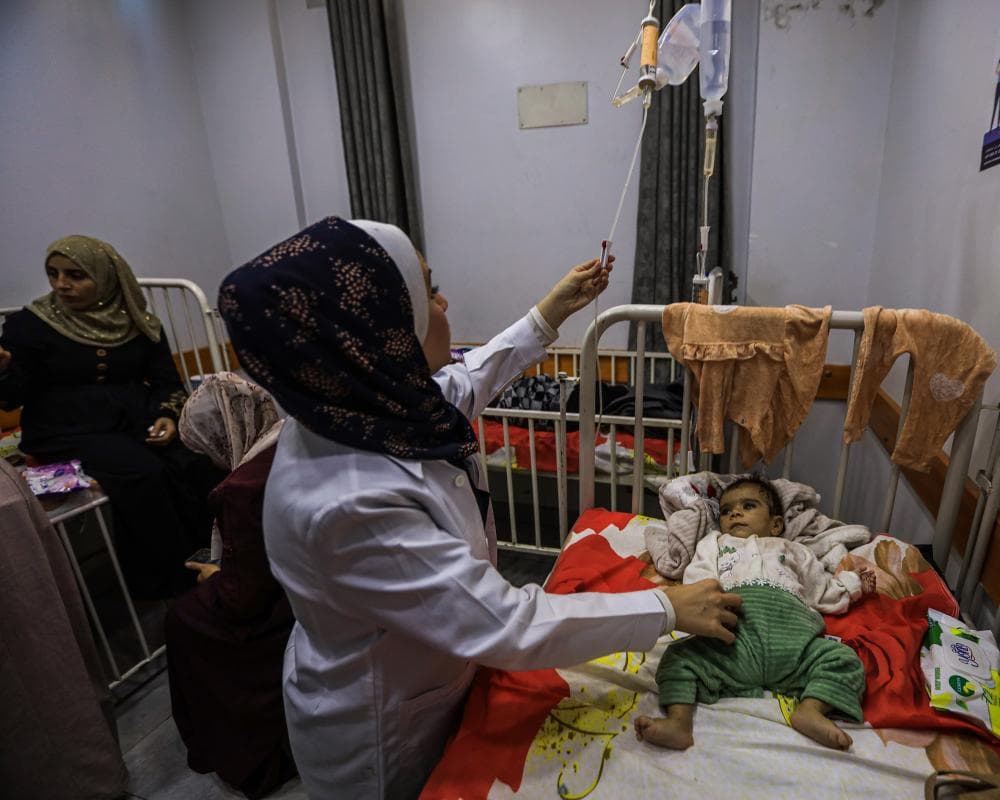
Malnutrition continues to take a toll among Gaza’s young despite a ceasefire declared two months ago, with more than 9,000 children hospitalised for acute malnutrition in October alone, according to the latest UN figures.
While the immediate threat of famine has receded for most of the 2.2 million Palestinians in Gaza after the ceasefire announcement on 10 October, the UN and other aid agencies report continuing Israeli restrictions on their humanitarian aid shipments, which they say fall well below the needs of a population weakened and traumatised by two years of war, homelessness and living in flimsy shelters.
Tess Ingram, a spokesperson for the UN child protection agency Unicef, said: “In Gaza’s hospitals I have met several newborns who weighed less than one kilogramme, their tiny chests heaving with the effort of staying alive.”
According to Unicef figures, 9,300 children were treated for severe acute malnutrition in October. That is significantly less than the peak of 14,000 children in August, but much more than the child malnutrition rate during the previous ceasefire in February and March of this year.
“It’s still a shockingly high number,” Ingram said, briefing journalists by video from Gaza.
In October, about 8,300 pregnant and breastfeeding women were also hospitalised for acute malnutrition.
“This pattern is a grave warning and it will likely result in low birthweight babies being born in the Gaza Strip for months to come,” Ingram added.
“This is not over. Generations of families, including those being born now into this ceasefire, have been forever altered by what was inflicted upon them.”
Unicef and other UN agencies say that aid deliveries crossing into Gaza have increased since the height of the war, but are still completely inadequate in relation to the humanitarian needs.
An average of 140 aid trucks a day have crossed so far in December, in convoys organised by the UN and the International Organisation for Migration. That is well below the target of 600 trucks a day set as part of the ceasefire.
Those figures do not include bilateral aid donations and commercial shipments, which have increased more sharply than UN-coordinated deliveries under the ceasefire. They have brought down market prices for many commodities, but they remain beyond the reach of the overwhelming majority of people in Gaza who have had no income for more than two years and who have depleted their savings.
Since the ceasefire, aid has been coordinated through a multinational hub called the Civil-Military Coordination Centre led by the US and Israel and involving representatives of other countries supporting the ceasefire. However, diplomats and aid officials say that the Israeli army still has the final say in what is allowed in to Gaza.
The UN reported that out of eight humanitarian convoys coordinated with Israeli authorities on Sunday, only four had been facilitated.