Why has ceasefire collapsed between Thailand and Cambodia?
Click any word to translate
Original article by Rebecca Ratcliffe South-east Asia correspondent
A long-running border dispute between Thailand and Cambodia has erupted in fierce clashes for the second time this year, despite a peace deal brokered by Donald Trump.
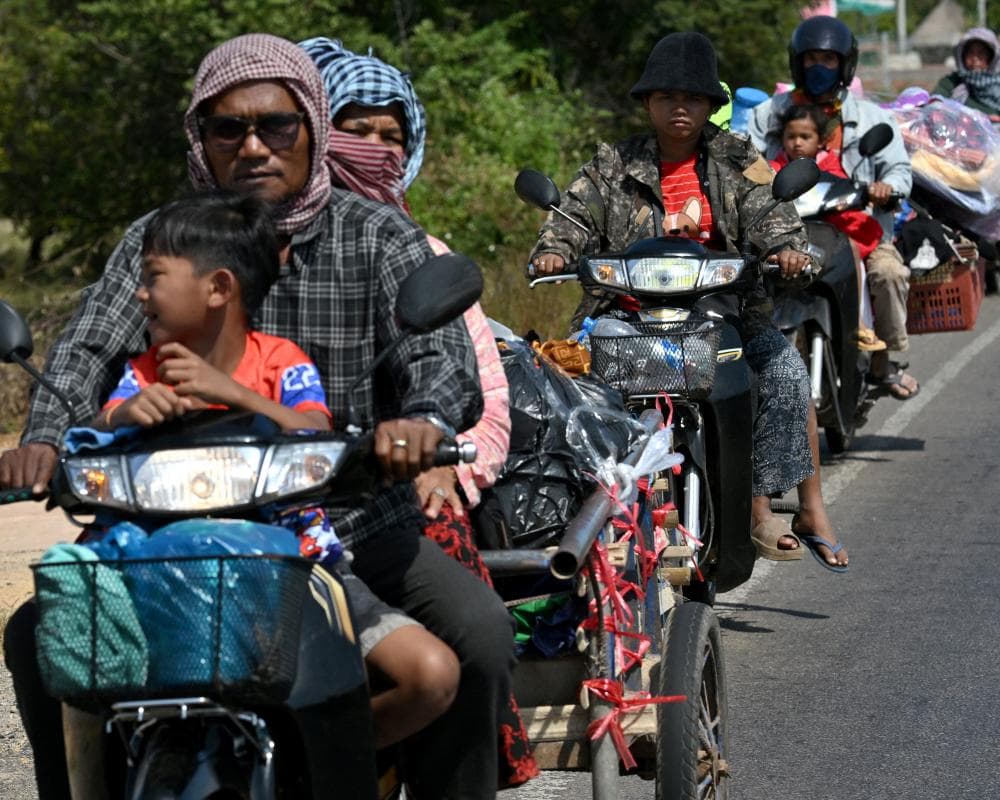
Seven civilians have been killed in Cambodia and 20 wounded, while Thailand has confirmed three soldiers’ deaths in the latest fighting, which began with skirmishes on Sunday night.
Both sides accuse the other of breaking a ceasefire, and have vowed to continue defending their territory.
What is the dispute about?
The competing territorial claims date back more than a century, to when France, which occupied Cambodia until 1953, mapped the land border stretching more than 508 miles (817km) between the two countries. Skirmishes have repeatedly broken out in the years since, fanned by nationalist sentiment.
One of the most fiercely contested sites is the 11th-century Hindu temple Preah Vihear, or Khao Phra Viharn in Thailand, which both countries claim. In 1962, the international court of justice (ICJ) awarded the temple to Cambodia. However, Thailand continues to claim the surrounding land. The dispute escalated into clashes in 2008 after Cambodia sought to list Preah Vihear as a Unesco world heritage site.
Why did tensions escalate this year?
Various political factors have led to the escalation. In Thailand, nationalist sentiments were fanned by a government plan to negotiate with Cambodia to jointly explore energy resources, which critics perceived as a threat to Thai territory. Tensions also escalated when Cambodia referred disputes over temples in four areas to the ICJ.
A breakdown in relations between Hun Sen and Thaksin Shinawatra, former leaders of Cambodia and Thailand, complicated matters further. The powerful political figures were once close friends, but fell out. Hun Sen released a full recording of a private phone call he had with Thaksin’s daughter Paetongtarn Shinawatra, then prime minister, in which they discussed the border issue. The recording triggered a political crisis that brought down her government.
Paetongtarn has since been replaced as prime minister by Anutin Charnvirakul, who has promised to hold elections next year. With nationalist sentiment running high, he will probably want to show a tough stance on the border issue.
What role has Trump played? And why did the peace deal collapse?
Trump put pressure on both sides to stop fighting in July, saying he would not negotiate a trade deal with either until the fighting stopped, at a time when both Thailand and Cambodia were facing a 36% US tariff. Thailand and Cambodia agreed to an “immediate and unconditional” ceasefire days later after talks in Malaysia, chair of the Association of Southeast Asian Nations regional bloc.
An enhanced ceasefire agreement, which included more detail on de-escalation measures, was officially signed six weeks ago in Trump’s presence. However, the ceasefire arrangements have been precarious, and both sides have accused the other of violations. On 10 November, a Thai soldier was wounded by a landmine, causing Thailand to suspend commitments in the agreement. Thailand alleged the landmine had been newly laid by Cambodia, which Cambodia has denied.
What happened in May and July?
Troops briefly exchanged fire at a contested area, killing a Cambodian soldier. This led to a series of tit-for-tat actions by both governments: Thailand imposed border restrictions on Cambodia, while Cambodia banned imports of fruit and vegetables, broadcasts of Thai films, and cut internet bandwidth from Thailand, among other measures.
When five Thai military personnel were injured by landmines while on patrol in July, both sides withdrew ambassadors and conflict erupted along the border. The fighting lasted five days, killing 48 people and forcing 300,000 from their homes.