Death toll from Indonesia floods passes 700 as 1 million evacuated
Click any word to translate
Original article by Rebecca Ratcliffe with Hidayatullah in Pidie Jaya
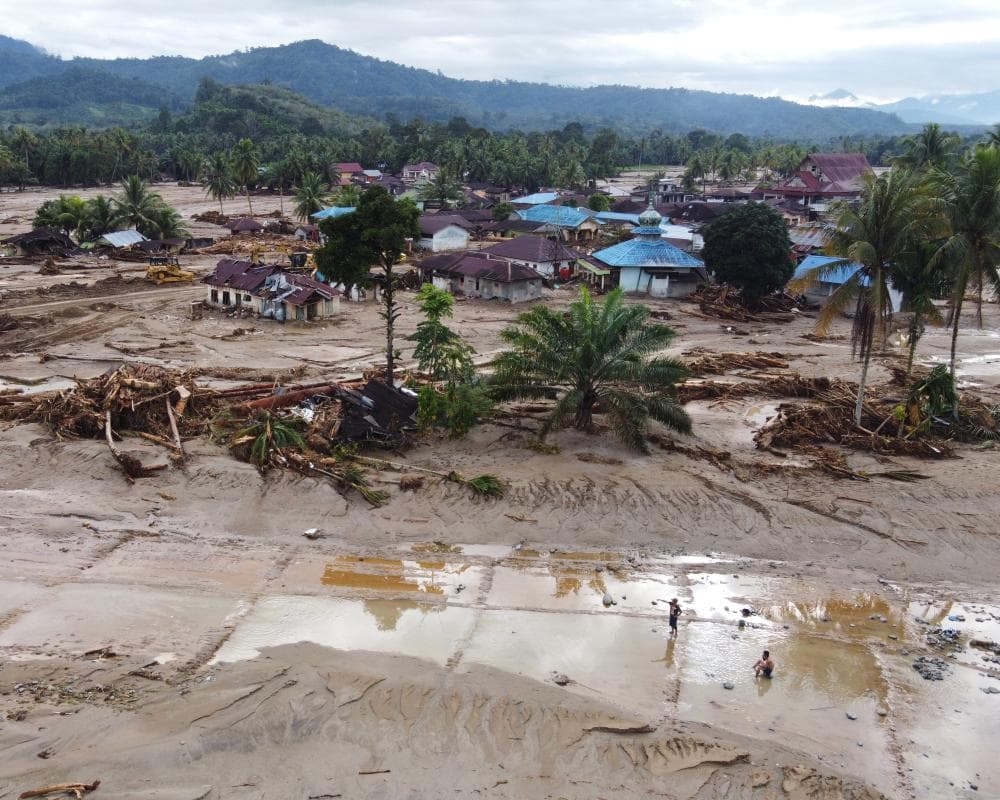
The number of people killed by floods and landslides on Indonesia’s Sumatra island rose to 708 on Tuesday, the country’s disaster agency said, with 504 people missing.
The toll was a sharp increase from the 604 dead reported by the agency on Monday.
Heavy monsoon rains and tropical cyclones have devastated parts of Asia this week, including Indonesia, Sri Lanka and southern Thailand, killing more than 1,300 people across the region, destroying infrastructure and inundating towns.
About 3.2 million people have been affected and 2,600 injured in Indonesia alone. A million people have been evacuated from high-risk areas. It was earlier reported that 753 people had died, but the figure was revised down to 708 on Tuesday evening.
Aid workers and response teams are racing to reach survivors, but have been hampered by blocked roads and broken bridges. Some areas, including Tapanuli Tengah in North Sumatra and Agam in Aceh, were inaccessible by road, according to Unicef.
In Aceh, one of the hardest-hit areas, markets are running out of rice, vegetables and other essentials, and prices have tripled, according to Islamic Relief, which is sending 12 tonnes of emergency food aid. “Communities across Aceh are at severe risk of food shortages and hunger if supply lines are not re-established in the next seven days,” the charity said.
The Indonesian government said on Monday it was sending 34,000 tonnes of rice and 6.8m litres of cooking oil to Aceh, as well as the provinces North Sumatra and West Sumatra.
The World Health Organization said it was deploying rapid response teams and critical supplies to the region, and strengthening disease surveillance.
The WHO director general, Tedros Adhanom Ghebreyesus, told reporters in Geneva that it was “another reminder of how climate change is driving more frequent and more extreme weather events, with disastrous effects”.
Survivors, many of whom are staying in evacuation shelters, have described how powerful currents of water arrived rapidly and submerged villages. “We didn’t think we would survive that night because the situation was so chaotic. Everyone was thinking about saving themselves. There was no prior warning whatsoever before the water came,” said Gahitsa Zahira Cahyani, 17, a student at an Islamic boarding school. Hundreds of students from the school ran out in the night to flee to safety, some of them clinging to trees and the mosque’s roof.
The season’s monsoons often bring heavy rains that can trigger landslides and floods, but this year’s downpours were compounded by a rare tropical storm formed in the Malacca strait, devastating parts of Sumatra and southern Thailand, where 181 people were killed.
Sri Lanka has also faced catastrophic flooding and landslides, caused by a separate storm, Cyclone Ditwah. It has killed 410, while another 336 remain missing.
President Anura Kumara Dissanayake has declared a state of emergency to deal with what he called the “most challenging natural disaster in our history”.
Rains have eased across the country, but landslide alerts remain in force across most of the hardest-hit central region, officials said.
Agence France-Presse contributed to this report.