Loading...
Please wait for a bit
Please wait for a bit
Click any word to translate
Original article by Graham Readfearn Environment and climate correspondent
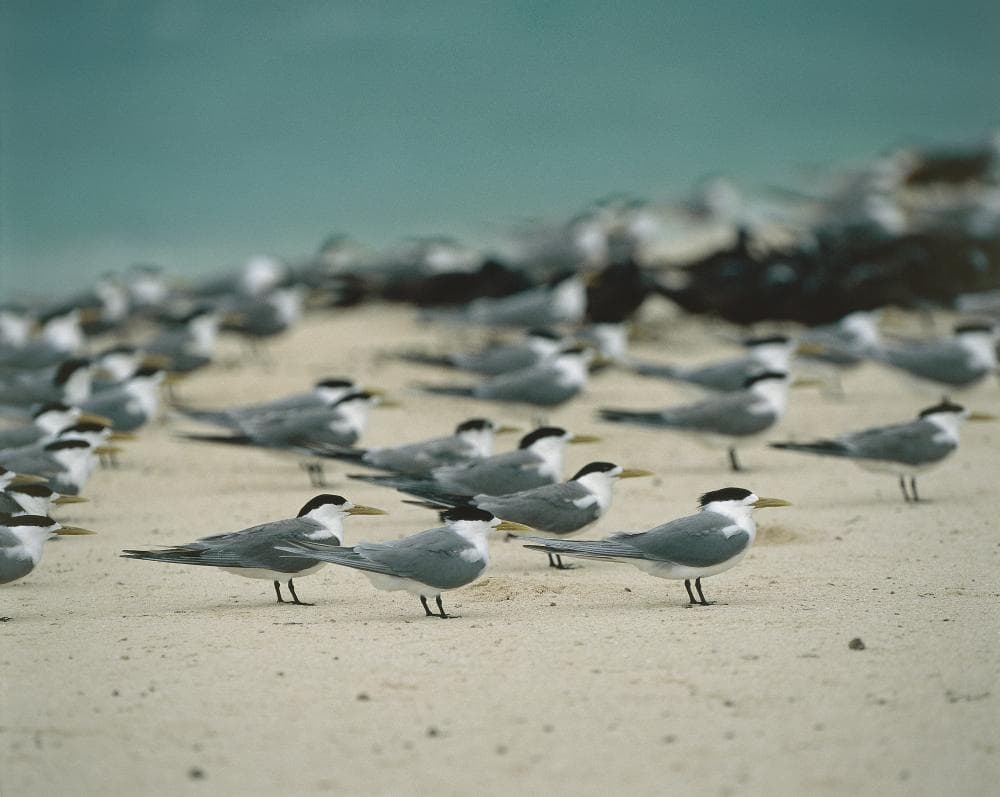
Sandwich terns are a graceful seabird known for their committed, forceful and spectacular plunging dives into the ocean to catch fish.
Thousands of the species started to fall sick across Europe in 2022 with tens of thousands dying as a lineage of the H5N1 bird flu – 2.3.4.4b – spread through the continent’s wild flocks.
The effects of the virus on the brain cause the terns to flounder on the ground, craning and straining their necks in a suffering behaviour known as star-gazing. It is difficult to watch.
“I remember a colony at Scolt Head Island in Norfolk,” says Prof James Pearce-Higgins, the director of science at the British Trust for Ornithology.
“You had adult terns trying to mate with dead terns and chicks begging for food from their dying parents.
“It was a real sense of a colony collapse as you watched this transfer of the virus between birds.”
Sandwich terns are close relatives of greater crested terns, which are seen all around Australia and were the first native bird to suffer a mass mortality event from the disease in Australia on South Australia’s Limestone Coast.
Since the virus re-emerged in Europe in 2021 it has swept over every other continent, killing millions of birds and mammals, and infecting more than 400 bird species as well as mammals – in particular, seals and sea lions.
The virus was finally detected in Australia two months ago in migratory seabirds that likely brought the disease from breeding grounds in the subantarctic.
Sign up for the Breaking News Australia emailThis week, the federal government revealed analysis of the potential threat to Australia’s wildlife which showed almost 400 species of birds and mammals were at “high risk” or worse if they caught the disease.
One expert who worked on the analysis, Prof John Woinarski of Charles Darwin University, tells the Guardian he expects the disease will have spread across the continent within a year.
Pearce-Higgins says: “I would expect Australia is going to experience large mortalities, like those we have been through, and it’s going to put some species at risk.”
Almost half of Australia’s bird species are unique to the continent, meaning that a lot of uncertainty comes with predicting what H5N1 could do to the animal population.
It also means the risk of the virus causing planet-wide extinctions is higher now that every continent is affected.
“We’ve been looking overseas since 2021 and seeing the advance of this virus,” says Dr Sara Ryding, an evolutionary ecologist at Deakin University.
“It has been horrible overseas – tens of thousands of birds dying in single colonies.
“The concern was, we knew it was going to arrive eventually – how could it not? But we didn’t know what it would look like when it got here.”
Ryding has led research to project the level of risk from H5N1 for all Australia’s bird families by developing a model based on official reports of the disease from around the globe to the World Organisation for Animal Health.
The research suggested the most at-risk families of birds were gannets and boobies (Sulidae), followed in descending order of risk by cranes (Gruidae), darters (Anhingidae), ducks, geese and swans (Anatidae), and gulls, terns and noddies (Laridae). But a host of other bird families – including pelicans, crows, ravens, falcons and kestrels – were all predicted to be susceptible.
While many species of those birds are not considered threatened, the sight of large numbers of dead and sick birds, particularly larger species like swans and pelicans, “is going to be confronting,” Ryding says.
“I don’t want to cause panic, but we have seen the devastation it has caused overseas and there’s no reason to think it will be any less devastating here,” she says. “I think it will be really bad.”
Studies have identified several behaviours that can make animals susceptible to catching the disease, such as scavenging dead and dying animals for food (as do gulls and Tasmanian devils), spending time in dense colonies (like seals and waterbirds) and spending time around bodies of water where the virus can live for weeks or months, or where other infected animals might also be around.
The virus has been particularly damaging for seals and sea lions. Tens of thousands of seals and sea lions have died in outbreaks in Peru, Chile, Brazil, Uruguay and Argentina and, most recently, on Australia’s subantarctic islands of Heard and McDonald.
The virus can cause debilitating conditions for the seals and sea lions – known collectively as pinnipeds – with severe neurological and respiratory symptoms.
Australia has three resident pinniped species – the New Zealand fur seal, the Australian fur seal and the already endangered Australian sea lion – and government analysis has suggested the risk for all three from the virus is “very high”, meaning “very severe reduction in population size or viability is predicted” if the virus reaches them.
Dr Saia Bartes is an Argentinian marine biologist who has just completed her PhD on Australian fur seals at Deakin University and has helped study declines in South American sea lions after the virus struck there.
“It was devastating for them. In north Patagonia, we lost a third of the sea lions,” she says.
Because pinnipeds often share space with infected birds, and tend to be in tightly packed groups, Bartes says they are particularly susceptible.
Pinniped numbers are still recovering from commercial hunting, she says, and “they could start declining again really quickly, which is happening in South America” if the virus found them.
Back in the UK, Pearce-Higgins says there is some hope. Their experience of collaboration with conservation groups, volunteers and local authorities through weekly and later monthly meetings had been critical in the response.
And there were some signs the impacts of the virus may be slowing.
“The hope is that because a lot of these birds are long-lived, the population could be more resilient. But we still don’t really know the probabilities of future outbreaks,” he says.
“It might look really bad for a few years, but the hope is that [Australia] can focus on the conservation of what is left.”