Brazil’s Lula launches historic fourth term bid – but son of jailed Bolsonaro stands in his way
Click any word to translate
Original article by Tom Phillips in São Bernardo do Campo
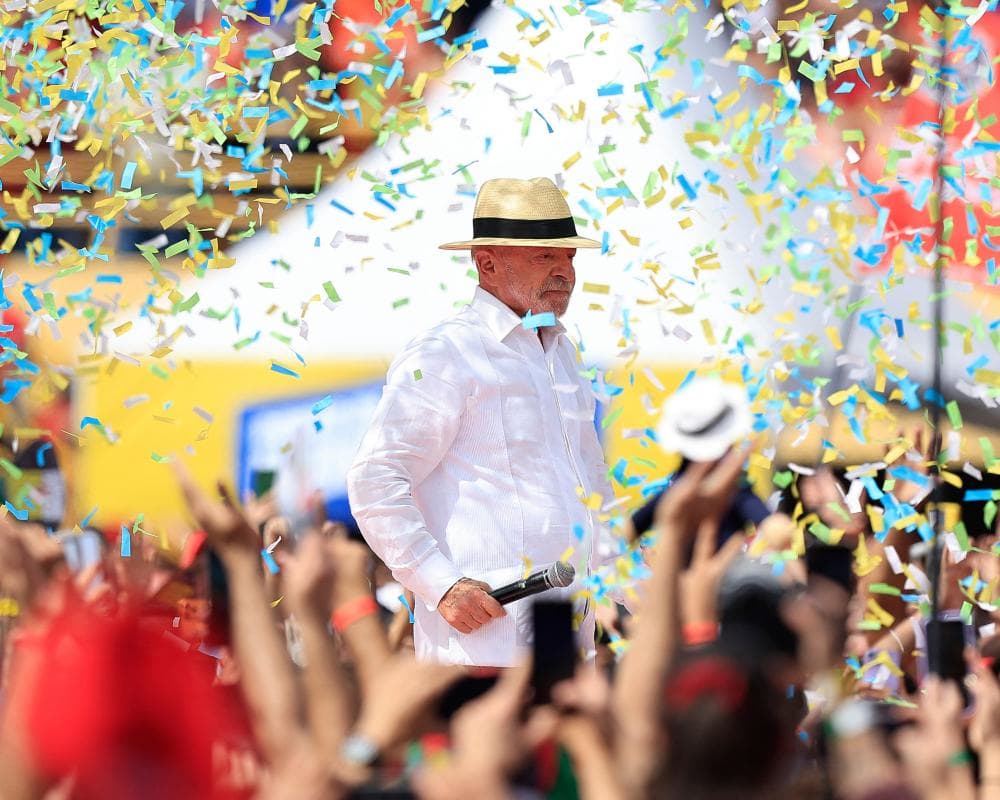
Brazil’s leftwing president, Luiz Inácio Lula da Silva, has launched his campaign for a historic fourth term and vowed that as long as he lived he would not allow the “shameless” right to return to power.
Addressing a sea of supporters in São Bernardo do Campo, the industrial city where his political career began nearly half a century ago, the 80-year-old politician reminded voters of the chaos and violence that unfolded during the 2018-22 presidency of his far-right predecessor, Jair Bolsonaro, whose son Flávio Bolsonaro will face Lula in October’s presidential election.
Lula recalled how hundreds of thousands of citizens died during a Covid outbreak Jair Bolsonaro was accused of bungling with his anti-science policies. Gun ownership soared as laws were relaxed, allowing criminal groups to expand their arsenals. “They handed out … more than a million weapons,” Lula said, promising to dedicate a fourth term to improving education and healthcare as well as developing Brazil’s rare-earth deposits, the world’s second largest after China’s.
Lula also said he would improve security by targeting the rich organised crime bosses who lived in luxury apartments. “It’s easy to kill a crook in a favela. But the guy running the show lives in a penthouse … and we need to stop this,” Lula said. He also told his far-right rivals to “show some shame”.
Lula was speaking at the Vila Euclides football stadium, where his astonishing rise to the presidency began in 1979 when, as 33-year-old union leader, he spearheaded two historic strikes that helped end the military dictatorship. Those strikes made Lula a household name and in 2002, after three failed attempts, he won a landslide victory to become his country’s first working-class president.
During Lula’s first two-terms, from 2002 until 2010, he was credited with fighting hunger, dramatically expanding social welfare programmes and access to higher education, and improving Brazil’s global standing, although his administration was blighted by corruption scandals. His successor, Dilma Rousseff, became Brazil’s first female president but led the country into a severe economic recession before being controversially impeached in 2016.
In 2018, Lula was jailed for alleged corruption and he spent 580 days in prison before the supreme court quashed his conviction. Lula’s imprisonment allowed Bolsonaro to win that year’s election, ushering in four years of environmental destruction and international isolation.
In 2022 Lula won his third term, defeating Bolsonaro by a razor-thin margin and vowing to rescue the country from “one of the worst periods in Brazilian history”. “This nightmare is over,” Lula declared at his January 2023 inauguration. A week later, far-right radicals rampaged through the capital, Brasília, in a botched attempt to bring Bolsonaro back.
Bolsonaro was jailed in 2025 for 27 years for plotting that failed post-election power grab. Flávio Bolsonaro, a 45-year-old senator, launched his campaign on Sunday with an event on Rio’s Copacabana beach, previously the scene of huge rallies in support of his father. “I am going to be Brazil’s next president because I’m going to fight this system,” Bolsonaro, who wore a bullet-proof vest under a yellow Brazil shirt, told a crowd far smaller than those his father used to attract.
Polls suggest Lula holds a slender advantage over Bolsonaro, with 43% of intended votes to his rival’s 40% in a run-off which will take place on 25 October if, as expected, no candidate secures 50% of the vote in the 4 October first round.
André Pagliarini, the author of a book about Lula called A People’s President and the Fight for Brazil’s Future, said the showdown would be “the single most important electoral contest this year in the world”.
Pagliarini said he believed a Bolsonaro victory would be a significant boost for the pro-Trump “reactionary block” that has won elections across Latin America, from Argentina and Chile to Colombia, where the far-right lawyer Abelardo de la Espriella recently took office.
Donald Trump’s administration has repeatedly asserted its leadership over the region, launching deadly military operations against alleged “narco-terrorists” in the Caribbean Sea and Pacific, threatening to “take back” the Panama canal and, in January, abducting Venezuela’s dictator, Nicolás Maduro. Last week, the US state department published an incendiary video declaring that “American dominance in the western hemisphere will never be questioned again”.
In recent months Trump has turned up the heat on Brazil, designating its two biggest organised crime groups, the Red Command and the PCC, as terrorist organisations. That has kindled fears of a US military intervention on Brazilian soil or interference in Brazil’s presidential election.
During a visit to a jungle training camp in Panama on Friday, Trump’s defence secretary, Pete Hegseth, said Washington planned to use the military to “ruthlessly” pursue Latin American drug traffickers, “just like [they did with] Isis and al-Qaida” during the “war on terror”.
The idea, Hegseth said, was to “do bad things to bad people – because for too long, bad people did bad things to good people inside the United States of America and across Central and South America”.
There was anger at the US outside Lula’s campaign launch on Sunday, where some activists handed out stickers that read: “Fuck Trump.”
Seixas Alves, a 33-year-old Lula supporter, said he worried the decision to classify Brazilian drug factions as terrorist groups could be used as a pretext for a US attack. “Just like they [did with] Saddam Hussein,” Alves added, referring to the Iraqi dictator’s supposed development of weapons of mass destruction.
In Rio, Flávio Bolsonaro praised Trump’s decision to target the Brazilian crime groups and said he was the only politician capable of “sitting down with the US”.
In Vila Euclides, Simone Tebet, a centrist Lula ally, urged voters to do everything they could to stop Brazil falling back into the hands of far-right politicians who wanted “to kill Brazilian democracy” and create “a country of hate”.