Loading...
Please wait for a bit
Please wait for a bit
Click any word to translate
Original article by Eva Corlett in Wellington
The Australian white supremacist who murdered 51 Muslim worshippers at two mosques in Christchurch in 2019, in the worst mass shooting in the New Zealand’s history, has asked a court to discard his guilty pleas, claiming harsh prison conditions had affected his mental health and compelled him to admit to the crimes.
Brenton Tarrant pleaded guilty in March 2020 to 51 counts of murder, 40 counts of attempted murder and a terrorism charge, after initially saying he would defend the charges. In August 2020, Tarrant became the first person in New Zealand under current laws to be sentenced to life in prison without the chance of ever walking free.
But in 2022 he filed an appeal at the court of appeal, for both his convictions and his sentence. The court will consider whether the appeal can proceed because it was filed outside the legislated time frame to do so.
The 35-year-old gave evidence via video link on 9 February, as part of a week-long hearing in Wellington.
In front of a panel of three judges, Tarrant said his mental health had deteriorated due to conditions in prison, where he was held in solitary confinement, with limited reading material or contact with other prisoners.
He said he was suffering “nervous exhaustion” by the time he entered his guilty pleas, and he had admitted to the crimes just months before his trial was due to begin because he felt there was “little else I could do”.
Crown lawyer Barnaby Hawes challenged Tarrant, suggesting there was little evidence he had been in serious mental crisis. Hawes said Tarrant had other options, including delaying his trial date on mental health grounds, or defending himself at trial.
Tarrant, a self-declared white supremacist, said he had masked his mental illness, partly driven by the “political movement I’m a part of”.
He said he had made a late application because he had not had access to the information required to make it.
According to court documents, the court will be primarily considering the application to vacate the guilty pleas.
“The central issue before the court will be whether at the time Mr Tarrant entered his guilty pleas he was incapable of making rational decisions as a result of the conditions of his imprisonment, which he says were torturous and inhumane,” it said.
The judges are expected to release a decision at a later date.
If the court grants the application to vacate the pleas, the case will be sent back to the high court for the terrorist to stand trial. If it declines the application then a further hearing will consider the sentence appeal later this year
Security has been ramped up at the court, with only media, counsel and authorised people permitted to attend the hearing inside the courtroom. Limited space for the public has been made in an adjoining room, while provision has been made for victims and family members to view the hearing in Christchurch via a delayed broadcast. Tarrant’s legal counsel have been granted permanent name suppression.
Aya Al-Umari, whose brother Hussein al-Umari was murdered at Masjid al-Noor, told The Post the hearing made her uncomfortable and listening to Tarrant give evidence for the first time would be difficult.
“For the sake of my sanity … I have to think of them as just words with absolutely no meaning behind them,” she said. “But at the same time it is reopening a wound that you try so hard to close and try and move forward with life.”
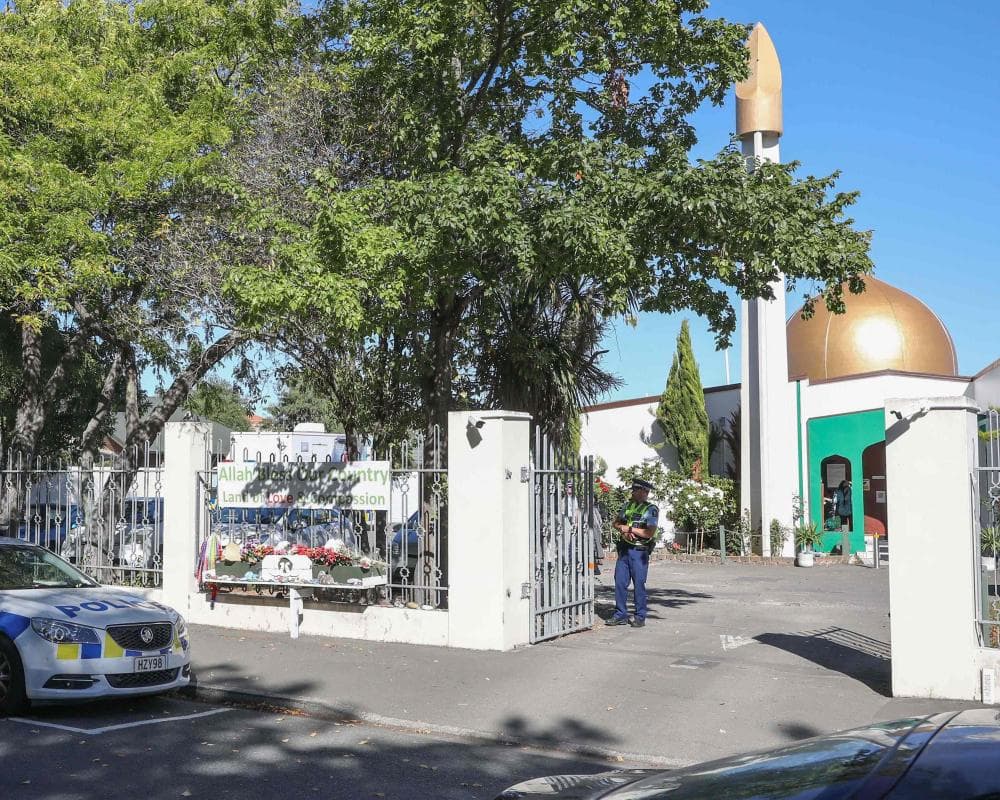
Tarrant moved to New Zealand in 2017 planning to carrying out a white supremacist attack. He planned the mass shooting for months, conducted reconnaissance at the mosques, distributed a manifesto expressing his racist views before he opened fire, and livestreamed part of the assault on Facebook.
In the wake of the attacks, the former Jacinda Ardern-led government banned military-style semi-automatic rifles and created a firearms registry.
An inquiry into the attacks is the largest coronial investigation New Zealand has seen and is still under way. In October 2025, the high court left the door open for Tarrant to be called as a witness at the inquest, despite objections from survivors and families of the victims.
Associated Press contributed to this report