Loading...
Please wait for a bit
Please wait for a bit
Click any word to translate
Original article by Jason Burke, and Seham Tantesh in Gaza
Every morning, Mansour Mohammad Bakr sets out from the small rented room in Gaza City he shares with his pregnant wife and two very young daughters. The 23-year-old walks past the port and the breaking waves of the Mediterranean where he once earned his living.
Before the two-year war that devastated Gaza, Bakr was a fisher, sharing tackle and a boat with his father and brothers. Now his brothers are dead, his father is too old, and his equipment was destroyed during the conflict. Like hundreds of thousands of others across Gaza, Bakr needs a job.
“Money is the main means of survival in Gaza … without it, a person cannot do anything,” he says. “The limited aid that reaches us doesn’t replace our need for money in any way and doesn’t cover even the most basic living requirements.”
Humanitarian organisations have ramped up distribution since October, when a ceasefire agreement came into effect, leading Israel to lift some of the heavy restrictions it had imposed on aid and easing its delivery within Gaza.
In January, United Nations agencies and their partners reached approximately 1.6 million people with household-level general food assistance. World Central Kitchen, an NGO, is now serving 1 million hot meals a day. But such assistance remains vastly insufficient and still covers only basic necessities. For everything else, brought in by the private sector, Palestinians in Gaza need cash.
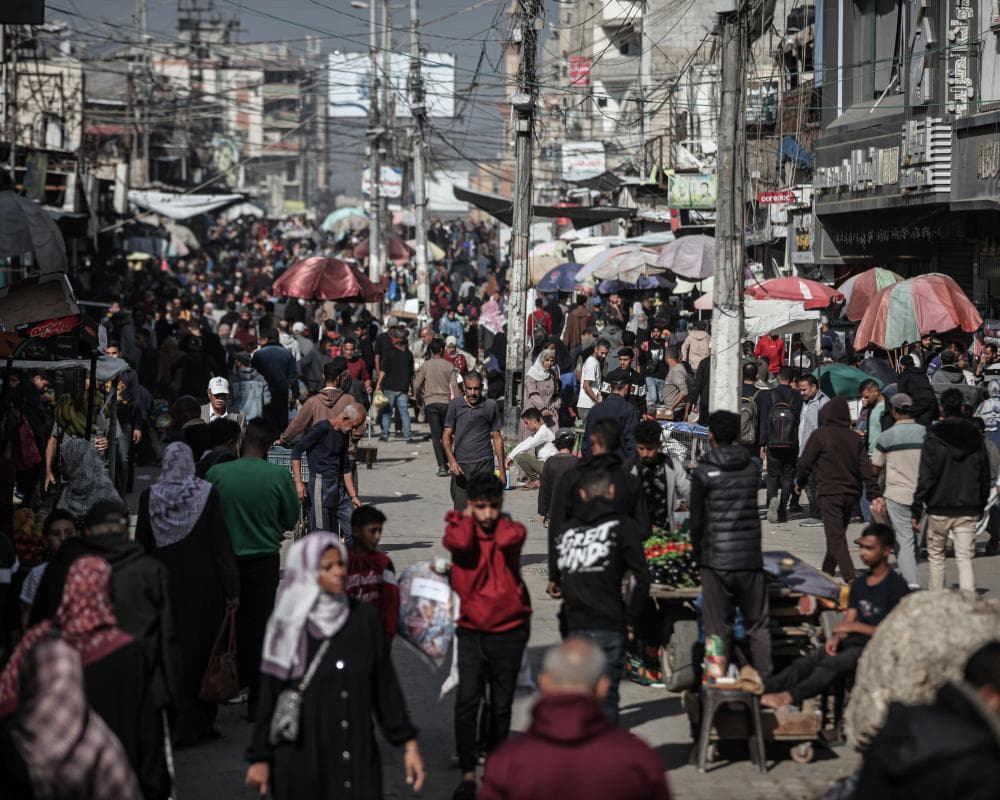
Aid workers in Gaza say more fresh fruit, vegetables, meat, clothes and household items are now available, but at exorbitant prices. “There has been a huge increase in commercial supplies … but it is all very expensive,” says Kate Charlton, a Médecins Sans Frontières medical coordinator in Gaza City.
Mohammed al-Far, a 55-year-old former trader who lives with his family in al-Mawasi, a coastal area crowded with tent encampments for the displaced, says they receive only one meal a day from aid organisations.
“It’s either rice, lentils or beans, and once or twice a week, some meat. Life requires cash to go on. We can get enough to eat … but transportation, haircuts, charging mobile phones and buying vegetables and fruit all require money,” he says.
Al-Far has tried to launch falafel and sweets businesses, but without success, and has run up substantial debts. His age now makes it harder to find work.
“My health is still good, and I’m ready to do anything, but employers are looking for younger workers. I have been searching for months and months … I walk around the market looking for work, but without success,” he says.
The problem for al-Far and Bakr, as for all the others seeking work in Gaza, is that there is virtually none. The official unemployment rate, estimated by the UN, is 80% and the economy has shrunk to 13% of its former size.
In November, Pedro Manuel Moreno, the deputy secretary general of the UN’s trade and development agency, said the war had “wiped out decades of progress”. “Gaza is going through the fastest and most damaging economic collapse ever recorded,” he said.
The UN agency’s data shows that in 2024, GDP per capita in Gaza fell to just $161 (£118) a year – among the lowest in the world. The Israeli offensive shattered sanitation, transport, power and health systems, ruined fields and greenhouses and decimated Gaza’s fishing industry, which once employed thousands.
Bakr says: “I dream of returning to the sea and to the profession of fishing, and of being able one day to buy a fishing boat like the one I used to own, so I can provide my family with food, drink, clothing and medicine.”
The October ceasefire agreement was supposed to lead swiftly to reconstruction but progress has largely stalled. Some elements of the agreement have advanced, including the return of all hostages and limited reopening of the Rafah border crossing. Plans for an international stabilisation force are also emerging, with Indonesia saying it is preparing thousands of troops for humanitarian and reconstruction roles.
But Hamas, which controls most of the coastal area where almost all of the 2.3 million-strong population of Gaza now live, is reluctant to fully disarm and Israel appears unwilling to relinquish its control over more than half of the territory.
Israel has blocked the new technocratic administration that was to govern Gaza under Donald Trump’s “peace plan” from entering, while key crossing points remain shut or subject to restrictions.
Even if Bakr could somehow find and equip a new boat, limits imposed by Israel at sea would prevent him from practising his trade.
“My work as a fisher in the sea of Gaza was passed down to us from our grandfathers. I left school young and fishing is all I’ve ever done. I have been searching for work … everywhere I can,” he says.
Even those with advanced qualifications struggle amid the ruins and rubble. Bisan Mohammad graduated with a degree in medical laboratory sciences just months before the war in Gaza was triggered by a Hamas raid into Israel that killed 1,200 people, mostly civilians, and led to 250 being taken hostage by the militant Islamist organisation.
Her husband, a security guard, was killed in the early days of the war, leaving her alone to provide for their daughter. She now lives in a tent with her parents in Nuseirat, in central Gaza.
“I began looking for any available job but without success … everything needs money; even water, food and bedding all require cash. Sometimes I feel that even breathing needs money,” says Mohammad, 23.
Violence has continued since the ceasefire and Israel launched more attacks in Gaza in January than in any month since October, according to Acled, an independent US-based conflict monitor. Gaza health authorities say 586 Palestinians have been killed since the truce took effect, bringing the war’s overall death toll to more than 72,000, mostly civilians.
“What is being called a ‘ceasefire’ hasn’t changed our reality; in fact, it has made it worse,” says Mohammad. “The media has stopped talking about the ongoing killing … while the bombardment continues … prices keep rising, and even basic necessities, when available, such as water and food, are barely sufficient.
“I don’t think about the future and I don’t try to; thinking about it is exhausting and frightening, and the future is unclear. I don’t know what will happen to me or my daughter if this situation continues without work or income.”