Loading...
Please wait for a bit
Please wait for a bit
Click any word to translate
Original article by Jon Henley in Paris
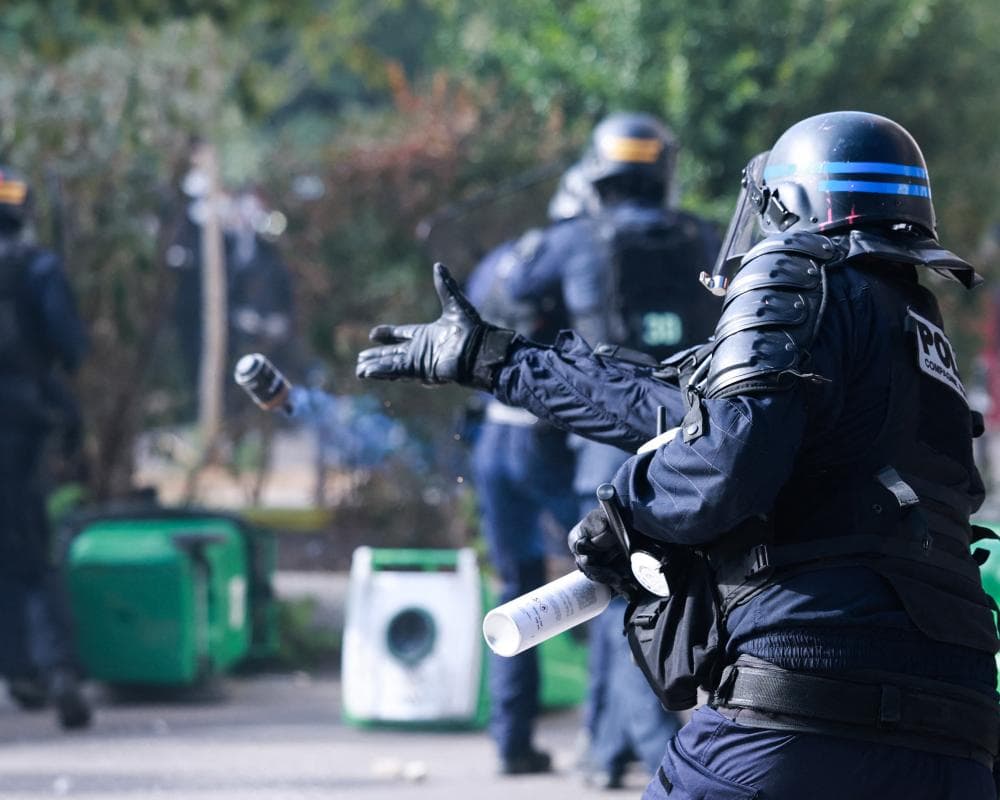
France’s interior minister has suspended the use of stun grenades by police at high school demonstrations but rejected mounting accusations of police brutality during two weeks of protests marred by often violent clashes that have injured hundreds.
Laurent Nuñez told RTL radio on Wednesday that he had ordered a temporary halt on the use of the grenades “in the context of the high school students’ movement” after a 15-year-old boy lost a hand during a protest in Lens, northern France, on Monday.
Authorities have not confirmed the exact circumstances – in particular, whether the boy had picked up the grenade or been struck by it – but said up to 200 protesters had been hurling projectiles at police when the riot squad intervened.
Nuñez said he was suspending use of the grenades “until we know exactly what happened in this case”. But he later told MPs that accusations of “police repression” were “excessive” because officers “are not intervening if the protests are peaceful”.
The injured boy’s mother said on Wednesday that her son’s hand had been amputated. She told BFMTV: “His life has been stolen. He’s a 15-year-old kid, how can children be treated like that?” She said her son had not tried to pick up the grenade.
The education ministry said classes had been wholly or partially suspended in 429 of the country’s 3,700 lycées – high schools attended by pupils aged between 15 and 18 – on Wednesday, a significantly lower number than on Tuesday.
However, 80 university campuses, including the prestigious Sciences Po in Paris, were blockaded in largely peaceful protests by students on Wednesday, unions said, and teachers’ and other unions said they backed further strike action on Thursday.
Nuñez told parliament that 215 teenagers and 89 school staff had been injured since the start of the protests – which were triggered by chronic teacher shortages, crowded classes, dilapidated buildings and long school days – while 761 police officers had also been wounded.
He said 18 internal police investigations had been launched over allegations of brutality during the demonstrations, including one incident in which a young protester lost multiple teeth and another in which a student lost the use of an eye.
He said inquiries were always opened over accusations of “non-proportional” policing, but he insisted officers were there to protect the students. Rights groups and trades unions have repeatedly accused the police of using unnecessary force.
On Tuesday at least 250,000 pupils, parents, teachers and unionists took to the streets in cities across France on the biggest day yet of the campaign, prompting the president, Emmanuel Macron, to hold an emergency cabinet meeting.
Most marches passed off without serious incident but some, including in Paris, ended in sporadic vandalism and running skirmishes with riot police, with officers firing teargas and carrying out baton charges to disperse protesters.
French security forces do not have orders to “confront” protesting high school students, the prime minister said on Wednesday, as allegations of police brutality mounted following days of protests.
Hundreds of students, police and teaching staff have been injured since the movement demanding better conditions in high schools began.
After rights groups, unions and the students accused authorities of using disproportionate force, the government said it would suspend the use of stun grenades by police at student-led demonstrations.
The prime minister, Sébastien Lecornu, said in a televised address on Wednesday night that the country could not be “indifferent” to the concerns of high school students, acknowledging that the “anger of young people does not come from nowhere”.
But he too denied police had “orders to confront” the protesters. He promised the government would present an action plan focusing on replacing absent teachers, renovating school buildings and reorganising timetables by the end of October.
Lecornu on Tuesday condemned the violence and told parliament it could not be tolerated, while also rejecting accusations that the government had ordered “police repression” against the protesters.
Over the past two weeks, demonstrators have set dustbins on fire outside their schools, destroyed bus shelters and hurled projectiles at riot police, who have responded using batons, teargas and riot-control rounds.
Twenty-four schools have been burned or ransacked, while more than 6,600 people have been arrested, almost all of them minors. More than 1,800 are being prosecuted, nearly 1,500 of them under 18, the justice ministry has said.
Anne Savinel-Barras, the president of Amnesty France, on Wednesday welcomed the decision to suspend police use of stun grenades as “an important first step” but said the devices should be “permanently banned from the policing of all protests”.
She added: “Protests should not be battlefields. Stun grenades are designed to shock, disorient and sow panic, often among dense crowds. Some can cause permanent hearing loss as well as life-changing mutilations due to the blast and shrapnel.”
The protests, months before key presidential elections to choose Macron’s successor, have rattled a government trying to reduce a ballooning budget deficit amid mounting investor concern over France’s sky-high debt and weak economic growth.
They have also sparked a heated political row, with the government accusing the radical-left La France Insoumise party of encouraging and even orchestrating the movement after numerous LFI MPs attended school blockades.
The party’s veteran leader and presidential candidate, Jean-Luc Mélenchon, has strongly supported the protests while urging non-violence.