Loading...
Please wait for a bit
Please wait for a bit
Click any word to translate
Original article by Jakub Krupa
Shaun Walker and Peter Beaumont
Volodymyr Zelenskyy says proposals negotiated with US officials on a peace deal to end Russia’s war in Ukraine could be finalised within days, after which American envoys will present them to the Kremlin.
After two days of talks in Berlin, US officials said on Monday they had resolved “90%” of the problematic issues between Russia and Ukraine, but despite the positive spin it is not clear that an end to the war is any closer, particularly as the Russian side is absent from the current talks.
In the early hours of Tuesday morning the Ukrainian president said the US Congress was expected to vote on security guarantees and that he expected a finalised set of documents to be prepared “today or tomorrow”. After that, he said, the US would hold consultations with the Russians, followed by high-level meetings that could take place as soon as this weekend.
“We are counting on five documents. Some of them concern security guarantees: legally binding, that is, voted on and approved by the US Congress,” he said in comments to journalists via WhatsApp. He said the guarantees would “mirror article 5” of Nato.
The main sticking point between the Ukrainian team and US negotiators remains the issue of land. Trump wants Ukraine to give up the parts of the Donbas region it still holds, while Ukraine wants to freeze the lines at the current point of contact. “We are discussing the territorial issue. You know it is one of the key issues. At this point, there is no consensus on it yet,” Zelenskyy said after the Berlin talks.
It is not clear how the two sides will proceed on the territorial issue, with Zelenskyy previously suggesting that a compromise solution such as a free economic zone could be theoretically possible if the Ukrainian people voted for it in a referendum. The critical stumbling block is likely to be when the plans are put to the Russian president, Vladimir Putin, who has given no sign he is willing to compromise on his war aims.
“If Putin rejects everything, we will end up with exactly what we are experiencing on our plane right now – turbulence,” said Zelenskyy, recording the comments after his plane took off from Berlin for the Netherlands for a series of meetings on Tuesday.
Speaking at the event in the Hague, EU foreign policy chief Kaja Kallas said Russia cannot escape paying the bill for its war in Ukraine.
The commission, which will validate war damages in Ukraine to be paid by Russia, sends a message to future aggressors, Kallas said in comments reported by Reuters, that “if you start a war, you will be held to account”.
She also announced the EU would provide “up to one €1m” to pay for the preparatory work for the new commission.
Updated
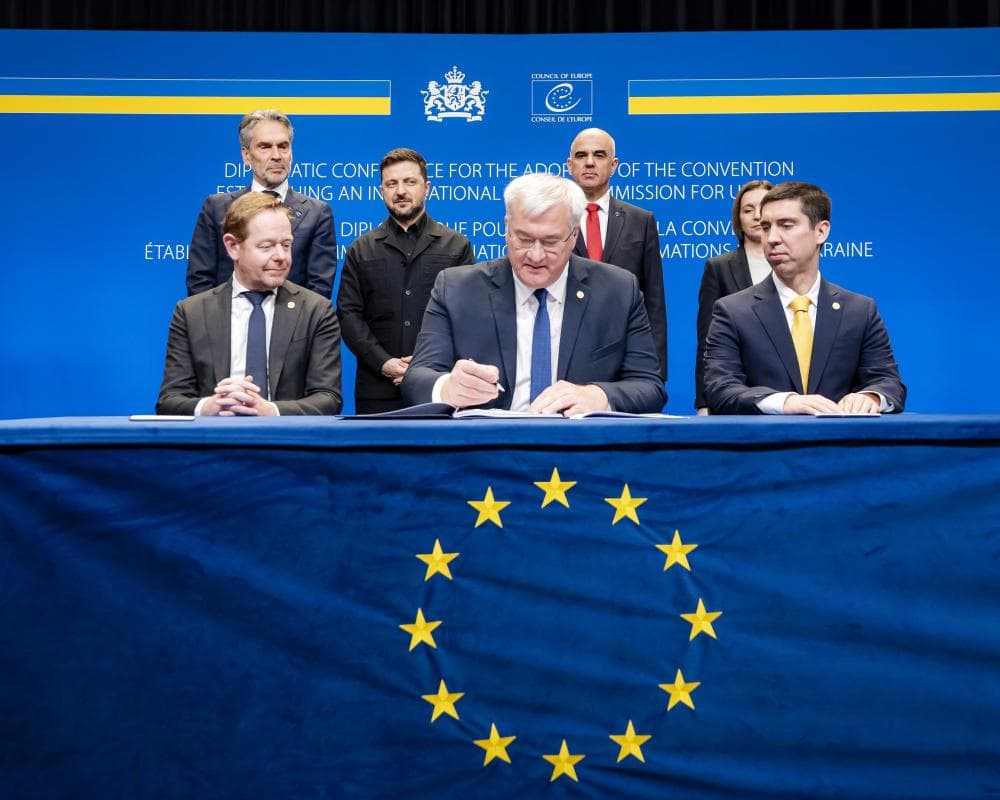
The treaty is now signed, establishing the International Claims Commission of Ukraine.
Ukraine’s Zelenskyy has just been speaking again at the launch of The International Claims Commission for Ukraine (10:39).
In his very brief remarks, he largely followed the same lines as in the Dutch parliament, saying that “all pressure on Russia must remain in place for as long as occupation of our land continue.”
“As long as our people remain in Russian captivity and until the Ukrainian children abducted by Russia are brought home, sanctions must limit Russia, until it shows respect for peaceful for peaceful life and the rights of its neighbours. And of course, of course, every Russian war crime must have consequences for those who committed them,” he said.
He said that making Russia accountable for its crimes is needed to “that others learn not to choose aggression.”
Speaking before him, the caretaker Dutch PM, Dick Schoof, warned that “there must be no impunity” for Russia’s acts in Ukraine.
“Today is all about justice, because without it, there can be no just and lasting peace. But justice doesn’t just follow automatically. We need to lay the groundwork and prepare as carefully as possible,” he said.
Similar sentiment was expressed by Moldova’s president Maia Sandu, as she warned that “where accountability is avoided or postponed, violence returns, often in more destabilising forms.”
“Accountability is a condition of security today and for the future. But accountability is not only about Ukraine, and it is not only about one aggressor and one victim. Accountability is about Europe, about every country in Europe, it is about whether Europe as a whole is willing to defend its peace,” she said.
Updated
Meanwhile, the Kremlin said that a Christmas truce that Ukraine has proposed would depend on whether a peace deal is reached or not.
Ukrainian president Volodymyr Zelenskyy said on Monday that Kyiv supported the idea of a ceasefire, in particular for strikes on energy infrastructure, during the Christmas period.
Asked about the idea, Kremlin spokesman Dmitry Peskov said: “The question now is whether we, as president (Donald) Trump says, will reach a deal or not.“
Peskov said Russia was unlikely to participate in such a ceasefire if Ukraine was focused on “short-term, unviable solutions” rather than a lasting settlement.
“We want peace. We don’t want a truce to give Ukraine a breathing space and prepare for a continuation of the war,” Peskov told reporters.
“We want to stop this war, achieve our goals, secure our interests, and guarantee peace in Europe for the future. That’s what we want.”
Commenting on Berlin talks, Zelenskyy says he held “really intensive” talks with US counterparts in Germany, “working in a great detail on documents that could stop the war and guarantee security.”
But he says “every single detail matters,” adding that nothing in the proposed peace deal should be allowed to “become a reward for Russia’s aggression.”
“If the aggressor receives a reward, he starts to believe that war pays off,” he says.
He says “there is a hardly a crime against humanity that Russia has not committed,” making a passing reference to the shooting down of Malaysia Airlines flight MH17 from Amsterdam to Kuala Lumpur in 2014, and says that these acts “cannot simply be forgotten.”
“It cannot be that those who kill[ed] are suddenly treated as respectable partners,” he says, calling for detailed accountability.
He ends on a hopeful note:
I truly hope that the next time I address your parliament it will be with gratitude for a peace that has been achieved.
That ends his speech. He gets a long standing ovation.
Zelenskyy then turns to the issue of energy security, as he says Russia “is deliberately targeting our infrastructure.”
“They know that in our region, the winter cold can become one of the most dangerous weapons. They try to use it against Ukrainians, against just ordinary people, against normal life, and that’s why it’s so important not to relax or rely on diplomacy alone.”
He then repeatedly thanks the Netherlands for its support with Patriot systems, F-16 aircraft, artillery and drones, and other elements of aid.
He says the talks are “not only about a ceasefire, but about security guarantees” to make sure that Russia cannot attack Ukraine again in a few years’ time.
He says “criminals don’t change in a day,” and so the peace process requires strong, international guarantees for Ukraine, so there is “true accountability” for any violation of the settlement.
He then talks about his recent visit to Kupiansk, which Russia had claimed to control weeks ago. He says he will keep exposing “every single Russian falsehood” and propaganda.
He then turns to the ongoing discussion on reparations loan and the use of frozen Russian assets, a decision on which EU leaders need to make later this week.
He says that “these Russian assets can and must be fully, fully used to defend against Russia’s own aggression.” “The aggressor must pay.”
Zelenskyy has the Russian governing elites have disregard to people’s lives, but “they do count every dollar and every euro they lose,” which is “why a strong decision on Russian money is needed, and these funds must work to defend against Russia.”
“And I urge you to support this,” he says.
Updated
Zelenskyy now criticises Russia’s territorial demands or suggestions it could limit Ukraine’s ability to join international alliances.
He particularly calls out its demands for Ukraine to “give up parts of our land they haven’t even managed to conquer,” or demands “that Ukraine accepts limits on our right to join alliance and our sovereignty.”
He says Russia is a repeated offender.
He says:
“It’s not enough to force Russia into a deal. It’s not enough to make it stop killing.
We must make Russia accept that there are rules in the world and that it cannot deceive everyone. This is the path to lasting peace.”
Zelenskyy is now speaking.
He says we are “in the midst of the most intense and focused negotiations for peace since the beginning of this war.”
He says “we are not talking about a pause or a temporary, uncertain solution; we are working closely with partners to finally end this Russian war against Ukraine.”
But he says Ukraine still needs “the same strong political support” it’s had since the beginning of the war.
He picks up on Russian commentary saying the negotiations need to address “the root causes of the war, as it there is something inevitable that forces Russia to keep fighting.”
“They always blame others and always try to explain their wars through someone else’s actions, as if the reason for the aggression is never, never in Moscow, but always in their neighbours,” he says.
He says that Russia repeatedly chooses conflict over peace – from Chechnya to the Balkans, from Moldova to Syria, from central Africa to Ukraine.
“And Russians always say that they somehow are not guilty,” he says, and others are “expected to make concessions so that Russia might stop the bloodshed.”
Ukraine’s Volodymyr Zelenskyy is about to speak in the Dutch parliament, hours before the International Claims Commission for Ukraine gets set up in the Hague.
House speaker Thom van Campen and Senate speaker Mei Li Vos welcome him to the chamber.
It will be the fourth time he addresses the parliament, but his words this morning will be watched particularly closely after last night’s Berlin talks.
We are now getting first lines from the Kremlin, saying that Russia has yet to see the details of proposals on security guarantees, and stressing that Moscow would not want a ceasefire “which will only provide a pause for Ukraine to better prepare for the continuation of the war,” Reuters reported.
I will bring you more as soon as we have it.
Top European officials meet on Tuesday to set up an international body to decide on tens of billions of euros of eventual reparations to compensate Ukraine over Russia’s invasion, AFP reported.
The International Claims Commission for Ukraine will assess and decide on claims for reparations, including any amount to be paid out.
The body was expected to be agreed at a high-level summit Tuesday in The Hague attended by Ukrainian president Volodymyr Zelenskyy and EU foreign policy chief Kaja Kallas.
The commission’s establishment follows the setting up of a so-called “Register of Damages”, which has already received more than 80,000 claims for reparations from individuals or organisations.
The reparations mechanism is being coordinated via the Strasbourg-based Council of Europe, the 46-nation group protecting human rights on the continent, AFP noted.
Updated
After positive comments from European, Ukrainian and US leaders taking part in Berlin talks, the focus now shifts to Russia as we wait for Moscow’s first reaction to some of the proposals for ending the war in Ukraine discussed last night.
Deputy foreign minister Sergei Ryabkov said this morning that Moscow had no understanding of the discussions just yet, as it awaits a debrief from the US negotiators. He also ruled out any territorial concessions by Russia.
Given the notably very positive tone of the US comments – from both the US officials involved and the US president, Donald Trump – about “tremendous support” from Europe, the Europeans will be feeling that the pressure is now on Moscow to, even reluctantly and begrudgingly, take a step closer towards the proposed plan.
But, crucially, they will be thinking that even if Moscow says niet, as it has so many times before, it will be hard for the US to blame Europe and Ukraine for that, which could be crucial in tense and delicate relations with Washington.
Meanwhile, Ukraine’s Volodymyr Zelenskyy continues his Europe tour ahead of this week’s crucial European Council meeting on the use of frozen Russian assets. He will be in the Netherlands today, addressing the Dutch parliament, and meeting with the country’s prime minister, Dick Schoof, among others.
Other EU leaders will also be busy. Finland’s prime minister, Petteri Orpo, hosts the first Eastern Flank Summit in Helsinki, bringing together leaders from the Nordics, the Baltics, Bulgaria, Poland, and Romania.
I will bring you all the key updates throughout the day.
It’s Tuesday, 16 December 2025, it’s Jakub Krupa here, and this is Europe Live.
Good morning.