Loading...
Please wait for a bit
Please wait for a bit
Click any word to translate
Original article by Jakub Krupa
in Berlin
Germany’s Federal Commissioner for Data Protection has warned citizens of Germany who wish to travel to the USA to weigh up in advance whether they are prepared to share the data requested by the US authorities in an adjustment to travel rules which includes handing over personal contact details and online activity information going back several years.
Louisa Specht-Riemenschneider told local media in Germany she had “taken note of the adjustments to the ESTA program with concern.”
She said German citizens must, on an individual basis, “carefully consider for themselves whether they are prepared to provide US authorities with this level of data in order to enter the country.”
She warned that the tightening of rules would also make the process of deciding whether someone could enter the US more complex.
“This can lead to an increased susceptibility to errors in the ESTA process,” she said.
Numbers of those travelling from Germany to the US either for work or leisure, have dropped considerably over the past year, influenced in part by the high profile detentions of several Germans at the US border, for days, and sometimes for weeks, at a time.
To be fair, it looks there isn’t that much appetite for travels in the opposite direction – from Germany to the US – either, as my colleague Kate Connolly reports from Berlin.
Curiously, US vice-president JD Vance – who dominated the headlines with his highly confrontational speech on Europe last year – is not attending the MSC this year.
He spent the weekend in Italy attending the Olympic Games, visited Armenia yesterday and is in Azerbaijan today, but won’t be coming back to Germany, it seems.
Politico’s Berlin Playbook reported via its sources that he was “explicitly” invited to come back, but “unexpectedly” turned it down.
Speaking to reporters upon his departure from Armenia, Vance wasn’t specifically asked about the MSC, but responding to a question about Trump’s Board of Peace meeting, he said in broader terms that his schedule is “always a little bit crazy, so I don’t know what I’m doing the day after tomorrow.”
But as things stand, he is not expected in Munich, it seems.
Just a reminder that our Europe Live blog will be coming to you from Munich this weekend too, so make sure to follow all the key events with us.
Ahead of this week’s Munich Security Conference, we are now getting a bit more detail on who is expected to attend.
Overnight, the US state department has confirmed that US secretary of state Marco Rubio will lead the US delegation.
His speech is expected on Saturday morning, and he will also meet for a 1:1 with the German chancellor, Friedrich Merz, Deutsche Welle reported.
He will then go on to visit Slovakia and Hungary, two EU countries run by leaders who continued to engage with Russia’s Vladimir Putin despite the invasion of Ukraine and regularly clash with the European Commission over sanctions and proposed push to ban Russian energy imports.
In both Bratislava and Budapest, Rubio will discuss energy issues, among others, the release said.
The Chinese foreign minister, Wang Yi, will also attend the Munich event, and, curiously, he will also stop in Budapest, but on his way to Germany, his ministry said.
Czech Republic’s Petr Pavel will also be in Munich among several other European leaders, with France’s Macron, EU’s von der Leyen, Poland’s Tusk, and Denmark’s Frederiksen also confirmed as attending.
Meanwhile, Romanian foreign minister Oana Țoiu spoke at Chatham House in London last night, saying Europe should “never be naive when it comes to Russia” and be “clear-eyed about the lessons that history has taught us” on Moscow’s intentions.
In a wide-ranging speech, she reiterated Romania’s support for Ukraine, saying mockingly that “we are four years into a war that was announced by Russia [that it would be] won in three days.”
“They were 500 times mistaken – it’s been almost 1,500 days since that moment,” she said.
Țoiu warned in particular about giving Russia any small wins that would let it “consider they are winning” the aggression, which would “indirectly create the encouragement to … repeat this pattern in the future.”
She said that the international community’s response to the 2014 Crimea accession “had not been strong enough,” and “if it had been, maybe we would not be today where we are.”
Țoiu also pointedly warned against different Russian sabotage attempts, both physical and in cyberspace, cautioning against treating digital threats as less serious just “because it’s not as easy to recognise … as a drone flying into your airspace or a ship in your territorial water,” or “it’s not seen as posing … an imminent danger.”
“We are gradually realising that we need to coordinate [more] among ourselves in terms of what we see, the [underpinning] analysis, and what are the instruments to increase the resilience of our societies,” sie said.
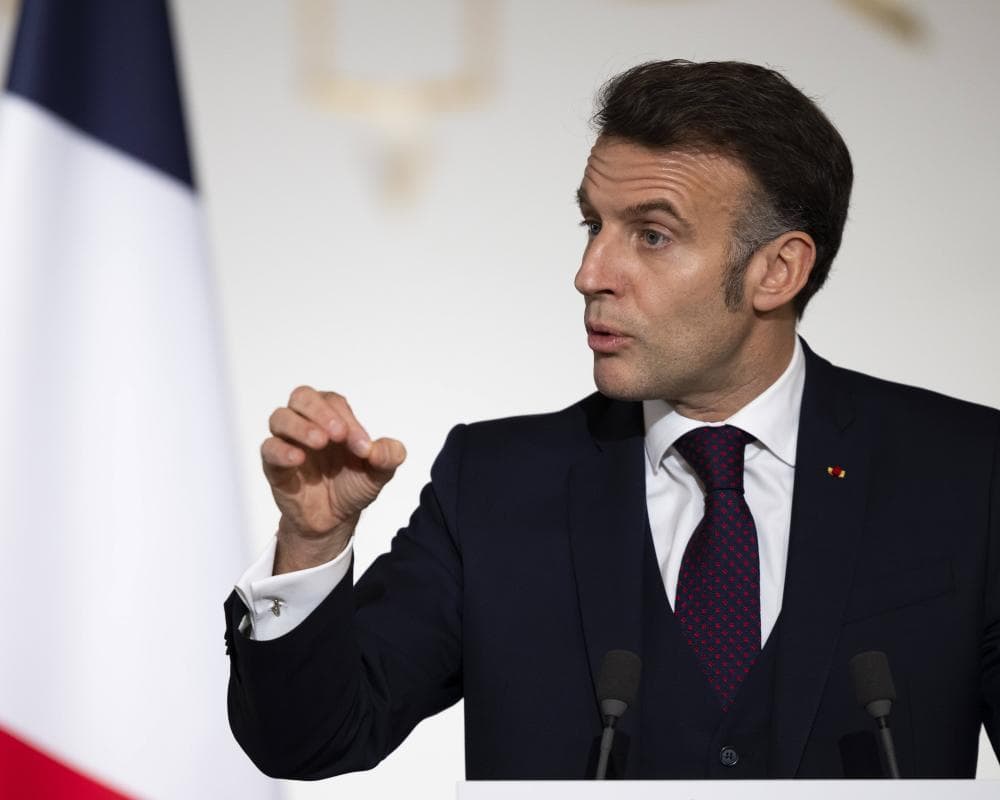
The French president, Emmanuel Macron, has urged Europe to reassert its position in the world, as the continent faces rapidally changing landscape in politics and trade.
In an interview with a group of European media outlets, Macron warned that the strategy of bowing down to the US and other geopolitical powers doesn’t work and urged Europe to urgently step up its integration to get ready to face “permanent instability” ahead.
“It is time for Europe to wake up … If we do not decide for ourselves, we will be swept away,” he told El País (€) and others, including Süddeutsche Zeitung (€), Financial Times (£), and Le Monde (€).
Macron said Europe was facing “a profound geopolitical rupture” with “a profound shock” on trade and defence as its relations with China and the US change.
“I think the best way is to reduce risk, reduce dependencies, and make decisions for ourselves instead of waiting for the next crisis,” he said.
“If we choose to be spectators, we will be vassals,” he said, calling it “the Greenland moment,” saying the US interest in a territory of its Nato ally should be a wake-up call for European leaders.
Macron said that Europeans “stand firm, but react too slowly,” and need to assert their position as a global superpower, with more “common leadership” on the continent.
He argued that the Franco-British-led Coalition of the Willing for Ukraine was an example of an initiative that allowed Europe to build a strong, international alliance to defend its interests, also in defence and security.
But in comments likely to raise some eyebrows, Macron also once again suggested that Europe should reopen diplomatic channels with Moscow, so to “not delegate this discussion” to others, including the US.
He said Europe should engage with Russia “without being naive or pressuring the Ukrainians, but also without having to depend on a third party” to conduct these talks.
“We have European interests to defend and I’m not going to delegate them to anyone, not even the US.”
Macron also spoke about what he saw as a real risk of tensions with the US flaring up again over the European push to regulate social media platforms or Greenland.
Updated
Here’s our daily briefing on Ukraine to bring you up to speed on the latest developments from the last 24 hours.
The headlines:
Ukraine and France have agreed to start joint weapons production, the Ukrainian defence minister said on Monday after hosting his French counterpart in Kyiv.
Ukraine is opening up exports of its domestically produced weapons, president Volodymyr Zelenskyy said – a way for Kyiv to cash in on its wartime technological advances to generate badly needed funds.
Russian attacks damaged production sites of Ukraine’s state-run oil and gas company Naftogaz in the Poltava and Sumy regions, the company’s CEO said on Monday.
The EU has proposed extending its sanctions against Russia to include ports in Georgia and Indonesia that handle Russian oil, the first time it would target ports in third countries, a proposal document showed.
Read in full:
Updated
In the meantime, Russia’s defence ministry claimed its forces had captured the settlement of Zaliznychne in Ukraine’s Zaporizhzhia region, Russian state news agency RIA reported.
Meanwhile, the Kremlin has just said there was no date set yet for the next round of talks on Ukraine – but insisted the negotiations were likely to happen soon, Reuters reported.
Estonia’s foreign intelligence service has released its annual assessment of the global security situation this morning, with a heavy focus on the threat from its neighbour Russia.
The forecast says Russia is unlikely to launch a conventional attack against Nato states over the next year but to continue with various forms of hybrid warfare.
It contradicts recent US claims that a deal to end Russia’s war in Ukraine is close, saying there is no sign Vladimir Putin is interested in real negotiations.
I joined a briefing with Kaupo Rosin, the head of the service, who said:
“We see that Russia is setting long-term operational objectives in the war against Ukraine. This confirms that the so-called peace talk rhetoric is merely a tactic to buy time, and Russia has no intention of ending the war until its objectives are achieved.”
On claims from Trump administration officials that a deal in peace talks is close, he said:
“I do not know what the US assessment is based on. Putin would only make a proper deal in our view, if the economy or financial sector takes very heavy hits with, for example, additional sanctions, which would be directed towards oil and gas industry... If additional measures and pressure are applied, then maybe Putin’s calculus changes. But currently, we do not see any change in his thinking.”
On Russia’s economic prospects over the coming year, Rosin said:
“We see that Russia’s economy has entered a downturn, this is fuelled by defence sector expanding at the expense of the contracting civilian economy and sanctions that amplify low productivity caused by outdated technology. While an economic crisis is a possibility, the total collapse of the Russian economy remains highly unlikely. A more plausible outcome is that financial considerations will carry much greater weight in political decision-making than before.”
Russian foreign minister Sergei Lavrov said that there was no reason to be enthusiastic about US president Donald Trump’s pressure on Europe and Ukraine as there was still a long way to go in talks on peace in Ukraine, Russian state-owned news agency RIA reported.
His comments just days after what the US, Ukraine and Russia said were difficult, but constructive talks in Abu Dhabi, but suggest that reaching a final agreement could be very difficult.
Russia still pursues its original maximalist demands, including territorial claims to control Ukraine’s eastern regions, and continues to oppose the prospect of Ukraine ever joining Nato or ever hosting western troops as part of security guarantees.
Ukraine’s Volodymyr Zelenskyy said in his nightly address yesterday that “reliable security guarantees are the only real foundation for peace,” as he warned that Russia could test it any peace settlement through strikes or “hybrid operations of some kind.”
In the meantime, Russia continues its strikes on Ukraine’s energy infrastructure, with an energy facility in the soutern Black Sea region of Odesa hit overnight, even as the country continues to be gripped by cold temperatures.
Elsewhere, we will be looking at the ongoing discussion on how to improve European competitiveness ahead of this Thursday’s informal EU summit on the issue, the latest on the EU-US trade deal which was briefly put on hold, and other topics from across the continent.
It’s Tuesday, 10 February 2026, it’s Jakub Krupa here, and this is Europe Live.
Good morning.