Loading...
Please wait for a bit
Please wait for a bit
Click any word to translate
Original article by Lucy Campbell (now); Nadeem Badshah, Tom Ambrose and Taz Ali (earlier)
As yet there has been no immediate comment from the Trump administration after the conclusion of indirect talks between the US and Iran in Geneva today. We’ll be sure to bring you any word from Donald Trump or US officials as we get it.
We have, however, heard from Iran, with foreign minister Abbas Araghchi telling reporters that “good progress” was made on the nuclear issue and sanction relief in this round of talks – but key differences remain. He described the talks as “one of our most intense and longest rounds of negotiations”, and said the two sides had begun to discuss “the elements of an agreement”.
Araghchi confirmed that further contacts would take place in less than a week. A reminder that on 19 February Trump issued a 10-15 day deadline for Tehran to reach a “meaningful deal” with Washington, which would bring us to next Friday, 6 March.
Here’s the full text of Araghchi’s statement:
Today I can say that one of our most serious and longest rounds of negotiations took place. The meeting lasted for about four hours in the morning and two hours in the afternoon.
These talks were held indirectly and with the mediation of the Omani foreign minister, and in some parts [IAEA chief Rafael] Grossi also conveyed the discussions between the two sides. His presence was useful from a technical point of view. The Omani foreign minister also played an active role, as in the past.
Overall, during these long and very intensive hours, good progress was made and we entered into a serious examination of the elements of an agreement; both in the nuclear field and in the sanctions field.
On some issues, understandings have come very close. Of course, there are still differences of opinion, which is natural, but compared to the past, both sides are more serious about reaching a negotiated solution.
It was agreed that, starting Monday, technical teams in Vienna and at the International Atomic Energy Agency will begin technical expert reviews to set some technical issues within a specific framework and then adapt them to the demands and political considerations of both sides.
It was also decided that the next round of negotiations will be held in the near future—probably in less than a week.
Updated
Here is the full story on today’s talks by my colleague Patrick Wintour.
High-stakes talks between the US and Iran over the future of Tehran’s nuclear programme ended on Thursday with the Omani mediators claiming that “significant progress” had been made and predicting the talks would reconvene at a technical level next week in Vienna.
But there was no immediate evidence to support suggestions that the two sides had drawn closer together on the fundamental issues of Iran’s right to enrich uranium and the future of its highly enriched uranium stocks.
Iran’s foreign minister, Abbas Araghchi, described the talks as “one of our most intense and longest rounds of negotiations,” but said that “good progress” had been made. He confirmed that further contacts would take place in less than a week.
The indirect talks in Geneva were held in two sessions, with reports that the US team led by Donald Trump’s special envoy to the Middle East, Steve Witkoff, had been disappointed by the proposals put forward by Iran.
Iran said the next round of nuclear talks with the U.S. is expected in less than a week.
Iranian foreign minister Abbas Araqchi described it the most serious exchanges with Washington, saying Tehran clearly laid out its demand for lifting sanctions and the process for relief.
Both sides needed to consult with their respective capitals, Araqchi said on Thursday to state TV.
Araqchi added technical-level discussions will start in Vienna from Monday.
Updated
Talks between US and Iran in Geneva over the future of Tehran’s nuclear program ended on Thursday with the mediators Oman claiming “significant progress” had been made, and predicting the talks will reconvene at a technical level next week in Vienna.
But there was no immediate evidence to back suggestions that the two sides had drawn closer together on the fundamental issues of Iran’s right to enrich uranium and the future of its highly enriched uranium stocks still in Iran.
The talks in Geneva were held in two parts with reports that the US team led by Steve Witkoff, the US special envoy, had been disappointed by the proposals put forward by Iran.
The brevity of the second session of the talks also appeared ominous.
Iranian officials rounded on reports issued during the talks by US media suggesting Iran was going to be required to end enrichment and allow its stockpile of highly enriched uranium to leave Iran.
Updated
Here is the full post from the Omani foreign minister’s account on X:
We have finished the day after significant progress in the negotiation between the United States and Iran. We will resume soon after consultation in the respective capitals. Discussions on a technical level will take place next week in Vienna. I am grateful to all concerned for their efforts: the negotiators, the IAEA, and our hosts the Swiss government.
We’re now seeing lines on the news wires that the talks have finished for the day, with the Omani foreign minister saying there was “significant progress” in the negotiations between the US and Iran.
Per Reuters, Sayyid Badr bin Hamad Al Busaidi – who was mediating the talks – said “discussions on a technical level” would take place next week in Vienna. Talks would resume soon after consultations in the respective capitals, he said.
We’ll bring you more on this as we get it.
Updated
CNN is also reporting that the fresh round of indirect US-Iran talks has begun in Geneva after a few hours’ break, citing Iran’s state-run broadcaster.
Islamic Republic of Iran Broadcasting said the “second round of the third phase” of the talks had started, after both delegations arrived back at the Omani embassy.
Earlier, we reported that the convoy carrying US diplomats in Geneva had arrived back at the location, shortly after the convoy carrying Iranian diplomats.
Iranian foreign minister Abbas Araghchi and US envoys Steve Witkoff and Jared Kushner have resumed indirect talks mediated by Oman, Reuters reports citing Iranian state media, after having adjourned their earlier session.
Updated
A convoy carrying US diplomats in Geneva has arrived at the location of indirect talks with Iran over its nuclear program.
The convoy pulled into the compound on the shores of Lake Geneva. A convoy carrying Iranian diplomats arrived earlier.
The two sides had taken a several-hour break in the talks. The US side went to a meeting with Ukrainian officials during that time.
And while negotiations continue, the build-up of US firepower around Iran goes on apace.
Earlier today, the USS Gerald R Ford, the world’s largest aircraft carrier, left the US naval base of Souda Bay on Crete for the Middle East – adding to what has become the biggest military presence in the region in decades.
The nuclear-powered carrier, the largest warship ever constructed, has spent four days at the deep-water port refuelling and resupplying.
The vessel, which is expected to reach the shores of Israel within 24 hours, will join the USS Abraham Lincoln aircraft carrier and other ships that arrived in the Middle East last month.
“It’s hard to see how such a powerful military presence can simply be de-escalated without very significant progress in today’s talks,” said one well-placed diplomat.
Just a reminder that, according to the Iranian foreign ministry, the talks in Geneva will resume shortly at 5.30pm local time (4.30pm GMT).
Stay with us for any news lines that may emerge in the coming hours…
Satellite photos shot Tuesday and Wednesday by Planet Labs PBC and analyzed by the Associated Press appeared to show that American vessels typically docked in Bahrain, the home of the US Navy’s 5th Fleet, were all out at sea.
Before Iran’s attack on a US base in Qatar during the closing days of the war last June, the 5th Fleet similarly scattered its ships at sea to protect against a potential attack.
If the talks fail, uncertainty hangs over the timing of any possible US attack.
If the aim of potential military action is to pressure Iran to make concessions in nuclear negotiations, it’s not clear whether limited strikes would work.
AP reports:
If the goal is to remove Iran’s leaders, that will likely commit the US to a larger, longer military campaign. There has been no public sign of planning for what would come next, including the potential for chaos in Iran.
There is also uncertainty about what any military action could mean for the wider region. Tehran could retaliate against the American-allied nations of the Persian Gulf or Israel.
Oil prices have risen in recent days in part due to those concerns, with benchmark Brent crude now around $70 a barrel.
Iran in the last round of talks said it briefly halted traffic in the Strait of Hormuz, the narrow mouth of the Persian Gulf through which a fifth of all traded oil passes.
According to the Iranian foreign ministry, the talks in Geneva will resume at 5.30pm local time (4.30pm GMT).
US and Iranian negotiators are still on a break, but we have had a statement from Esmail Baghaei, a spokesperson of Iran’s foreign ministry, via Iranian state media, saying the roughly three-hour talks so far “were very serious”, without providing any details of what was discussed. Still, the statement conveyed a sense of hope for the Iranian delegation, with Baghaei saying they were feeling “confident”.
The statement read:
Both in the nuclear field and on the lifting of sanctions, very important and practical proposals were put forward, and both sides pursued the discussions with great seriousness.
We are confident. We must continue and see. This is a process. Contradictory statements from foreign media and some American officials continue to fuel doubts. For us, the focus is on the outcome. We have been consistent, and our positions have been consistent with our words.
Today’s talks were very serious, and we hope that tonight we will see the continuation of talks on the lifting of sanctions and the nuclear issue in a practical manner.
The spokesperson added that any agreement must include the lifting of sanctions, which have “greatly affected” the people of Iran.
Updated
While the talks have been taking place in Geneva, people have gathered in front of the UN office in the Swiss city to protest against the Iranian government.
Looking ahead to the resumption of talks later today, it is worth noting that US president Donald Trump wants Iran to completely halt its enrichment of uranium and roll back both its long-range missile program and its support for regional armed groups.
But Iran says it will only discuss nuclear issues, and maintains its atomic program is for entirely peaceful purposes.
US secretary of state Marco Rubio told reporters on Wednesday that Iran is “always trying to rebuild elements” of its nuclear program. He said that Tehran is not enriching uranium right now, “but they’re trying to get to the point where they ultimately can.”
Iran has said it hasn’t enriched since June, but it has blocked IAEA inspectors from visiting the sites America bombed. Satellite photos analyzed by the Associated Press have shown activity at two of those sites, suggesting Iran is trying to assess and potentially recover material there.
The west and the IAEA say Iran had a nuclear weapons program until 2003. After Trump scrapped the 2015 nuclear agreement, Iran ramped up its enrichment of uranium to 60% purity – a short, technical step away from weapons-grade levels of 90%.
Updated
The US-Iran nuclear talks in Geneva have paused and will resume later today, Oman’s foreign minister announced on social media.
Badr Albusaidi, who is mediating the talks, expressed optimism that the negotiations were heading in the right direction.
“We’ve been exchanging creative and positive ideas in Geneva today, and now both US and Iranian negotiators have adjourned for a break. We’ll resume later today. We hope to make more progress,” he posted on X
So far, the indirect negotiations have taken just over three hours.
Updated
I have been speaking to Fawaz Gerges, professor of international relations at the London School of Economics, about the different aspects of the US-Iran negotiations and what they signify.
The talks have been described as “indirect” – what does that mean and how does it work? Gerges explains:
The three rounds of talks are indirect, not face-to-face, with the Omani foreign minister shuttling between the two delegations. There is a sea of mistrust between the Iranian and American sides and the Iran delegation has avoided direct talks with their US counterpart because they prefer a neutral mediator to do the exchange of messages between them.
Nonetheless, we have evidence that Iran foreign minister [Abbas Araghchi] and [US special envoy] Steve Witkoff met on the sidelines and shook hands and probably talked.
What is the significance of Rafael Grossi, the head of the UN nuclear watchdog (IAEA), joining the talks? Gerges says:
Grossi has the legal authority to make it clear if Iran’s offer to verify its commitment on enrichment matches the UN nuclear agency’s requirements. His presence could be legally decisive by pulling the rug from underneath president Trump’s rationale to carry out an attack on Iran. Of course, this is all theoretical if Trump has made up his mind to attack Iran. We have to wait and see if the white smoke appears in Geneva.
What is the mood like in Iran in light of these talks? Gerges says:
Lost in all of this reporting frenzy in the west about the question of war and peace is the plight of the everyday Iranian people. Trump and European leaders talk about Iran as if the Iranian people are a sideshow. Iranians are pressed between the rock of a repressive regime and the hard place of a potential American war that could be devastating in terms of human loss and social and economic turmoil and even civil strife. While Trump and leaders profess to support the plight of Iranians, their very actions could bring more hardship and ruin.
By overlooking the hopes, fears and aspirations of Iranians, US actions might produce the opposite results of their intended consequences. Sadly, this has been a systemic pattern of US foreign policy towards the Middle East, from overthrowing Mohammed Mossadegh in August 1953 to the overthrow of Saddam Hussein in March 2003.
Updated
Here are some images from the newswires from Geneva this morning, showing the US and Iranian delegations arriving at the talks and the large police presence in the area.
Ali Shamkhani, a prominent adviser to Iran’s supreme leader, has suggested that an agreement can be reached if the negotiations focused solely on Iran’s commitment not to develop nuclear weapons.
“If the main issue of the negotiations is preventing Iran from producing nuclear weapons, this would be in line with the supreme leader’s fatwa (religious edict) and Iran’s defence doctrine, and an immediate agreement is within reach,” he posted on X.
He added that the Iranian foreign minister Abbas Araghchi, who is leading the talks for Tehran, has “sufficient support and authority to secure this agreement”.
While we wait for more updates on the US-Iran talks, over in Jordan, the Duke and Duchess of Sussex are in Amman where they visited the World Central Kitchen Food (WCK) hub coordinating food relief for Gaza.
Harry and Meghan, who stepped down as working royals in 2020, arrived in Jordan yesterday for a two-day trip to spotlight organisations that help people affected by war and displacement, the PA news agency reported. They visited a refugee camp for thousands of displaced Syrians and met with children from Gaza being treated at a hospital in Amman as part of their trip.
Updated
Iran’s semi-official Mehr news agency reported that Rafael Grossi, the head of the International Atomic Energy Agency, has joined the talks and is the “technical observer” of the negotiations.
As our diplomatic editor Patrick Wintour reports here, for Iran, the presence of Grossi at the Geneva talks along with mediators from Oman is regarded as significant, since Grossi has the legal authority to state if he thinks any access offered by Iran to verify its commitments on enrichment matches the inspectorate’s needs.
Updated
The nuclear talks today are the third between the US and Iran since June 2025, when the US joined Israel’s war against Iran and bombed its nuclear and military sites. It effectively ended the US-Iran talks that were held in the weeks prior to the conflict aimed at reaching a nuclear peace agreement.
As before, the negotiations are being mediated by Oman, which has maintained a policy of neutrality and assumed the role of mediator both within the Arabian peninsula and more broadly across the Middle East. The country lies in the centre of tensions between the US and Iran and is directly vulnerable to maritime instability and regional escalation.
If the talks fail, there is uncertainty over what the US may do regarding a possible military attack against Iran, and when it might act. Questions remain over what this could mean for the wider region, with Iran warning it would retaliate and even attack Israel.
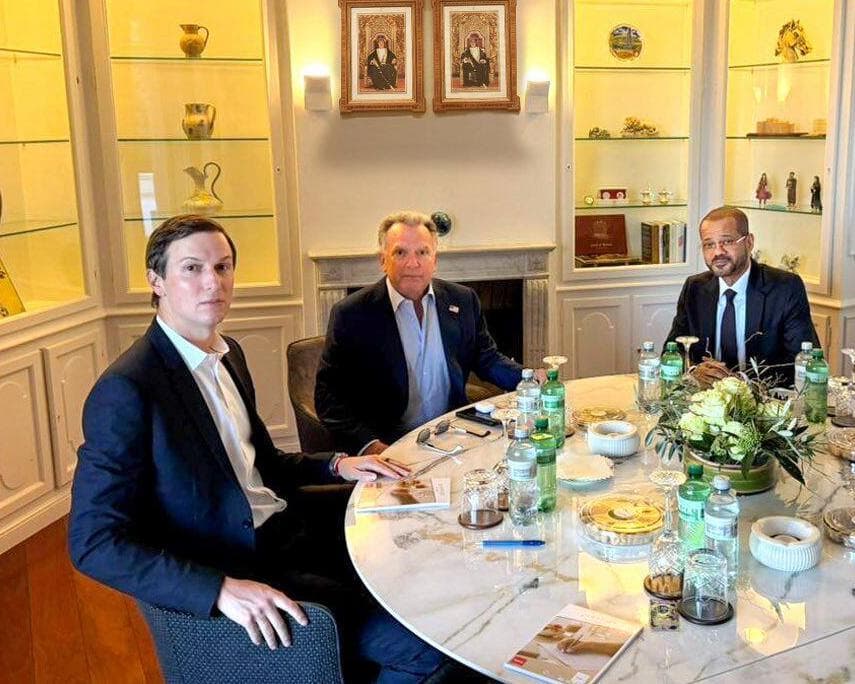
The state-run Oman News Agency has posted photos on social media showing the Omani foreign minister Badr Albusaidi sat with US envoys Steve Witkoff and Jared Kushner in Geneva.

The accompanying message struck a positive tone, saying:
[They] reviewed the Iranian side’s views and proposals, as well as the responses and inquiries of the US negotiating team, related to addressing the main elements of Iran’s nuclear programme and the necessary guarantees to achieve the desired agreement on this important issue in all its technical and monitoring aspects.
[Albusaidi] stated: Efforts are continuing diligently and constructively, with the negotiators demonstrating unprecedented openness to new and creative ideas and solutions, and creating a supportive environment for progress and reaching a fair agreement with sustainable guarantees.
Updated
An Iranian agreement on a suspension of uranium enrichment is not unprecedented. In 2003 the then secretary of the supreme national security council, Hassan Rouhani, agreed with France, Germany and the UK to suspend all uranium enrichment and processing activities and to allow snap inspections by the UN nuclear watchdog.
The Iranian negotiating team who are being asked to present specific proposals at the Geneva talks will seek irreversible sanctions relief such as the release of frozen Iranian assets held abroad.
Esmaeil Baqaei, Iran’s foreign ministry spokesperson, said the talks will solely focus “on the nuclear issue”, according to the AFP news agency.
He added that Iran will push for the lifting of sanctions and assert Tehran’s right “to peaceful use of nuclear energy”.
He said these terms were relayed to the Omani foreign minister mediating the talks.
The Reuters news agency has compiled a list of countries that have pulled diplomatic staff and non-essential workers from some locations in the Middle East or have warned citizens to avoid travelling to Iran amid mounting tensions between Washington and Tehran.
They include: the US, Germany, Finland, Australia, Sweden, Poland, Serbia, Cyrpus, India, Brazil and Singapore.
For more details on the travel warnings, click here:
The third round of US-Iran nuclear talks have begun in Geneva, according to Iranian state media.
Omani mediators will once again sit across from Iranian foreign minister Abbas Araghchi and US special envoy Steve Witkoff.
Araghchi met Oman’s foreign minister Badr Albusaidi after arriving in Geneva last night. The ministers “reviewed the views and proposals that the Iranian side will present to reach an agreement on the Iranian nuclear programme, based on the guiding principles agreed upon in the previous round of negotiations”, a report from the state-run Oman News Agency said. Albusaidi will pass on Iran’s offer to US officials today, the news agency added.
It is understood that US special envoy Steve Witkoff, who is heading to Geneva for the talks along with Trump’s son-in-law Jared Kushner, has asked only that Iran agree to enrichment at below 5% purity, roughly the level it accepted in the 2015 nuclear deal and well below weapons grade.
A source in contact with Iran’s negotiation team said members were surprised at the lax terms of the proposal submitted last week by Kushner and Witkoff as a first step. The key request, this source said, was that Iran agree to limit enrichment to 5% and convert the programme to civilian use.
But, in turn, the source said there were no offers of immediate sanctions relief or diplomatic ties: Iran would be left in economic handcuffs. Still, the next step, the source said, would be negotiations to gradually relieve sanctions and opening dialogue.
Rafael Grossi, the director general of the International Atomic Energy Agency (IAEA), will probably attend the talks, Iranian media has reported, citing a statement from Iran’s foreign ministry.
Grossi had attended the second round of US-Iran talks earlier this month, where he met directly with Iran’s foreign minister Abbas Araghchi. The meeting was a significant step after Iran suspended all cooperation with the IAEA after the 12-day war with Israel in June.
The UN nuclear watchdog agency said it has been unable to verify the status of Iran’s near weapons-grade uranium stockpile since the war. Iran has allowed the IAEA some access to sites that were not damaged, but has not allowed inspectors to visit other sites.
Abbas Araghchi, Iran’s minister of foreign affairs, met with the Omani foreign minister, Badr Albusaidi, in Geneva last night. Albusaidi is expected to meet with the US negotiating team this morning
Hello and welcome to our live coverage of the US-Iran talks.
Iran and US negotiators will be meeting in the Swiss city of Geneva today for a third round of indirect nuclear talks. The Oman-mediated discussions will take place amid a massive buildup of US warships and aircraft in the Middle East to pressure Iran into a deal.
This is the third meeting between the US and Iran since June last year, when Israel launched attacks on Iran that sparked a war marked by tit-for-tat airstrikes.
Ahead of today’s talks, the Iranian president, Masoud Pezeshkian, said Iran’s supreme leader, Ali Khamenei, has banned weapons of mass destruction, which “clearly means Tehran won’t develop nuclear weapons”. Khamenaei, who has the final say on all state matters in Iran, is thought to have issued a fatwa – or religious edict – banning the Iranian use of weapons of mass destruction, including nuclear weapons, some time before or in 2005.
In his State of the Union speech on Tuesday, US president Donald Trump accused Iran of seeking to rebuild its nuclear weapons programme, but gave no clear indication of his intentions regarding a possible military strike against Tehran. He did, however, say he wanted to resolve tensions diplomatically.
Iran has maintained that it will continue to enrich uranium, a component of a nuclear weapon, for peaceful purposes and has long argued that uranium enrichment is a sovereign right.
Iran has threatened to retaliate in kind if the US were to launch a strike, and said that it would also attack Israel.
“There would be no victory for anybody – it would be a devastating war,” Iran’s foreign minister Abbas Araghchi told India Today before he flew to Geneva.
You can read our diplomatic editor Patrick Wintour’s preview of the talks here:
Updated