Loading...
Please wait for a bit
Please wait for a bit
Click any word to translate
Original article by Jakub Krupa
At least one person is dead, and at least 20 are reported injured after a tram derailed and crashed into a building in Milan, Italy.
Some media reports suggested that the number of people injured could be higher, up to 40 people.
The specific model of the tram involved in the crash was reportedly only recently introduced to the city’s streets as part of a new, modern bi-directional fleet that could be steered from either end.
The investigation into the cause of the crash is under way, with early media reports suggesting the speed may have played a factor.
Updated
French president Emmanuel Macron will on Monday present his plan for how France’s nuclear arsenal could be used to protect Europe more broadly.
AFP says that his address, at France’s Ile Longue nuclear submarine base, will be closely watched across Europe, which for decades has relied on the United States’ nuclear deterrent but is now increasingly debating whether to bolster its own arsenals.
He is expected to update France’s nuclear doctrine, with a member of his team telling AFP to expect “fairly significant shifts and developments” but declining to give any further details.
Updated
European community affairs correspondent
EU states will be able to tap into a social fund to help citizens access safe abortions, in an announcement hailed as a “victory for women”.
The roots of Thursday’s announcement go back to a long campaign for the European Commission to create a funding mechanism that would allow women from countries with near-total bans on abortion, such as Malta and Poland, to go where it is legal.
At the heart of the My Voice, My Choice campaign was the assertion that women across the 27 member states should have equal access to legal, safe abortions.
More than 1.2 million people signed up to the initiative, forcing the commission to reply. The proposal was backed by a majority of MEPs in December.
The commission said countries would be able to draw on already allocated funds for social services to support travel and access to abortion care. “This is groundbreaking,” said Hadja Lahbib, the EU’s commissioner for equality. “This decision will change lives.”
The aim was to reduce the 500,000 unsafe abortions that took place in Europe every year, she said. “This is half a million women at risk, half a million women traumatised, half a million women who may carry lifelong consequences, and this is half a million too many,” added Lahbib.
“We live, of course, unfortunately, in a time when women’s bodies have become political battlefields, when rights are being rolled back around the world. But Europe is standing firm.”
The EU has seen a surge in support for far-right parties, many of which oppose abortion. Olivier Bault of Ordo Iuris, a Polish anti-abortion group that championed a near-blanket ban in 2020, told Reuters the EU announcement impinged on countries’ rights to set their own health policies.
Meanwhile, Italian prime minister Giorgia Meloni called for a European free trade zone with the US, saying that recent US proposals on tariffs were “a mistake” and urging a move “in a diametrically opposite direction.”
In an interview with Bloomberg (£), Meloni also revealed that Italy played a role behind the scenes to moderate the recent trade tensions with the US administration under Donald Trump.
She said she also tried to convince him that an escalating trade dispute was not “a functional decision.”
“We should try and use what happened to try to move in a diametrically opposite direction,” she said. “But it clearly takes two to do that,” she told Bloomberg.
Meloni stressed that in the meantime the EU should go ahead with implementing the trade deal agreed with the US last summer, which remains on pause as the EU seeks clarity on Trump’s trade policies.
German chair of the European Parliament’s trade committee Bernd Lange has also offered his backing for the commission’s decision.
He said:
“Decision [of the European Commission] to go ahead with provisional application EU-Mercosur is the right one. Many in [European Parliament] agree. We are in an exceptional situation where EP can only vote after ECJ. At the same time, international trade rules are constantly violated by others.
The time to reap the benefits of this agreement is now, not in a few months. Where others are breaking rules, we provide certainty, predictability and economic opportunities for our consumers and producers.”
In stark contrast to comments coming from France, German foreign minister Johann Wadephul hailed a “historic” deal with South America’s Mercosur bloc of countries.
He said on X:
“This is the hour of Europe: With the [European Commission] provisionally applying the EU-Mercosur FTA [free trade agreement] companies & people from both continents can finally benefit from more prosperity & growth.
Germany will work tirelessly to help tap the full potential of this historic agreement.”
The gamble Ursula von der Leyen has taken will be pay off if in a year or two years’ time the impact of Mercosur has not been as bad as opponents predict.
The European court of justice could take two years to adjudicate on the legality of the deal by which time the world will know how Mercosur has landed.
European farmers in the grain, beef, and poultry sectors have described themselves as “collateral damage” in the deal but within two years the level of that damage will be known.
So von der Leyen’s gamble is that the ECJ rules in favour of the deal, trade will deliver economic growth with limited impact on European farmers making it difficult for the European Parliament to then vote against the deal.
Meanwhile, French president Emmanuel Macron said the commission’s decision was “a bad surprise” and considered it “disrespectful” towards the European Parliament.
He offered his take on the deal at a press conference with Slovenian prime minister Robert Golob.
Irish MEP belonging to one of Ireland’s ruling parties said today’s decision by the European Commission to press ahead with Mercosur was “no surprise”.
Maria Walsh is one of several MEPs who believe the decision by the European Parliament to send the deal to the European court of justice was just a delaying tactic and a full vote should have been held in the European parliament instead.
Walsh, who is full member of the European Parliament’s Agriculture Committee, said:
“While I’m bitterly disappointed with today’s news, it comes as no surprise to me that the Commission has decided to provisionally implement the Mercosur trade deal. I warned that the court referral would not block this deal - it would only change the route by which it comes into force. MEPs who voted in favour of the referral should feel the full weight of their decisions today.
While provisional application is legally within the Commission’s powers, I believe it runs against the spirit of cooperation between EU institutions. MEPs should have had their say before any part of this agreement was activated.
The referral to the ECJ was a political gesture dressed up as strategy. Those who supported it knew it was highly unlikely to deliver meaningful protections for Irish farmers. In fact, we now find ourselves in a worse position - facing earlier implementation and prolonged uncertainty for our agricultural sector.”
Argentinian beef could be in the supermarkets in the EU by May after European Commission president Ursula von der Leyen took a major gamble that sets her on a collision could with the European parliament and farmers.
After consultation with member states she has decided to go ahead with provisionally applying the constested Mercosur trade deal with a group of South American countries after two of them, Uruquay and Argentina, ratified the deal at their end.
It was a bold move by the commission president on a deal that was approved by 21 of 27 member states but was effectively paused by a majority of MEPs in the European Parliament who voted it to send it to the European court of justice.
The commission’s trade spokesperson Olof Gill confirmed that the move now set up a process that could take around two months which would open the preferential trade deal.
According to the rules, the two sides must exchange “notes verbales”, an unsigned formal diplomatic communication, to say they agree to trade under the deal.
Then provisional application of the Mercosur deal would start on the first day of the second month following of the exchange of diplomatic notes. So if the notes were exchanged next week, the deal could go into provisional operation in May.
Zelenskyy’s move of inviting Slovakia’s Fico to Ukraine will likely be seen as an attempt to de-escalate the issue while isolating Hungary’s Orbán as he faces a difficult parliamentary campaign.
As Orbán has been ramping up the use of fiercely anti-Ukrainian rhetoric – to the point of putting Zelenskyy on some AI-generated election posters and claiming that Ukraine could actively seek to harm Hungarian energy grid – it is almost certain to be easier for Ukraine to engage with the Slovak prime minister instead.
Let’s keep an eye on what comes out of that – and Fico will no doubt tell us what he thinks about all of this soon, as he is not usually one to hold back.
In an almost immediate response, we are hearing from the Ukrainian president Zelenskyy’s office that he is now holding a phone call with Slovakia’s Fico.
He has invited Fico to Ukraine to “discuss all existing issues,” Zelenskyy’s office said, as reported by Reuters.
Back to Druzbha pipeline, Hungary’s Viktor Orbán has just announced that he spoke with the Slovak prime minister, Robert Fico, and the pair agreed to form “a joint investigative committee” to “clarify” the contested condition of the pipeline.
In a clip on social media, he said that both countries were affected by what he called “an oil blockade” by Ukraine, a claim contested by both Ukraine and the EU.
He also repeated his claim that Kyiv’s explanations that the pipeline is not operational due to Russian damage was “not true,” and alleged that it “has been shut down exclusively for political reasons.”
He urged Zelenskyy to allow the inspectors to access the pipeline for further inspections.
Remember: the spat with Ukraine comes amid a difficult electoral campaign for Orbán, who is at risk of being ousted after 16 years in power in the upcoming parliamentary vote in April.
Meanwhile, we are getting first reactions from EU member states to the provisional application of the Mercosur deal, and France – which led the opposition to the agreement – is deeply unhappy.
“It is a decision that I regret,” French agriculture minister Annie Genevard told reporters at the Salon de l’Agriculture following EU chief Ursula von der Leyen’s announcement.
“It is not in line with the respect that should have been shown for the European Parliament’s decision.”
She denounced the provisional application as “very damaging to the functioning of our institutions and, above all, to the spirit of our European institutions,” AFP reported.
Updated
The European Commission got also asked about Viktor Orbán’s latest plan to inspect the Druzhba pipeline for damage as he continues to question the Ukrainian explanation on why oil transit to Hungary and Slovakia is disrupted (10:21, Europe Live yesterday).
An EU spokesperson said it was “a welcome step,” and the bloc is “in contact with the Ukrainian authorities on this matter” to see how to take this forward.
However, they also stressed that they remain strongly of the view that the disruption was caused by Russian attacks on Ukrainian and European energy security.
Trade between the EU and two South American countries may start within two months under a provision application of the Mercosur deal.
“The law allows the provisional application of the deal can happen two months after notification has been exchanged between both sides in the form of a ‘note verbale’ that the deal will enter into provision application.”
Gill said he expected the other Mercosur countries, including Paraguay, Argentina, Bolivia, and Brazil, to ratify the deal soon.
“Mercosur countries are ratifying at a rate of knots, so I can anticipate that the remaining Mercosur four countries will also ratify,” said Gill.
Updated
EU’s Gill also said that the European Commission’s president, Ursula von der Leyen, had been in touch with EU leaders ahead of the decision, and they “empowered the Commission to take a decision on provisional application”.
“The president reached out to member states and to MEPS, that’s what it means. She reached out to member states and MEPs, and I remind you that the member states as the European Council, endorsed and approved the EU Mercosur agreement and empowered the European Commission to move forward with provisional application.”
Repeatedly pushed on the deal at the commission’s midday briefing, Gill also insisted that “the processes by which this agreement have been brought forward approved and now entered into provision application are in line with the treaties governing the European Union for which all European institutions have given their consent.”
Updated
The EU has said the decision to go ahead with the Mercosur deal with two countries in the South American bloc was an important move in the present unstable geopolitical environment.
“We want to deliver tangible benefits for our businesses, workers and citizens, and we want to deliver them ASAP,” said the European Commission spokesperson Olof Gill.
“We need to move forward with this agreement that is so important for the European Union and for its future prospects, economically, diplomatically, strategically.”
An exchange of notifications between the EU and Uruquay and Argentina must take place before trade can commence but that “will happen” soon, Gill indicated.
It was imperative that the EU used is “first mover advantage, because if we wait, others may overtake us”.
The European Commission’s decision to provisionally apply the contested Mercosur trade deal is a bold move by Ursula von der Leyen that puts her on a collision course with the European Parliament.
Her decision comes after two countries in the Mercosur bloc of South American countries, Uruguay and Argentina, ratified the deal in their own parliaments.
But opponents to the deal, including France and Ireland, have already tried to stall the deal in the European Parliament by referring the deal to the European court of justice.
Trade is the competence of the European Commission but it is a risky political move to press ahead with a deal while it has not got the backing of the European Parliament.
The hope in the Commission will be that if they can now open up trade routes to Uruguay and Argentina and show growth in trade and diversifies supplies from China they could win the longer term political battle.
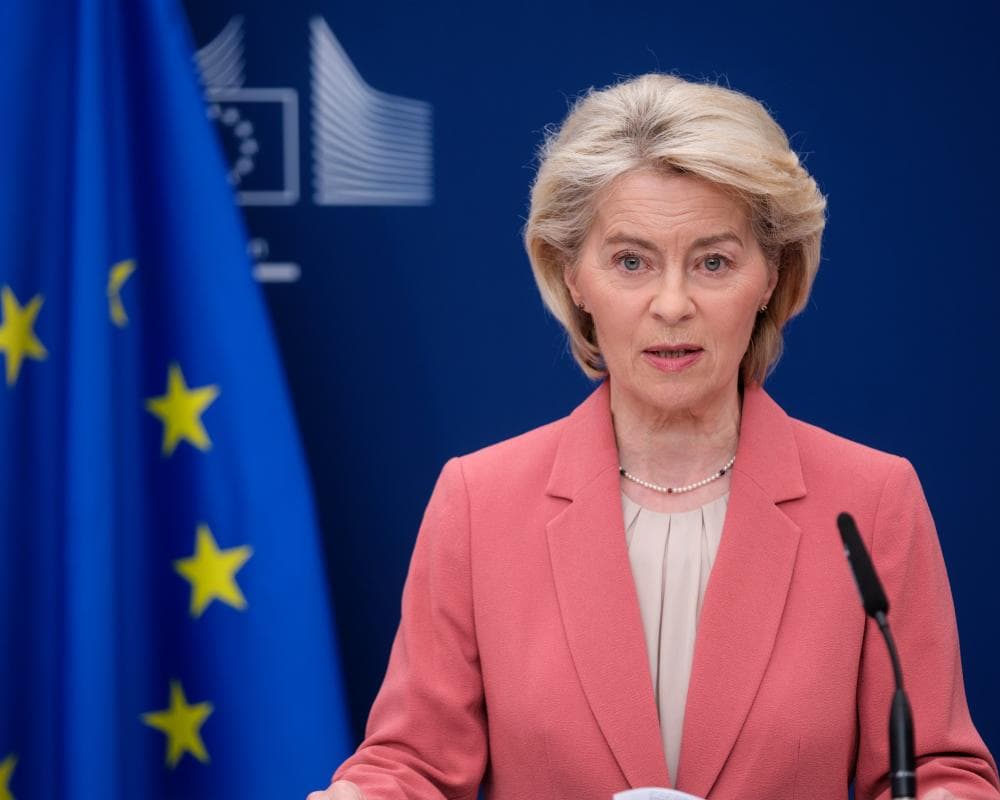
The European Commission president, Ursula von der Leyen, said the EU will provisionally apply the contested EU-Mercosur free trade agreement.
Speaking from Brussels, she said that the European Council had last month empowered the commission to provisionally apply the agreement as soon as the first Mercosur country ratifies it, and as Uruguay and Argentina did that yesterday, the commission wants to move ahead with the plan.
“Provisional application is, by its nature, provisional; it is right there in the name. In line with the EU treaties the agreement can only be fully concluded once the European parliament has given its consent,” she said.
Last month, EU lawmakers referred the deal to the bloc’s top court amid continuing opposition to the deal from the agricultural sector and a number of countries, including France, Ireland and Poland.
Updated
Ukraine shot down a drone close to the border with Romania during a Russian attack on Ukrainian port infrastructure early on Friday, Romania’s defence ministry said in comments reported by Reuters.
The ministry said in a statement that it had scrambled fighter jets to monitor the attack and that the drone was brought down 100 metres (110 yards) from the Romanian village of Chilia Veche, which lies across the Danube River from Ukraine.
Romania, which is a member of the European Union and Nato, shares a 650-km (400-mile) land border with Ukraine. Drones have breached its airspace and fragments of drones have fallen on its territory repeatedly since Russia began attacking Ukrainian ports across the Danube during its war in Ukraine.
Romania has legislation in place enabling it to shoot down drones during peacetime if lives or property are at risk, but has not yet made use of it, Reuters noted.
Fresh opinion polls ahead of Denmark’s 24 March parliamentary election showed prime minister Mette Frederiksen’s Social Democrats nearing a majority with left-wing parties, indicating an end to nearly four years of cross-partisan government, Reuters said.
Two surveys showed the left-leaning bloc led by Frederiksen winning 87-88 seats in Denmark’s 179-seat parliament, according to polls by Epinion and Megafon for broadcasters DR and TV2, just short of the 90 needed for a majority.
The right-leaning bloc led by defence minister Troels Lund Poulsen of the Liberal Party was projected to win 73 and 77 seats in the two polls.
It’s six weeks until Hungary will go to the polls and Viktor Orbán increasingly battles for his political future as he faces a realistic prospect of being ousted after 16 years in power.
My colleagues Flora Garamvolgyi and Ashifa Kassam looked more closely at how Orbán uses Ukraine to mobilise his support amid worsening poll figures suggesting that he could lose power to the Tisza opposition party, led by Péter Magyar.
Hungary continues to block the EU’s €90bn loan to Ukraine and the 20th round of sanctions against Russia over the disrupted oil supply via the Druzbha pipeline. Ukraine says the interruption is caused by recent Russian strikes and the pipeline requires substantial repairs first, but Budapest continues to question these explanations.
But a new option for resolving the standoff seems to be emerging, with Croatia offering to carry deliveries via its Adria pipeline instead.
Croatian prime minister Andrej Plenković said the Adria pipeline can transport up to 15m tonnes of oil a year, enough to fully meet the needs of both Hungary and the other affected country, Slovakia.
But some observers worry whether it’s really just about oil deliveries or, perhaps, about a strong campaign theme for Orbán, which would give him less of an incentive to actually resolve the problem before 12 April?
Let’s see. It’s six weeks to go.
A local ceasefire around the Zaporizhzhia nuclear plant in southeastern Ukraine has been agreed, with the help of the International Atomic Energy Agency, to allow for necessary repairs of the backup power lines to the plant.
The IAEA has confirmed that a local arrangement has been reached to help the repair teams ensure the safety of the plant, with demining activities in the area ongoing to enable access.
Reuters noted that the plant, Europe’s largest, has been under Russian control since shortly after the start of the war in 2022. It is not currently producing electricity, and relies on external power to keep its nuclear material cool and avoid a catastrophic accident.
Russia and Ukraine have frequently accused each other of jeopardising safety at the plant by staging attacks nearby. The repairs are expected to last for at least a week, according to Russia.
The peace talks between Ukraine, Russia and the US are now expected to resume next month.
“We need to finalise everything achieved so far for real security guarantees and prepare a meeting at the leaders’ level. This is the format that can resolve many issues. At the end of the day, leaders decide key issues and when it comes to Russia … this is relevant even more than in other countries,” Ukraine’s president Volodymyr Zelenskyy said last night.
It’s Friday, 27 February 2026, it’s Jakub Krupa here, and this is Europe Live.
Good morning.