Loading...
Please wait for a bit
Please wait for a bit
Click any word to translate
Original article by Adam Fulton (now); Lucy Campbell, Frances Mao and Jakub Krupa (earlier)
It’s 1.45am in Caracas and 12.45am in Bogotá and New York City and we’re going to close this live coverage now. Here’s a recap of the day’s developments. Thanks for following along.
Donald Trump has said arrangements are being made for Colombia’s president Gustavo Petro to visit the White House following a call between the two leaders on Wednesday that Trump described in positive terms. It was their first talks since the US president on Sunday threatened the country with military action.
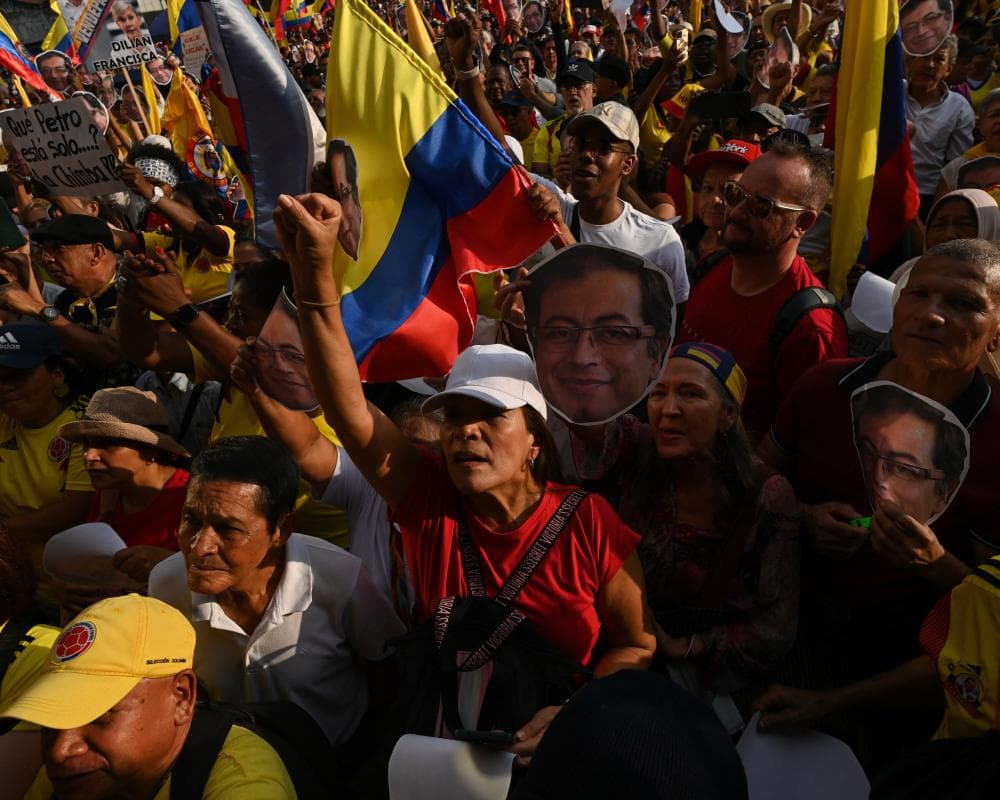
The call came as crowds gathered across Colombia in demonstrations “to defend national sovereignty” following Petro’s call for a “day of national mobilisation” against Trump’s threat. The threat came after Trump ordered the US capture of the president of neighbouring Venezuela, Nicolás Maduro, who was flown to the US to face drug and weapons charges.
American vice-president JD Vance reiterated the US would have complete control of Venezuela’s oil supplies, while Venezuelan interim president Delcy Rodríguez defended plans to open up her country’s oil market to Washington.
Rodríguez said America’s attack to remove Maduro put a “stain” on the countries’ relations but that it was “not unusual or irregular” to trade with the US, adding that Venezuela was “open to energy relations where all parties benefit”.
Trump’s administration has sought to assert its control over Venezuelan oil, seizing a pair of sanctioned tankers on Wednesday – one sailing under Russia’s flag – while announcing it would manage all sales of future crude production and oversee the sale of the country’s petroleum worldwide.
The seizure of the Marinera crude oil tanker ended a weeks-long chase across the Atlantic. “It was a fake Russian oil tanker,” JD Vance told Fox News. Earlier on Wednesday, the US coast guard also intercepted a tanker carrying Venezuelan oil, the Panama-flagged M Sophia.
Trump said on his Truth Social platform after his call with Petro that it was “great honour” to speak to the Colombian president, “who called to explain the situation of drugs and other disagreements that we have had”. “I appreciated his call and tone, and look forward to meeting him in the near future,” Trump said, adding that arrangements were being made for a meeting between them soon at the White House.
Trump also said on social media that Venezuela would use the proceeds from its oil deal with the US to buy American products, including farm commodities and medicine.
Venezuelan interior minister Diosdado Cabello said 100 people died in the US weekend raid.
With news agencies
Updated
“I’m a bit of an insomniac. So at almost 2am, I was awake, actually, and the first explosion, I swear I thought it was an earthquake.”
For Anna (not her real name), a journalist based in Caracas, it took some time for the realisation to dawn on her that the US had attacked Venezuela’s capital. “But then when the explosions continued in the following 20 minutes, one after the other, something deep down told me, you know, it’s the Americans.”
In this Guardian podcast published today, Anna describes to Helen Pidd the atmosphere on the streets of Caracas and the nervousness that many continue to feel about the regime.
And Tom Phillips, the Guardian’s South America correspondent, describes the apprehension and mixed feelings among Venezuelans crossing the border with Colombia.
He also outlines the mistrust and fragility within the new leadership, the disappointment of the opposition movement, and how considerations about the country’s vast oil reserves may have shaped Washington’s calculations.
The podcast can be heard here:
Updated
Venezuelan interim president Delcy Rodríguez has defended plans to open up her country’s oil market to Washington, as Donald Trump’s vice-president JD Vance reiterated that the US would have complete control of the country’s supplies.
As reported earlier, Rodríguez said on Wednesday that America’s attack to remove her predecessor, Nicolás Maduro, put a “stain” on the countries’ relations, but added it was “not unusual or irregular” to trade with the US, adding that Venezuela was “open to energy relations where all parties benefit”.
Trump’s administration has sought to assert its control over Venezuelan oil, seizing a pair of sanctioned tankers while announcing it will manage all sales of future crude production and oversee the sale of the country’s petroleum worldwide.
That and more is in our newly launched full report here:
Updated
The US’s first overt attack on an Amazon nation last weekend is a new phase in its extractivist rivalry with China.
The outcome will decide whether the vast mineral wealth of South America is directed towards a 21st-century energy transition or a buildup of military power to defend 20th-century fossil fuel interests.
Although this onslaught was ostensibly aimed at one corrupt dictatorship in a miserably dysfunctional country, the ramifications are far wider.
Venezuela’s oil is the obvious objective, but not the only one.
You can read the full analysis here:
Venezuela’s military has held a funeral for some of the soldiers killed during the US operation that captured president Nicolás Maduro.
Venezuelan interior minister Diosdado Cabello said late on Wednesday that 100 people including civilians died in the US raid at the weekend.
The army earlier posted a list of 23 of its personnel killed. Below are some images from Caracas of Wednesday’s funeral procession to honour the dead.
Updated
Donald Trump’s administration has said it will dictate decisions to Venezuela’s interim leaders and control the country’s oil sales “indefinitely” after toppling Nicolás Maduro.
“We obviously have maximum leverage over the interim authorities in Venezuela right now” following the capture operation, White House press secretary Karoline Leavitt told a briefing on Wednesday.
We’re continuing to be in close coordination with the interim authorities, and their decisions are going to continue to be dictated by the United States of America.
Trump’s assertion of US dominance over the oil-rich country comes despite its interim leader Delcy Rodríguez saying there is no foreign power governing Caracas.
“There is a stain on our relations such as had never occurred in our history,” Rodríguez said about the US attack to depose her predecessor.
Updated
The US European Command’s confirmation that it boarded the Russian-flagged oil tanker Marinera over alleged sanctions violations brings to an end a dramatic two-week pursuit that began in the Caribbean and concluded in the Atlantic.
Separately on Wednesday, the US coast guard announced it had intercepted another dark-fleet tanker that is under sanctions, the M Sophia, in a pre-dawn operation in the Caribbean.
Commenting on the twin operations, the White House signalled it would continue to seize Venezuela-linked oil vessels after Donald Trump last month imposed what he described as a “complete blockade” on ships transporting oil for Caracas.
Asked whether the seizure of a Russian-flagged oil tanker in the Atlantic risked escalating tensions with Russia, the White House’s press secretary did not respond directly but said the vessel’s crew could be transferred to the US for prosecution “if necessary”.
For more on this and the day’s other main Trump administration stories, see our overview here:
Updated
Donald Trump and his advisers are working up a sweeping plan to dominate Venezuela’s oil industry for years to come, the Wall Street Journal has reported.
The US president has told aides he believes his efforts could help lower oil prices to $50 a barrel, according to the report on Wednesday.
Citing people familiar with the matter, the report also says a plan being considered includes the US exerting some control over Venezuela’s state-run oil company PDVSA, including acquiring most of its oil production.
The report could not be immediately verified.
Thousands of protesters have taken to the streets of cities across Colombia to decry Donald Trump’s threats to expand his military campaign in South America into their territory, after last weekend’s deadly attack on Venezuela.
In Cúcuta, a city on Colombia’s eastern border with Venezuela, several hundred demonstrators marched towards its 19th century cathedral waving the country’s yellow, blue and red flag and shouting: “Fuera los yanquis!” (“Out with the Yanks!”)
Demonstrator José Silva, 67, said the abduction of Venezuelan president Nicolás Maduro during Saturday’s attack made a mockery of Trump’s claim to be “the president of peace”.
The full report we’ve just published is here:
Updated
Further to our last post, Venezuela had not previously given a number for those killed in the weekend US operation that removed president Nicolás Maduro from power, but the army posted a list of 23 names of its dead.
Interior minister Diosdado Cabello said late on Wednesday that 100 people died in the US raid, Reuters reports.
Venezuelan officials have said a large part of Maduro’s security contingent was killed “in cold blood”, and Cuba has said 32 members of its military and intelligence services in Venezuela were killed.
Cabello also said that Maduro’s wife, First Lady Cilia Flores – who was detained alongside him – suffered a head injury during the US raid, while Maduro sustained a leg injury.
As our piece on the pair’s appearance in a New York City court on Tuesday detailed, Flores had two large Band-Aids on her face – on the temple and forehead.
Venezuela’s interim president Delcy Rodriguez, who Cabello praised during his weekly show on state television as “courageous”, on Tuesday declared a week of mourning for members of the military killed in the raid.
Updated
Venezuela’s interior minister is being quoted just now as saying 100 people died in the US attack on the country at the weekend, and that the toll includes civilians.
We’ll bring you more on Diosdado Cabello’s comments as they come to hand.
Updated
Venezuela’s interim leader has said US forces’ attack to depose her predecessor put a “stain” on the countries’ relations, but she defended plans to sell oil to Washington.
“There is a stain on our relations such as had never occurred in our history,” Delcy Rodríguez said on Wednesday, cited by AFP.
But she added it was “not unusual or irregular” to trade with the US now, following the announcement by state oil firm PDVSA that it was in negotiations to sell crude to the US.
Rodríguez was separately quoted as saying in a meeting with the leadership of Venezuela’s national assembly that the country was “open to energy relations where all parties benefit”.
Updated
Crowds of Colombians have gathered in public squares across the country in nationwide demonstrations “to defend national sovereignty” against Donald Trump’s military threats.
Colombia’s flags waved in the breeze from rooftops, windows and taxi antennas in the capital, Bogotá, on Wednesday in response to President Gustavo Petro’s call for a “day of national mobilisation”.
“The U.S. is the biggest threat to world peace,” one placard at said at a protest in the city’s central Plaza de Bolívar. Hundreds of demonstrators chanted “Long live free and sovereign Colombia!”
In a security alert, the US embassy in Bogotá warned Americans to steer clear of the protests “as they have the potential to turn violent”.
As the Associated Press also reports, Petro has been frustrated with Colombian congressional resistance to his contentious reforms, and as he faces a series of electoral tests he has found in Trump the perfect foil as he fights for his legacy.
“He wants this stage where he is the clearest adversary, rhetorically or politically, to the US,” said Sergio Guzman, a political risk analyst based in Bogotá.
Updated
Donald Trump just confirmed he spoke with Gustavo Petro, saying he “appreciated his call and tone” and that a meeting between them at the White House would be arranged soon.
The US president said on his Truth Social platform:
It was a Great Honor to speak with the President of Colombia, Gustavo Petro, who called to explain the situation of drugs and other disagreements that we have had. I appreciated his call and tone, and look forward to meeting him in the near future. Arrangements are being made between Secretary of State Marco Rubio and the Foreign Minister of Colombia. The meeting will take place in the White House in Washington, D.C.
Updated
Keir Starmer spoke with Donald Trump on Wednesday evening and set out his position on Greenland, the UK government said.
Both leaders also discussed the joint operation to intercept the Marinera tanker, recent progress on Ukraine and the US operation in Venezuela, said the statement, cited by Reuters.
Starmer had earlier said he stood with Denmark in its defence of Greenland and that no one else should determine the future of the vast territory after Trump said he needed it for defence.
Updated
Donald Trump and Colombia’s Gustavo Petro held a phone call on Wednesday afternoon, Reuters has cited a Colombian presidential source and local media as saying.
It is the first phone call between the two presidents since Trump said on Sunday that a US military operation focused on Colombia’s government “sounds good” to him.
Details of the conversation were not immediately made clear but the source within Petro’s office said the call was “cordial” and “respectful”.
Updated
The US military strike on Venezuela that deposed its leader Nicolás Maduro could ripple out into a “catastrophe” for the whole of South America, Colombia’s deputy foreign minister has said.
“If there is a major humanitarian crisis, the impact, the devastation will be unstoppable ... We are talking about a catastrophe that Latin America has never seen,” Mauricio Jaramillo told Agence France-Presse in an interview in Bogotá on Wednesday.
Colombia shares a porous 2,200km (1,370-mile) border with Venezuela and has been the major recipient of migrants fleeing the economic and political crisis there.
Jaramillo said Colombia could never be “fully prepared in the event there is a degradation brought about by war”, especially at a time Latin America is split on Donald Trump’s actions.
Rightwing governments in Argentina and Ecuador have backed Maduro’s ouster but leftists in Brazil, Mexico, Colombia and others have firmly condemned it.
Jaramillo said:
That division obviously undermines a regional solution ... Without shared premises and minimum consensus, it’s obviously very difficult to respond at the regional level.
He added that a US military attack on Colombia seemed “unlikely” but that the country would have a “legitimate” response if needed.
Colombia and its first-ever leftist president, Gustavo Petro, have consistently criticised Washington’s mass naval deployment in South America, its bombing of alleged drug-smuggling boats, seizure of Venezuelan oil tankers and Saturday’s capture of Maduro.
The censure from Bogota has irritated Trump, who has accused Petro of being a drug baron – which Petro denies – and warned him on Saturday to “watch his ass”.
This is Adam Fulton picking up our live coverage. Stay with us for the latest developments
Updated
Donald Trump has also signed a proclamation withdrawing the United States from 35 non-United Nations organizations and 31 UN entities that “operate contrary to US national interests”, the White House said in a statement.
It did not list the organizations, but said they promote “radical climate policies, global governance, and ideological programs that conflict with US sovereignty and economic strength”.
It said the move was the result of a review of all international intergovernmental organizations, conventions and treaties that the US is a member of or party to, per Reuters.
“These withdrawals will end American taxpayer funding and involvement in entities that advance globalist agendas over US priorities, or that address important issues inefficiently or ineffectively such that US taxpayer dollars are best allocated in other ways to support the relevant missions,” the White House said.
Since beginning his second term a year ago, Trump has sought to slash US funding for the UN, ended US engagement with the UN Human Rights Council, extended a halt to funding for the Palestinian relief agency UNRWA and quit the UN cultural agency UNESCO. He has also announced plans to quit the World Health Organization and the Paris climate agreement.
Updated
Donald Trump has said in a post on his Truth Social platform that Venezuela will be purchasing American-made products with the money they receive from the new deal arranged with his administration.
I have just been informed that Venezuela is going to be purchasing ONLY American Made Products, with the money they receive from our new Oil Deal. These purchases will include, among other things, American Agricultural Products, and American Made Medicines, Medical Devices, and Equipment to improve Venezuela’s Electric Grid and Energy Facilities.
In other words, Venezuela is committing to doing business with the United States of America as their principal partner — A wise choice, and a very good thing for the people of Venezuela, and the United States.
Updated
The US seized two sanctioned oil tankers linked to Venezuela in two separate missions in the North Atlantic and the Caribbean.
After a two-week pursuit, US forces boarded the Russian-flagged Marinera - originally known as the Bella 1 - over alleged sanctions violations, in a high-stakes operation that could risk confrontation with the Kremlin after Moscow reportedly dispatched a submarine to safeguard the vessel.
The UK confirmed it provided assistance for the seizure of the Marinera, with the RAF providing extra surveillance and navy refuelling while capture under way. The UK argued the operation was legal and justified because the “stateless” vessel had breached US sanctions on Iran. The UK’s support was “in full compliance with international law”, defence secretary John Healey said.
However, Russia said the seizure had violated maritime law after claiming it had given the vessel permission to fly the Russian flag a month ago.
Meanwhile the US Coast Guard said it had separately intercepted another dark-fleet tanker that is under sanctions, the M Sophia, in a pre-dawn operation in the Caribbean.
The White House press secretary Karoline Leavitt later confirmed that the Marinera crew members were now subject to prosecution and could be transferred to the US “if necessary”.
The Russian foreign ministry demanded the US ensure the humane and dignified treatment of Russian citizens onboard the Marinera and guarantee their swift return to Russia.
Ukraine’s foreign minister said Kyiv welcomed the seizure of the tanker, adding it was a good example of how to act against Moscow and said it showcased “President Trump’s resolute leadership”. “We welcome such an approach to dealing with Russia: act, not fear. This is also relevant to the peace process and bringing a lasting peace closer,” Andrii Sybiha wrote on X.
On Venezuela, the White House also claimed that oil from the country would arrive in the US “very soon”, following Trump’s announcement of a deal with Caracas to get access to up to $2bn worth of Venezuelan crude.
But Venezuela’s state-run oil company PDVSA said that it is progressing in negotiations with the US for oil sales, as a board member for the company told Reuters the US will need to buy cargoes at international prices. “If they want to buy it, they will have it in due time, sold at the international price,” PDVSA board member Wills Rangel told Reuters. “Not the way [Trump] intends, as if that oil belongs to them because we supposedly owe them. We do not owe anything to the United States.”
US secretary of state Marco Rubio told reporters that the US “is not winging it” in Venezuela and that the Trump administration has a long-term plan for the country. The three-step plan for Venezuela that will begin with stabilizing the country after US forces seized Nicolás Maduro on Saturday, overseeing the country’s recovery and finally a transition to a more representative form of government, Rubio told reporters.
Rubio also confirmed he would be meeting with Denmark next week to discuss Greenland.
Leavitt told reporters that the Trump administration was “actively discussing” the purchase of the island and while diplomacy was the first option, “all options are always on the table”. In a statement earlier in the day, Leavitt had added that “utilizing the US military is always an option at the commander-in-chief’s disposal”. She also said told reporters that the US controlling Greenland would deter Russian and Chinese aggression in the Arctic.
Venezuela’s state-run oil company PDVSA has said that it is progressing in negotiations with the US for oil sales, as a board member for the company told Reuters the US will need to buy cargoes at international prices.
On Tuesday, Washington announced a deal with Caracas to get access to up to $2bn worth of Venezuelan crude, a sign that Venezuelan government officials are responding to Donald Trump’s demand that they open up to US oil companies or risk more military intervention.
Trump has said he wants interim Venezuelan president Delcy Rodríguez, installed this week after the US deposed Nicolás Maduro, to give the US and private companies “total access” to her country’s oil industry.
And earlier, White House press secretary Karoline Leavitt told reporters Venezuelan oil would be arriving in the US “very soon”.
PDVSA said in a brief statement that the parties have been talking about similar terms as those in place with foreign partners such as Chevron, the company’s main joint venture partner, which currently controls all oil exports to the US.
The process ... is based on strictly commercial transactions under terms that are legal, transparent and beneficial for both parties.
PDVSA board member Wills Rangel, who is also a union leader, told Reuters the US will need to buy cargoes at international prices if the country wants Venezuelan oil.
If they want to buy it, they will have it in due time, sold at the international price. Not the way [Trump] intends, as if that oil belongs to them because we supposedly owe them. We do not owe anything to the United States.
Chevron, which has a special US license to export Venezuelan crude despite sanctions, is the only company currently exporting crude from the country, Rangel added, as a US blockade on Venezuela keeps exports bound to China, the main destination of its oil, paralyzed.
Updated
US authorities have released two videos filmed by the military following the separate seizures of the Sophia and Marinera oil tankers on Wednesday.
US homeland security secretary Kristi Noem and US Southern Command posted the clips on X, which appear to show the US military intercepting a Venezuela-linked tanker in the Caribbean Sea. The footage was released on the same day US forces also intercepted and seized the Russian-flagged Marinera in the north Atlantic.
We have the clips here:
Britain’s Ministry of Defence said it had provided military help to the US forces that seized a Russian-flagged oil tanker north-west of Britain and Ireland, initially arguing the operation was legal because the vessel had breached US sanctions on Iran.
John Healey, the defence secretary, said the UK had allowed US aircraft to use bases to prepare for and carry out the mission, while the RAF had provided extra surveillance and the navy refuelling while the final capture was under way.
Healey said British involvement was justified under international law because the Marinera, which was sailing from the Caribbean Sea towards Russia, had previously been placed under sanctions when it was known as the Bella 1.
“This ship, with a nefarious history, is part of a Russian-Iranian axis of sanctions evasion which is fuelling terrorism, conflict and misery from the Middle East to Ukraine,” Healey said.
Later, Healey expanded the justification for the seizure. The tanker, he told MPs in the evening, had changed its name “five times in the last five years” and had been falsely flying the flag of Guyana when it was called Bella 1 and arrived in the Caribbean.
A “stateless” vessel, the defence secretary said, “may be lawfully intercepted and subjected to the law of the interdicting state”. Stateless ships are generally considered to be without protection under international law, although there is debate about the extent to which they can be boarded or seized.
The Marinera was also, the minister said, part “of an increasing web of shadow shipping that fuels and funds instability” and that “Russia operates a vast shadow fleet of its own to bankroll its illegal invasion of Ukraine”. Stopping such ships from trading covertly was hurting Russia’s war effort, he added.
The UK had decided to assist in response to a request from the US for help, the defence secretary said. But British forces only played a supporting role and no British forces took part in the boarding, Healey told MPs on Wednesday evening.
Updated
By Jon Henley and Miranda Bryant
The Trump administration has said repeatedly that the US needs to gain control of Greenland, a mineral-rich, largely self-governing part of Denmark with foreign and security policy run from Copenhagen.
The White House has said using the US military is “always an option”, but few analysts believe an armed operation is likely and France’s foreign minister has said the US secretary of state, Marco Rubio, has ruled out the possibility of an invasion.
Here are five options Donald Trump has in order to take over Greenland:
Alaska senator Lisa Murkowski told the Associated Press (AP) earlier that she hated “the rhetoric around either acquiring Greenland by purchase or by force,” adding, “I think that it is very, very unsettling.”
New Hampshire Democrat Jeanne Shaheen and North Carolina Republican Thom Tillis, co-chairs of the bipartisan Senate Nato Observer Group, said the US needs to honor its treaty obligations to Denmark, AP reported.
“Any suggestion that our nation would subject a fellow Nato ally to coercion or external pressure undermines the very principles of self-determination that our Alliance exists to defend,” the senators said in a joint statement.
by Tural Ahmedzade, Harvey Symons, Oliver Holmes and Dan Sabbagh
A massive, rusty crude oil tanker floating north through the Atlantic has become the centre of global interest after it was followed for days and eventually seized by US forces while Russia’s military rushed towards it.
Despite not carrying any oil, the 300-metre-long ship is clearly of value. Theories for why range from speculation that high-value Russian weapons are hidden in the hull, to the ship’s potential to become a symbolic trophy in a transatlantic power struggle between Washington and Moscow.
Currently called the Marinera, the name-changing ship is part of the shadow or “ghost” fleets used by Russia, Iran and Venezuela to avoid western sanctions. For years these vessels have moved cargo and cheap fuel around the globe, including to China.
Washington and its European allies have long sought to crack down on the illicit maritime trade. Those efforts reached a critical point last month after Donald Trump imposed a naval blockade on sanctions-busting tankers operating near Venezuela, home to the world’s largest oil reserves and a key destination for shadow fleet vessels.
Read the full explainer at the link below:
Further to his insistence that the US is “not winging it” in Venezuela, we have more details on what secretary of state Marco Rubio said earlier regarding the US’s plan for the country.
Rubio said the United States has a three-step plan for Venezuela that will begin with stabilizing the country after US forces seized Nicolás Maduro on Saturday, overseeing the country’s recovery and finally a transition to a more representative form of government, Reuters reports.
“We don’t want it descending into chaos,” said Rubio, after briefing US senators on the Trump administration’s plan for the country. He added that he was working with Venezuela’s interim president, Delcy Rodríguez, and had spoken with her several times since the weekend’s raid in Caracas.
A tightened quarantine on Venezuelan oil would be central to that effort, he said:
We are in the midst right now and in fact about to execute on a deal to take all the oil. We are going to take between 30 and 50 million barrels of oil. We’re going to sell it in the marketplace at market rates, not at the discounts Venezuela was getting.
That money will then be handled in such a way that we will control how it is disbursed in a way that benefits the Venezuelan people, not corruption, not the regime.
Rubio went on:
The second phase will be a phase that we call recovery, and that is ensuring that American, western and other companies have access to the Venezuelan market in a way that’s fair.
Also, at the same time, begin to create the process of reconciliation nationally within Venezuela, so that the opposition forces can be amnestied and released and from prisons or brought back to the country, and begin to rebuild civil society.
And then the third phase, of course, will be one of transition.
Ukraine’s foreign minister has said that Kyiv welcomes the US seizure of the Marinera Russian-flagged tanker linked to Venezuela, adding that it showed Donald Trump’s “resolute leadership”.
“The apprehension of a Russian-flagged ship in the North Atlantic underscores the United States’ and President Trump’s resolute leadership,” Andrii Sybiha wrote on X.
“We welcome such an approach to dealing with Russia: act, not fear. This is also relevant to the peace process and bringing a lasting peace closer.”
Updated
My colleague Shrai Popat reports that US House speaker Mike Johnson emerged from the closed-door meeting with top administration officials and his lower chamber colleagues about the capture of Nicolás Maduro convinced that there would be “no boots on the ground” in Venezuela.
“We don’t anticipate that’s going to be necessary,” the speaker said. “We went to apprehend a criminal. We did it with precision. It was justified, and that job has been done. We now hope that the people in Venezuela can govern themselves.”
He also appeared to downplay the prospect of the US taking military action on Greenland, despite the White House making it clear that all options remain on the table for Trump’s aspiration to acquire the Arctic island.
“We’re not at war with Greenland,” Johnson said in comments reported by the Hill. “We have no intention of being, no reason to be at war with Greenland, OK?”
“So, all this stuff about military action and all that. … I don’t think that’s a possibility. I don’t think anybody’s seriously considering that. And in Congress, we’re certainly not,” he added.
Earlier Karoline Leavitt told the White House press briefing that while there are currently no boots on the ground in Venezuela, “the president, of course, reserves the right to use the United States military if necessary”.
And, as we’ve been reporting, she also didn’t rule out the possibility of using military forces in Greenland. She told reporters:
All options are always on the table for President Trump as he examines what’s in the best interest of the United States, but I will just say that the President’s first option always has been diplomacy.
Again, look at Venezuela, he tried ardently to strike a good deal with Nicolás Maduro and he told him I will use the United States military and you will not like it, if you don’t take such a deal, and look at what happened.
Updated
US secretary of state Marco Rubio has pushed back on the heavy criticism from Democratic senators of the US military operation in Venezuela and the Trump administration’s plan to run the country, telling reporters on Capitol Hill that the US is “not winging it” in Venezuela.
“The bottom line is, we’ve gone into great detail with them about the planning. We’ve described it to them,” Rubio said, following a private meeting with senators.
In fact, it’s not just winging it. It’s not just saying or speculating, it’s going to happen. It’s already happening.
The regime can no longer move oil and generate revenue unless the US allows, Rubio said, giving Washington “tremendous leverage” and “control”.
Sky New has the clip.
Earlier, White House press secretary Karoline Leavitt also pushed back on criticism and insisted there was a plan for the country after the US capture of Nicolas Maduro and , telling reporters, “There is a long-term plan here.”
Updated
Mike Tapp, parliamentary under-secretary of state at the Home Office has spoken to the BBC describing the UK’s assistance in the US operation to seize two oil tankers as “important activity with our US allies”.
When asked if there were concerns of Russian retaliation for the UK’s role in helping seize the Russian-flagged Bella 1/Marinera ship, he said the UK’s concerns were focused on “taking on those who are trying to get around sanctions and we’ve been really clear we’ll continue to do that with the Russian shadow fleet, and today is a part of that”.
Updated
Leavitt is asked if there are concerns of increased tensions with Russia because of the tanker seizure, and with China over the Venezuela operation. She says:
“The president has very good, open relationships with both President Putin and President Xi. He has spoken with them numerous times… and I believe those personal relationships are going to continue.
But as for the president and the United States- he’s going to enforce our policy that’s best for the US, and in respect to these ship seizures, that’s enforcing the embargo on all dark-fleet vessels that are illegally transporting oil.”
The Kremlin has already responded angrily to the US seizure, saying “no state has the right to use force against ships properly registered in the jurisdictions of other states”.
Updated
When questioned on whether Trump is still committed to Nato and the article 5 provision of the alliance’s members coming to each other’s defence – Leavitt repeats Trump’s message on Nato from earlier today that “we will always be there for Nato even if they are not there for us”.
A reporter asks Leavitt what the US stands to gain if it were to take control of Greenland given it already has access to military bases there, can station personnel on the territory, and place assets.
Leavitt replies: “More control over the Arctic region and ensuring that China and Russia and our adversaries cannot continue their aggression in this very important and strategic region.”
Updated
Leavitt says the US coastguard is “escorting” the Sophia to the US – this is second oil tanker that was seized in the Caribbean.
Asked a slew of questions on Greenland, Leavitt is pressed on why the US has not ruled out using military force.
She says Trump won’t broadcast the US’s foreign policy. “All options are always on the table for President Trump as he examines what’s in the US’s interests…but the president’s first options, always, has been diplomacy,” she claims.
Updated
White House press secretary Karoline Leavitt has just spoken for the first time on the US seizures of two Venezuelan oil tankers, in the North Atlantic and the Carribean.
She was asked by a reporter whether the seizure of the Russian-flagged Bella-1/Marinera risked larger conflict with Russia. Moscow has already responded angrily to the US seizure, calling it a violation of international law.
Leavitt did not answer the question about antagonising Russia, instead just providing a summary of the operation. I don’t see any key details we didn’t know.
Leavitt said: “The vessel seized in the North Atlantic… shows the USA is not going to tolerate that [ships breaching sanctions].
She pointed out the vessel was subject to a US order which means its crews could be subject to prosecution too and brought back to the US to face trial. Moscow earlier had urged the US to release the crew.
“This administration is going to fully enforce the sanctions policy.”
Updated
Speaking to reporters, Rubio said that the US is about to execute on a deal to take “all the oil that is stuck in Venezuela”.
“We’re going to sell it in the marketplace, at market rates, not at the discounts Venezuela was getting. That money will then be handled in such a way that we will control how it is dispersed in a way that benefits the Venezuelan people, not corruption, not the regime,” Rubio added.
When pressed by reporters about whether the US is concerned about the interim leader’s loyalty to her deposed predecessor, Rubio remained resolute.
“The bottom line is that there is a process now in place where we have tremendous control and leverage over what those interim authorities are doing and are able to do,” the secretary of state said.
“But obviously this will be a process of transition. In the end, it will be up to the Venezuelan people to transform their country. We are prepared under the right conditions, using the leverage that we have, which includes the fact that they cannot move any oil unless we allow them to move it.”
Rubio also told reporters that Venezuela’s interim leaders had asked for the oil cargo seized on one of the ships to be “part of this deal” – i.e. the current US negotiations around the oil proceeds in Venezuela.
“They want the oil that was seized on one of those ships to be part of the deal. They understand that the only way they can move oil and generate revenue and not have economic collapse is if they work with the United States.”
Updated
Defence Secretary Peter Hegseth also just chimed in behind Rubio – describing the US action in Venezuela as “one of the most historic military operations the world has ever seen”, and referencing the overnight seizures of the two tankers.
He says the US military is the only one powerful enough to do that: “And the world is taking notice of that, certainly Venezuela is taking notice of that, and it continues, because two oil tankers overnight were seized by the United States of America… that leverage will continue.”
“The president when he speaks he means it. He’s not messing around. We are an administration of action to advance our interest and that is on fully display.”
Updated
US Secretary of State Marco Rubio is speaking to reporters on Venezuela – he says the US administration will control how oil is dispersed in the country, and they’re exercising such leverage “in a positive way”.
He’s asked on Denmark and Greenland. He declines to answer questions on whether military intervention would be used – “I’m not here to talk about that”.
He says he’s meeting with Denmark representatives next week.
Updated
Russia’s foreign ministry also says the US should ensure the swift return of its citizens on board the seized Bella 1/Marinera.
They’ve already declared it a violation of international law with one senior lawmaker calling it “piracy”.
The Russian transport ministry said the Marinera was boarded by the US Navy at approximately 12pm GMT, after which they lost contact with the boat, reports Tass state media.
The vessel had been authorised to sail under the Russian flag on 24 December.
Updated
The map below shows the US’s pursuit of the Venezuelan vessel, first known as the Bella-1 and then renamed and reflagged as the Marinera.
The ship had been sanctioned by the US in 2024 for allegedly smuggling cargo for Hezbollah.
The US Coast Guard attempted to board it in the Caribbean in December as it headed for Venezuela. But the ship refused boarding and headed across the Atlantic.
Today, the US has seized the vessel in an operation supported by the UK air force and navy.
Updated
We will hear from the White House shortly with press secretary Karoline Leavitt due to hold a press briefing, where she will most likely give further detail on the US seizures of two oil tankers linked to Venezuela, the Bella 1/Marinera and the Sophia.
Updated
That MoD statement confirms the UK involvement suspected after a RAF surveillance plane was shown by flight-tracking sites over the area where the Bella 1/Marinera was seized.
The UK has said it provided one of its largest naval supply ships – the RFA Tideforce – to help the US operation. It also confirms that UK military bases were used by US planes and military assets in the operation in the North Atlantic.
Updated
The UK Ministry of Defence has just confirmed the UK has provided “enabling support” to the US during its operation to seize the Bella 1 / Marinera vessel.
Its statement said:
“UK Armed Forces provided pre-planned operational support, including basing, to U.S. military assets interdicting the Bella 1 in the UK-Iceland-Greenland gap following a U.S. request for assistance. RFA Tideforce provided support for U.S. forces pursuing and interdicting the Bella 1, while the RAF provided surveillance support from the air.
The UK and U.S. defence and security relationship is the deepest in the world and the UK provided enabling support in full compliance with international law.”
UK defence secretary John Healey hailed the UK armed force’s “skill and professionalism,” while describing the action as “part of global efforts to crack down on sanctions busting.”
“This ship, with a nefarious history, is part of a Russian-Iranian axis of sanctions evasion which is fuelling terrorism, conflict, and misery from the Middle East to Ukraine.
The UK will continue to step up our action against shadow fleet activity to protect our national security, our economy, and global stability – making Britain secure at home and strong abroad.
The U.S. is the UK’s closest defence and security partner. The depth of our defence relationship with the U.S. is an essential part of our security, and today’s seamlessly executed operation shows just how well this works in practice.”
The UK MoD added that the ship was “initially flying a false flag,” and then “turned off its transponders while at sea and sought to reflag while being pursued, indicating its nefarious links to global sanctions evasion.”
“Recent assessments show that the Bella 1 has been involved in illegal activity, linked to international terrorism and crime including Hezbollah, and part of the web of rising shadow activity that fuels and finances nefarious activity across the globe,” it said.
“The Russian flagging of the vessel shows their role in this interconnected shadow activity we are seeing across the world, which threatens our national security, harms our economy and undermines global security.”
Meanwhile, a senior Russian lawmaker from the ruling United Russia party, Andrei Klishas, said the US seizure of a Russian-flagged oil tanker on Wednesday was an act of outright piracy, the TASS state news agency reported, as per Reuters.
Responding to the seizure of Bella 1/Marinera, the Russian transport ministry has accused the US of breaking the 1982 UN Convention on the Law of the Sea, saying “no state has the right to use force against ships properly registered in the jurisdictions of other states.”
The tanker had received a temporary permit to sail under the Russian flag on 24 December, it said in a statement.
Updated
In the meantime, US president Donald Trump has offered his view on Nato in a lengthy post on Truth Social, saying he “doubted Nato would be there for us if we really needed them,” but insisted “we will always be there for Nato, even if they won’t be there for us.”
(Not a word on what it means given his repeated threats to take over Greenland, which is a part of a fellow Nato member, Denmark.)
Trump also took credit for pushing Nato to raise its defence spending, and claimed that “without my involvement, Russia would have all of Ukraine right now,” while pointedly criticising the Nobel committee for not giving him the Nobel peace prize (erm.).
Trump also said that “the only nation that China and Russia fear and respect is the DJT [Donald J. Trump] rebuilt USA.”
Here is the post in full:
“Remember, for all of those big NATO fans, they were at 2% GDP, and most weren’t paying their bills, UNTIL I CAME ALONG. The USA was, foolishly, paying for them! I, respectfully, got them to 5% GDP, AND THEY PAY, immediately. Everyone said that couldn’t be done, but it could, because, beyond all else, they are all my friends. Without my involvement, Russia would have ALL OF UKRAINE right now. Remember, also, I single-handedly ENDED 8 WARS, and Norway, a NATO Member, foolishly chose not to give me the Noble Peace Prize. But that doesn’t matter! What does matter is that I saved Millions of Lives. RUSSIA AND CHINA HAVE ZERO FEAR OF NATO WITHOUT THE UNITED STATES, AND I DOUBT NATO WOULD BE THERE FOR US IF WE REALLY NEEDED THEM. EVERYONE IS LUCKY THAT I REBUILT OUR MILITARY IN MY FIRST TERM, AND CONTINUE TO DO SO. We will always be there for NATO, even if they won’t be there for us. The only Nation that China and Russia fear and respect is the DJT REBUILT U.S.A. MAKE AMERICA GREAT AGAIN!!! President DJT”
Updated
One of the big questions for the next few hours is whether there was any UK involvement in the US operation to seize Bella/Marinera.
If there was – and that doesn’t strike me as the riskiest assumption – you would expect us to hear about it at some point today.
Updated
In a post commenting on the Bella/Marinera seizure, US defence secretary Pete Hegseth said:
“The blockade of sanctioned and illicit Venezuelan oil remains in FULL EFFECT – anywhere in the world.”
The latest tracking information, via TankerTrackers, shows Marinera or Bella 1 changing its course to east-by-southeast after the interception, with the service speculating it could be going in the direction of Scotland.
In the meantime, we also got the confirmation of the second, and completely separate, seizure of a Venezuela-linked tanker in international waters in the Caribbean Sea (13:43).
The US Southern Command said on X:
“In a pre-dawn action this morning, the Department of War, in coordination with the Department of Homeland Security, apprehended a stateless, sanctioned dark fleet motor tanker without incident.
The interdicted vessel, M/T Sophia, was operating in international waters and conducting illicit activities in the Caribbean Sea. The U.S. Coast Guard is escorting M/T Sophia to the U.S. for final disposition.
Through Operation Southern Spear, the Department of War is unwavering in its mission to crush illicit activity in the Western Hemisphere. We will defend our Homeland and restore security and strength across the Americas.”
Updated
And here’s the screengrab from footage published by Russian state media purporting to show a US helicopter approaching the Marinera that Dan Sabbagh referenced earlier (14:46).
The US statement continues:
“This seizure supports @POTUS Proclamation targeting sanctioned vessels that threaten the security and stability of the Western Hemisphere.
The operation was executed by DHS components with support from @DeptofWar, showcasing a whole-of-government approach to protect the homeland.”
We also got this photo from the operation:
The US European Command has now confirmed the seizure of the tanker.
In a post on X, it said:
“The @TheJusticeDept & @DHSgov, in coordination with the@DeptofWar, today announced the seizure of the M/V Bella 1 for violations of U.S. sanctions.
The vessel was seized in the North Atlantic pursuant to a warrant issued by a U.S. federal court after being tracked by USCGC Munro.”
Defence and security editor
Footage of a light helicopter tracking a vessel at sea broadcast by Russian state broadcaster Russia Today today appears to show an MH-6 Little Bird helicopter of the type used by US special forces, with a distinctive T-shaped blade at the rear.
Though the film cannot definitely be verified, its timing is consistent with reports the US is trying to seize the tanker.
But there is not yet any footage of an actual boarding attempt.
Updated
NBC News is now reporting that the tanker has been secured by the US forces, quoting US officials involved in the operation.
The broadcaster reported that “the Department of Homeland Security lead the operation with U.S. military support,” and “US law enforcement officials are currently on board.”
We still need an official confirmation, though.
Updated
Nordic correspondent
The Icelandic coast guard has confirmed it is monitoring the movements of Marinera, which it said sailed into the southeastern Icelandic exclusive economic zone at around 4am.
The coast guard said it is not carrying any oil cargo.
A spokesperson for the coast guard told MBL.is:
“The Icelandic Coast Guard has been monitoring the movements of this vessel, as with other ships that appear in the Coast Guard’s surveillance systems in the waters around Iceland.”
There are also further suggestions that something is happening over the North Atlantic on flight tracker services, with three US Air Force Pilatus U28 aircrafts, used by US special forces, seen north of the UK coast.
One to watch.
Russian affairs reporter
The US appears to be attempting to seize a Russian-flagged oil tanker in the North Atlantic in a high-stakes operation following a pursuit lasting more than two weeks, after Moscow reportedly moved to safeguard the vessel by dispatching a submarine.
Russian state broadcaster RT published two grainy photographs showing a helicopter approaching the tanker, saying an operation was under way. Reuters, citing two American officials, also confirmed that the US was attempting to board the ship.
The tanker, Marinera, had been travelling from Iran to Venezuela but turned back into the Atlantic after attempting to evade a US blockade targeting sanction-hit oil tankers operating near Venezuelan waters.
In the 24 hours preceding the operation, multiple surveillance flights were observed over the vessel, including aircraft from US bases in Iceland and RAF Rivet Joint and P-8 Poseidon planes from the UK, which are capable of detecting submarines.
In December, the crew repelled an attempted US boarding near Venezuela, after which a Russian flag was hastily painted on the hull and the ship was added to Russia’s official shipping registry. Moscow subsequently lodged a formal diplomatic protest demanding that Washington halt its pursuit.
The seizure of the tanker would likely strain US relations with president Vladimir Putin, at a sensitive moment as negotiations over a potential peace deal in Ukraine continue.
Updated
Mind you, these reports are coming to us shortly after tracking services such as Tanker Trackers and Marine Traffic showed that Marinera made a sudden southbound turn, substantially deviating from its earlier course.
Separately, the US coast guards has also reportedly intercepted another Venezuela-linked tanker in Latin American waters, Reuters is reporting.
That’s two different tankers though – our European focus is on Marinera, which was earlier reported near Iceland.
We are getting first reports from Reuters and Russian state media RT that the US is reportedly carrying out an operation to seize the Venezuela-linked Russian-flagged tanker Marinera, formerly known as Bella-1 (11:07, 12:59).
RT posted two grainy photographs showing a helicopter approaching the tanker.
There is no official confirmation yet, mind.
Updated
Nordic correspondent
Lars Løkke Rasmussen, the Danish foreign minister, and his Greenlandic counterpart, Vivian Motzfeldt, are seeking an urgent meeting with US state secretary Marco Rubio.
“We would like to add some nuance to the conversation,” Rasmussen said on social media. “The shouting match must be replaced by a more sensible dialogue. Now.”
Trump has claimed that Greenland is “full of Chinese and Russian ships” and that Denmark is incapable of defending Greenland, which the president has said is vital for US national security.
But Rasmussen said after the extraordinary meeting that the US was giving a false representation of what was happening in Greenland.
“The image that is being painted of Russian and Chinese ships right inside the Nuuk fjord and massive Chinese investments being made is not correct,” he said.
The situation, Rasmussen said, was “based on a misreading of what is up and what is down”, adding: “We are looking after the kingdom.”
Denmark’s defence minister, Troels Lund Poulsen, disputed US claims that the country was not doing enough to protect Greenland. “We have invested close to 100bn [Danish krone] (£11.6bn) in security capabilities,” he said.
Russian affairs reporter
Russia has dispatched naval assets to escort a “shadow fleet” oil tanker being pursued by the US across the Atlantic, according to reports, as tensions over the vessel escalate.
The ship, formerly known as the Bella 1, has spent more than two weeks attempting to evade a US blockade of sanctions-hit oil tankers operating near Venezuela. Ship-tracking data from MarineTraffic showed the vessel nearing Iceland’s exclusive economic zone on Wednesday.
The ship began its journey in Iran and was bound for Venezuela to pick up oil, part of the so-called shadow fleet that moves oil for Russia, Iran and Venezuela despite US and allied sanctions.
According to the Wall Street Journal, Russia on Wednesday dispatched a submarine and other naval vessels to escort the tanker, which is believed to be heading for Murmansk in northern Russia.
It remains unclear where the Russian navy could rendezvous with the ship, but the oil tanker’s entry into European waters has coincided with the arrival of about 10 US military transport aircraft and several helicopters in the UK.
In December, the vessel’s crew repelled an attempted US boarding near Venezuelan waters before abruptly changing course and heading into the Atlantic.
The tanker was renamed Marinera, with its crew hastily painting a Russian flag on the hull, and it was added to an official Russian shipping registry. Moscow subsequently lodged a formal diplomatic protest demanding that Washington halt its pursuit.
The ship has been under sanctions by the US treasury since July 2024, accused by American authorities of being involved in carrying illicit cargo for a company owned by Hezbollah, the Iranian-backed Lebanese group.
Russia’s state-run outlet RT earlier posted a video it said was filmed from the deck of the oil tanker, showing a US Coast Guard vessel trailing it. On Tuesday, Russia’s foreign ministry said it was monitoring the situation “with concern”.
Flight records show the Marinera appears to have been closely monitored over the last two days by US P-8 surveillance aircraft flying from RAF Mildenhall in Suffolk as it crossed the Atlantic. Any US military operation launched from the UK would be expected to involve prior coordination with British authorities.
Meanwhile, let’s go across to our Russian affairs reporter, Pjotr Sauer, for the latest on the oil tanker near Iceland (11:07).
We’d like to hear from people in Greenland on their views on Trump’s renewed call to take over the autonomous territory.
You can share your views below.
Meanwhile, in the UK, Nigel Farage has offered his take on Trump’s plans to control Greenland, saying it would be “outrageous” for the US to seize it from Denmark.
Farage says he agrees with Starmer that the fate of Greenland must be decided by Greenland and Denmark, not the US – but sided with Trump on “some genuine security concerns” that require further presence there.
He said:
“What I will say is this. There are some genuine security concerns around Greenland and that becomes ever more relevant with a retraction of the ice caps as we head towards the North Pole. There is a strong feeling in British intelligence circles, and many in Nato, that there needs to be a significant Nato base located directly on the north of Greenland.
At the moment, it would appear that is something Greenland is not particularly keen to do.
As you know, since 2009, Greenland has been moving further and further away from Danish control and is pretty close to establishing its own level of independence and the fear is that they will fall prey to very large amounts of Chinese money and Chinese influence.
So, as ever, with things that Trump says, they may sound outrageous, and in the case of potentially using force, they are. But there is point behind it.”
More on our UK live politics blog with Andrew Sparrow:
Meanwhile, over in France, Brigitte Bardot’s funeral gets under way in Saint-Tropez, with hundreds of well-wishers lining up the streets, AFP reported.
Bardot’s coffin, covered in mostly orange and yellow flowers, was carried into the town’s Notre-Dame-de-l’Assomption church at the start of the funeral service, which was covered live by French news channels.
Bardot’s funeral will be attended by a number of far-right figures, including the National Rally leader Marine Le Pen, reflecting the star’s polarising political views.
Reuters noted that incendiary remarks on immigration, Islam and homosexuality saw her convicted multiple times for inciting racial hatred.
As Esther Addley explained in a recent profile,
“Later-life Bardot was a passionate defender of animal rights, true, but she was also a committed, enthusiastic racist. … She also referred to gay people as “fairground freaks” and denounced #MeToo victims as “hypocritical, ridiculous, and pointless”.
…
How can history square the contradiction of Bardot, who in her long life was both a symbol of sexual emancipation and a mouthpiece for toxicity and hate?”
Head of Zelenskyy’s office, Kyrylo Budanov, offered a bit more detail on the talks, stressing however that “not all details of these discussions can be made public at this stage.”
“However, tangible results have already been achieved, and the work is ongoing. The national interests of Ukraine will be protected,” he stressed.
Ukrainian president Volodymyr Zelenskyy said on Wednesday that he expected the Russian-occupied Zaporizhzhia nuclear power plant and territorial issues to be discussed by his team and US negotiators in their talks now being held in Paris, Reuters reported.
In a post on X, he said that “another session” with US envoys, Steve Witkoff and Jared Kushner, will take place today, the third in two days.
Zelenskyy said that he told his team to “discuss possible formats for leader-level meetings between Ukraine, other European states, and the United States.”
“Ukraine does not shy away from the most difficult issues and will never be an obstacle to peace. Peace must be dignified. And this depends on the partners – on whether they ensure Russia’s real readiness to end the war,” he said.
Meanwhile, a lot of attention is being given to an ageing oil tanker, formerly known as Bella 1 and renamed as Marinera, which is now going through the Icelandic territorial waters.
The Russian Navy has reportedly deployed a submarine and other naval vessels to escort the tanker, previously involved in Venezuelan oil exports, amid growing speculations the US and allies are monitoring its movements.
The tanker has recently switched to Russian flag in an apparent attempt to evade scrutiny, according to US media reports.
As my colleagues explained earlier this week:
“As Bella 1, the tanker had been preparing to pick up oil from Venezuela last month before the US Coast Guard approached it on 20 December, on suspicion that its country of registration was not valid. The ship was said to be registered in Guyana.
The crew refused to allow it to be boarded and the vessel fled, during which time it re-registered as the Marinera in the Russian port of Sochi. Its tracking transponders, which had been turned off since mid-December, were restored as it headed north.
Bella 1 had been under sanctions by the US treasury since July 2024, accused by the American authorities of being involved in carrying illicit cargo for a company owned by Hezbollah, the Iranian-backed Lebanese group.”
The New York Times reported that three other previously sanctioned tankers seen in Venezuelan waters have also re-flagged to Russia.
Updated
Europe correspondent
From This is Europe newsletter – sign up here
The EU is in a deep, deep bind over Donald Trump’s smash-and-grab raid on Venezuela – just as it is over his repeated assertions that the US “absolutely” needs to take control of Greenland, a self-governing territory of the Kingdom of Denmark.
“If Europe acquiesces in US actions against the Maduro regime, it risks weakening the legal principles that underpin its opposition to Russia’s invasion of Ukraine,” said Alberto Alemanno, a professor of EU law, neatly summing up the dilemma.
“If, however, it condemns those actions,” Alemanno said, “Europe risks alienating its primary security guarantor and straining transatlantic unity – at a moment when collective defence against Russia is especially critical.”
Europe’s leaders, who have heard Volodymyr Zelenskyy say a peace deal is “90% ready” and on Tuesday met the Ukrainian president and the US envoy Steve Witkoff in Paris to discuss US-backed postwar security guarantees for Kyiv, are desperate not to derail it.
More broadly, they are also keen to avoid antagonising a US president who has made no secret of his contempt for Europe and its leaders for fear of reviving trade tensions or undermining already withered US security guarantees to Europe generally.
The weak position this has left them in was on full display in the aftermath of Trump’s Venezuela operation. In a statement, France’s Emmanuel Macron said he would shed no tears for Maduro.
In an even more contorted response, the German chancellor, Friedrich Merz, also stressed Maduro’s illegitimacy as Venezuela’s leader – and added that “legal assessment” of the US raid was “complex and requires careful consideration”.
Italy’s Giorgia Meloni went further, describing the attack as “legitimate” self-defence, while the European Commission president, Ursula von der Leyen, resorted to the well-worn formula that the bloc was “following the situation closely”.
A few leaders, most notably Spain’s Pedro Sánchez, were more outspoken. Spain “did not recognise the Maduro regime”, the Spanish prime minister said bluntly, “but neither will it recognise an intervention that violates international law”.
But the overall response came across as circumspect and was perhaps best characterised by the fact that Trump himself gleefully endorsed the French president’s remarks, reposting them on his Truth Social network.
Was Europe’s response right? Nathalie Tocci of Rome’s Istituto Affari Internazionali argued forcefully it was not. “The more European countries act as colonies, unable and unwilling to stand up to Trump, the more they’ll be treated as such,” she said.
Dr John Cotter, a researcher in EU constitutional law at Keele University, was equally forthright. European leaders who failed to condemn the US attack “out of fear of provoking Trump’s ire” were missing two fundamental points, he said.
“First, Trump clearly doesn’t care what they think. Second, he couldn’t hold them in more contempt anyway. In fact their mealy mouthed responses … will only heighten his contempt. European leaders might as well have shown some dignity.”
There are signs, though, that European resolve may finally be hardening when it comes to Greenland – led by straight-talking Denmark.
But … while their verbal rebuff of Trump’s Greenland threats may be significantly stiffer than their responses to his Venezuela raid, no one is willing to say what actual steps the EU and its members may take were the US to attempt any kind of grab.
Mujtaba Rahman of the Eurasia Group risk consultancy warned:
“A possible US intervention in Greenland is the biggest source of risk to the transatlantic alliance, and to intra-Nato and intra-EU cohesion – arguably far greater than [the risk] presented by Russia’s invasion of Ukraine.”
Defence and security editor
The idea that one Nato country could attack another – a US invasion of Greenland – is so alien that the most famous article in Nato’s founding treaty does not distinguish clearly what would happen if two of its members were at war.
Article 5, the cornerstone of mutual protection, dictates that “an armed attack against one or more” in Europe or North America shall be considered “an attack against them all”. Simple enough if the military threat comes from Russia, but more complicated when it comes from easily the alliance’s most powerful member.
“If the US chooses to attack another Nato country, everything will stop,” Denmark’s prime minister, Mette Fredriksen, said on Monday. The military alliance may well continue to exist but its effectiveness will be called into fundamental question; the obvious beneficiary, an already aggressive Moscow.
There have already been several months of transatlantic uncertainty about Ukraine caused by two failed US efforts to force Kyiv, after the Alaska summit and again with the adoption of the Russian 28-point plan, to give up more territory as a precursor to the Kremlin even considering a ceasefire.
December’s US national security strategy hectored Europe, with its extraordinary warning that the continent faced “civilizational erasure”, partly because, within a few decades, “certain Nato members will become majority non-European”. On that extreme basis, the strategy questioned if these unnamed countries would view their alliance with the US “in the same way” as did the 12 who founded Nato in 1949.
If the diplomatic dance and the noises were not clear enough, then the re-emergence of the territorial lust for Greenland in the aftermath of the capture of Venezuela’s Nicolás Maduro has finally brought Nato itself sharply into focus, with the US explicitly challenging the historical sovereignty of Denmark, a fellow ally.
Nobody would realistically expect any of Nato’s 31 other members to defend Greenland militarily if the US sought to seize it, a point emphasised by Trump’s adviser Stephen Miller overnight. The real world, he added, was “governed by strength, that is governed by force, that is governed by power” – not treaties or mutual support.
Nor would they have any hope of doing so. The US has 1.3 million active military personnel, across all its services; Denmark 13,100. Nato figures show the US was expected to spend $845bn on defence in 2025, the other 31 allies a combined $559bn. The ease with which the US was able to capture Maduro and his wife, Cilia Flores, is a demonstration of the scale of sheer American power.
The alliance’s membership may not even change even if the US did take Greenland. There is no clear provision in the Nato treaty for expelling a country, though its preamble does commit the US and other allies “to live in peace with all peoples and all governments” and “to safeguard the freedom, common heritage and civilisation of their peoples” – wording once intended to be used against a member that became communist during the cold war.
Nevertheless, one alliance member turning on another, even over an Arctic territory with a population of less than 60,000, would undermine the credibility of the 76-year-old military alliance, intended to ensure peace and mutual protection across Europe and the North Atlantic.
The latest update from Amsterdam’s Schiphol airport says that at least 700 flights will be cancelled today because of snow and wind.
Yesterday, Flightradar also reported on issues with the supply of de-icing fluid needed for planed to take off safely.
More than 1,000 people spent the night at Schiphol, the airport said, adding that it had set up camp beds and offered breakfast to travellers forced to sleep there. The number of cancellations is expected to rise throughout the day, AFP noted.
Miranda Bryant Nordic correspondent and Dan Sabbagh
European leaders have dramatically rallied together in support of Denmark and Greenland after one of Donald Trump’s leading aides suggested the US may be willing to seize control of the Arctic territory by force.
Keir Starmer, the UK prime minister, Emmanuel Macron, the French president, and Friedrich Merz, the German chancellor, declared that Greenland – a semi-autonomous territory of the kingdom of Denmark – “belongs to its people”, in a rare European rebuke to the White House.
“It is for Denmark and Greenland, and them only, to decide on matters concerning Denmark and Greenland,” the three leaders said in a statement on Tuesday, made jointly with the prime ministers of Denmark, Italy, Poland and Spain.
Later in the evening, Starmer repeated British support for Denmark at a press conference in Paris where Trump’s special envoy, Steve Witkoff, and son-in-law, Jared Kushner, were present. “I’ve been very clear as to what my position, the position of the UK government, is,” the British leader said.
But, anxious to avoid deepening the transatlantic rift, Starmer, Macron and Merz chose to focus on making fresh security commitments to Ukraine, at an event aimed at bolstering support for Kyiv planned before the Greenland crisis broke.
The European declaration emerged in response to renewed US demands to seize control of the self-governing territory in the aftermath of the capture of Venezuela’s president Nicolás Maduro by the US military.
It’s one step forward, one step back in Europe’s relations with the US.
Just hours after the Coalition of the Willing made a big step towards providing Ukraine with long-awaited security guarantees with potential UK and French troops deployments and all briefly seemed to be going in the right direction once again, the White House said that using US military is “always an option” for acquiring Greenland.
The comments came just hours after a number of European allies issued a stern statement backing Denmark and Greenland, as they continue to oppose Donald Trump’s plan.
Denmark held an emergency meeting of the foreign affairs committee last night to discuss its next steps.
Overnight, the Wall Street Journal reported ($) that US state secretary Marco Rubio told lawmakers that Trump’s preferred option was to buy Greenland from Denmark, and not invade it, but I am not entirely sure if that will convince anyone in Copenhagen about the merits of the proposal.
This morning, the French foreign minister Jean-Noël Barrot said that having spoken to US Rubio last night, he was also confident that a Venezuela-like scenario would not materialise in Greenland. For now.
But he confirmed that France was working with partners on a plan on how to respond should the US act on its threat to move to take over Greenland, with the issue expected to come up at today’s ministerial meeting with his counterparts from Germany and Poland.
Separately, I will keep an eye on EU talks on the Mercosur trade deal, which is back on the table today after a delay caused by some opposition from the likes of France and Italy, as the bloc looks to boost its international trade.
Oh, and there are numerous winter disruptions across Europe, causing havoc with hundreds of flight cancellations and delays at the Schiphol airport in Amsterdam (more than 3,300 flights cancelled since last Friday, as per Flightradar24’s count) and CDG in Paris, among others.
Large parts of Europe will see temperatures well below zero today, with -9 in Warsaw, -5 in Berlin, and -2 in Paris and Brussels.
I will bring you all the key developments here.
It’s Wednesday, 7 January 2026, it’s Jakub Krupa here, and this is Europe Live.
Good morning.