Loading...
Please wait for a bit
Please wait for a bit
Click any word to translate
Original article by Yohannes Lowe (now) and Vicky Graham (earlier)
Spain’s Civil Guard has said in a post on X that it has set up several offices so that the families of those affected by the crash in Adamuz “can file reports and provide DNA samples for identification purposes”.
There were about 400 passengers on the two trains, operated by Iryo and Alvia, according to an earlier statement from state-owned rail operator Renfe.
Emergency workers said the twisted wreckage of the trains has made it hard to recover those trapped inside the carriages.
As we have mentioned in the blog already, officials have said at least 39 people were killed in the crash but this figure is expected to rise as rescue work continues throughout the day.
On Monday morning, emergency services in Andalucía said 122 people had been treated for their injuries and 48 people were still in hospital, of whom 12 were in intensive care units.
Updated
King Felipe of Spain has expressed his “concern about the terrible accident” in which at least 39 people have been killed.
Speaking from Greece, the monarch was quoted as having told the media:
We have been in contact with Sánchez and Juanma Moreno to learn the details. As soon as we finish, we will return as soon as possible. I understand the anguish of the families of the victims and the injured.
We know that many residents of Adamuz assisted the victims immediately, and we express our gratitude to them for that.
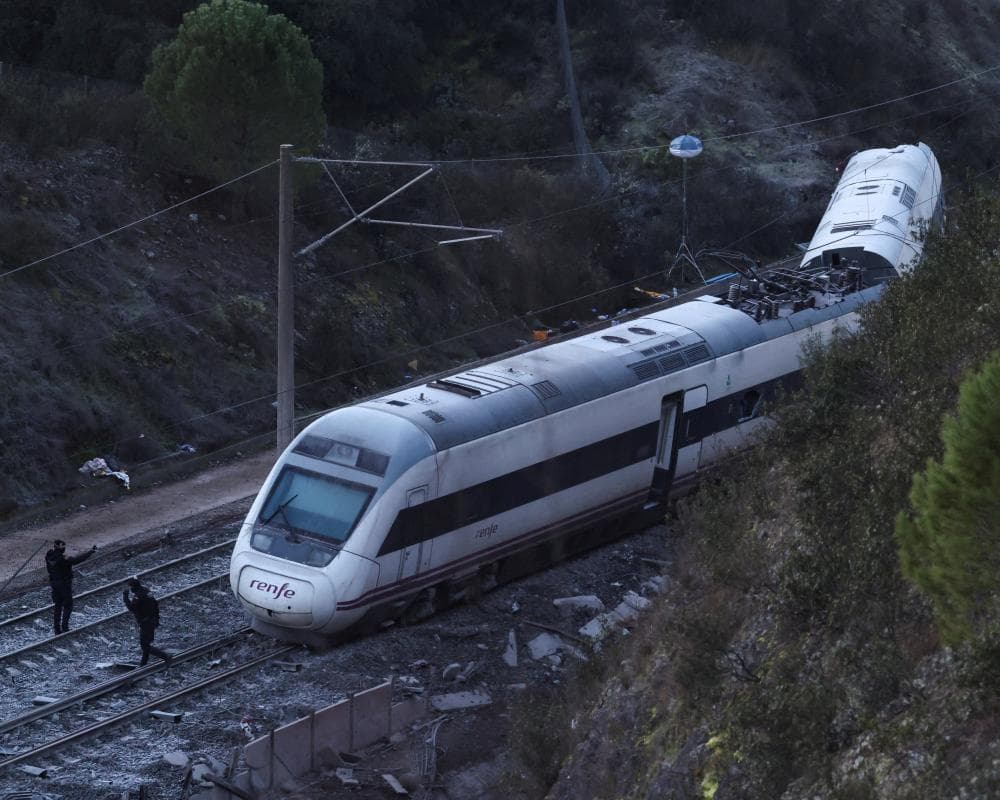
Here are some of the latest images being sent to us over the newswires as rescue efforts continue in the aftermath of the deadly train collision in southern Spain:
Updated
The municipal sports centre of Adamuz, in Córdoba, has been turned into an improvised field hospital, where the most minor injuries are reported to have been treated.
Here is a recap of what we know so far about the deadly train collision:
At least 39 people have been killed and 12 others are in intensive care after two trains collided in southern Spain on Sunday evening.
A high-speed Iryo train travelling from Málaga to Madrid derailed near the municipality of Adamuz in Córdoba province at about 7.40pm yesterday, crossing on to the other track where it hit an oncoming train, which was travelling south from Madrid to Huelva.
The impact of the crash pushed the carriages of the second train into an embankment, the Spanish transport minister, Oscar Puente, said, adding that most of those killed and injured had been in the first two carriages of the second train.
The first train to derail was “practically new”, making the accident “extremely strange”, Puente said.
The cause of the derailment has not yet been determined. Spain’s Railway Accident Investigation Commission is investigating the crash.
Rescue efforts to recover all the victims from the derailed carriages are continuing this morning with the death toll expected to increase.
On Monday morning, emergency services in Andalucía said 122 people had been treated for their injuries and 48 people were still in hospital, of whom 12 were in intensive care units.
Train services between Madrid and cities in Andalucía were cancelled on Monday.
Sunday’s crash was the deadliest train accident since 2013, when a train travelling at 111mph (179km/h) derailed on a stretch of track with a 50mph speed limit in the north-western region of Galicia, killing 80 people.
Updated
The European commissioner for equality, preparedness and crisis management, Hadja Lahbib, has said the commission’s emergency centre is in contact with Spanish authorities regarding the fatal train crash and is “ready to help with support” if requested.
Iryo, a private rail company that operated the journey from Málaga, has issued a statement on social media saying it “deeply regrets” what it describes as a “serious railway accident” yesterday.
At the start of the journey to Madrid last night, the company said there were these many people onboard:
289 passengers
4 crew members
1 driver
The statement added:
As indicated by the ministry of transport, this was an accident that occurred on a section of the line, and the train involved was newly built, manufactured in 2022, with the last inspection carried out on 15 January.
Iryo said its CEO, Fabrizio Favara, travelled to the site of the crash yesterday and is closely monitoring the situation. The company’s chair, Carlos Bertomeu, is travelling to the site too, it said.
Iryo said the “entire company” sends its condolences to the families of those who died and expresses its solidarity to those who were injured, wishing them a “speedy recovery”.
Updated
Sam Jones is Madrid correspondent for the Guardian
Spain’s transport minister, Óscar Puente, said the cause of the accident had yet to be established. Speaking at a press conference at Atocha station in Madrid, he added it was “really strange” that a derailment should have happened on a straight stretch of track. This section of track was renewed in May, he said.
Puente said most of those killed and injured had been in the first two carriages of the second train …
A journalist from the public broadcaster RNE, who was travelling on one of the trains, said the impact had felt like an earthquake. Passengers had used emergency hammers to break carriages windows and get out, he said.
A woman named Carmen posted on X that she had been onboard the Málaga to Madrid train. “Ten minutes after departing [from Córdoba], the train started to shake a lot, and it derailed from coach six behind us. The lights went out.”
You can read the full story here:
The Spanish prime minister, Pedro Sánchez, will visit the crash site later today.
Earlier, he wrote on X:
Tonight is a night of deep pain for our country due to the tragic railway accident in Adamuz. I want to express my most sincere condolences to the families and loved ones of the victims.
No words can alleviate such immense suffering, but I want them to know that the entire country stands with them in this extremely difficult moment. All emergency services are working in a coordinated manner without rest.
Updated
The death toll from the high-speed train crash in southern Spain is not final, the transport minister Oscar Puente said Monday, indicating it could rise from the current figure of 39.
“The death toll has already reached 39 and is not definitive. I want to express my deepest gratitude for the tremendous work of the rescue teams throughout the night, under very difficult circumstances,” he wrote on X.
Spanish police said Monday that at least 39 people died in the high-speed train collision Sunday in southern Spain and rescue efforts were continuing.
The collision occurred when the tail end of a high-speed Iryo train travelling between Málaga and Madrid with about 300 passengers went off the rails near the municipality of Adamuz in Córdoba province at 7:45pm local time (6.45pm GMT).
It slammed into a train coming from Madrid to Huelva operated by the state rail company, Renfe. This also derailed and went down an embankment, authorities said. It is not clear how many were on board.
Rescue efforts were still underway Monday morning. Andalusia regional President Juanma Moreno said 75 passengers had been taken to hospital.
Updated