Loading...
Please wait for a bit
Please wait for a bit
Click any word to translate
Original article by Jakub Krupa (now); Yohannes Lowe and Adam Fulton (earlier)
Macron ends his Q&A with a direct call to “not waste time with crazy ideas.”
“Let’s not open Pandora box or new topics.
And it’s not a time for new imperialism or new colonialism.
This is a time of cooperation in order to fix these three global challenges for our fellow citizens.”
Like, look, I know I said it earlier, but there’s absolutely no doubt in my mind that a substantial part of that is aimed at no one else but the US president, Donald Trump.
What a time to be alive.
Macron says his main message is to “not be shy” and “not be divided.”
“Let’s not accept a global order, which will be decided by those who claim to have them I would say is a bigger voice … but let’s just focus on common interests and common challenges.
We know what we have to fix: growth, peace, climate.”
In Q&A, Macron talks about the need to push ahead with Europe’s simplification agenda, as he also talks about other key issues, such as Ukraine.
But he also picks up on Trump’s threat of tariffs.
He says it “doesn’t make sense to have tariffs and be divided and even to threaten now with additional tariffs” among allies.
He says the idea the EU could deploy its anti-coercion instrument for the first time against its ally in the US is “crazy”.
“I do regret that, but this is a consequence of just unpredictability and useless aggressivity.”
Macron talks up the importance of Europe saying maybe it is “sometimes … too slow, for sure, and needs to be reformed, sure, but which is predictable, loyal and where you know that the rules of the game are just the rule of law” but it remains “a good place, for today and tomorrow.”
He says in order to “fix global imbalances” Europe needs to be “much stronger and more autonomous.”
He says:
“We do believe that we need more growth, we need more stability in this world.
But we do prefer respect [over] bullies … and we do prefer rule of law [over] brutality.
You’re welcome in Europe, and you are more than welcome to France.”
Erm.
Anyone in particular you’re targeting your words at, Emmanuel?
Updated
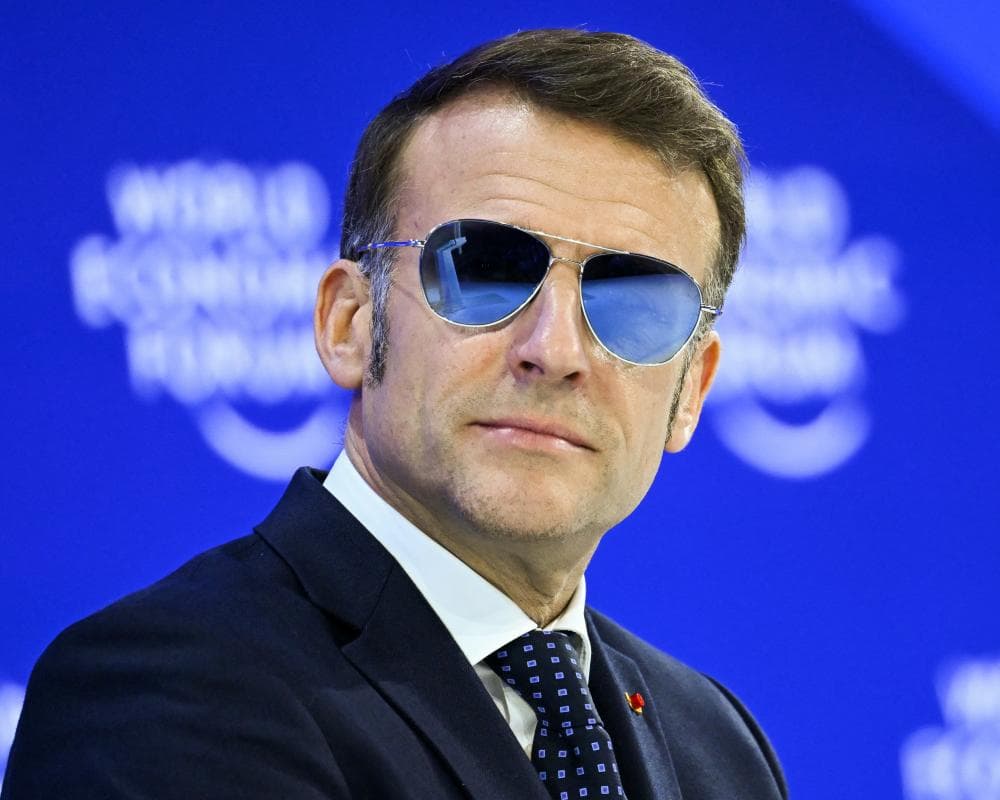
And, by the way, that’s Macron’s Davos shades look I mentioned earlier.
Macron goes into detail on his trade thinking as he responds to what the EU should do to respond to the US and Chinese more assertive policies.
He says Europe needs to be “more realistic” about how they respond this as there are sectors – he points to chemical and automotive – “that are being literally killed” by the lack of level playing field.
He also calls for the EU to “advance the principle of European preference” in the same way it works in the US.
But he says that doesn’t mean isolationism, but playing within the rules, as he says that for example Chinese foreign direct investment in Europe is welcome – but it needs to respect the same standards and rules.
He then turns to similar themes as in von der Leyen’s speech, talking about the need to cut red tape and simplify the regulations (11:20).
He says the 450 million EU inhabitants need to be open as the domestic market for all EU companies, reducing barriers and promoting innovation and competitiveness.
Just like von der Leyen, he also talks about the capital market union.
I’m sure my colleagues over on the business blog will have plenty to say on this.
Macron says the choice is to “passively accept the law of the strongest” that would lead to “vassalisation and block” politics and “new colonial approach,” which I’m sure you get by now that he rejects, or to defend “effective multilateralism” that serves our interest.
He says that national sovereignty and independence are both a key part of that and he says that the recent French deployment of military to Greenland was part of a move to defend that – not “threatening anyone, but supporting an ally and another European country.”
He says that through its presidency in G7, France will also want to revive G7 as the forum for “frank dialogue” to prevent trade wars, protectionist escalation and other attempts to disrupt global order.
“So our objective through the G7 is to demonstrate that the world’s major powers are still capable of reaching a shared diagnosis of the global economy,” he says.
France’s Macron warns that “multilateralism is weakened by powers that obstruct it or turned away from it,” and where “rules are undermined”.
He says it is “concerning” as “we are killing the structures where we can fix the situation” through talks and diplomacy.
He says that collective governance gives way to “relentless” competition, and says the US “demands maximum concessions and openly aim to weaken and subordinate Europe,” and criticises "accumulation of new territories.”
He also talks about China’s “massive excess capacities” and “distortive practices” that seek to “overwhelm” some sectors.
“The answer in order to fix this issue is more cooperation and building new approaches, and it’s clearly building more economic sovereignty and strategic economy, especially for the Europeans, which is, for me, the core answer,” he says.
Ouch.
Macron takes swipe at Trump in more or less the first paragraph of his speech.
As he warns about the instability and imbalances of today’s world, he says there were “more than 60 wars in 2024, an absolute record,” before adding “even if I understand that a few of them were fixed” to a muffled chuckle from the audience.
This will obviously be seen in context of Trump’s repeated bragging about how many wars he ended.
France’s Macron is speaking now.
You can watch along below, but I will bring you all the latest lines here.
And he is still sporting his shades as he addresses the room.
It’s a very hectic day in Europe as the continent scrambles to respond to the latest round of attacks, criticism and threats from the US president, Donald Trump, on his social media channels overnight.
Here is the latest:
European Commission president Ursula von der Leyen has warned business leaders to let go of “nostalgia” about the past pre-Trump world, telling them that it “will not bring back the old order,” and urging them to focus on building a more independent Europe instead (11:16, 11:56).
She repeatedly criticised Trump for his tariff threats against European allies (11:20), saying that would be “a mistake” (11:31) and could send the relations into “a downward spiral” benefiting geopolitical rivals (11:36) as she pledged her solidarity and support with Denmark and Greenland.]
Belgium’s outspoken prime minister Bart de Wever warned that “so many red lines are being crossed” with Trump that Europeans had to defend their self-respect by opposing his moves (13:14, 13:28), as he warned the US president could bury the postwar atlanticist world order.
De Wever said it could not be taken for granted that the US would continue to be an ally, as they “have to behave like an ally,” saying Trump’s actions only embolden the west’s rivals, including Putin’s Russia and Xi’s China (13:38).
In a particularly strong warning, he said that Europe needs to “wake up and rearm” for the new emerging world order, as it “cannot stay a herbivore” in a post-atlantic world (13:40).
Separately,
Von der Leyen also criticised Russia for continuing strikes on Ukraine (11:29), amid worsening situation on the ground (12:50) and scepticism about whether a peace deal can be agreed (13:08).
And it’s only 2pm local time in Davos, 1pm in London.
France’s Emmanuel Macron is speaking next. Stay tuned.
Meanwhile, the Danish prime minister, Mette Frederiksen, has been speaking in the Danish parliament.
She told lawmakers that Europe would have no choice but to respond if a trade war started, following Trump’s tariffs threat on countries opposing his plans to take over Greenland, AFP reported.
“As Europe, if anyone starts a trade war against us – which I really cannot recommend – we must of course respond. We are compelled to do so,” she said.
She added that “we have never sought any conflicts.”
Note: no Danish officials are involved in Davos this year.
Officials explanations vary, but it’s impossible not to link it with what’s going on with Trump and Greenland.
Updated
Ooof.
Lots to digest there. I will post a summary for you shortly.
But France’s Emmanuel Macron is up next very soon, with his keynote address in the main hall.
As during his public appearances last week, he is sporting dark glasses to hide a ruptured blood vessel in his eye, a condition which the Élysée Palace said should not be a source of any worry.
Or he just really liked the pretty cool look.
Back to Russia and Belarus, Belgium’s De Wever says negotiating with Putin is “not a very good idea,” because Europe doesn’t always have the hard power to back up its words and it needs to quickly change that.
He says the EU’s enlargement is important, as “it’s in Europe that … people want to join the European Union,” whereas “nobody wants to join China, … no neighbour of the US says we want to join the US.”
But he says that “at the moment, when we need deep integration to get the big [geopolitical] stick, enlargement debate is contradictory to that,” unless the EU chooses to integrate at two levels, at different speeds.
Ukraine’s Plenković says Ukraine has lots to give to Europe, particularly when it comes to security and defence. “Basically, Ukrainian military today is the only one that has been in such a test of war and defence that nobody else has done that on such a large scale,” he says.
Lithuania’s Nausėda says he is in favour of “setting a very clear date” for Ukraine to join the EU, not as a legally binding declaration, but a political ambition, and he will keep pushing for it.
Croatia’s Plenković is now talking about the prospects of the EU enlargement, as he talks about the importance of the western Balkan countries, the south-east Europe region, and – obviously – Ukraine.
He says until know, enlargement was about meeting technical criteria, but now it may be more about “geopolitical approach” – but still the details and the impact of any such enlargement needs to be properly scrutinised.
In further explosive comments, Belgium’s De Wever says:
“If the atlanticism really dies, I hope not, but if it dies, globalisation will die with it. That’s very clear. And we cannot stay a herbivore in that world.”
He says Europe needs to “wake up and rearm” to respond to the “structural shift” in the US, and Europe “has become totally dependent on technology that we do not own and control.”
He says:
“We were a little bit naive, and it’s time to wake up.
We need our own technological platforms to build the prosperity of tomorrow.
If not, Trump can do with us … he can make us slaves, because we actually are slaves then, and we will have to take for granted whatever he does.
We’ve been accustomed to very nice presidents like Obama, and we haven’t noticed that the shift in America is not bound to one presidency.
It’s a structural shift. The face of America has turned to the Pacific. Their backside is turned to the Atlantic, and that will not change after Trump.”
Belgium’s Bart De Wever doubles down on his criticism of the US.
Asked if we can take it for granted that the US is an ally of Europe, he says “unfortunately, not”.
“I would like to confirm that they are an ally, but then they have to behave like an ally.”
He also says that during a recent meeting of the Coalition of the Willing, the US representatives said they didn’t want to take sides on the Russia-Ukraine war.
“I found this very shocking, because I grew up in the 1980s when the west stood for something: for the sovereignty of the people, for democracy, for freedom.
The idea that in a conflict between a tyrant and a democracy, the United States will say, well, we’re not going to take sides, in a gathering of the Coalition of the Willing pro Ukraine, of democratic allied countries saying we’re coming here together, because one of us is threatened by Russian aggression, we have to support him …
Putin sees this is. This is his strength, our division.”
He says:
“If he follows the news and sees [that] now a Nato country is threatening another Nato country with military invasion, it will not discourage him to continue his war on Ukraine [and] it will certainly not discourage the Chinese to choose for an imperialistic agenda.”
Lithuania’s Nausėda picks up on Russia again, as he says that the state of the Russian economy is worsening, and the EU should put additional pressure on Moscow – as well as Belarus, which continues hybrid attacks on EU neighbours.
He says Europe should take more responsibility for its own defence.
He repeats his warning that Russia will continue to be aggressive and pose threat to Europe even in the unlikely case it agrees a deal on Ukraine.
By the way, turns out De Wever also offered some similarly hardline rhetoric on Trump in his comments to Belgian media earlier today.
Speaking on the sidelines of the main event earlier today, he said:
“We as Europe must tell Trump: this far and no further. ‘Back down,’ or we’ll go ‘all the way,” VRT news reported.
He said Trump had a point on defence spending so his previous frustration with Nato allies was understandable, but “threatening Nato allies with military intervention on Nato territory is so unprecedented that you are really approaching a breaking point.”
He added that any trade war with the US would be “catastrophic,” but “equally” for both sides of the Atlantic.
Curiously, Croatia’s Plenković also says that “many of us will be hearding to Kyiv on the 24 February to extend further support” for Ukraine on the fourth anniversary of the full-scale Russian invasion of Ukraine.
Not sure his security detail will be very pleased with him saying that out loud: these sort of things usually remain in secret for as long as possible.
More broadly, he says “I think the only safe way for the European Union to remain an actor is to try to be as united as possible.”
He says this week’s EU summit on Thursday will be about supporting Denmark.
But he also strikes a cautiously optimistic tone on the US, saying that “despite all the, let’s say, noise in the communications channel” – he means Trump’s social media – “the US is an ally and a friend” and that’s what matters.
De Wever also goes back to last month’s discussion on the EU’s funding for Ukraine.
He says that the EU eventually reached the right decision, but says “the way in which we did it, the discussions we had, maybe are not an example of the best governance you can imagine.”
He says Europe “learned the lesson the hard way” about previous mistakes and illussions catching up with it after years.
On seizing Russian assets, he says:
“There’s nothing like the Alibaba cave that opens and you can simply take the gold and get away with it. That was an illusion that existed for a few months at the European table, but I think we managed to put an end to it for the moment.”
Croatia’s Plenković picks up on this, saying that whatever the process, the outcome was good – and that’s what matters.
“Bart has managed to convince the majority of us that his arguments were fine,” he says.
Belgium’s Bart De Wever is up next, as he gets asked about the relations with the US and Trump’s behaviour.
He doesn’t mince his words at all.
He says that “Europe is at a crossroads” and it has to decide what it’s policy will be.
He continues:
“Until now, we tried to appease the new president in the White House. We were very lenient, also with the tariffs. We were lenient hoping to get his support for the Ukraine war. … But now so many red lines are being crossed that you have the choice between your self-respect. Being a happy vassal is one thing. Being a miserable slave is something else.
If you back down now you’re going to lose your dignity. And that’s probably the most precious thing you can have in a democracy.”
He says he will meet with Trump on Wednesday, accompanied by the Belgian monarch Philippe.
“But it will have a different character than we had planned.
It will probably be the message that we have to send: you’re crossing red lines here.
We either stand together or we will stand divided, and if we are divided, there is the end of an era, of 80 years of atlanticism, really drawing to a close.
And you know, as Gramsci said, ‘if the old is dying and the new is not yet born, you live in a time of monsters,’ and it’s up to him to decide if he wants to be a monster – yes or no.”
Ooooooof.
Updated
The European panel now gets under way.
In opening exchange, Lithuania’s president Gitanas Nausėda gets asked about the prospects of securing a peace settlement for Ukraine.
He says he is and will remain “on the sceptical side,” saying simply it’s because he – and Lithuania – “know Russia very well.”
He says that as Ukraine talks the language of diplomacy, the Russians continue stocking missiles, so “it’s probably too early to conclude that Russians are ready to take this plan and start to negotiate.”
He says Moscow “wants to buy more time to attack Ukraine,” making ordinary people’s lives – as covered below – “impossible, even in the capital.”
Nausėda stresses Russia’s maximalist territorial demands, and he says he has no doubt that “Russia will refuse” to drop its imperialist ambitions.
“Even the change of Kremlin’s regime probably will not mean the radical changes in the policy of Russia, because, from time to time, I hear what the Russian opposition leaders are talking about, actually, they are presenting the same ideas. And those ideas are, first of all, [about] the expansionist policy of Russia,” he warns.
The backdrop to all these conversations in Davos is not just what’s happening in Greenland, but, as von der Leyen also mentioned, also the continuing and worsening situation in Ukraine.
AFP is reporting that an overnight Russian bombardment left thousands of residential buildings in Kyiv without heating and water in -14C temperatures, when the Ukrainian capital was already scrambling to restore vital utilities destroyed in earlier attacks.
“After this attack, 5,635 residential buildings are without heating,” Kyiv mayor Vitali Klitschko said on Telegram – about half the capital’s apartment blocks.
Much of Kyiv was also without running water, he added.
As a result, Ukraine’s president Volodymyr Zelenskyy suggested he would skip the ongoing World Economic Forum in Switzerland to deal with the aftermath of the strike.
But he kept open the possibility of going to the gathering of world leaders in the Swiss resort of Davos if agreements with the United States on possible postwar economic and security support were ready to be signed.
Updated
We will hear from more European leaders in Davos today.
Belgium’s prime minister Bart De Wever, of the Russia frozen assets fame, will appear alongside Croatia’s prime minister Andrej Plenković and Lithuania’s president Gitanas Nausėda on a panel at 1pm local (midday UK).
And Emmanuel Macron, the French president “nobody wants” in their club according to Trump (9:49), is due to deliver his address at 2pm (1pm UK). You could reasonably expect some fireworks there, as he will be no doubt unhappy with Trump’s comments overnight.
Separately, the EU’s foreign policy chief Kaja Kallas will speak on Greenland at the European parliament’s Strasbourg plenary at 1pm local (midday UK), too.
We won’t be short of news lines.
Obviously, I will bring you all of them here.
Updated
A fairly straightforward message from EU’s von der Leyen: in this crazy world we live in, the EU is well positioned and ready to reform as needed to respond to the “geopolitical shocks” of Trump, Russia and China, with no return to the world as it used to be (11:16).
She advanced a positive vision of how the EU could and should change to make the most of its potential and assert itself as a global power in its own right, reducing dependencies where they carry unacceptable risks, and leveraging new emerging relationship with others.
In this vein, she repeatedly took aim at Trump for his threats, stressing the EU’s commitment to “free trade over tariffs” – including with new partners globally, be it Mercosur or India – and wilingness to push for more (11:20).
(What she didn’t say, perhaps understandably, is that some of these trade mores are very much controversial and could become a real political problem down the line.)
But she also spoke about the EU’s own reformist agenda, with hints of frustration over the national bureaucracy and red tape, and the need to make it easier to invest and run business (11:25).
These lines will no doubt be popular with the Davos audience, and the sentiment behind them is shared by a growing number of EU leaders talking about the need to deregulate and simplify things after years of what some of them see as overregulation.
(Another thing she didn’t mention is the EU’s own very real political risks arising from the rise of the far-right, which could take control of some key EU capitals in the coming years, posing a clear risk to businesses thinking about expanding in the bloc. But, quite understandably, that’s not the time or place for it.)
On foreign policy, she reiterated the EU’s key lines on Ukraine, but it’s not entirely clear what’s the path forward here as the peace process – note her name-checking Trump with credit – appears to be stuck. Her declaration that the EU will be there for Ukraine for as long as it’s needed is important, but some big questions remain unanswered there.
Finally, she delivered a strong rebuke to Trump on Greenland: even as she diplomatically said she shared his security assessments, she made it very clear that threatening Denmark or Greenland is not the way forward and “the sovereignty and integrity of their territory is non negotiable.”
She called Trump’s tariff threats “a mistake” (11:31) and pointedly warned about “plunging us into a downward spiral would only aid the very adversaries we are both so committed to keeping out of the strategic landscape” (11:36). These are strong lines, but they won’t make her any more popular with Trump.
Her pledge to work on “a massive European investment surge in Greenland” is also interesting, but let’s see what it actually means. Also, there is a risk of Trump seeing that as an offensive move amid his interest in the territory.
Well, he will no doubt let us know what he made of this soon in another social media post soon.
In tougher language then perhaps before, von der Leyen says that tariffs risked “plunging us into a downward spiral would only aid the very adversaries we are both so committed to keeping out of the strategic landscape.”
She says Europe’s response will be “unflinching, united and proportional.”
She stresses “full solidarity with Greenland and the Kingdom of Denmark,” stressing “the sovereignty and integrity of their territory is non negotiable.”
She says the EU is working on “a massive European investment surge in Greenland.”
(Trump won’t like that.)
But she says Europe will work with the US and all other partners – names the UK, Canada, Norway, Iceland – on wider Arctic security.
She says:
“Finally, I believe Europe needs to adjust to the new security architecture and realities that we are now facing.
And this is why Europe is preparing its own security strategy, which we plan to publish later this year. As part of this, we are upgrading our Arctic strategy.
And at the heart of this will be the fundamental principle: it is for sovereign people to decide their own future.”
She ends by saying that security in the High North “was not the main theme” when she started working on this speech, but it shows how much can change in a short period of time – and why Europe needs to push for its independence to be able to respond accordingly.
She ends:
“The point is that the world has changed permanently. We need to change with it.”
Updated
Von der Leyen now turns to Greenland.
She says that “when it comes to the security of the Arctic region, Europe is fully committed,” and it shares the US focus on securing the region.
But she pointedly says that the bloc has the capabilities required, and the security “can only be achieved together.”
She then criticises Trump directly:
This is why the proposed additional tariffs are a mistake especially between longstanding allies. The EU and US have agreed to a trade deal last July. And in politics as in business – a deal is a deal. And when friends shake hands, it must mean something.
Updated
Von der Leyen says Europe “needs an urgency mindset” to face the challenges it’s facing, in all areas: from energy to AI and defence. She says the EU has done more on defence “in the last years than in decades before.”
She needs “this need for ambition is most important when it comes to the security of our continent.”
She turns to Ukraine, and criticises Russia for continuing attacks on Ukraine, as she says Moscow shows “no sign of abating, … remorse, … seeking peace.”
“On the contrary: Russia is intensifying its attacks, killing civilians every day. Just last week, its bombing of Ukraine’s energy infrastructure left millions facing darkness, cold, and water shortages. This must end.”
She says we “all want peace for Ukraine,” and she recognises Trump’s “role in pushing the peace process forward.”
She says the EU’s recent decisions on funding Ukraine “reaffirm Europe’s unwavering commitment to the security, the defence and the European future of Ukraine.”
She says Europe “will always stand with Ukraine until there is a just and lasting peace.”
EU’s von der Leyen is now going through main points on her reformist agenda in the EU, talking about the need to attract investment and tighten the EU single market.
One proposal is to create “a new truly European company structure” – called “EU Inc” – with “a single and simple set of rules that will apply seamlessly all over the union,” and one that can be registered online within 48 hours.
(I can think of some questions about how this would work in practice, though.)
She says:
“Ultimately, we need a system where companies can do business and raise financing seamlessly across Europe – just as easily as in uniform markets like the US or China.
If we get this right – and if we move fast enough – this will not only help EU companies grow. But it will attract investment from across the world.”
She also talks about a number of more technical issues: on investment and capital, energy market, and resilience.
I’m sure my colleagues over on the business blog will look at some of these things in more detail:
Von der Leyen is continuing with her speech.
She says “this new Europe is already emerging,” pointing to the recent signing of the EU-Mercosur trade agreement, completed after a quarter of a century of negotiations, which created the largest free trade zone in the world.
“This agreement sends a powerful message to the world that we are choosing fair trade over tariffs, partnership over isolation, sustainability over exploitation. And that we are serious about de-risking our economies and diversifying our supply chains,” she says in what reads as a thinly veiled swipe at Trump after his most recent tariff threats.
Von der Leyen says the EU is also advancing talks with other markets, including India, which she claims “some call … the mother of all deals” (huh?), which would create a free market of two billion people.
“From Latin America to the Indo Pacific and far beyond, Europe will always choose the world. And the world is ready to choose Europe,” she says.
European Commission president Ursula von der Leyen has warned business leaders to let go of “nostalgia” about the past, telling them that it “will not bring back the old order,” and urging them to focus on building a more independent Europe instead.
Opening her speech in Davos, said the EU had to use the “geopolitical shocks” – that’s this week’s polite codeword for Trump, as well as the rise of assertive China and Russia – to “build a new form of European independence.”
She insisted the EU “acted immediately” to respond to the new challenge, and “whether on energy or raw materials, defence or digital – we are moving fast.”
In a particularly striking passage, she said:
“But the truth is also that we will only be able to capitalise on this opportunity if we recognise that this change is permanent.
Of course, nostalgia is part of the human story.
But nostalgia will not bring back the old order. And playing for time – and hoping for things to revert soon – will not fix the structural dependencies we have.
So my point is: If this change is permanent, then Europe must change permanently too. It is time to seize this opportunity and build a new independent Europe.”
European Commission president Ursula von der Leyen is about to take the stage at Davos to speak about Europe’s take on the latest events.
I will bring you the key lines here.
You can watch along here:
Russian foreign minister Sergei Lavrov claimed that Greenland was not “a natural part” of Denmark in comments that could further fuel the increasingly contentious debate about the territory’s future.
At a conference in Russia, Lavrov spoke of “crisis tendencies” within the west, with Greenland the latest example of that, as it’s causing unprecedented tensions even within Nato.
He said Russia was monitoring the “serious geopolitical situation” around Greenland.
While he insisted that Russia was not interested in interfering in Greenland affairs and that Washington knows that Russia has no plans to capture Greenland, he said that in his view Greenland was not a natural part of Denmark, Reuters reported.
Speaking more broadly, Lavrov also warned that it was “unlikely” that Russia could strike agreements with the current group of leaders in Europe.
Here is a bit more on Bessent’s comments that I mentioned in the opening post (9:49), from my colleagues, Graeme Wearden in Davos and Julia Kollewe.
The US treasury secretary, Scott Bessent, has urged European countries not to retaliate against the US’s trade tariffs announced over the Greenland crisis.
Speaking in Davos, during the World Economic Forum, Bessent said countries and companies should pause and “let things play out” after Trump threatened a 25% tariff on a slew of European countries in his pursuit of the autonomous Danish territory.
As global stock markets fell amid political uncertainty, Bessent indicated that retaliatory tariffs would be unwise, citing last year’s tit-for-tat tariff war that broke out between the US and China.
Last April, Trump’s “liberation day” tariff announcement caused turmoil in global stock markets before some countries agree trade deals and markets recovered to reach record highs later in the year, fuelled in part by the AI boom.
Bessent told a press conference at the annual meeting of global leaders: “I would say this is the same kind of hysteria that we heard on 2 April. There was a panic.”
Bessent said: “What I am urging everyone here to do is sit back, take a deep breath, and let things play out. The worst thing countries can do is escalate against the United States.
“What President Trump is threatening on Greenland is very different than the other trade deals. So I would urge all countries to stick with their trade deals. We have agreed on them, and it does provide great certainty.”
Bessent said he did not believe that European countries will retaliate against the US over the Greenland crisis by selling their holdings of America’s debt.
Bessent claimed that predictions that Europe could stop lending to the US, and dump its holdings of US treasuries, was a “false narrative” that defied logic.
Bessent accused the media of having “latched on” to a report from Deutsche Bank on the issue, and of being “hysterical”.
“I think it is a completely false narrative. It defies any logic, and I could not disagree more strongly,” he added.
The UK has now responded to Trump’s fierce criticism of the Chagos deal – a significant departure from the previous US backing for the agreement – defending it as critical for UK’s national security.
It said “we acted because the base on Diego Garcia was under threat after court decisions undermined our position and would have prevented it operating as intended in future”.
The government’s statement also pointedly reminded everyone that the deal “has been publicly welcomed by the US”.
Andrew Sparrow has more on this – including other domestic reactions from Nigel Farage and Kemi Badenoch - over on the UK blog.
Updated
And Davos looks like the place to be this week, with Trump now declaring that after his call with Nato’s Rutte he will have “a meeting of the various parties” on Greenland – whatever that means and whoever is going to be involved.
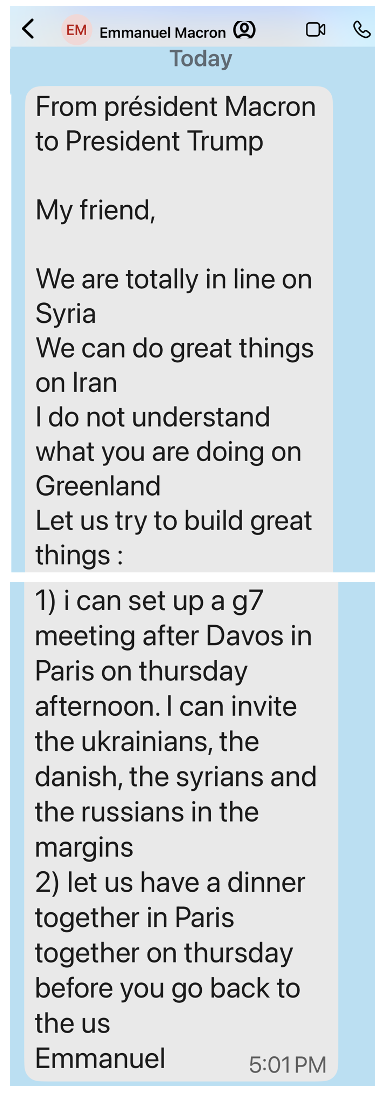
Separately, it’s not clear if Macron’s offer of setting up a G7 meeting on the sidelines was accepted (although looking at timings it would risk clashing with the emergency EU summit on Thursday night), but his separate invitation to a dinner at the Élysée Palace might be gone after Trump’s very pointed and personal criticism of the French president.
Or at least it would make it a very awkward dinner.
Updated
It seems like the US president, Donald Trump, has had a busy evening US time with his phone in his hand.
Overnight, he:
Attacked the UK, mockingly calling it a “brilliant” ally, for “shocking” plan to hand over sovereignity of the Chagos islands to Mauritius (despite previous US support), saying it’s among a “long line” of reasons why Greenland “has to be acquired”
Leaked private text messages from France’s Emmanuel Macron and Nato’s Mark Rutte discussing his latest policy moves
Threatened France with 200% tariffs on French wine and champagne over Macron’s refusal to join the Gaza “board of peace”, said of Macron that “nobody wants him because he’s going to be out of office very soon”
Reiterated his intention of taking over Greenland as “imperative for national and world security,” saying “there can be no going back”
Posted an AI generated visual of himself planting the US flag on Greenland, saying it’s “US territory, est. 2026,” days after the US delegation agreed with Danish foreign minister for talks to be conducted behind closed doors, and not through threatening messages on social media.
It’s not even 10am in Europe.
On top of that, his treasury secretary Scott Bessent appeared to taunt the Europeans in Davos, saying they will “form the dreaded European working group first, which seems to be their most forceful weapon” before they can retaliate on trade (£), as he warned them against any moves aimed at the US administration.
As the World Economic Forum gets under way in Davos, we are going to hear from two senior EU politicians as they give us their first reactions to what’s going on.
European Commission president Ursula von der Leyen is due to speak at 10:50am CET (9:50 UK) and France’s Emmanuel Macron is on later at 2pm (1pm UK).
Meanwhile, EU foreign policy chief Kaja Kallas is also expected to address the European Parliament in Strasbourg on Greenland at 1pm CET (midday UK).
It’s going to be a busy day, again.
I will bring you all the latest updates here.
It’s Tuesday, 20 January 2026, it’s Jakub Krupa here, and this is Europe Live.
Good morning.
Updated
This is Yohannes Lowe here. I am handing the blog over now to my brilliant colleague Jakub Krupa who will bring you the latest lines out of Europe over the course of the day.
Donald Trump’s very public assertion that the UK’s Chagos Island agreement was “an act of great stupidity” will seriously embarrass the British prime minister, Keir Starmer, who has tried to placate the president for favourable trading terms and to keep Washington on side as it is so integral (some would say dangerously so) to the UK’s national security and defence.
Yesterday, Starmer played down the prospect of retaliatory tariffs on the US, after Trump threatened to impose fresh levies against Nato allies if a deal over Greenland is not secured.
During a hastily arranged news conference held on Monday, Starmer said a “trade war is in no one’s interest” and said “alliances endure because they’re built on respect and partnership, not pressure”.
In a rare, direct rebuke to Trump, Starmer also said that applying “tariffs on allies for pursuing the collective security of Nato allies is wrong”.
The British prime minister said he urged Trump to find a solution “rooted in partnership, facts and mutual respect” in a phone call over the weekend.
Trump, emboldened by the recent capture of the former Venezuelan president, Nicolás Maduro, in an operation which is widely seen as having broken international law, has intensified his rhetoric over Greenland, a largely self-governing part of Nato ally Denmark, which the president says the US will take “one way or the other”.
The eight European countries targeted by Trump’s tariffs (Denmark, Finland, France, Germany, the Netherlands, Norway, Sweden and the UK) warned of a “dangerous downward spiral” and said they “stand in full solidarity” with Denmark and Greenland against the threats of annexation.
Updated
Reform UK, led by Nigel Farage, has previously vowed to overturn the Chagos Islands agreement, claiming the deal was fuelled by a feeling of “postcolonial guilt” in a government “run by human rights lawyers”.
In a post to X this morning, Farage, who has a close relationship with Donald Trump, said: “Thank goodness Trump has vetoed the surrender of the Chagos islands.”
Updated
In May 2025, the UK signed an agreement to cede sovereignty over the Chagos Islands to Mauritius, but lease the largest one, Diego Garcia, for 99 years to continue operating a joint US-UK military base there.
The agreement followed lengthy negotiations started under the previous Conservative government after a 2019 advisory opinion by the International Court of Justice said the UK should cede control.
As well as establishing a £40m fund for Chagossians expelled from the islands, the UK has agreed to pay Mauritius at least £120m annually during the 99-year agreement, a total cost in cash terms of at least £13bn.
The Conservatives framed the deal as “an act of national self-harm”, which the party claimed left Britain more vulnerable to China because of its links with Mauritius.
The UK’s prime minister, Keir Starmer, vigorously defended the agreement at the time, saying there was “no alternative” to the deal as it was “part and parcel of using Britain’s reach to keep us safe at home” and hailed it as “one of the most significant contributions that we make to our security relationship with the United States”.
The UK bought the Chagos Islands for £3m in 1968 and forcibly displaced up to 2,000 people – to make way for the UK-US armed forces base – in what is widely seen as a crime against humanity and a shameful example of postwar colonialism.
The 2025 agreement is yet to be ratified by the UK government and has not been implemented into domestic law.
Updated
The US president, Donald Trump, has suggested Britain’s decision to cede the Chagos Islands to Mauritius is among the reasons he wants to take over Greenland.
In a Truth Social post, he said the UK’s plan to hand over sovereignty of the Chagos Islands to Mauritius is an “an act of GREAT STUPIDITY”. He said:
Shockingly, our “brilliant” NATO Ally, the United Kingdom, is currently planning to give away the Island of Diego Garcia, the site of a vital U.S. Military Base, to Mauritius, and to do so FOR NO REASON WHATSOEVER.
There is no doubt that China and Russia have noticed this act of total weakness. These are International Powers who only recognize STRENGTH, which is why the United States of America, under my leadership, is now, after only one year, respected like never before.
The UK giving away extremely important land is an act of GREAT STUPIDITY, and is another in a very long line of National Security reasons why Greenland has to be acquired.
Denmark and its European Allies have to DO THE RIGHT THING. Thank you for your attention to this matter. PRESIDENT DONALD J. TRUMP.
Trump’s comments mark a major reversal from his position when the UK signed the deal last May. At the time, Starmer said: “President Trump has welcomed the deal along with other allies, because they see the strategic importance of this base and that we cannot cede the ground to others who would seek to do us harm.” The US secretary of state, Marco Rubio, also praised the deal, saying it reflected “the enduring strength of the US-UK relationship”.
Updated
The text message from Emmanuel Macron that Donald Trump shared on his Truth Social platform as a screenshot was authentic, a source close to the French president said on Tuesday morning.
“It demonstrates that the French president defends the same line in public as in private,” the source said, quoted by Reuters.
Macron told Trump that he could set up a meeting after Davos in Paris on Thursday afternoon, the message showed.
Trump’s reply, if any, was not part of the screenshot.
Updated
Donald Trump has said he had a “very good” telephone call with Nato secretary general Mark Rutte concerning Greenland.
The US president also said he had agreed to a meeting of various parties in Davos at the World Economic Forum (WEF), while not specifying who the parties were, Reuters reports.
“As I expressed to everyone, very plainly, Greenland is imperative for National and World Security,” Trump said in a post on Truth Social on Tuesday.
There can be no going back - On that, everyone agrees!
Trump had earlier told reporters the US would talk about acquiring Greenland at the WEF because Denmark could not protect the territory.
Updated
Welcome to our European live coverage.
In the build-up to Donald Trump’s expected appearance at the World Economic Forum in Davos on Wednesday, the US president has reiterated his threats to take Greenland, suggesting Europe wouldn’t “push back too much”.
He also threatened 200% tariffs on French wine and champagne to get Emmanuel Macron to join his Gaza “board of peace”.
Trump is expected to meet global business leaders in Davos on Wednesday, Reuters has reported, as his presence looms large over the annual gathering of the global elite in the Swiss resort.
Business leaders – including CEOs in financial services, crypto and consulting – were invited to a reception after Trump’s special address to the forum, the news agency said, citing sources.
In key developments:
Trump said of European leaders over his attempt to buy Greenland: “I don’t think they’re gonna push back too much. We have to have it. They have to have this done.”
Trump, who is expected to arrive in Davos on Wednesday, has posted an image on his Truth Social platform of what he says is a “note from President Emmanuel Macon” in which it appears Macron says: “I do not understand what you are doing on Greenland.” Macron also says “let us try to build great things” and that he can set up a G7 meeting in Paris on Thursday, also proposing a dinner with Trump that day.
China is being represented in Davos by vice-premier He Lifeng, who is due to deliver an address on Tuesday.
Tuesday’s program at the World Economic Forum also includes addresses from Macron, European Commission president Ursula von der Leyen, Ukrainian president Volodymyr Zelenskyy and Canadian prime minister Mark Carney.
Updated