Loading...
Please wait for a bit
Please wait for a bit
Click any word to translate
Original article by Jakub Krupa
If you are still planning your summer holidays and looking at some of perhaps more original ways of spending your time crossing Europe, you now have a new option in a train between Prague and Copenhagen via Berlin and Hamburg.
The Czech operator, České dráhy, has been somewhat excitedly posting about the latest addition to the growing network of cross-European trains as more passengers turn towards environmentally friendly and picturesque alternatives to flying.
The trip takes almost 13 hours, but this time should go down a bit as the available infrastructure along the route improves in the next few months.
The Prague train, which left at 6:31 this morning, is currently in Hamburg, en route to the Danish capital. You can follow it here.
Angela Giuffrida in Rome and Jon Henley
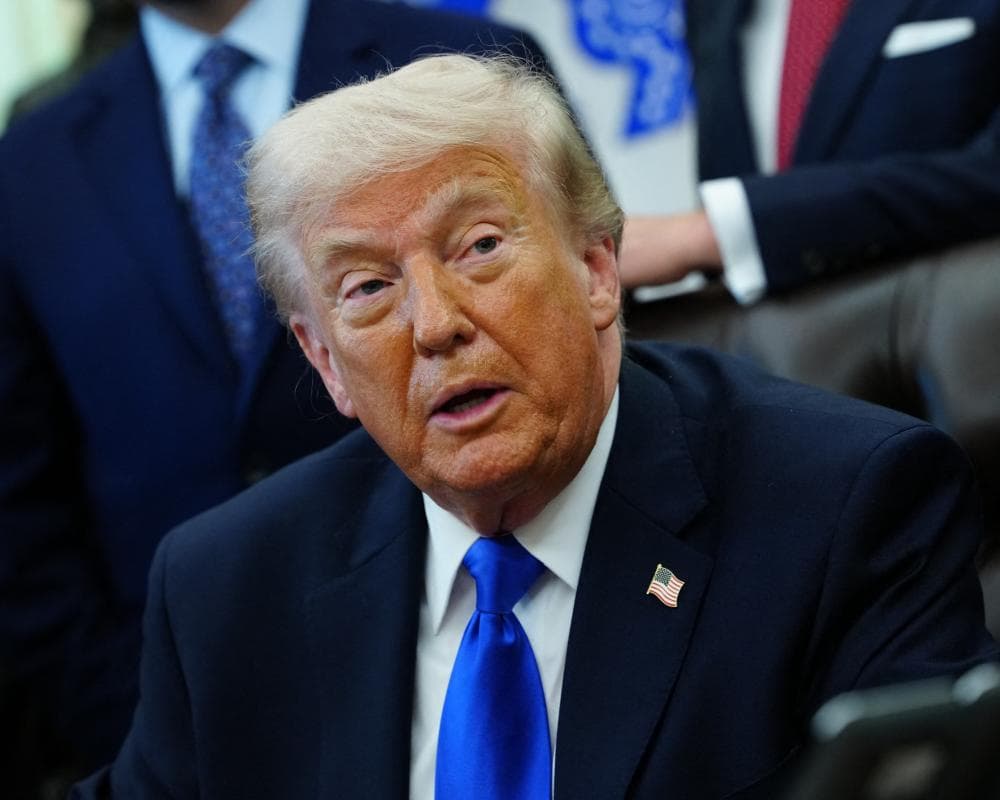
Donald Trump has threatened to withdraw US troops from Italy and Spain a day after saying he was looking at reducing the number deployed in Germany.
The US president’s threat to Germany came after the country’s chancellor, Friedrich Merz, said America was being “humiliated” by Iran.
Trump has severely criticised Nato allies for not sending their navies to help to open the strait of Hormuz, a crucial commercial shipping corridor.
Spain’s prime minister, Pedro Sánchez, has spoken out against the US-Israeli war on Iran from the start, and Rome had played a balancing act until late March, when it refused the use of an airbase in Sicily to US planes carrying weapons for Iran.
In more serious news, the European Union’s mammoth trade deal with South American bloc Mercosur provisionally enters into force today, despite a pending court ruling on its legality, AFP noted.
The agreement to create one of the world’s biggest free-trade zones was sealed in January after more than 25 years of intermittent negotiations. Together, the EU and Mercosur account for 30 percent of global GDP and more than 700 million consumers.
But the agreement has, as AFP puts it, “proven divisive” in Europe, or, more accurately, it led to major protests in several EU countries in recent months.
The application of the deal comes after the European parliament referred it to the EU’s top court in January, instead of giving it the green light, AFP noted.
But the European Commission’s president, Ursula von der Leyen, welcomed the deal today, saying it will “show the agreement’s tangibler benefits,” and insisting that “legitimate” sensitivities in the EU had been addressed.
In another “it’s an extended weekend everywhere but not in the UK” development, we have this crazy story about a missing Oscar statutette.
The statuette belonging to Pavel Talankin, star and co-director of the Academy award-winning documentary Mr Nobody Against Putin, has disappeared after officials at New York’s John F Kennedy airport confiscated it before he boarded a flight, claiming it could be used as a weapon.
“It’s completely baffling how they consider an Oscar a weapon,” Talankin told the outlet after landing in Frankfurt, Germany, without the Oscar. On previous flights through numerous airlines, he said, “[I] flew with it in the cabin and there never was any kind of problem.”
(I love how he’s just casually flying with it around the world.)
Responding to an Instagram post about the statuette’s disappearance, Lufthansa said it “will do everything we can to find the Oscar as fast as possible and have already escalated this.”
But then, in a perfectly timed development, asked by Reuters for an update, the airline “did not immediately respond to a request for further comment on Friday, which is a public holiday in Germany.”
Updated
Today also marks the 22nd anniversary of the European Union’s “big bang” enlargement eastwards, with 10 countries joining the bloc: Cyprus, the Czech Republic, Estonia, Hungary, Latvia, Lithuania, Malta, Poland, Slovakia, and Slovenia.
At the time, the Guardian reported that “leaders of ‘old’ and ‘new’ Europe embraced in ceremonies and parties along their shared and once barbed borders, ushering in a new era.”
Guardian writers Ian Black and Patrick Wintour said at the time:
“Today will provide one of those moments when Europe looks like a glacier moving slowly but with enormous power over a long period and then suddenly it shifts and the landscape changes forever.”
Several EU leaders from these countries are celebrating the anniversary today, including Poland’s prime minister, Donald Tusk, and Czech Republic’s president, Petr Pavel.
“Already then, we knew it was a good decision. 22 years of pride!,” Tusk said, posting a video clip showing the scenes from 2004.
Czech Republic’s Pavel said:
“Twenty-two years ago, we joined the European Union and thereby strengthened our security and stability. The world has changed significantly since then, and the importance of cooperation with European partners is growing. The Union is not perfect, but in difficult times, we can only stand together.”
Lithuania’s prime minister Inga Ruginienė said:
“Today we mark the 22nd anniversary of Lithuania’s EU membership – built on unity and shared values. In times of war right next to the EU borders and rising tensions, our unity is our strength. We must stand firm: supporting Ukraine, strengthening defence, and countering hybrid threats. A stronger Europe depends on all of us.”
And Latvia’s Edgars Rinkēvičs also joined in celebrations, saying:
“22 years ago, [Latvia] joined [the EU]. The European dream is well alive. We must resist Russian aggression, support Ukraine, Moldova and the Western Balkans on their path to EU membership, and keep democracy and the rule of law at the heart of our union.”
It’s a fairly slow news day today, as half of Europe is enjoying their long weekend celebrating the International Workers’ Day.
So let’s show you some early pictures of 1 May parades – often led by trade unions and putting forward demands for better pay or working conditions – taking place in several countries around Europe.
Expect to see more of them during the day.
So far, there has been no public reaction from the Spanish government.
But this is not the first time they face similar threats from Trump.
Last week, Reuters published an internal Pentagon memo suggested that the US considered suspending Spain from Nato. It’s not entirely clear how this was expected to happen, as there is no obvious procedure to go through and that would allow the US to make that decision without the other allies.
There are 3,200 US troops in Spain, mainly at the Rota naval base and the Morón airbase.
No jokes about names please.
Italy’s defence minister Guido Crosetto rejected accusations that Rome has not helped the US, especially in relation to maritime security in the strait of Hormuz.
“I don’t understand the reasons,” he told the ANSA news agency.
In reference to Trump’s accusations that Europeans have crossed the strait of Hormuz, he said this isn’t true and “we also made ourselves available for a mission to protect shipping.”
“This was greatly appreciated by the American military,” he added.
La Repubblica noted that there are seven US bases in Italy, with up to 15,000 troops, which for example provide Italy with air defence systems that would take a decade to replace.
Italy and Spain have joined a growing list of countries that US president Donald Trump is threatening with pulling US troops from as part of a broader review of the US military presence in Europe.
Responding to a question from a reporter, Trump said he would “probably” consider such a move, linking it to the two countries’ criticism of the US campaign in Iran.
“Look, why shouldn’t I? Italy has not been of any help to us and Spain has been horrible, absolutely horrible.”
Both countries have been vocally critical of Trump’s war in the Middle East, with the US president repeatedly taking aim at their leadership for refusing to join the conflict.
Italy’s Giorgia Meloni, previously a close ally, fell out with the US president over Rome’s unwillingness to join the conflict – she “lacked courage,” Trump said – as well as her criticism of Trump’s “unacceptable” comments about Pope Leo.
She also denied the use of an airbase in Sicily to US military planes carrying weapons for the war in Iran after the US did not follow the required authorisation procedure.
Meanwhile, Spain’s Pedro Sánchez has been the most vocal European critic of the war from the very outset, repeatedly facing all sorts of angry reactions and threats from Trump in response, including of a trade embargo or a suspension of Nato membership (which is not even really a thing, really).
They know join Germany’s Friedrich Merz who was the prime target of Trump’s frustration in recent days, getting harshly criticised for his domestic record on energy and migration, involvement in the Russian aggression on Ukraine, and Iran.
Who’s next in the Trump lottery? Join us this Friday to see for yourself.
Let’s see if we are going to get any reactions from Rome or Madrid, or perhaps some other countries who previously stood resolutely behind the allies in the face of Trump’s threat.
Elsewhere, I will bring you the latest on the EU-Mercosur trade agreement which becomes provisionally applicable today, and on the 1st of May marches and demonstrations across Europe.
It’s Friday, 1 May 2026, it’s Jakub Krupa here, and this is Europe Live.
Good morning.