Loading...
Please wait for a bit
Please wait for a bit
Click any word to translate
Original article by Jakub Krupa
… and on that note, it’s a wrap for today!
Romania’s president Nicușor Dan has urged calm (17:09, 17:12) after the country’s pro-European coalition government led by Ilie Bolojan collapsed after losing a key vote of confidence in the Romanian parliament (13:27).
Dan insisted he would seek to find majority for forming a new pro-EU government in the country, amid pressures from the far-right AUR party which leads in the poll (17:58).
But the political limbo could last for weeks, raising questions over the consequences of this political crisis for Romania’s access to EU funds and key economic reforms (13:47, 14:18).
In other news,
US secretary of state Marco Rubio expects a “frank” meeting with Pope Leo during a visit to the Vatican this week, the US ambassador said, after president Donald Trump took a fresh pot-shot at the pope for criticising the US war in Iran (12:30).
French president Emmanuel Macron has made an unabashed pre-election pitch on behalf of Armenia’s prime minister, Nikol Pashinyan, saying the country’s destiny lies with Europe ahead of next month’s tricky election (15:21).
Volodymyr Zelenskyy has accused the Kremlin of “utter cynicism” for killing five people in overnight strikes at the same time as seeking a truce so it can stage a military parade in Moscow (10:33).
The EU has urged the US to make “a swift return” to the terms of the trade deal struck last summer after Donald Trump said he would tear up part of the deal and increase tariffs on EU cars (17:33, 17:45).
If you have any tips, comments or suggestions, email me at jakub.krupa@theguardian.com.
I am also on Bluesky at @jakubkrupa.bsky.social and on X at @jakubkrupa.
in Bucharest
Back to Romania, tough negotiations lie ahead for president Nicușor Dan as he seeks to form a new government coalition, after the liberal PNL and the reformist USR parties have vowed to oppose any future administration with the Social Democratic party (PSD).
President Dan has ruled out snap elections – an unprecedented event in Romania’s modern history – which would risk propelling George Simion’s far-right AUR, currently polling ahead of all governing parties, to the top.
Determined to prevent that scenario, he appears willing to go to considerable lengths to mediate and preserve a pro-western government.
However, many Romanians have grown disillusioned with the reformist president after what they perceive as a passive first year in office, marked by inaction on justice reform, appointing controversial chief prosecutors and a failure to name heads for the intelligence services.
For weeks, he also declined to publicly back PM Bolojan after PSD and AUR began signalling their desire to remove him. Some have accused the president of colluding with PSD to ease Bolojan out and install a new prime minister who might prove less divisive within the coalition.
A faction of senior figures within the PM’s Liberal party are keen to remain in government, breaking ranks with Bolojan and USR, who refuse to enter into any alliance with the Social Democrats.
One of the senior Liberal figures still backing an alliance with PSD is Cătălin Predoiu, who held interior and justice ministries through many governments and is believed to have his eyes on the PM’s office.
Dan now faces the difficult task of convincing the two centre-right parties to remain in the coalition. A technocrat government could ease out the tensions, but it’s unclear if there will be consensus on that.
Observers have said that the government crisis was triggered once Bolojan’s government started to pursue reforms that put him on a collision course with Social Democrats.
If Dan manages to bring the coalition together with a more neutral prime minister, it could be seen as an implicit signal for the new administration to steer clear of reforms in these areas.
Updated
The EU has urged the US to make “a swift return” to the terms of the trade deal struck last summer after Donald Trump said he would tear up part of the deal and increase tariffs on EU cars.
Maroš Šefčovič, European Commission vice-president with responsibility for trade, had a 90 minute meeting with the US trade representative Jamieson Greer in Paris on Monday.
“He called for a swift return to the agreed Turnberry terms, i.e. a 15% all-inclusive tariff rate, with the agreed carve-outs for the EU. It would be beneficial for the main features of the deal to be in place ahead of its one-year anniversary,” a spokesperson for the EU commisioner said.
The spokesperson said Šefčovič also updated Greer on the complicated EU legislative process which meant the deal is still no implemented on the EU side with so-called “trilogue” sign off yet to happen.
This entails a formal agreement between the European Commission, the European Council and the European Parliament.
Usually legislative agreements and trade agreements continue unchanged between a vote in parliament and the trilogue sign-off, but there have been occasions when amendments are made.
German MEP Bernd Lange, chair of the European Parliament’s trade committee, is discussing “all options” with the European Council tomorrow.
But the main voting block in the parliament, the centre right European People’s Party, is pushing for the deal to be implemented as soon as possible.
With hopes the deal could be implemented on the first anniversary, 27 July, there may yet be hitches.
“In the meantime, both sides agreed to step up engagement at both the political and technical levels, while also engaging more forcefully on a positive agenda, such as critical raw materials and steel ring-fencing,” said the spokesperson for Šefčovič.
Meanwhile, old divisions over how the EU should deal with Donald Trump are resurfacing after the US president threatened to increase tariffs from 15% to 25% on EU cars.
German chancellor Friedrich Merz and the European Commission president Ursula von der Leyen are pushing EU leaders and MEPs to finish implementing the trade deal with US to avert the increase in tariffs.
But French president Emmanuel Macron said the EU should deploy powers in the anti-coercion instrument which would allow the EU to retaliate strongly against the US.
The laws, which have been dubbed the “bazooka” in the EU’s trade tool box, have never been used before and could take up to a year to implement.
But von der Leyen said that the bloc should stick to the deal, cut last year at Donald Trump’s Turnberry golf course in Scotland. “A deal is a deal,” she said referring to the agreement for 15% tariffs on most EU exports to the EU and near zero or zero tariffs on much of US imports to the US along with guarantees that tariffs on cars would be reduced from 27.5% to 15%.
Merz, whose country is likely to be hit hardest by a car tariff increase, told broadcaster ARD that he understood why Trump hit out on Friday complaining that the EU had not yet implement the Turnberry deal on its side.
“The Americans have it finalised, and the Europeans haven’t – and that’s why I hope we can reach an agreement as quickly as possible,” he said on Monday.
MEPs in the centre right EPP grouping are backing Merz’s position but others, including the influential chair of the trade committee, German MEP Bernd Lange, said Trump’s threat was a further example of how unreliable the US president was.
He told Euronews on Monday he was convinced the tariff threat was directed at Merz over his comments to schoolchildren that the US was being “humiliated” by Iran.
Lange said he would be discussing the threat with the European Council on Wednesday warning all options were on the table.
“I am not sure we can really go on. We have the toolbox of possible reaction and we will discuss it quite intensively.”
Although the European parliament has voted in favour of the US-EU deal having twice paused the ratification process, final sign off by the parliament, the commission and the council, has yet to happen.
in Bucharest
It was notable that in trying to help calm the situation, Dan listed all the agreements that exist among the mainstream parties.
He said that his informal consultations will focus on forming a new administration, and stressed at the end of the process Romania will have a pro-western government.
Dan also excluded a scenario in which there would be snap elections.
“With calm, we will get through this,” he said.
He did not take any questions.
In his very brief statement, Dan says it is “not a happy moment” for Romania’s democracy, but recognises “a democratic decision of the parliament.”
He urges calm, stressing Romania remained a stable state, with functioning state institutions, and a clear consensus about the country’s pro-western direction. Dan also references a number of key agreements between parties, including on deficite target, EU “Recovery and Resilience” and SAFE funds.
He says he will start informal consultations on forming the new government, before progressing to formal talks about the next administration.
The president says that he understands the public’s expectations on the functioning of the state and its fightig against corruption, and will have this in mind.
But he pointedly rules out early elections, and insists there will be a new – and still pro-western – government soon.
And that ends the statement.
Updated
Romania’s president Dan is speaking now.
You can watch along in Romanian here, and I will bring you the key lines.
Interestingly, Romania has never had a snap election before. Could we be on course for the first one? Way too early to say.
Let’s see what president Dan says as he plays a central role in the government-forming process.
His statement is expected in the next few minutes, and we will bring you the lines here.
Updated
in Bucharest
In an emergency meeting following the vote, the Liberal party (PNL) members reaffirmed their stance against forming any alliance with the Social Democrats in future negotiations, according to local media reports citing inside sources.
The decision exposed a split within the party, as several senior figures had previously signalled openness to such a partnership.
The reformist Save Romania Union (USR) mirrored PNL’s position, passing its own resolution stating it would not negotiate any new governing formula that includes the Social Democrats.
Party leader Dominic Fritz said USR is not afraid of snap elections and is open to either a minority government or a return to opposition.
Meanwhile, the leader of far-right AUR party, George Simion, celebrated the collapse of the pro-European government in Romania.
AUR leads in the polls with 35-37% of Romanians declaring their support for the party.
Simion narrowly lost last year’s presidential election to pro-European Nicușor Dan.
In a post on X, he said:
“The Bolojan government has just been ousted by the Romanian Parliament. An end to ten months during which the so-called pro-Europeans have delivered nothing but: taxes, war, and poverty. The voice of the people was heard today. Time for national reconciliation!”
Ukrainian Ppresident Volodymyr Zelenskyy said he discussed Iran’s airstrikes against Bahrain, and the strait of Hormuz, during a meeting with Bahrain’s king, Hamad bin Isa Al Khalifa, earlier.
“Our country is facing similar terrorist strikes almost every day, and our people have relevant experience in full-scale defence,” Zelenskyy wrote in a post on X. “Ukraine is ready to share this security expertise with Bahrain and help strengthen the protection of life.”
“I proposed signing a drone deal and scaling up cooperation with Bahrain, and we agreed that our teams will work out the details,” the Ukrainian leader, who is defending his country against the Russian full-scale invasion, added.
After more than four years of fighting, Ukraine has battle-tested drone interceptor expertise and has developed groundbreaking air defence technology.
Since the US and Israel launched its war on Iran on 28 February, Ukraine has been offering its drones and knowhow to several Middle Eastern countries suffering from Iranian drone attacks.
Ukraine says it has now signed deals with Saudi Arabia, the UAE and Qatar. In return for its aid to Gulf countries, Ukraine is seeking more high-end air-defence missiles that they possess and that Kyiv needs to counter Russia’s attacks.
Read more in the Guardian’s live blog covering the latest on the crisis in the Middle East:
Updated
Romania’s Dan left the EU-Armenia summit in Yerevan early to attend to the political crisis unfolding back home.
But the Yerevan summit – and a linked state visit by France’s Emmanuel Macron – is also a big political story in itself, with Europe siding with the Armenian pro-European leadership in another high-stakes battle against Russia’s influences in this part of Europe ahead of next month’s parliamentary election.
Our diplomatic editor Patrick Wintour, who is in Yerevan, has more:
“Emmanuel Macron has made an unabashed pre-election pitch on behalf of Armenia’s prime minister, Nikol Pashinyan, saying the country’s destiny lay with Europe.
The French president also accused Russia of abandoning Armenia after the 2020 Nagorno-Karabakh war that led to Azerbaijan displacing tens of thousands of Armenians.
Pashinyan, who – unlike the leaders of neighbouring Georgia – is increasingly open about his determination to side with Europe, faces a tough challenge to be re-elected next month. Three more pro-Russia or nationalist parties are trying to end his eight-year rule and accuse him of making too many concessions to Azerbaijan in an effort to win peace.
France has one of the largest Armenian expatriate communities in Europe, and Macron has long championed a European path for Yerevan.
It was with his encouragement that more than 40 European leaders gathered in Yerevan on Monday under the banner of the European Political Community, a body that brings together EU and non-EU countries. At the first summit between Armenia and EU on Tuesday morning, the bloc offered visa and trade liberalisation.”
in Bucharest
President Dan is set to issue a statement at 6pm local time (4pm UK).
Sorin Grindeanu, leader of the Social Democrats, said he is keeping “all options open” and that his party wants to preserve the coalition, but under a new prime minister, ruling out a technocrat head of government.
Liberal Party vice-president Cătălin Predoiu said his party should remain in government and would not rule out a coalition with the Social Democrats.
Updated
in Bucharest
Romania is now entering a potentially lengthy period of political negotiations after the no-confidence motion.
The process of forming a new government involves presidential consultations, the president nominating a prime minister and a parliamentary confidence vote. It could take weeks, or even longer if no stable majority can be assembled. The current government will fulfil caretaker responsibilities until those decisions are made.
President Nicuşor Dan, who returned from the European Political Community summit in Yerevan, will begin consultations with parties to appoint a new prime minister.
The path to a stable majority is far from clear. The Social Democrats, the far-right AUR, non-affiliated MPs and other smaller parties have not signalled any willingness to come together and form a coherent government, even though they voted for the motion together.
President Dan has been categorical that the far-right AUR will play no role in any future government and gave firm assurances that Romania will maintain its pro-western direction.
The most plausible scenario is a rebuilt coalition involving the same pro-European parties – the Liberals (PNL), Save Romania Union (USR) and the Hungarian minority party UDMR – either under a new Liberal prime minister or a technocrat figure nominated by Dan to hold the coalition together.
This significantly narrows the coalition arithmetic, as AUR, which partnered with the Social Democrats to bring down the government, currently leads in opinion polls with around 37% support.
The political turmoil is already being felt in financial markets. Since the crisis erupted the Romanian leu has depreciated against the euro, which reached a historical high of 5.21 lei.
Romania must complete critical EU-mandated reforms by August to unlock around €11.4bn in recovery funds, many of which were overseen by the very ministries the Social Democrats have now abandoned.
Ilie Bolojan also departs as a polarising prime minister. He succeeded in reducing the country’s budget deficit from 9.3% to 7.9%. It was a significant achievement for a country that holds the largest fiscal gap in the European Union, but the medicine proved deeply unpopular.
His reform programme leaned heavily on cuts to education, culture and social spending, while also raising VAT, measures that disproportionately affected ordinary Romanians already squeezed by high inflation.
Updated
In his speech before the vote, Bolojan warned lawmakers against passing the “cynical and artificial” motion, which he said “seems to be written by people who were not in government every day and did not participate in all the decisions,” AP reported.
“Can anyone say how Romania will function from tomorrow, do you have a plan?” Bolojan asked.
Well, he clearly didn’t convince them.
But the question of what’s next is not an easy one as there is no obvious way to form a different majority or government. The unlikely allies in bringing down the Bolojan government – the socialist PSD and the far-right, including George Simion’s AUR party – are reportedly not particularly keen on forming a new administration together.
One scenario reportedly floated by the rebel Socialists was to reshuffle the current coalition with a new prime minister, but it’s not clear if other parties would be prepared to endorse this suggestion.
Bolojan is expected to stay on as interim prime minister with limited powers, as the country’s president Nicușor Dan will convene talks to figure out what next.
But the talks are likely to take weeks to get anywhere.
Updated
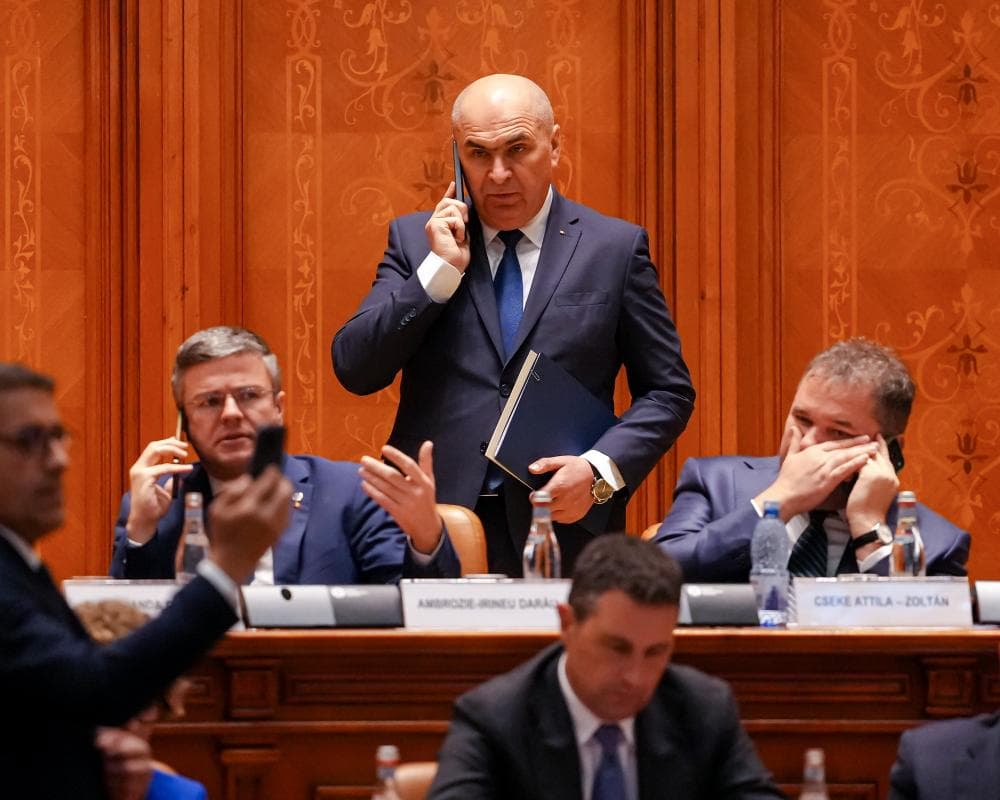
And here it is: 281 votes in favour of the motion, meaning Ilie Bolojan’s pro-EU coalition government lost the confidence of the parliament.
The result was welcomed with loud applause from those present.
The Romanian media are reporting that the defeated PM Bolojan has already left the parliament’s building.
Updated
Over in Romania, we are expecting a result of the no confidence vote in Ilie Bolojan’s government any moment now.
Bolojan has led a minority government since late April when the leftist Social Democrats – parliament’s largest party – called for his resignation and then walked out of the coalition of four pro-European parties and teamed up with the far-right opposition to file a no-confidence vote, Reuters noted.
The no-confidence motion was signed by 254 MPs, and 233 votes are required, so the government is expected to lose the vote, triggering a scramble to find a new majority and a new prime minister.
I will bring you the result as soon as we have it.
Updated
US secretary of state Marco Rubio expects a “frank” meeting with Pope Leo during a visit to the Vatican this week, the US ambassador said, after president Donald Trump took a fresh pot-shot at the pope for criticising the US war in Iran.
“Nations have disagreements, and I think one of the ways that you work through those is ... through fraternity and authentic dialogue,” said Brian Burch, the US ambassador to the Holy See, in comments reported by Reuters.
“I think the secretary is coming here in that spirit,” Burch told journalists. “To have a frank conversation about US policy, to engage in dialogue.”
Reuters noted that Trump has repeatedly disparaged the first U.S.-born pope in recent weeks, drawing a backlash from Christian leaders across the political spectrum.
Rubio is a Catholic, as is Vice President JD Vance. The two met Leo a year ago after attending his inaugural mass, the Trump administration’s only previous known cabinet-level meetings with the pope, the agency said.
Meanwhile, over in Russia, mobile internet services have been cut off to many customers in Moscow as part of the preparations for 9 May Victory Parade given concerns about a potential attack from Ukraine.
The Kremlin said the limits had been introduced to ensure security amid a heightened risk of Ukrainian drone attacks, but for many Russians they have complicated payments, navigation and communication, Reuters reported.
Russian mobile phone operators said there could be problems with mobile internet due to the need to ensure security over coming days. Sberbank, Russia’s biggest bank, also cautioned that there could be issues with mobile internet and messaging, the agency added.
The restriction is the latest sign of Moscow’s concerns about a potential attack from Ukraine, after last week’s decision to host the parade without military hardware for the first time in almost two decades.
Another big topic of the Yerevan summits – which continue today after an earlier meeting of the European Political Community over the bank holiday weekend – is the UK’s willingness to join the EU’s €90bn loan for Ukraine.
Prime minister Keir Starmer has said the benefit of joining the European Union’s scheme for Ukraine “outweighs the cost” as he argued the continent must move at pace to bolster its own defence.
The prime minister, who said the UK’s involvement in the recovery loan plan would also help create jobs at home, acknowledged that tensions were high between Donald Trump and Europe, particularly over military issues.
As the Nato military alliance comes under intense pressure from Trump’s threats amid a difference in stances on the war in Iran, Starmer said: “We cannot deny that some of the alliances that we have come to rely on are not in the place we would want them to be.”
He continued:
“There is more tension in the alliances than there should be and it’s very important that we therefore face up to this as a group of countries together.”
Meanwhile, the European Commission president, Ursula von der Leyen, responded to US president Donald Trump’s latest threats on car tariffs.
Blindsiding Brussels late on Friday, a public holiday in much of Europe, Trump announced that he would be increasing tariffs on cars and lorries imported into the US from the EU from 15% to 25% from next week.
Speaking from Yerevan, where the EU-Armenia summit is taking place, von der Leyen said:
“A deal is a deal, and we have a deal, and the essence of this deal is prosperity, common rules and reliability. Now we are both implementing this deal while respecting the different democratic procedures we have on both sides.
On the European Union side, we are now in the final stages of implementing the remaining tariff commitments. At the same time, the US has the commitment, for example, where alignment with the agreed ceiling is still outstanding.
So we want from this work mutual gain, cooperation and reliability, and we are prepared for every scenario.”
Ukraine’s president Volodymyr Zelenskyy has criticised Russia’s “utter cynicism” of launching more attacks on Ukraine while also calling for a short ceasefire enabling it to stage its 9 May Victory Parade in Moscow.
In a post on X condemning the latest series of attacks, he said:
“It is utter cynicism to ask for a ceasefire in order to hold propaganda celebrations while carrying out such missile and drone strikes every single day leading up to it. Russia could cease fire at any moment, and this would stop the war and our responses. Peace is needed, and real steps are needed to achieve it. Ukraine will act in kind.”
The overnight attacks were primarily aimed at Ukraine’s energy infrastructure, but killed four people and injured more, Zelenskyy said.
Earlier, Zelensky said that holding a ceasefire between 8 and 9 May so Moscow could hold the Victory Parade despite fears of a Ukrainian attack was “not serious”, and suggested an earlier truce starting already midnight (9pm GMT) on Tuesday.
“It is time for Russian leaders to take real steps to end their war, especially since Russia’s defence ministry believes it cannot hold a parade in Moscow without Ukraine’s goodwill.”
There is nothing to suggest that Russia will abide by the proposed ceasefire.
Elsewhere, I will keep an eye on the EU leaders’ meeting in Yerevan, Armenia after the latest round of Donald Trump’s threats against European partners, and on a vote of no confidence in Romania’s prime minister Ilie Bolojan, which could see his government collapse this afternoon.
It’s Tuesday, 5 May 2026, it’s Jakub Krupa here, and this is Europe Live.
Good morning.