Loading...
Please wait for a bit
Please wait for a bit
Click any word to translate
Original article by Jakub Krupa
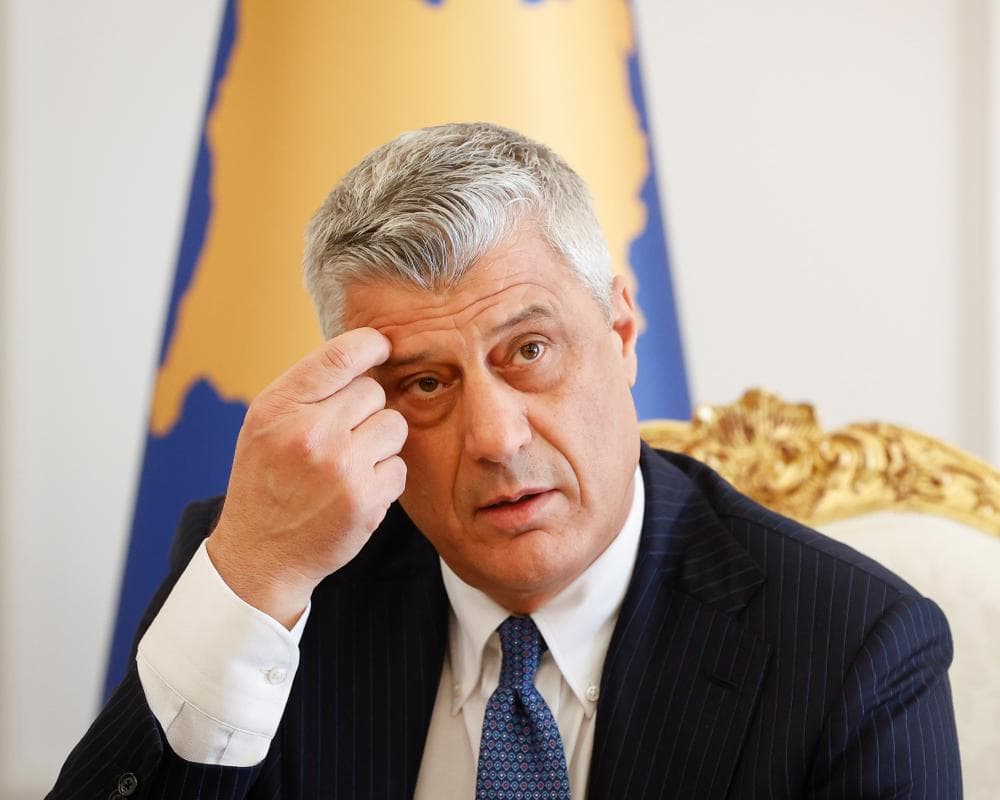
We are now getting a bit more on the findings against Thaçi and his three co-defendants.

Here is from the Kosovo Specialist Chambers & Specialist Prosecutor’s Office:
“The Trial Panel found that all four Accused were criminally responsible for the war crimes of arbitrary detention against 385 individuals, cruel treatment against 49 individuals, torture against 303 individuals, and murder against 96 individuals.
The Trial Panel found the accused not guilty of crimes against humanity because the Specialist Prosecutor failed to prove beyond a reasonable doubt that there was a widespread or systematic attack directed against a civilian population. The accused were also found not guilty in connection with a number of specific incidents of war crimes.
The judges found that during the Kosovo conflict Mr. Thaçi, Mr. Veseli, Mr. Selimi and Mr. Krasniqi contributed significantly to the common criminal purpose of targeting perceived opponents of the Kosovo Liberation Army’s political and military goals, including Kosovo Albanians associated with other political or military forces, like the LDK and FARK; individuals alleged to be associated with the FRY/Serbian authorities; and certain members of ethnic minorities, including a number of Roma and Serbs.
The targeting of such opponents took the form of killings; arrests and detention without due process; physical and psychological mistreatment; as well as other forms of abuse, intimidation and harassment.
With limited exceptions, the Trial Panel found no evidence that any of the victims had engaged in any criminal activity, taken an active part in hostilities or presented any other legitimate security concern for the Kosovo Liberation Army (KLA).”
And here is a bit more detail on Thaçi himself:
“In the case of Hashim Thaçi, the Trial Panel found that as a member of the General Staff of the KLA and in his capacity as the head of the Political Directorate, he was a key member in formulating and implementing the common purpose that entailed setting up detention facilities; identifying individuals perceived as opposing the KLA; arresting and detaining them; and, if necessary, killing them.
This included the targeting of alleged “collaborators”, the setting up of a structure, competent bodies and regulations to do so, and the deployment of “special warfare” against Opponents, including through the publication of communiques and political declarations and other public statements expressing tolerance and encouragement for the commission of crimes against opponents.
The Trial Panel further found that Hashim Thaçi also personally participated in crimes, including the arrest, arbitrary detention and interrogation of 13 parliamentarians and the arrest, detention, transfer and murder of Behajdin Allaqi.
He further disseminated false information about detainees and victims of the crimes committed by KLA members, gave false assurances of compliance with international humanitarian law on behalf of the KLA, and contributed to a policy of impunity in respect of perpetrators of crimes against opponents.”
Full summary of the judgment is here.
Former Kosovo Liberation Army commander and later Kosovo president Hashim Thaçi has been sentenced to 25 years in prison as he is held criminally responsible for war crimes during the violent break from Serbia in the 1990s by the international court in The Hague.
Thaçi had denied all charges.
I will bring you more on this shortly.
Here is the background to this story:
“As prosecutors presented their case against Thaci and fellow defendants Rexhep Selemi, Kadri Veseli and Jakup Krasniqi – all senior figures in the KLA’s leadership during the war against Serb forces from 1998 to 1999 – they described an alleged campaign of murder, torture and repression against opponents and members of ethnic minorities directed by the four men. …
The proceedings, deeply unpopular in Kosovo and neighbouring Albania, recall the period of brutal conflict between 1998 and 1999 where both Serbian and Kosovan armed organisations committed war crimes in the context of the KLA’s armed uprising and Belgrade’s military response.
His supporters gathered in Kosovo earlier today to listen to the verdict:
Updated
The European parliament is still discussing von der Leyen’s address.
In sharp contrast with von der Leyen’s comments, the far-right National Rally president Jordan Bardella criticised her for constantly “glorifying what you have done,” while, in fact, “the [current] system is reaching an end.”
“We have the Europe of those who write the rules; the bureaucrats who write waste public money and make up taxes for tomorrow … and then there’s the Europe that has to pay, the second Europe: those who have to pay €2.5 for a litre of petrol … they have to pay for heating, they have to pay increasing bills.
Europe that continues to work harder to earn less. That essentially is the state of the Union.”
He told von der Leyen that “your Europe is not just more expensive every year,” but it also “protects us less and less,” pointing to the migration crisis in Ceuta.
“Let’s look at the world around us: the war in Ukraine, war in the Middle East, Islamist terrorism, food insecurity, energy insecurity. The US is investing, China is investing, and we continue to regulate even more.
We’re regulating things that we no longer produce. We’re taxing things that we no longer know how to make. And we’re also taxing things that we’ve banned the production of in Europe. That is the major paradox in Europe. And that’s why we need to change.”
He called that “when the money is European, the jobs need to be in Europe; when the money is French, the jobs need to be in France” and urged the commission to “get ride of red tape, these absurd and useless rules.”
I’m bringing you these quotes as Bardella’s National Rally could find itself in a very strong position in France after next year’s presidential election, with Marine Le Pen leading in the polls.
Worth remembering that Mark Carney is due to address the European parliament tomorrow, so will be definitely worth tuning in to hear his take on the “associate membership” idea.
He is scheduled to speak 11:30 local time (10:30 UK) tomorrow.
Senior correspondent
Ursula von der Leyen’s dramatic offer to open the gate to Canada to become the EU’s first ever associate member (9:54) cannot be overestimated in political and trade significance.
It, at once, aligns what Canadian prime minister Mark Carney called the “middle powers” in his Davos speech in January but creates an opening for a speedy enhanced trade deal particularly on critical raw materials and rare earths.
It also sets Canada apart from the UK which could, once upon a time, have some sort of associate membership with the EU were it not for the drive for a clean break Brexit.
Two points of realpolitik make it possible that the long winding road that typifies third country’s relationships with the EU could turn into a high speed motorway.
Canada has something the EU desperately needs: rich supplies of CRM and rare earths in a bid to diversify from China which has a stranglehold on both.
And Europe has something Canada urgently wants: new market for products it can no longer sell into the US in the face of a trade war with Donald Trump.
Looking at the bigger picture a new enhanced trade deal between the EU and Canada could leave the UK somewhat scrambling in a two speed race.
Keir Starmer talked about forging a CRM and rare earths deal with Canada but it never materialised.
If political energy in Brussels is now focused on Canada that could be bad news for Andy Burnham.
Updated
European Commission president Ursula von der Leyen has warned the EU is “the strongest” but “most precarious” (9:16) it has ever been as it faces “an openly hostile world” (9:18) as she delivered her annual State of the Union address in the European parliament in Strasbourg.
Von der Leyen outlined proposals for reforming the EU’s single market (9:21) and improving competitiveness and innovation (9:30), as well as electrifying its energy market (9:24), and rebalancing its trade relationship with partners, particularly China (9:27).
In one of the most eye-catching proposals, she suggested Canada could become an associate member of the European Union (9:54).
Von der Leyen also warned about the growing threat from Russia as she called for a “European Security Council” to help countries coordinate on security issues (9:58), as she pledged further support to Ukraine (10:04).
In her wide-ranging speech, she also discussed the issue of irregular migration (10:10) and criticised Israel for “unacceptable” plans for its illegal E1 settlement project (10:07).
She also called for urgent action on climate preparedness as she warned Europe faced “the hottest summer months ever, but the coolest of years to come” (9:34, 9:39).
Von der Leyen also confirmed plans to introduce tougher rules on social media to protect children online, including a ban for users under the age of 13, as she warned that highly addictive platforms are “depriving children of their childhood” (10:20).
The commission president also advocated for “AI with human agency,” and for Europe to explore “hidden” value where it can capitalise on its “big advantages” (9:45, 9:48).
In a pointed comment, she also criticised Serbia for last week’s funeral of convicted war criminal Ratko Mladić, saying “glorifying war criminals simply has no place in the European Union” (10:24).
Updated
Von der Leyen now talks about the EU’s “powerful promise” dating back from its foundation, as she calls for new generations to “rediscover this ability to think European.”
The EU will create a new “Congress for Europe,” drawing on its origins, to get “the brilliant minds from across our union and across our continent” to “inspire the new generation of Europeans.”
“We should never forget the origins of our union. So long at war, united to forge a common destiny, a destiny of peace and prosperity, of democracy and freedom.
They never wrote down where the destiny would finally lead. But each generation has built on the foundations of its predecessors. Step by step, brick by brick, of course, imperfections are diversity, and our differences remain.
But that is precisely what makes Europe, our Europe and our common home.”
And on that point, she ends her speech to some applause from the audience.
Switching to French now, von der Leyen says “we also have to win back the hearts of Europeans.”
She also says the EU needs to look beyond its borders in the western Balkans.
She says the process “will continue on merit.”
But she says the adherence to EU values is “non-negotiable,” as she says she was “horrified by the pictured from Ratko Mladić’s funeral in Belgrade last week.”
“He committed the most atrocious crimes against humanity. Glorifying war criminals simply has no place in the European Union.”
Von der Leyen then turns to the question of online safety, particularly for children.
She warns that “young Europeans now spend four to six hours a day on screens,” as they “are pulled ever deeper into feeds designed to keep them scrolling.”
“What we are witnessing is a great capture of our children. A capture of their attention, their focus, their minds. This is depriving children of their childhood.”
She references the death of a 14-year-old Belgian girl, Oléa, who killed herself as a victim of online bullying.
She quotes her mom who said: “I am convinced that had it not been for these omnipresent networks, my daughter would still be with us.”
Von der Leyen says “enough is enough” and confirms plans to bring forward “the Kids’ Act” with strict restrictions on social media usage by children.
“We will take a gradual and differentiated approach. Each age has its own sensitivities, and therefore each will have its own tailored protection level.
No social media under the age of 13. No personal account under the age of 15.
That means from 13 to under 15, only mini accounts set up and supervised by parents or guardians, with limited features and time restriction to one hour a day and between 15 and 18, safe design will be an obligation for the platforms.”
She says the EU “will not accept addictive features” and “children being drawn into ever more extreme content.”
“We are reversing the burden of proof: now platforms will have to prove to us that they are safe because this is not about our minors accessing social media. It is about when and how do we allow social media to access our minors. Europe has the power to act. It is us who decide the rules, not big tech.”
Von der Leyen then turns to the issue of democracy in Europe.
She says “our European democracy is being threatened” with “disinformation and foreign interference seeking to divide us, seeking to erode trust in our democratic fabric and free media.”
She pointedly says “the threats to our democracies do not only come from the outside,” as Europe sees “the rise of anti-democratic, anti-European forces.”
But she says “nothing is inevitable,” as she celebrates the change in Hungary, with the new pro-EU government led by Péter Magyar after 16 years of Viktor Orbán.
“12 April will stay in our memory for a very long time,” she says, referencing to the election day in Hungary.
“Hungarian people took their future in their hands. They chose democracy. They chose Europe. They brought Hungary back to where it belongs, at the heart of the European Union.
Years of backsliding have started to be reversed. The fight against corruption and state capture is speeding up. There is real progress on fundamental rights, on academic freedom, and now billions of euros of investment in Hungary have been unlocked. There is, of course, much more work ahead.
But … this shows the hard work pays off.”
Von der Leyen then turns to migration, and not surprisingly touches upon the migration crisis in Ceuta.
She says “vulnerable people are being exploited by callous traffickers and smugglers, by our adversaries.”
She addresses the Spanish people, saying “Ceuta border is a European border, because Ceuta is Spain and Ceuta is Europe – and Europe will be there for you.”
She talks about the EU’s pact on migration and asylum, which “needs to be fully implemented.”
But she says the EU needs new rules for emergency situations, “especially in scenarios when mass movements are engineered and weaponised.”
“This is why we will propose a new European Emergency Response instrument. It will only be triggered under a strictly defined set of criterias. And in those cases, it will allow for a time limited and strictly defined flexibility of standard procedures.”
She says the message is clear: “we will always comply with our values and fundamental rights, but we will never compromise on protecting our borders because it’s us Europeans who decide who comes to our union and under what circumstances.”
She also talks about the need to strengthen the EU’s border agency, Frontex, and proposes a new “Mediterranean Youth Skills and Jobs Initiative” to work with partners in third countries.
Updated
Von der Leyen then turns to the situation in Gaza.
She says “the deep suffering in Gaza and unchecked settler violence in the West Bank have deeply affected Europeans.”
She says the Israeli government’s decision to go ahead with the illegal E1 settlement project is “unacceptable.”
“It is painful for many Europeans that member states have been unable to build the necessary majorities for a unified response. Some member states have moved ahead. Others are considering to do so. When Europe is divided, it cannot change the course of events,” she acknowledges.
She says the EU is “leading the way in supporting Palestinians,” and will continue to do so.
She says “Europe supports the right to self-defence for Israel, and the Palestinian people have an equal right to live in safety and dignity.”
“It is Europe’s role to keep the flame of the two state solution alive.”
Switching to German, von der Leyen moves on to Ukraine.
She says “the coming winter will be tough for Ukraine,” but says nothing can break “the Ukrainian spirit of resistance.”
“Our task remains to support Ukraine as best we can,” she says.
She says the EU “will give our strongest ever support to Ukraine over the toughest winter of the war.”
She says the EU is now using its funding to help Ukraine buy air defence systems, and wants to work on developing “an affordable modular missile defence system,” made in Europe.
But she says “more is needed.”
The EU will work on “setting up a new programme for joint projects with Ukrainian companies,” and work to “tighten our sanctions on Russia.”
“What is needed is not necessarily new sanctions, but above all the enforcement of existing ones. Our sanctions … are putting enormous pressure on the Russian economy. Russia is doing everything it can to get around them. So we must close the loopholes.”
She goes back to English, talking about Russia’s indiscriminate attacks on civilian populations in Ukraine.
“This is a deliberate strategy of terror,” she says.
She talks about a story of a Ukrainian girl named Sasha and her resilience in returning to gymnastics after losing her leg in a Russian strike.
“Just seven months after the attack, she was back in the gym with her new prosthetic leg. She trained harder than ever. She started winning gold after gold. This summer, she travelled the world with her Dance of Freedom tour. Her aim is to tell the world about Ukrainian resilience and the fight for freedom," she says.
Sasha is in the audience and gets a standing ovation.
Von der Leyen says “there is no room for any kind of doubt: Europe will defend each and every single square metre of its territory.”
Von der Leyen then moves to security, as she references the recent incidents in Lithuania, Denmark, and Poland just this week.
“Russia’s war of aggression on Ukraine rages on and threats are mounting on our soil,” she warns.
“We need to be clear about what this was an attack using military grade material carried out by Russian operatives on European soil and attack not only on one member state, but against all of our union.”
She adds that “hybrid threats facing Europe are less and less hybrid and less and less threats.”
“Cyber sabotage, arson. Drone incursion. They are ramping up every day.”
Von der Leyen says the EU’s preparedness needs to be raised, with existing systems “made for a different world.”
She says the EU needs “its own counter-hybrid playbook,” and how it can respond to incidents just below the threshold of armed aggression.
She calls for the EU’s equivalent of Nato’s Article 4 (note: Article 4, not best known Article 5), “an emergency security protocol.”
“When triggered by one member state, all member states should convene to coordinate a European response to deter further escalation and to mitigate the impact,” she says, calling for the establishment of a “European Security Council.”
Von der Leyen then moves again to trade.
She says “in this age of tipping points, our prosperity and security will not only be built at home,” as she references new trade deals with Australia, India, the Mercosur bloc, Mexico, and Indonesia.
In a passage that includes what will no doubt be read as a swipe on Donald Trump, she says:
“These partnerships are a strategic choice for Europe, but they also respond to the fracture in the international rules based system.
For some, the answer is to go it alone. But this is not an option for us.
Europe will always lead when it comes to defending the rules based system. But we can no longer rely on it to be the only way to secure our interests, or assume that its rules will shelter us from the complex threats that we face.
In this new world, we must urgently reimagine our partnerships and build global coalitions for our resilience and democracies.”
She welcomes Canada’s Carney, saying his presence “is a symbol of the enduring friendship between our people.”
“Mark, Europe and Canada believe in democracy. That power does not belong to the strongest, richest and loudest, but to all of us. That democracies have the freedom to choose with whom to work. So we are joining forces voluntarily.”
She says the EU wants to “move the partnership with Canada to the highest level possible”, and says they will work together on “opening the door for Canada to being the first associate member of the European Union.”
“This is not a partnership against anyone else. But for our common strength.”
The proposal gets a standing ovation.
Von der Leyen then moves to women’s rights, as she warns that “some people want to backslide” on them.
“They want to send us back in an age where women were second class citizens.
We have fought so hard for equal treatment, equal opportunities, equal pay.
Look around this room. Finally, there are many of us here presidents, vice-presidents, group leaders, commissioners, members of the European Parliament, staffers and ushers.
So let me send a very clear signal and message. Women are here to stay. We will defend our rights. And we will continue to stand up for our values every single day.”
Von der Leyen also says that AI benefits are “unevenly spread between skill sets, generations, and region.”
She says the EU’s response “must keep pace, from education to employment.”
She also goes through other social proposals, including on housing “to tackle short term rental and housing speculations.”
Von der Leyen’s state of the union speech – in pictures
Von der Leyen then moves to the issue of artificial intelligence.
She says Europe’s stance is clear: Europe wants to “make the most” of the technology to “improve our societies, our quality of life and our productivity,” but is aware of “massive risks” that come with its rollout.
“As the frontier models become more capable, these risks have become sharper and come sharper into focus,” she says.
“CEOs of the most advanced companies tell us that it is time to slow down on the self recursive models to pace the frontier. If the people developing the technology are clear, then we should be too.”
She says the EU will “step up together” with like-minded partners like Canada and the UK, working particularly on “model evaluation, verification, early warning, AI security.”
She says the EU will invite the main frontier labs for discussions on how we can support ongoing industry efforts to pace the frontier.”
She also says Europe needs “its own capabilities,” and “massively boost our computing capacity.”
She then says “the next leg of this race is not only about frontier models.”
“Just as with the printing press in times gone by; it was invented by a German inventor, but it was mastered and applied across western Europe. So we do not need to develop the frontier technology to be the ones who draw the greatest value from it. The key is creating the value that AI has not yet delivered.”
She says the EU can lead on applications in real life scenarios, whether on a factory floor, a hospital ward, in precision agriculture, or autonomous driving.
“This is where the real value is hidden and it is where Europe has big advantages.”
She talks specifically about AI applications in health.
“Do I want my doctor to have instant AI access to all the data needed to make the best diagnostic treatment and choice? Yes, of course. But do I want my doctor to be a robot? … No, of course not. I do not want a robot to tell me whether I have cancer or not. The point is, AI needs to empower our doctors not to replace them. And this is just one example.”
She says the EU’s approach is clear: “we want artificial intelligence; we want AI to create more value, more responsibility, and at a lower cost and with less energy consumption.”
“But above all, we want AI with human agency. This is the essence of the European way.”
Von der Leyen then turns to water and food security, stressing “the risks of water scarcity for our farmers, SMEs, energy and supply chains.”
“Yet European pipes lose almost one litre in every four litres, mostly through leakage. What a waste.”
She hails Europe’s farmers for their resilience this summer, and pledges to “support them every step of their way.”
She then turns to wildfires, warning that “they are getting more intense, more frequent and more spread out.”
“We need to think bigger and learn faster,” she says.
She says the EU will work on its preparedness and emergency rules.
She specifically pays tribute to a 46-year-old Danish pilot, Rune Kyndal, who died in a tragic accident in Greece in July when taking part in an emergency mission.
With his family in the attendance, von der Leyen says “all of Europe owes him,” as the parliament raises to a standing ovation for Kyndal.
Von der Leyen turns to climate next.
She says that “our future prosperity and security will greatly depend on how we manage the tipping points of our points: climate change and AI.”
On climate, she says “this summer was the summer of truth,” with “almost no part of our continent spared.”
She lists places and rivers affected, with 660,000 hectares burned to ground, some 12 million tonnes of crops lost, and over 35,000 excess deaths.
“All of this is a mere preview. This was the hottest summer months ever, but probably the coolest of the years to come.”
She says that “the transition is complex and we will need to adjust and learn along the way,” but “there is no doubt: Europe can, must and will stay the course on our climate targets.”
She says the EU will propose a new package on climate resilience next month, and a separate package on heatwave preparedness, including rules on urban adaptation, cooling.
Von der Leyen then turns to investment and growth, as well as the EU’s next budget.
She talks about the need to simplify and tackle fragmentation on investment to help fund European start ups.
She pays specific tribute to the success of ICEYE, a radar satellite imaging and space-based monitoring company, built by Finland’s Pekka Laurila and Poland’s Rafał Modrzewski after they met through Erasmus student exchange programme 15 years ago.
“Today they are one of the world’s leading space technology companies,” she says. “You are a true European success story.”
Von der Leyen turns specifically to China, warning that the EU’s trade deficit with China is now €1bn a day, and it has “reached its tipping point.”
“Some say the second China shock is looming, but it’s already here. It shows in our communities and factories across our union. It leads to deindustrialisation in the industrial heartlands of Europe. This is unsustainable.”
She says the EU “will use all tools at our disposal to rebalance our relationships.”
She also talks about the need to diversify on critical raw materials.
Von der Leyen also talks about the need to reform Europe’s energy market.
She says “Europe cannot remain an industrial powerhouse if its energy prices are structurally too high.”
She says the bloc successfully pivoted towards homegrown cleaner energies in the aftermath of Russia’s full-scale invasion on Ukraine, but it still “bitterly felt the cost” of the strait of Hormuz closing later.
“We need to double down on our affordable and home-grown clean energy. Be it renewables or nuclear, be it biomethane or others. Technologically neutral. But these energies must give us independence and drive down energy prices.”
She says “we need to electrify Europe,” and cut the fossil fuel import bill.
She says lots of renewable capacity is waiting to be connected, and the EU needs to speed up grid connections.
She then turns to trade.
Updated
Von der Leyen says “kickstarting Europe’s economy is our number one priority,” as Europe needs to tap into its huge market, world class industries and services.
She says its single market remains too fragmented and needs to reform further, with the aim of completing it by the end of next year.
“In today’s economy, speed is of the essence. A permanent permit or a form, a grid connection of financing decision – all of this can determine where an investment is made and where jobs are created. We need to move much faster,” she says.
Von der Leyen also talks about the need to simplify its rules.
Updated
Von der Leyen frames it as a choice between “independent Europe that stands up for its values in this world,” or “letting divisions and dependencies hold us back.”
“Do we want to rally around our European idea that together we can decide our own destiny? Or do we let our democracies be undermined by the proxies and puppets of authoritarians?
Whether it is the ultra nationalist or the anti-European, whether it’s Russian interference or disinformation, the names may be different, but their goal is the same.
They despise our values and they want to shatter our European unity. So let’s not only fight back against that, but let’s fight together for our European ideal.”
Updated
Von der Leyen warns that “we are now dealing with an openly hostile world,” in which “old assumptions and relationships have frayed.”
She talks about “a territorial war of aggression” in Ukraine, “a fight for industrial capacities” and “narratives,” and “the dizzying speech of change and technology” impacting people’s lives.
“We see this in the rise of the extreme and the decline of nuance, even in the way that we relate to each other. These real concerns are being weaponised to drive a wedge between us, sometimes from the outside, but too often from the inside.
But our path is clear. Building an independent Europe that has the power to act. Nothing can divert us from this. Because in this world, the fate of Europe must remain in the hands of Europeans.”
Von der Leyen begins her speech.
She quotes Charles Dickens’s description of the days of the French Revolution, “it was the best of times; it was the worst of times.”
“It is also a fair description of the world we live in,” she says, as she adds “the speed of change is incredible.”
“I would say the state of our union is the strongest it has ever been. The state of our union can also feel as precarious as it has ever been. These two statements may seem incompatible, but they are both true and they reflect these exceptional times.”
She says Europe “has chosen to forge its own path” as it navigates “the complex age of … great possibilities and … great perils.”
Europe is “breaking free from the toxic dependency on Russian fossil fuels,” better prepared to defend itself than ever before, and standing for its values with Ukraine and Greenland, she says.
“In the cold fragility of today’s world, only Europe can provide true sovereignty for Europeans,” she says.
EP’s Metsola sets out what people expect from Europe:
“Our union has always moved forward because people were willing to take a leap where the moment demanded it and turned uncertainty into possibility.
People expect a union that does more to protect them, more to support them, and more to fight their corner.
They want answers on security, on competitiveness, on affordable homes, on quality jobs, on climate, on borders. They want us to stand up for a Europe of values …”
She goes on, also pointedly mentioning the need to continue supporting Ukraine.
Opening the session, the European parliament president Roberta Metsola welcomes Canada’s Carney, who gets long and warm applause from EU lawmakers.
“They haven’t heard you giving your speech yet,” laughs Metsola.
Updated
We are about to start.
It’s also worth noting that this year’s SOTU will see a special guests in attendance: Canada’s prime minister Mark Carney.
He will listen to von der Leyen’s speech as Canada seeks closer ties with the EU – particularly on defence, digital regulation and trade - amid growing tensions with and outright repeated threats from US president Donald Trump.
Carney will also address the European parliament on Thursday.
The speech is expected to start in the next 10-15 minutes, so you can watch as the European Parliament’s Hemicycle in Strasbourg is filling up ahead of the speech.
Here’s our live stream for today:
The European Commission president Ursula von der Leyen is about to speak at the European parliament to discuss “the state of the Union” in her annual speech about the EU’s place in the ever more complicated world.
Her speech in Strasbourg comes as the list of challenges facing the bloc grows ever longer – not least an increasingly aggressive Russia following incidents involving Denmark, Lithuania, and Poland this week. Security is set to be a key theme.
We are also likely to hear about Europe’s competitiveness and its standing in a global race dominated by superpowers like China and the US, as well as the rise of nationalism and populism across the continent and beyond.
Expect updates on other major priorities, too: digital regulation (with a sharp focus on online safety), migration (following the Ceuta crisis in late July), and climate and energy in the wake of another record-breaking summer.
Plenty to cover. I will bring you all the key lines here.
It’s Wednesday, 16 September 2026, it’s Jakub Krupa here, and this is Europe Live.
Good morning.
Updated