European leaders rally behind Ukraine in Downing Street talks
Click any word to translate
Original article by Eleni Courea, Jennifer Rankin and Peter Beaumont
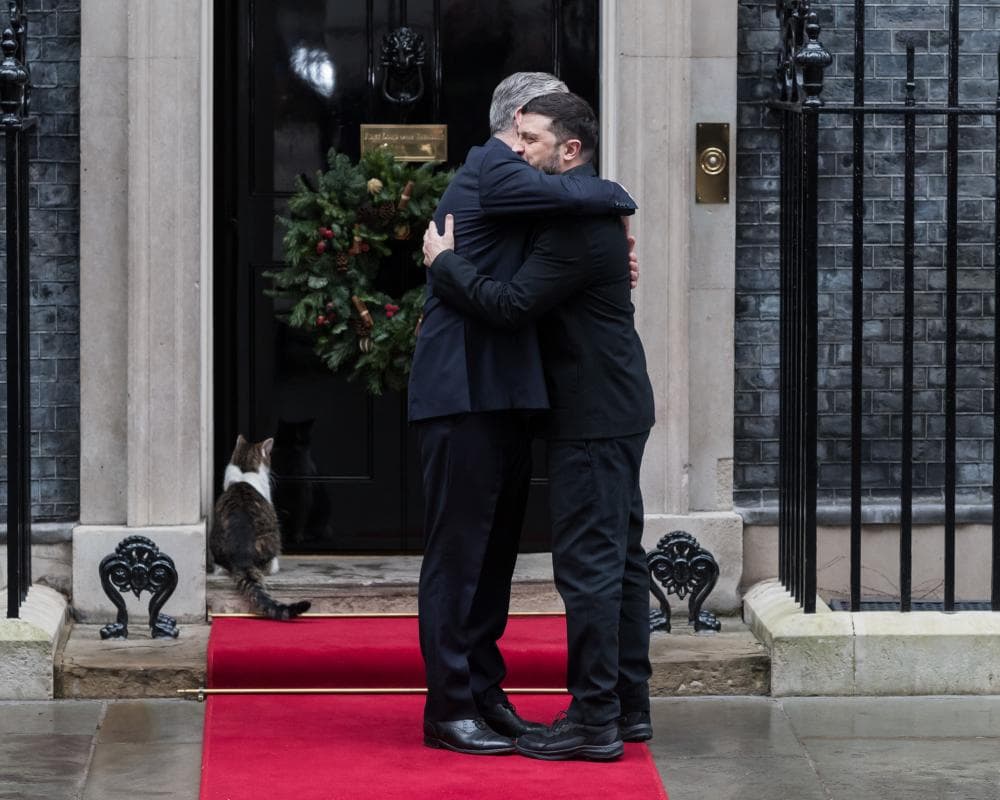
European leaders rallied behind Volodymyr Zelenskyy on Monday night amid hopes they might finally achieve a breakthrough to allow Ukraine access to billions of pounds of frozen Russian assets.
Despite vociferous support for the Ukrainian president, who has come under heavy pressure from Donald Trump to cede territory in order to bring the war to a speedy end, there was still no agreement on the thorny question of turning immobilised assets into a loan for Kyiv.
But Downing Street said “positive progress” was made on the issue during crisis talks hosted in Downing Street with Zelenskyy, France’s president, Emmanuel Macron, and the German chancellor, Friedrich Merz.
They were joined on a call by the leaders of seven other European countries, a senior representative from Turkey and Nato and EU chiefs. During the meeting, leaders “underscored the need for a just and lasting peace in Ukraine” including “robust security guarantees” against further Russian aggression, Downing Street said.
The leaders agreed that “now is a critical moment” for Ukraine and vowed to ramp up support for Kyiv and increase economic pressure on Moscow “to bring an end to this barbaric war”.
The European show of support came after sharp criticism from President Trump, who said he was “a little disappointed” in Zelenskyy, claiming he had not read the US proposal for a peace deal. He insisted without evidence that “his [Ukrainian] people love it” and that Russia’s president, Vladimir Putin, was “fine with it”.
The discussions follow US efforts to push through a peace deal that has triggered widespread concerns because it is seen by many critics as favouring positions held by Russia.
Downing Street is hoping for a breakthrough on a deal to seize billions in Russian state assets held by European banks and funnel it to Ukraine.
No 10 said the talks on Monday had yielded “positive progress” in the lengthy effort to use “immobilised Russian sovereign assets to support Ukraine’s reconstruction”. More than £180bn of Russian assets has been frozen in European banks and financial institutions since Putin launched his full-scale invasion of Ukraine in 2022.
EU leaders will meet on 18 and 19 December in a bid to sign off on a long-awaited European Commission proposal to funnel £78bn of the frozen assets into a “reparations loan” that would go to Kyiv next year.
The unprecedented proposal hinges on the idea that Moscow would eventually pay Kyiv reparations for the colossal damage caused by the fighting. Kyiv would use the reparations from Moscow to repay the loan to the EU, ensuring that the financial institutions holding the assets would get the money back.
Though a majority of EU countries support the plan, it has met strong resistance from Belgium. About £160bn of Russian assets are immobilised at Euroclear, a central securities depository in Brussels, and the Belgian government is concerned that it will bear liability for any seizure and face retaliation from Moscow.
The UK is prepared to hand over £8bn of assets frozen in Britain to support Ukraine but wants to do so in conjunction with other European countries.
Starmer is set to discuss the issue on Friday with his Belgian counterpart Bart De Wever, who has come under pressure from other EU leaders. A spokesperson for the Belgian prime minister said he would be meeting Starmer in Downing Street to discuss “priorities like migration, supporting Ukraine, European security and mutual economic growth”.
The meeting will come a week after Merz flew to Brussels in an effort to persuade De Wever to drop his opposition to the reparations loan plan.
British, French, German and Ukrainian national security advisers have been instructed to continue discussions on the US-proposed peace plan this week.
Zelenskyy, who has warned that his country “can’t manage” without European and American support, said the talks had been productive and had made a “small progress towards peace”. He said that Ukraine-Europe plans for a peace deal should be ready by tomorrow to share with the US.
US officials claim they are in the final stage of reaching an agreement but there is little sign that either Ukraine or Russia is willing to sign the existing framework deal drawn up by Trump’s negotiating team.
The foreign secretary, Yvette Cooper, was due to meet her US counterpart, Marco Rubio, for further discussions on Monday, with the Foreign Office saying the two sides would “reaffirm their commitment to reaching a peace deal in Ukraine”.
The talks follow the publication of a US national security strategy, which spells out the Trump administration’s core foreign policy interests.
The document released on Friday by the White House said the US wanted to improve its relationship with Russia after years of Moscow being treated as a global pariah and that ending the war was a core US interest to “re-establish strategic stability with Russia”.
Dmitry Peskov, the Kremlin’s spokesperson, said the document was largely in line with Moscow’s vision. The strategy paper also said Nato must not be “a perpetually expanding alliance” and suggested European states faced the “prospect of civilisational erasure” because of migration.