Loading...
Please wait for a bit
Please wait for a bit
Click any word to translate
Original article by Dan Sabbagh in Jerusalem
Diplomatic negotiations aimed at halting the war in the Middle East appeared to be faltering a day before a deadline imposed by Donald Trump with a threat to destroy Iran’s bridges and attack its power plants.
Mediators from Pakistan, Egypt and Turkey want both sides to agree to a ceasefire and reopen the strait of Hormuz, to be followed by a period of detailed negotiations intended to reach a more complete peace agreement.
Iran, however, said it wanted a permanent end to the war, not a ceasefire. It submitted its own 10-point peace plan, according to the country’s Irna news agency, and called for a “permanent end to the war in line with Iran’s considerations, while rejecting a ceasefire”.
Trump acknowledged Iran’s proposal as he spoke to reporters during an Easter egg event for children at the White House on Monday and said it was insufficient. “It’s a significant step. It’s not good enough,” he said.
Trump had demanded on Sunday that Iran “Open the Fuckin’ Strait” by 8pm Tuesday evening ET (1am Wednesday BST) or else he would target the country’s power plants and bridges.
The prospect of bombing power plants and bridges has been condemned by lawyers and experts as a likely war crime because its impact on civilians would be disproportionate to whatever notional military advantage is gained.
Trump, however, said such an attack on Iran would not be a war crime because the country was led by “animals” who had given orders to shoot large numbers of protesters in the streets in January.
“They killed 45,000 people in the last month, more than that, it could be as much as [60,000]. They killed protesters, they’re animals,” he said, though casualty figures that high have not been verified.
Meanwhile, he emphasised in a press conference later on Monday afternoon that Iran’s failure to meet the proposed deadline could result in significant escalation and destruction: “The entire country can be taken out in one night, and that night might be tomorrow night.”
Similarly, US defence secretary Pete Hegseth said on Monday that “per the president’s direction, today will be the largest volume of strikes since day one of this operation”.
He added: “Tomorrow, even more than today. And then Iran has a choice. Choose wisely because this president does not play around.”
Yet despite the bellicose rhetoric, the Trump administration, particularly the US president himself, have also publicly signalled an apparent willingness to negotiate with Iran.
Speaking at Monday’s press conference, Trump said he was still open to a deal, adding that Iran was an “active, willing participant” in war negotiation and that “we may even get involved with helping them rebuild their nation”.
Iranian officials earlier told Reuters that they would not open the strait to merchant shipping as part of a temporary ceasefire. Another report, on the Axios news site, suggested that Iran did not want to be caught in a situation where there was an agreement on paper but the US and Israel periodically attacked anyway.
Iran’s foreign ministry spokesperson, Esmaeil Baghaei, said Tehran had responded privately, but added that peace negotiations were “incompatible with ultimatums and threats to commit war crimes”.
The country’s central military command warned of a “much more devastating” retaliation should the US and Israel escalate.
Ceasefire discussions have involved Pakistan’s army chief, Field Marshal Asim Munir, in contact with the US vice-president, JD Vance, while Trump’s special envoy Steve Witkoff has been in contact with Iran’s foreign minister, Abbas Araghchi.
Israeli political sources told the country’s Haaretz newspaper they believed the talks were likely to collapse, though they thought Trump was looking for a way to end the war.
Israel was preparing for all scenarios, they added, and had identified further targets if the bombing of energy and infrastructure targets went ahead.
Israel has already shown its willingness to step up its bombing. Iranian news agencies reported explosions at Iran’s South Pars petrochemical complex in Asaluyeh. Israel claimed responsibility shortly afterwards through its defence minister, Israel Katz.
The minister said the IDF had struck “the largest petrochemical facility in Iran” and that the attack had come after a separate strike on the Mahshahr complex on Saturday. Katz said the two sites were “responsible for roughly 85% of Iran’s petrochemical exports and have now been put out of operation”.
Oil prices dipped on Monday morning, reflecting hopes for a de-escalation. Brent crude futures fell by $1.92, or 1.76%, to $107.11 a barrel by mid-morning before ticking back up above $108 as the fighting continued. Prices were at $70 a barrel before the US and Israel attacked Iran at the end February.
Israel’s military said it had bombed Tehran again on Monday and that another strike on Sunday killed Majid Khademi, the head of intelligence of Iran’s Revolutionary Guards.
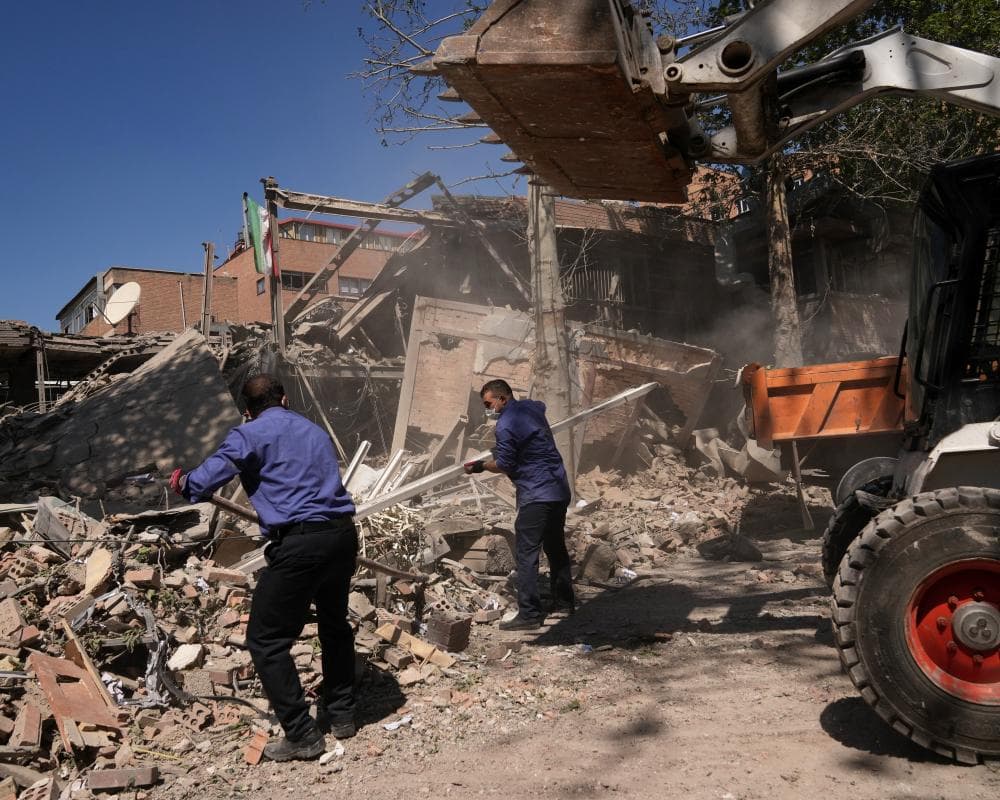
Four people were confirmed dead in Haifa, northern Israel, on Monday after a missile strike the day before, as a rescue team recovered all the bodies buried beneath the rubble. The missile got through Israel’s air defences and destroyed a building.
Israel bombed Beirut’s southern suburbs on Monday, where Hezbollah has its stronghold in the capital. A day earlier, 15 people were killed in Lebanon, including Pierre Mouawad, an official in the anti-Hezbollah Christian party, who was one of three people who died in a strike on Ain Saadeh, east of Beirut.