Loading...
Please wait for a bit
Please wait for a bit
Click any word to translate
Original article by Eva Corlett in Wellington | Photography: Derek Morrison
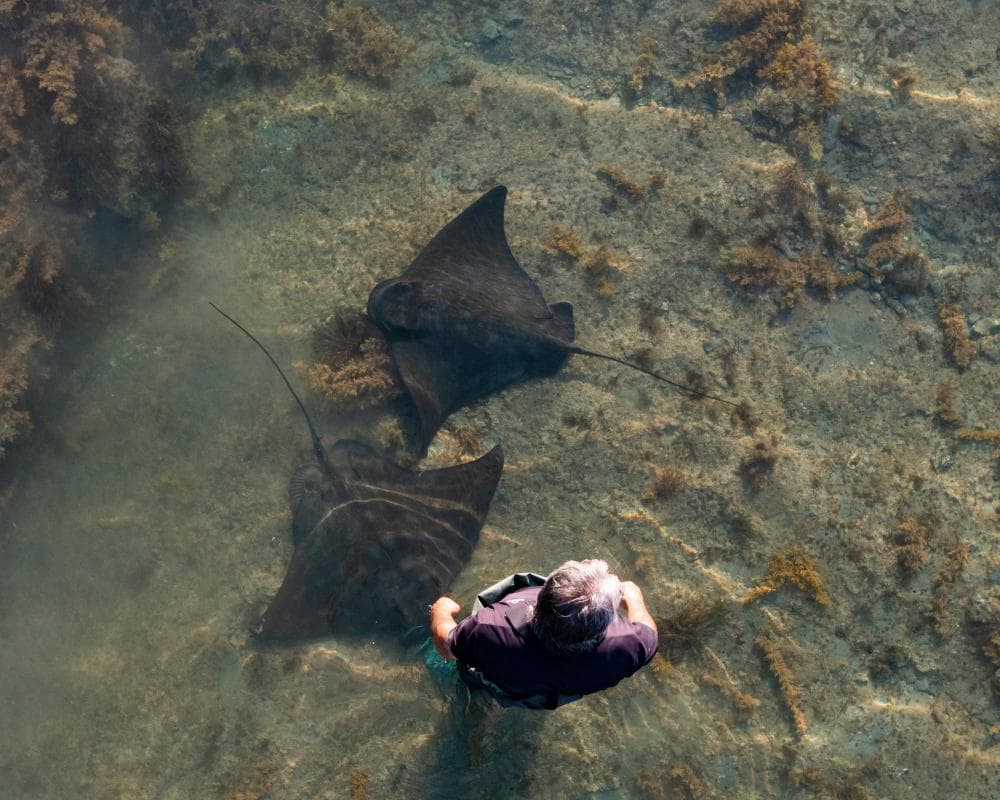
In a shallow reef close to New Zealand’s east coast shore, a group of 30 people wearing khaki overalls and boots huddle together like a crescent moon, waiting for the stars of the show to arrive.
They don’t have to wait long.
Six eagle rays and short-tailed stingrays – some weighing over 300kg - glide through the green waters to the group where they brush up against legs and, with the force of a vacuum-cleaner, slurp fish off submerged hands.
If the group had initially felt trepidation about encountering these animals in the wild, their minds are soon changed.
“Stingrays are like big sea puppy pancakes,” says Bella, 19, who in January joined New Zealand’s only wild stingray experience, run by Dive Tatapouri near Gisborne. “They were all so loving to the people and the staff, they just wanted pats and cuddles,” she says. “It was the coolest thing I’ve ever seen.”
Bella, who wished to give her first name only, said interacting with the species was “unreal” and had changed her perspective on the creatures.
“I would never expect to have a stingray literally right by my feet and petting it, it was honestly breathtaking.”
New Zealand is home to three coastal stingray species, which are abundant and frequently spotted cruising harbours and coastlines. There are few places around the world where people can safely interact with the creatures in their natural habitat.
Owner of Dive Tatapouri Dean Savage – a former commercial diver and underwater cameraman – started the business more than 20 years ago but his affinity with stingrays developed much earlier as a child watching his father, another diver, interact with the animals.
“He knew the image of the stingray and the reality of the stingray were two different things,” Savage says.
With a desire to share this knowledge, Savage and his wife Chris turned their former kina – or sea urchin – processing facility into an eco-tourism business. The nearby shallow reef, home to a stingray nursery, made it uniquely located to develop a wild stingray experience.
For Savage, the stingrays are “not just a performing animal”. They are free to come and go, or interact with people as they please, he says, adding that he ensures the animals do not become dependent on the business for food by limiting the number and length of interactions during the year.
“There are times during the year when we may not interact with animals for a month or six weeks, or limited times during the winter so that they can look out for themselves,” Savage says. “We never get to the point where they totally rely on us.
“They actually live in this environment, so its not hard to get them to come and hang out with the crew,” Savage says, adding the stingrays pick up on the movement of people into the water and will come to investigate. The group then has the option to feed the stingrays a piece of fish.
Visitors are instructed to stand still and allow the animals to leave when they are ready. They are briefed on how to handle the stingrays gently and if anyone disrespects the animals, they are removed from the tour.
“All the reef animals must be treated with respect – it is our responsibility as kaitiaki [guardians].”
The resident stingrays, some of which are more than 20 years old, have become so familiar to Savage they now have names, including Pancake, Waffle, Hine and Charlie.
“They all have different markings and traits – Charlie likes climbing up on you and getting a bit bloody boisterous; some are very laidback and just sit at your feet.”
Concerns over wildlife tourism have emerged in recent years, with communities and scientists fearful too much human contact could disrupt eco-systems and animal behaviour, introduce infections, or compel animals to become too reliant on people for food.
But if the animals and environment are handled with care and the tourism operator informs visitors of the threats species face, it can be a “good conservation advocacy tool”, says Clinton Duffy, the marine biology curator at Auckland Museum.
“As long as people get some sort of education through these sorts of experiences, there should be an overall benefit to the species,” Duffy says.
It can also help humans engage more deeply with the world around them. “It’s very hard for people to feel any empathy for animals that they have no knowledge of or no direct contact with,” he says. “Species like [stingrays] can be good ambassadors for marine conservation generally.”
The perception stringrays are aggressive has likely been influenced by the death of Australian naturalist Steve Irwin, who was killed by a stingray in 2006. But while they can inflict nasty wounds, and in some cases, kill, they are curious, gentle creatures, and “really intelligent for a fish”, Duffy says.
Stingrays, or whai in Māori language, hold significant cultural, spiritual and ecological importance to Māori. The North Island, or Te Ika-a-Māui – the fish of Maui – is likened to the shape of stingray, while for many communities, stingrays are viewed as protectors of the coast and shellfish.
Educating visitors about the stingrays’ importance to Māori and how to treat them with respect, can help instil a deeper care for the creatures, while allowing people to reconnect with nature, Savage says.
“It’s a deep experience for a lot of people,” he says. “There are not many places you can go and have a 300kg animal nudge your feet with no ill intent, while genuinely wanting to be there.”