Loading...
Please wait for a bit
Please wait for a bit
Click any word to translate
Original article by Pjotr Sauer
Russia’s military has fired its new hypersonic Oreshnik missile at a target in Ukraine during a massive overnight strike.
Ukraine confirmed the attack, saying it took place in the west of the country near the EU border. Moscow said the launch of the intermediate-range ballistic missile was retaliation for a supposed attempted Ukrainian drone attack on Vladimir Putin’s residence late last month – an allegation Kyiv and Washington have said is false.
Ukraine’s foreign minister said the use of an Oreshnik missile so close to the EU and Nato border posed a “grave threat” to European security and called on partners to increase pressure on Moscow. Kyiv also dismissed Russia’s attempts to justify the strike, calling them “absurd”.
Ukraine’s security service released photos it said showed fragments of an Oreshnik missile recovered in Ukraine’s western Lviv region.
The governor of Lviv said Russian strikes had damaged a critical infrastructure facility. Unverified social media reports suggested the site may have been a large underground gas storage facility.
Pro-Russian military bloggers circulated footage they said captured the Oreshnik strike. The video, filmed over a snow-covered area, appears to show several bright flashes hitting the ground before a loud explosion and a sequence of secondary blasts.
Russia first used Oreshnik, which is capable of carrying nuclear warheads and is named after the Russian word for hazel tree, in November 2024, when Moscow said it struck a Ukrainian military-industrial facility. Ukrainian officials and analysts at the time said the missile carried dummy warheads rather than explosives and caused limited damage.
Initial reports suggest the Oreshnik used in Friday’s strike again carried inert warheads, indicating the launch was largely symbolic. The strike came days after Ukraine’s European allies agreed to provide key elements of postwar security guarantees in the event of a ceasefire with Russia.
Putin has invoked the Oreshnik repeatedly in recent months as a threat against Ukraine and the west, warning it could be used against countries that supply weapons for Kyiv to strike targets inside Russia with longer-range missiles.
Kaja Kallas, the EU’s foreign policy chief, said Russia’s reported use of an Oreshnik missile was a clear escalation against Ukraine and was meant as a warning to Europe and the US.
“EU countries must dig deeper into their air defence stocks and deliver now. We must also further raise the cost of this war for Moscow, including through tougher sanctions,” Kallas added.
The Russian leader has claimed the intermediate-range missile is impossible to intercept because of its speed – which he says exceeds 10 times the speed of sound – and that its destructive power rivals that of a nuclear weapon even when armed with a conventional warhead.
Some western analysts have expressed scepticism about those claims, though Ukraine has no air defence systems capable of intercepting the missile.
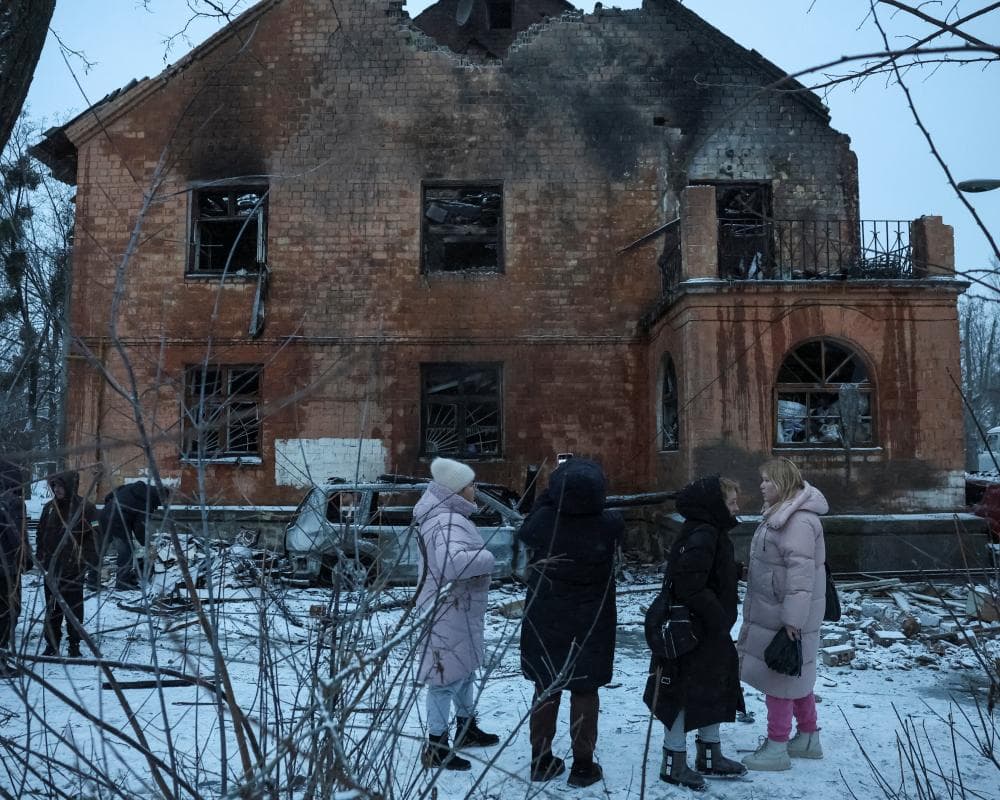
Russian forces also carried out overnight strikes on Kyiv, hitting several districts of the Ukrainian capital. At least one person was killed, according to Tymur Tkachenko, the head of the Kyiv city military administration. Five rescue workers were injured while responding to the attacks, Ukraine’s security service said.
The Kyiv mayor, Vitali Klitschko, said half of the capital’s apartment blocks were without heating after the Russian strikes and urged residents who had places to stay outside the city to do so. Ukraine’s president, Volodymyr Zelenskyy, said a building of the Qatar embassy was damaged in the strikes.
The Oreshnik launch capped a week in which Ukraine and its European allies said they had made significant progress on plans for postwar security guarantees.
On Tuesday, Britain and France said they were prepared to deploy troops to Ukraine after a future peace agreement – a significant commitment under discussion for months.
Russia’s foreign ministry rejected the idea on Thursday, calling the prospect of western troops in Ukraine a “direct threat”, a position that again casts doubt on the prospects for a negotiated peace.