Loading...
Please wait for a bit
Please wait for a bit
Click any word to translate
Original article by Peter Beaumont in Kyiv
On the night of 9 January, amid warnings from Ukraine’s president, Volodymyr Zelenskyy, of massive and imminent Russian airstrikes, Tetiana Shkred began cooking for her children at midnight.
Concerned that the power was once again about to be knocked out in her apartment block on Kyiv’s left bank – the side of the city that has been most affected by Moscow’s attacks on energy infrastructure – she cooked until 3am, when her flat was plunged into freezing darkness.
In a shelter space between two walls, Tetiana and her two children, aged four and 11, sat out the missiles and drones.
When the wave of attacks ended, like tens of thousands of others, they would have to deal with the aftermath in a prolonged cold snap. Daytime temperatures have dropped to –12C (10F) and as low as -19C at night.
While the heat in her block has come back on, like many she must cope with the fact that, despite her having bought storage batteries, all her appliances, including her cooker and the water pump for her block, rely on electricity.
“Everything in the apartment is electric. No electricity means no water and I can’t cook. And for the first 24 hours after the attack there was no heating. All of us were in our thermal underwear, ski clothes, and then more clothes on top of that, and then all sleeping in the same bed,” she said.
“My son is 11 and he stayed calm, but my daughter is just four and she was cold even then.”
While there have been heavier strikes on Kyiv in the almost four years of war since the full-scale Russian invasion, the impact of the 9 January raid on Ukraine’s energy infrastructure has rivalled the dark days of the early weeks of the war, when Russian tanks were trying to force their way into the capital.
The intention is clear to all. Following a fresh wave of Russian attacks on Monday night, Ukrenergo, the country’s state-owned grid operator, said Moscow’s aim was to “disconnect the city”.
“The Russians are trying to disconnect the city and force people to move outside [Kyiv],” Vitalii Zaichenko, the chief executive of Ukrenergo, told the Kyiv Independent, saying substations had been hit overnight and 70% of Kyiv was without electricity.
Russia’s increased focus on attacking energy infrastructure has led to major blackouts in recent weeks in Odesa, Dnipro and Zaporizhzhia, compounded both by the cold and an increasing shortage of spare parts as repairs mount from the attacks.
Even in areas of the capital with more reliable electricity supply, rolling blackouts are in evidence in darkened streets, in cafes and in supermarkets, where escalators and conveyor belts are turned off when the power goes out. Some supermarketsannounced plans on Tuesday for temporary closures.
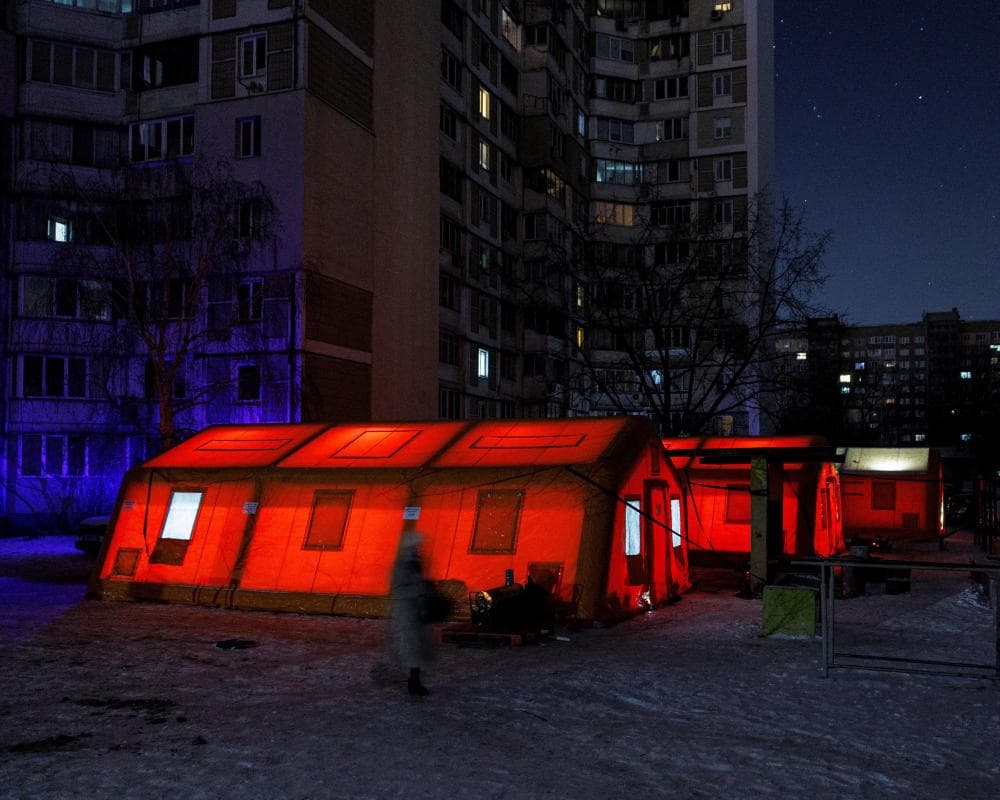
Elsewhere in the worst-hit neighbourhoods of Kyiv, where, days later, power has yet to come anywhere close to reliable, emergency services have erected warming tents in the snow, with pumped heating and a hot food station serving drinks and stew.
Amid a cluster of tower blocks on Kharkivske Shoshe on Kyiv’s left bank, Alla Polischuk was in one of the tents with her teenage daughter Iryna, who had just finished online classes while her school is closed.
“We just came in here to warm up,” said Polischuk. “We’ve had no electricity for three days in a row. In some places it comes on for a few minutes but then it goes again.
“But the worst thing is the cold, even when we dress in all our clothes and under blankets. It doesn’t matter how much you dress, you can still feel it on your skin. We live in an old building so it gets cold very quickly.”
Some in her building, she added, took the advice of the mayor of Kyiv, Vitali Klitschko, to leave the city and go to dachas or relatives in the country.
“I’m afraid they are trying to freeze us,” she said. “They waited for this cold snap. They had a large raid on the energy infrastructure in November but the temperature was 8C. I’m worried now that they will strike again now it’s so cold.”
Outside the Coffee and Friends cafe in another area of the left bank, Oleksandr Matienko, a building manager, was trying to help the owner fix a failed generator that had forced the cafe to shut down.
Matienko’s building was well organised. In his office was a large inverter and a bank of 12 large batteries. But with no supply for five hours when the Guardian visited, a third of the batteries had been drained.
“We are fortunate,” Matienko said, “but the building next door doesn’t have the same equipment and it is freezing cold in their apartments. I tell the residents here, please be mindful how you use your electricity because everyone wants to start charging and doing laundry when the power does come on and it strains the supply.”
Across the road from his office is school 329. While online lessons are continuing it has been shut since the latest strikes, with temperatures inside the building hovering around 10C. Housing an air raid shelter for the local community, it has also been designated as a warming centre where residents can visit and borrow LED lighting among other emergency supplies.
On the night of 9 January a Russian missile hit the apartment block 100 metres from where deputy director Valentina Verteletska lives, killing a mother and her daughter.
“I think the Russians want to break us. There is nothing to be done so we need to survive these kinds of problems. They want to make Ukrainians angry and unhappy. They think this will make us go out on the streets and protest but that won’t happen,” she said.
“And this makes us tougher and more determined. War doesn’t make people bad or good but it amplifies who you are are. It allows people to show who they are inside and we have seen a lot of volunteering to help their neighbours.”
“You can see with your own eyes what is going on,” said Matienko. “They are trying to kill us. They can’t win any other way. So they are willing to do anything to destroy Ukraine.”