Loading...
Please wait for a bit
Please wait for a bit
Click any word to translate
Original article by Stephen Burgen in Barcelona
Spain’s rail network is under scrutiny after a commuter train crashed near Barcelona just days after at least 43 people died and 152 were injured in a collision between two high-speed trains.
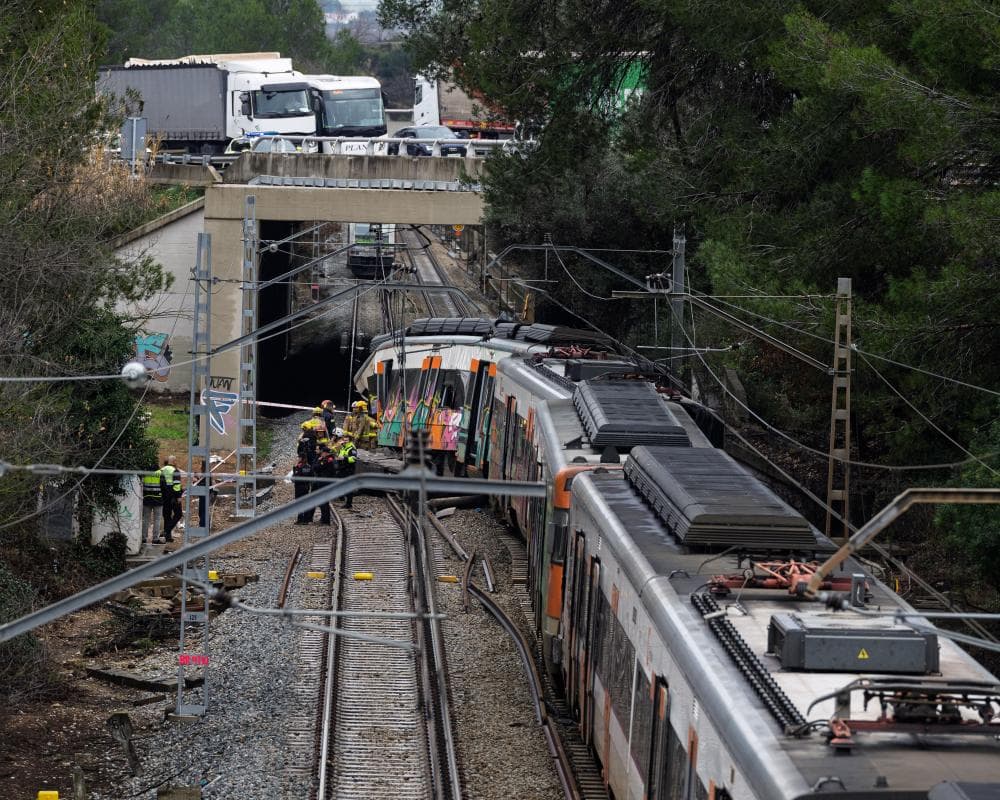
The second crash in as many days occurred at approximately 9pm on Tuesday when a retaining wall collapsed on to the track near Gelida in the region of Catalonia in north-east Spain, derailing a local train.
A trainee driver, named as 27-year-old Fernando Huerta from Seville, was killed and 41 people were injured, five of whom are in a critical condition.
It is believed the wall collapsed as a result of the unusually heavy rainfall that Catalonia is experiencing. However, as a precaution the region’s network was shut down pending inspections, stranding hundreds of thousands of people and causing chaos on the roads.
Earlier in the day, several people were injured, none seriously, when a train on the Maresme coast north of Barcelona struck a rock on the track. After a delay, the train was able to continue its journey.
The incidents have prompted Spain’s biggest train drivers union to call for an indefinite strike to demand assurances for the profession’s safety.
“We are going to demand criminal liability from those responsible for ensuring safety in the railway infrastructure,” the Semaf union said in a statement on Wednesday. It said it could not accept “the constant deterioration of the rail network” and was calling for “urgent new measures”.
While the cause of Monday night’s collision at Adamuz, near Córdoba in southern Spain, is not yet clear, the train’s black box recorder revealed that the driver of the high-speed train from Málaga to Madrid had warned the control centre that he was in trouble moments before.
The driver is heard saying: “I’ve got an enganchón [a snag] near Adamuz.” According to the train operator Adif, the issue referred to was related to the connection between the train’s operating system and the overhead power source. The control centre tells him to disconnect the train from the power source; the driver replies that he has already done so.
He tells the controller to stop all oncoming trains and is told there aren’t any, but only moments later the high-speed train collides with a regional train heading in the other direction. The driver is then heard saying the train has been derailed and calling for emergency services.
The two accidents have focused minds on the rail network – both the nearly 4,000km (2,485 miles) of the super-efficient high-speed AVE network, mostly built with EU funding, and the chronically unreliable and underfunded regional services.
The transport minister, Óscar Puente, stressed during an interview with the television station Telecinco that the two accidents were “completely unrelated”. But opposition parties have seized the opportunity to pile pressure on the government.
“This is too much,” the head of the rightwing Popular party, Alberto Núñez Feijóo, wrote on X as he demanded an “immediate clarification” of the state of the nation’s railways.
Speaking to reporters on Tuesday before the Barcelona-area crash, the far-right Vox party’s spokesperson Pepa Millán claimed Spaniards were now “afraid to get on a train”.
However, while the latest accidents raise concerns about safety, according to EU statistics Spain’s rail network is one of Europe’s safest. According to the same report, in 2024 a total of 16 passengers died in accidents on Europe’s rail networks, among them one passenger in Spain. During the same period there were 20,000 deaths on Europe’s roads.