Loading...
Please wait for a bit
Please wait for a bit
Click any word to translate
Original article by Facundo Iglesia in Buenos Aires
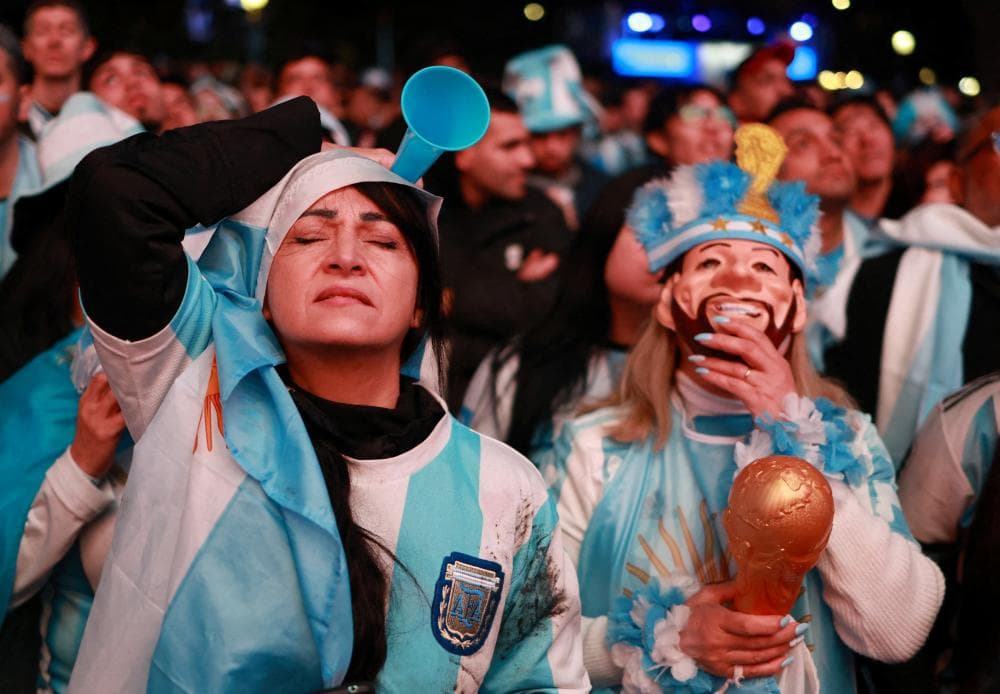
“What happened?” people outside an empanada shop in downtown Buenos Aires ask, trying to read the groans and gestures of the customers inside whose TV was a minute ahead of theirs.
“Spain scored,” says Julián Escalante, 20, holding up his phone. Spain’s Ferran Torres had delivered the decisive blow in the 106th minute of a final that had gone into extra time, sealing a tense, largely one-sided showdown that ended 1-0.
When the final whistle blew, Escalante doesn’t hesitate and reminds the other supporters: “We defeated Los Ingleses [the English], man! And that’s what matters.”
Escalante, a stretcher-bearer, says Argentina’s team “was a bit all over the place, but it doesn’t matter – they gave it everything they had. We made it to the final. We made it to extra time. That’s because we’ve got huevos.”
“This is the first time I’ve felt so proud of my country,” he says, heading toward the Obelisco, the designated meeting point to celebrate Argentina’s efforts. “We beat France in the final [in 2022]. We have three World Cups. Messi retired from the Argentina national team as the greatest player in the world.”
Cintia Martínez, 28, a housekeeper, can barely hold back tears. “I don’t want to speak much, because my son is crying and I will too,” she says, holding her four-year-old’s hand. Also heading to the Obelisco, she says she was celebrating anyway, “because we made it to the final”.
Thousands did the same and went to the monument. The 67-metre-high Obelisco was lit up with images of the Argentinian squad and its supporters, amid the sound of fireworks nearby. A street vendor sold Fernet, a spirit, with coke: “To wash the anger down!”
Next to the Obelisco, Ellen Vicente, 20, a Brazilian medical student wearing an Argentina jersey, says she came out because she respects Argentinians and considers it “an honour” to live in the country. “We are not Argentine, but you played very well, and I’m very proud,” she says. Asked about recent racism accusations against Argentinians, she said they’re partly substantiated. “I am Black, and it is real, but we can’t generalise – this country has welcomed us, and most people treat us well,” she adds. “And Argentina deserved to win.”
Emiliano Romero, 18, hung an Argentine banner on the Obelisco’s fence. It read: “Thank you! You made a people happy. Love is paid with love.” Romero explains: “This is love for our country, something I can’t explain. Football is like that – you win, and you lose. But we’re proud of the result all the same.”
Young people sat along the fence of the Obelisco. “We’re climbing up here because of the euphoria of the moment, of wanting to be seen, of the love all Argentines have for one another,” said Sofía Gómez, 22, a shop assistant. “Those who watched the match knew that, for Leo Messi’s last game, it had to be Argentina.”