Loading...
Please wait for a bit
Please wait for a bit
Click any word to translate
Original article by Patrick Wintour Diplomatic editor
The indefatigable ability of UK Foreign Office ministers over decades to issue boilerplate statements of concern about the extension of illegal settlements in Israel has long been a matter of ridicule.
Even some of the Conservative ministers who issued them, notably Alan Duncan and Alistair Burt, have agreed. Duncan described the UK stance towards settlements as weak and naive, while Burt wondered at the ability of the Foreign Office to find new forms of diplomatic condemnation that never amounted to any specific action. Margaret Thatcher, often torn as prime minister between her natural sympathy for Israel and her fear of the Gulf states falling under the sway of the Soviet Union, similarly expressed her anger at the settlements.
But in the face of the Israeli disillusionment with a two-state solution – to which the UK had been committed at the UN since 1946, if not before – the UK produced little practical policy to prevent the spread of Israel’s illegal settlements.
The UK-Israel trade agreement prevented preferential tariffs applying to goods coming from territories brought under Israeli administration after June 1967. The business department also advised companies not to trade with the settlements – but many simply ignored the advice or, to secure the preferential tariff, relabelled their goods as from Israel. The then trade minister Chris Bryant told the business select committee in June it was very difficult to be certain of the origin of goods.
At the same time, the legal advice was that the UK regime could place sanctions on entities only if they were linked to settler violence, but could not put a contractor under sanctions simply for working on settlements.
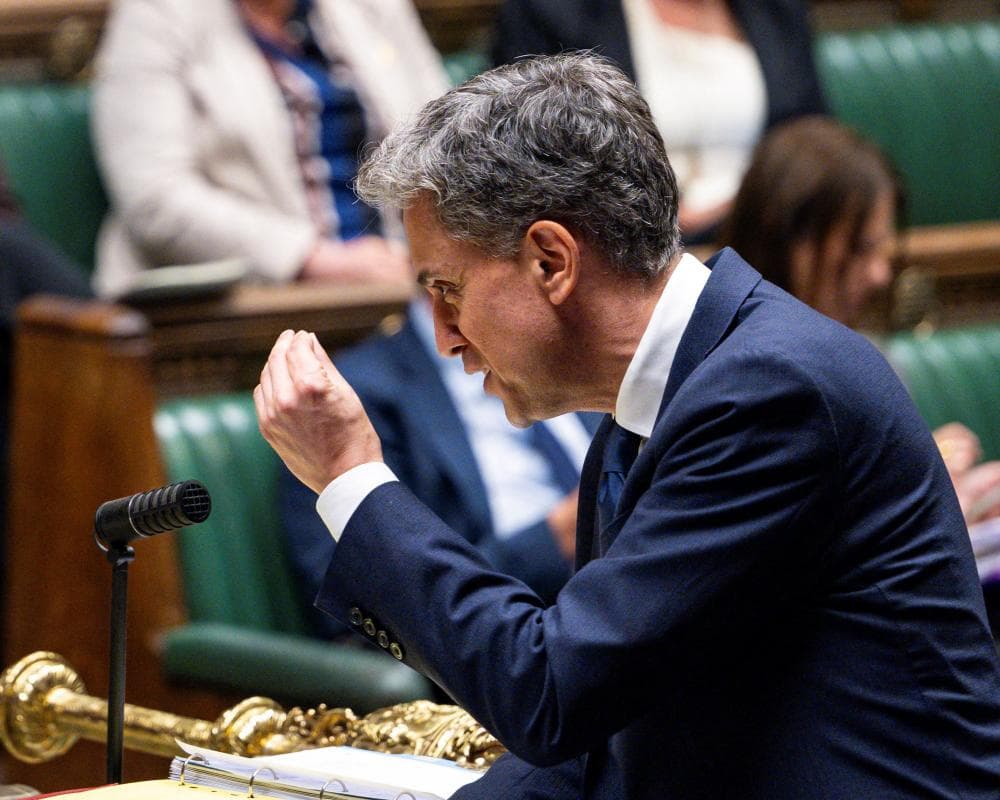
It was this unhappy moral and legal mess that Ed Miliband inherited. As soon as he took office as foreign secretary, he said he refused to be a bystander to further suffering and the destruction of the two-state solution that settlement expansion represented. In this he had the support of the prime minister, Andy Burnham.
Above all, Miliband felt that the UK could not feign powerlessness, and to do so, or pay lip service to action, would prove disastrous to Israel’s own future. He was perhaps the only front-rank Labour politician who could push this argument through at such pace, overturning the inertia and caution built into Foreign Office legal advice.
His Jewish heritage – his mother, Marion Kozak, was a Holocaust survivor who fled to Israel – his life growing up with the Palestinian question and empathy for those subjected to antisemitism put him in a near unimpeachable position to adopt the role of Israel’s critical friend.
The US ambassador to Israel, Mike Huckabee, might this week say the Labour government is gripped by Jew-hatred, a charge he laid at Miliband’s door knowing he is Jewish, but Miliband’s riposte is simple. The best route to Israel’s security lay in Palestinian self-determination and the introduction of the two-state solution in its fullest form. To equate Israel only with the current Likud-led government as too many Conservatives have been prone to do, was a category error, he said: “Holding Jewish people responsible for the actions of the Israeli government is antisemitism, plain and simple.”
He is thus the first UK foreign secretary to describe what is happening in the West Bank as ethnic cleansing, and in so doing to in effect to accuse Israel of turning a blind eye to acts that amount to war crimes.
Miliband also ended the two years of delay in responding to the international court of justice advisory opinion in June 2024 that the occupation is unlawful. In what he admitted was an overdue statement of reality, he accepted the ICJ opinion that the occupation, and not just the settlements, were so designated. Accepting the ICJ opinion arguably places stronger obligations on the UK government to not assist the occupation. It may help to explain why the trade ban extends into services such as providing insurance for illegal settlements.
The biggest diplomatic rabbit Miliband pulled from the hat was the agreement of France and Canada to impose similar trade bans. France took the lead last year on recognition of Palestine; this year, it is the turn of the UK to lead on following through on the consequences of that recognition.
Paris appears to have been persuaded by the UK to stop waiting for the EU to reach an agreement on collective action, since it seemed unlikely the opposition in Germany and indifference in parts of the European Commission would end. A group of countries imposing the trade ban together of course makes Israeli reprisals harder, and serves to underline Israel’s isolation.
The perceived weaknesses are obvious.
Miliband still left it to the international courts to determine whether a genocide occurred in Gaza, something that might not be adjudicated for at least five years. There was mounting evidence of ethnic cleansing in Gaza, he said, but again it was for the courts to determine if that was so.
There is no pledge to protect the international court of justice or the international criminal court from the US drive to render them inoperable. As to a UK arms sales ban, an exemption continues for the sale of parts for F35 jet planes to the main US spares pool – all on the basis the F-35 jets “do not materially support the occupation” – the criteria the foreign secretary has set.
Miliband specifically condemned the Boycott, Disinvestment and Sanctions movement because it targets the whole Israeli economy and not just the occupied territories. The secondary legislation required to make sanctions as wide as envisaged may take as long as nine months, contrasting with the speed with which sanctions were enforced against Russia over the annexation of Crimea.
But to focus solely on what is absent is to miss the moment. Duncan, for instance, said: “At last, in the face of state-backed terrorism by illegal settlers, the British government has shown unprecedented moral courage.”
There is a risk of a cascading backlash from the White House – but Trump, trapped in a political labyrinth after he was persuaded to attack Iran, has little reason to come to Benjamin Netanyahu’s aid. Miliband has taken a risk, but after more than 70,000 deaths in Gaza, and the two-state solution on life support, it may be time to dare.