Loading...
Please wait for a bit
Please wait for a bit
Click any word to translate
Britain will host further talks on reopening the vital Strait of Hormuz shipping lane with a coalition of countries next week.
The meeting will continue the UK government’s efforts to restore freedom of navigation to the strait, which provides shipping routes for oil and gas.
It comes after the Prime Minister spoke to Donald Trump about the need for a “practical plan” to get ships going through the area amid suggestions Iran wants to charge vessels for passage.
An official with knowledge of the planning has said the meeting is expected to look for ways to support a sustainable end to the conflict and focus on increasing international diplomatic pressure on Iran to reopen the strait.
This includes exploring coordinated economic and political measures, such as sanctions, and working with the International Maritime Organisation to secure the release of thousands of ships and sailors trapped in the strait.
The White House considered but decided against a national televised address by Donald Trump on Tuesday to announce the ceasefire deal with Iran, with some aides and advisers privately voicing concern about potentially overselling the still-nascent agreement, three US officials have told Reuters.
The decision suggests a balancing act by the Trump administration, which sought to project early confidence in the deal to pause fighting and open the strait of Hormuz even as aides recognised its fragility.
Ahead of talks slated to begin on Saturday in Islamabad, it is far from clear if the ceasefire will translate into a negotiated settlement to the war.
Reuters’ sources said Trump was talked out of making the speech. But the White House denied the discussions rose to Trump’s level. It said in a statement:
This is fake news. This was never even discussed with the president.
As you will remember, Trump ended up announcing the ceasefire in a social media post just hours before his Tuesday 8pm ET deadline, after which he had threatened to wipe out Iran’s “whole civilisation”.
One of the sources told Reuters that Trump had been “adamant” about delivering the address. The officials said it had been under consideration, but the White House did not move forward with it because details of the ceasefire were still shaky.
Trump’s senior advisers were working through what was in the deal and did not think they had enough clarity for the US president to address the nation, the sources said.
One senior White House official acknowledged internal discussions about Trump addressing the nation on Tuesday night.
“There was chatter about it, but obviously it didn’t come to fruition, and we didn’t alert the networks or anything; it didn’t get that far,” the official told Reuters, without confirming whether Trump was talked out of giving an address.
This weekend’s negotiations between Iran and the US in Islamabad are “make or break” to achieve a permanent ceasefire, Pakistan’s prime minister has said.
Shehbaz Sharif said in a televised address:
This is a make-or-break moment. I ask all of you to pray that these talks are successful and countless lives are saved and the world shall see peace.
He said that – “God-willing” – negotiators from both the US and Iran would be present for the talks in Islamabad on Saturday, adding that hosting the talks is “not just a proud moment for Pakistan but for the entire Muslim world”.
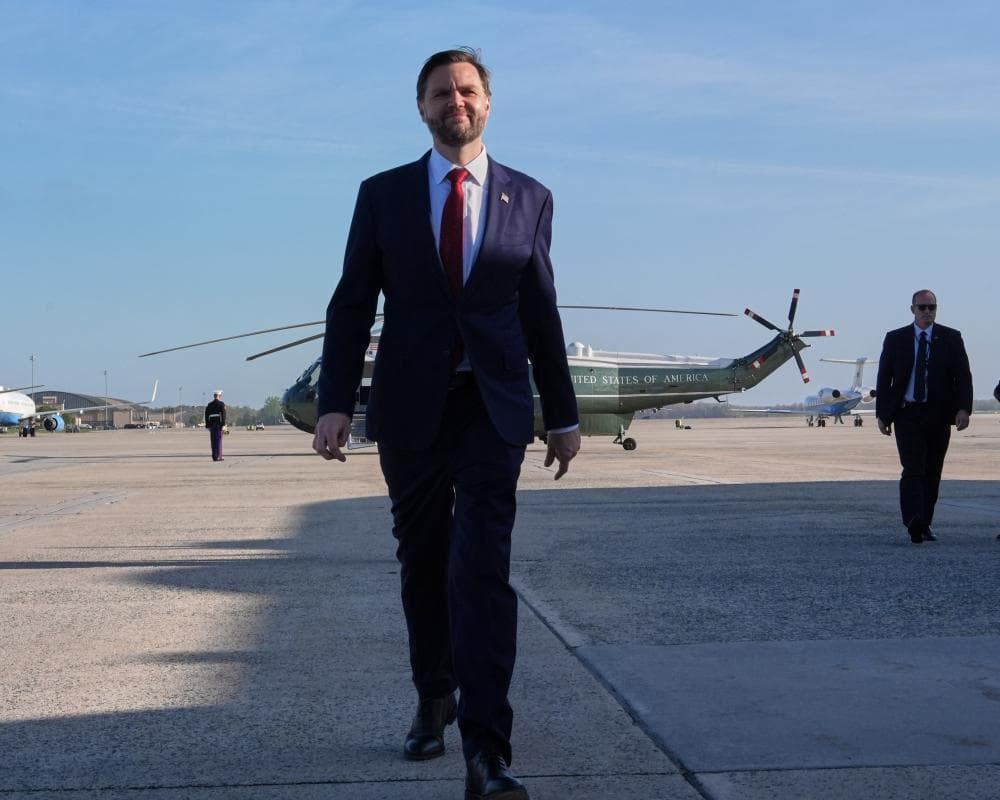
US vice-president JD Vance boarded a plane bound for the negotiations in Pakistan on Friday morning, saying that he was “looking forward” to the talks and he expected them to be positive, though he warned Iran not to “play” the United States.
There are conflicting reports over whether Iran’s delegation, which will include parliament speaker Mohammad Bagher Ghalibaf and foreign minister Abbas Araghchi, has departed for Islamabad.
Ghalibaf said on Friday that two previously agreed measures, a ceasefire in Lebanon and the release of Iran’s blocked assets, “must be fulfilled before negotiations begin”.
Updated
Lebanon’s health ministry has updated the death toll from Israel’s most brutal strikes on the country in years on Wednesday to 357 killed.
The health ministry said that with rubble removal operations ongoing and “the presence of a very large number of remains, which require time to complete DNA testing and confirm the identities of the victims”, the figure remains “non-final”.
It brings the total killed since Israel renewed its offensive on 2 March to more than 1,953 people. The number of people wounded stands at 6,303, the health ministry added.
Updated
There has to be a ceasefire in Lebanon and it is “not acceptable” to be “negotiating under bombardment”, the country’s minister of social affairs has said, accusing Israel of committing war crimes by targeting civilians.
Haneen Sayed told Sky News that “what happened two days ago was really unbelievable”. In a punishing wave of strikes across Lebanon, Israel killed more than 300 people and injured over 1,000 others on Wednesday.
Lebanon’s prime minister, Nawaf Salam, accused Israel in a statement of targeting “densely populated residential neighbourhoods” and killing unarmed civilians in breach of international law.
“It goes beyond what anyone expected,” Sayed said, adding that it’s a “huge calamity”.
Despite international condemnation, Israel has continued to bombard Lebanon since, insisting that the country was never included in the ceasefire agreed by the US and Iran, even though Iran and Pakistan – which helped broker the deal – said it was.
Lebanon and Iran are demanding that Israel must agree to a ceasefire before talks between Lebanon and Israel can begin. Israel, meanwhile, has insisted that “talks will be held under fire”.
Sayed said that was an unacceptable expectation.
Negotiating under bombardment and, you know, bombs falling over our heads is not acceptable. So that’s a condition.
There “has to be a ceasefire”, she said.
She also accused Israel of committing war crimes.
I can say war crimes have been committed. There is no explainable reason why that many ... civilians and health workers are targeted. Entire buildings were flattened, as you know.
People are still burying their dead, she said, after the country observed a day of mourning on Thursday.
Updated
Melania Trump made a surprise appearance at the White House on Thursday to announce that she “never had a relationship” with the late child sex offender Jeffrey Epstein and his accomplice Ghislaine Maxwell. Her address has seemingly put Epstein back on the political agenda when focus had been firmly on the US and Israel’s war in Iran.
The intervention came at a difficult time for her husband, Donald Trump, as the fragile ceasefire agreed between the US and Iran seemed to be at risk of falling apart, and as US lawmakers are raising the alarm over the president’s mental stability.
In today’s edition of The Latest podcast, Lucy Hough speaks to the Guardian US editor, Betsy Reed, Trump’s rhetoric in the Iran war, and whether there is anything to be hopeful about in US politics.
Updated
US inflation soared in March amid the US-Israel war with Iran, with prices up 0.9% compared with last month and 3.3% over the year, according to new data released on Friday.
The spike in the consumer price index (CPI), which measures the price of a basket of goods and services, is the largest in nearly two years and the first official measure of how the conflict has affected US consumer prices, particularly as Iran blocked the strait of Hormuz, through which a fifth of the world’s oil and gas would typically pass.
The index for energy rose 10.9% in March, led by a 21.2% increase in the index for gasoline which accounted for nearly three-quarters of the monthly all items increase. Airfares rose 2.7% in March and were 14.9% higher than a year earlier.
Core inflation – which strips out volatile food and energy prices – rose at a more modest 0.2% over the month and was 2.6% higher over the year.
The annualized inflation rate has not pushed past 3% since summer 2024, when inflation was finally cooling after reaching a generational high of 9.1% in June 2022.
The war on Iran has driven the American economy into deeper uncertainty, adding to a precariousness that first came with Donald Trump’s tariffs last year. Inflation reached a four-year low last April, when price increases dropped to 2.3%. It rose to 3% by September, before coming back down to 2.4% in January and February.
Oil prices dropped after Trump announced a two-week ceasefire with Iran, which agreed to reopen the strait during the ceasefire period, but oil prices still remain high. Even after the agreement was announced, US crude oil was still priced 10% higher than before the conflict and nearly 30% higher since the start of the year.
Read the full story here:
US vice-president JD Vance has warned Iran not to “play” the US as he headed overseas for negotiations aimed at ending their war. Vance, who has long been sceptical of foreign military interventions and outspoken about the prospect of sending troops into open-ended conflicts, set off Friday to lead mediated talks with Iran in the Pakistani capital of Islamabad.
President Donald Trump has said that US warships are being reloaded with weaponry to strike Iran if talks in Pakistan fail to produce a deal, in an interview with the New York Post. “We have a reset going. We’re loading up the ships with the best ammunition, the best weapons ever made – even better than what we did previously and we blew them apart,” the Post quoted Trump as saying.
Iran’s parliament speaker Mohammad Baqer Qalibaf said on Friday that two previously agreed measures, a ceasefire in Lebanon and the release of Iran’s blocked assets, must be implemented before negotiations begin. In a post on X on Friday, Qalibaf said the steps were part of commitments made between the parties and warned that talks should not start until they were fulfilled, amid mounting disputes over ceasefire terms and continued hostilities in Lebanon.
US negotiators intend to request the release of Americans detained in Iran as part of upcoming talks aimed at ending the war, according to media reports. The Washington Post cited people briefed on the plans in its report.
Iran-backed Hezbollah fired around 30 projectiles from Lebanon into Israel on Friday, the Israeli military said, reporting that some strikes caused damage. Air-raid sirens were activated across northern Israel near the Lebanese border, where Israeli forces and Hezbollah militants have continued to exchange fire despite a truce in the broader conflict involving Iran.
Lebanon’s president Joseph Aoun said on Friday that 13 state security personnel were killed in an Israeli strike on a governmental building in the southern city of Nabatieh. In a statement, Aoun condemned continued Israeli attacks and said targeting state institutions would not deter Lebanon from defending its sovereignty, Reuters reported.
Israel’s foreign affairs ministry announced Spanish representatives will not be allowed access to the US-led centre responsible for monitoring the ceasefire in the Gaza Strip due to what it described as a “blatant anti-Israeli bias”. In a statement on its website, the ministry said the decision was made to block Spain from participating in the Civil-Military Coordination Center (CMCC) in light of “the anti-Israel obsession of [Spanish] Prime Minister [Pedro] Sánchez’s government and its serious harm to Israeli (and also American) interests - including during the war against Iran”.
European airports have said jet fuel shortages could hit the summer holiday season, if oil supplies do not start to flow through the strait of Hormuz within the next three weeks. Airports Council International (ACI) Europe wrote to Apostolos Tzitzikostas, the EU transport commissioner, saying the bloc is three weeks away from shortages.
The Israeli military has claimed to have destroyed more than 200 Hezbollah rocket launchers since the start of the conflict. The Israel Defense Forces (IDF) said in a statement online that it destroyed more than 200 rocket launchers, including approximately 1,300 launch tubes, belonging to the Iran-backed militant group since 2 March.
Keir Starmer said he used a call with Donald Trump to set out the views of Gulf states, the Press Association reported. “I had a discussion with president Trump last night and set out to him the views of the region here, these Gulf states are the neighbours of Iran, and therefore, if the ceasefire is to hold – and we hope it will - it has to involve them,” the UK prime minister said in Qatar, where he was on the final leg of his Middle East tour.
Anwar Gargash, the UAE’s senior diplomatic envoy, said on X that his country will review regional and international ties in light of attacks by Iran to “determine who can be relied upon”. The UAE’s defence ministry said yesterday that its air defences have intercepted 537 ballistic missiles, 26 cruise missiles and 2,256 drones since the start of the war.
The UN children’s agency, Unicef, reported that nearly 600 children have been killed or injured in Lebanon since the outbreak of the latest Israel-Hezbollah war on 2 March. More than 30 children were killed and nearly 150 injured by the wave of bombings carried out on Wednesday by Israeli troops, Unicef said.
Donald Trump said that Iran has “no cards” ahead of peace talks in Pakistan in a post on social media this afternoon.
Writing on Truth Social, he said:
The Iranians don’t seem to realize they have no cards, other than a short term extortion of the World by using International Waterways. The only reason they are alive today is to negotiate!
Updated
President Donald Trump has said that US warships are being reloaded with weaponry to strike Iran if talks in Pakistan fail to produce a deal, in an interview with the New York Post.
“We have a reset going. We’re loading up the ships with the best ammunition, the best weapons ever made – even better than what we did previously and we blew them apart,” the Post quoted Trump as saying.
“And if we don’t have a deal, we will be using them, and we will be using them very effectively.”
He added:
We’re going to find out in about 24 hours. We’re going to know soon.
In a brief and cryptic message on his Truth Social network earlier, Trump had spoken of the “WORLD’S MOST POWERFUL RESET!!!”
Iran-backed Hezbollah fired around 30 projectiles from Lebanon into Israel on Friday, the Israeli military said, reporting that some strikes caused damage.
Air-raid sirens were activated across northern Israel near the Lebanese border, where Israeli forces and Hezbollah militants have continued to exchange fire despite a truce in the broader conflict involving Iran.
Israeli emergency services reported a strike in Safed, where a direct hit damaged several vehicles, AFP reported.
The emergency services reported additional impacts in the Galilee region, including in Baana and Deir al-Assad, where a building was hit.
European airports have said jet fuel shortages could hit the summer holiday season, if oil supplies do not start to flow through the strait of Hormuz within the next three weeks.
Airports Council International (ACI) Europe wrote to Apostolos Tzitzikostas, the EU transport commissioner, saying the bloc is three weeks away from shortages.
The warning will raise concerns of a risk of flight or holiday cancellations if the US and Israel’s war on Iran continues. Oil prices have soared since the start of March after Iran effectively closed the strait of Hormuz, a key shipping route for exports from the Gulf, in retaliation.
Donald Trump this week announced a ceasefire, but Brent crude oil prices remained at about $96 per barrel on Friday amid concerns over whether it would hold. Before the war, oil traded at about $72.
Lebanon’s president Joseph Aoun said on Friday that 13 state security personnel were killed in an Israeli strike on a governmental building in the southern city of Nabatieh.
In a statement, Aoun condemned continued Israeli attacks and said targeting state institutions would not deter Lebanon from defending its sovereignty, Reuters reported.
An AFP photographer saw extensive damage at the site, where a fire was still raging.
Updated
Iran’s parliament speaker Mohammad Baqer Qalibaf said on Friday that two previously agreed measures, a ceasefire in Lebanon and the release of Iran’s blocked assets, must be implemented before negotiations begin.
In a post on X on Friday, Qalibaf said the steps were part of commitments made between the parties and warned that talks should not start until they were fulfilled, amid mounting disputes over ceasefire terms and continued hostilities in Lebanon.
Pope Leo has issued a thinly-veiled criticism of the US-Israeli war on Iran, saying “military action will not create space for freedom”.
Writing on X, he also said that God “does not bless any conflict”.
He said:
God does not bless any conflict. Anyone who is a disciple of Christ, the Prince of Peace, is never on the side of those who once wielded the sword and today drop bombs.
Military action will not create space for freedom or times of #Peace, which comes only from the patient promotion of coexistence and dialogue among peoples.
US negotiators intend to request the release of Americans detained in Iran as part of upcoming talks aimed at ending the war, according to media reports.
The Washington Post cited people briefed on the plans in its report.
Here are some of the latest images on the newswires:

Further to the announcement by the Israeli foreign affairs ministry of Spain’s exclusion from the Civil-Military Coordination Center (see previous post), the Israeli prime minister, Benjamin Netanyahu, has accused Madrid of “hostility” towards his country.
In a video message posted today, he said:
Israel will not remain silent in the face of those who attack us.
Spain has defamed our heroes, the soldiers of the IDF, the soldiers of the moral army in the world.
Therefore, I have instructed the removal of the Spanish representatives from the coordination center in Kiryat Gat, after Spain has repeatedly chosen to stand against Israel.
Whoever attacks the State of Israel instead of the terrorist regimes, whoever does this, will not be our partner in the future of the region.
I am not willing to tolerate this hypocrisy and this hostility. I do not intend to allow any country to wage a diplomatic war against us without paying an immediate price for it.
Israel’s foreign affairs ministry announced Spanish representatives will not be allowed access to the US-led centre responsible for monitoring the ceasefire in the Gaza Strip due to what it described as a “blatant anti-Israeli bias”.
In a statement on its website, the ministry said the decision was made to block Spain from participating in the Civil-Military Coordination Center (CMCC) in light of “the anti-Israel obsession of [Spanish] Prime Minister [Pedro] Sánchez’s government and its serious harm to Israeli (and also American) interests - including during the war against Iran”.
It added that the US was informed in advance of the decision.
Sánchez has arguably been the most vocal western critic of Donald Trump’s war in Iran. While most European leaders have reacted with cautious optimism at news of the ceasefire between the US and Iran, Sánchez said his government “will not applaud those who set the world on fire just because they show up with a bucket”.
In a statement, the Israeli foreign affairs minister, Gideon Saar, said: “The Sánchez government’s anti-Israel bias is so egregious that it has lost all capability to serve as a constructive actor in implementing President Trump’s peace plan and in the CMCC operating under that plan.”
US vice-president JD Vance has warned Iran not to “play” the US as he headed overseas for negotiations aimed at ending their war.
Vance, who has long been sceptical of foreign military interventions and outspoken about the prospect of sending troops into open-ended conflicts, set off Friday to lead mediated talks with Iran in the Pakistani capital of Islamabad.
Boarding Air Force Two on his way to Pakistan, the vice president said:
We’re looking forward to the negotiation. I think it’s gonna be positive. We’ll of course see.
He cited Trump, adding: “If the Iranians are willing to negotiate in good faith, we’re certainly willing to extend the open hand.”
But he said: “If they’re gonna try and play us, then they’re gonna find that the negotiating team is not that receptive.”
Vance also said that Trump “gave us some pretty clear guidelines” on how talks should go, but he didn’t elaborate. The vice president did not take questions from reporters traveling with him.
Updated
Hezbollah chief Naim Qassem on Friday called on the Lebanese government to stop giving “free concessions” to Israel, with the two governments due to begin negotiations in Washington next week.
“We will not accept a return to the previous situation, and we call on officials to stop offering free concessions,” Qassem said in a written message broadcast on the party’s Al-Manar TV, in which he also denounced the “bloody criminality on Wednesday,” when Israeli strikes killed more than 300 people in Lebanon.
US trade representative Jamieson Greer said on Friday that the United States is trying to have a stable relationship with China, but if Beijing is going to be involved with Iran in a way that goes against US interests, that would complicate matters.
In an interview on CNBC, Greer said he expected president Donald Trump to have a good meeting next month with Chinese president Xi Jinping but not every challenge with China is resolved.
Hezbollah said it had targeted Israel’s Ashdod naval base with missiles, two days after deadly Israeli airstrikes on Beirut left more than 300 people dead.
“In response to the enemy’s violation of the ceasefire and its repeated attacks on Beirut, and after the Resistance adhered to the ceasefire while the enemy did not, the fighters of the Islamic Resistance targeted... the naval base in the port of Ashdod with missiles,” the group said in a statement.
Iran’s deputy foreign minister for political affairs, Majid Takht Ravanchi, said Tehran does not want a ceasefire that will allow the US and Israel to attack again.
Iran’s semi-official Tasnim news agency reported remarks he made during a meeting today with foreign ambassadors and heads of organisations in Tehran.
A translation of his remarks read: “We do not want a ceasefire that allows the aggressor enemy to re-arm and launch another aggression.”
He also claimed that “it has been agreed that Iran’s 10-point plan will be the basis for negotiations”.
Gulf states rethink security in light of US-Israel war on Iran
Gulf nations will seek to add security partners as they rebuild battered economies after the US and Israel’s war on Iran and deal with an emboldened Tehran.
The Gulf will have to live with a continuing threat from the regime in Iran and its remaining missile arsenal. American bases on their soil turned them into targets for Iran, as it retaliated against a joint attack by the US and Israel.
But, the countries say they can’t tolerate Iran keeping control of the strait of Hormuz, through which most of their trade flows. In agreeing to a ceasefire this week, Iran insisted it would retain the hold it took during the war over the waterway, which would allow Tehran to throttle the Gulf at will. The future of the strait will be one of the main disputes to be negotiated between the United States and Iran, in talks in Islamabad due to start as soon as Friday.
Gulf nations trumpeted success in largely intercepting the Iranian barrage of missiles and drones over the five weeks of the conflict, showing they can defend themselves.
The countries are, however, split over future relations with Iran, with a hawkish grouping led by the United Arab Emirates and Bahrain taking a harder line, and other nations hoping for peace through renewed ties with Tehran, experts say.
Read the full report here:
The Israeli military has claimed to have destroyed more than 200 Hezbollah rocket launchers since the start of the conflict.
The Israel Defense Forces (IDF) said in a statement online that it destroyed more than 200 rocket launchers, including approximately 1,300 launch tubes, belonging to the Iran-backed militant group since 2 March.
Keir Starmer said he used a call with Donald Trump to set out the views of Gulf states, the Press Association reported.
“I had a discussion with president Trump last night and set out to him the views of the region here, these Gulf states are the neighbours of Iran, and therefore, if the ceasefire is to hold – and we hope it will - it has to involve them,” the UK prime minister said in Qatar, where he was on the final leg of his Middle East tour.
“They have very strong views on the strait of Hormuz. We spent most of the time on the call talking about the practical plan that’s going to be needed to get navigation through the strait and the role that the UK is playing.”
Anwar Gargash, the UAE’s senior diplomatic envoy, said on X that his country will review regional and international ties in light of attacks by Iran to “determine who can be relied upon”.
The UAE’s defence ministry said yesterday that its air defences have intercepted 537 ballistic missiles, 26 cruise missiles and 2,256 drones since the start of the war.
Keir Starmer said he is “fed up” with energy bills going up in the UK “because of the actions of Putin and Trump”.
The remarks, made during an interview with ITV, were a rare display of frustration by the UK prime minister who seldom calls out Donald Trump directly in public. And, in this instance, he has linked the US president with Vladimir Putin.
Starmer is due to return to the UK today after visiting allies in the Gulf for talks on how to support the US-Iran ceasefire and secure a permanent reopening of the strait of Hormuz. After travelling to Bahrain, Saudi Arabia and the UAE, his last stop is Qatar.
You can follow our UK politics blog where my colleague Andrew Sparrow is reporting the latest on the impact of war on the UK and other related news:
Pictures: Islamabad on high alert ahead of talks between Iranian and US negotiators
The UN children’s agency, Unicef, reported that nearly 600 children have been killed or injured in Lebanon since the outbreak of the latest Israel-Hezbollah war on 2 March.
More than 30 children were killed and nearly 150 injured by the wave of bombings carried out on Wednesday by Israeli troops, Unicef said.
In a statement, the agency said:
Unicef is receiving reports of children being pulled from under the rubble, while others remain missing and separated from their families. Many are experiencing trauma, having lost loved ones, their homes, and any sense of safety. Across the country, more than one million people have been uprooted, including an estimated 390,000 children, many for the second, third, or even fourth time.
International humanitarian law is clear: civilians, including children, must be protected at all times.
Updated
The Israeli military has repeated the claim that Hezbollah is using ambulances for military purposes.
In a post on X, Avichay Adraee, the Arabic-language spokesperson for the Israel Defense Forces (IDF), accused Hezbollah of making “extensive military use” of ambulances, without providing evidence.
A few weeks ago, my colleague, William Christou, spoke to medics in Lebanon, visited destroyed medical centres and inspected damaged ambulances to explore the IDF’s claim. He found that none of the sites showed signs of military use. Lebanese healthcare workers and officials say Israel is deliberately targeting medical workers and facilities, including through the use of double-tap strikes. You can read the report here:
Spain’s foreign minister, José Manuel Albares, said he urged his Iranian counterpart, Abbas Araghchi, to negotiate “in good faith” during talks with the US in Islamabad.
Albares said he spoke to Araghchi “the day before yesterday” and had asked him to halt “all missile and drone launches”.
“I encourage Iran – this is what I conveyed to the Iranian foreign minister – to take part in those negotiations and to participate in good faith,” he said, according to the AFP news agency.
He again condemned Israel over its continued strikes on Lebanon, saying the attacks were a “disgrace on the conscience of humanity”.
He added: “The level of violence, the violation of international law and international humanitarian law by Israel is unacceptable.”
UK defence minister Luke Pollard said there is no truth in Donald Trump’s claims that the Royal Navy is “too old” and that its aircraft carriers “don’t work” and are “toys”.
“We’ve got a strong Royal Navy,” he told BBC Breakfast.
“HMS Sutherland, the Type 23 frigate behind me here, is crewed by brilliant men and women. We’ve got a globally deployed navy at the moment.”
Pollard added that the UK has a “unique convening role” that it can use to bring its friends and allies together to work out solutions to reopen the strait of Hormuz.
Pakistan’s defence minister, Khawaja Asif, has deleted a post on X in which he called Israel “cancerous” and a “curse for humanity”.
The post appeared on X last night but has since been deleted, Reuters news agency reported.
In the post, Asif wrote that as “peace talks are underway in Islamabad, genocide is being committed in Lebanon”. He added that “innocent citizens are being killed by Israel, first Gaza, then Iran and now Lebanon, bloodletting continues unabated”.
The Israeli prime minister’s office said the remarks were “outrageous”. In a post on X, it said: “This is not a statement that can be tolerated from any government, especially not from one that claims to be a neutral arbiter for peace.”
The Israel Defense Forces (IDF) chief of staff, Eyal Zamir, said Israeli forces are continuing their combat operations in southern Lebanon and are “not in a ceasefire” with Hezbollah, according to remarks released by the IDF.
During a visit near Bint Jbeil in southern Lebanon, Zamir said:
The IDF is in a state of war, we are not in a ceasefire, we continue to fight here in this sector, this is our main fighting sector. In Iran, we are in a ceasefire, and we can return to fighting there at any moment, and in a very powerful manner.
An intense wave of Israeli airstrikes in Lebanon on Wednesday killed more than 300 people, according to Lebanese authorities, making it the deadliest day for the country since the recent bout of fighting between Israel and Hezbollah began on 2 March.
Several world leaders, including the UK, have condemned Israel’s strikes and have called for Lebanon to be included in the US-Iran ceasefire.
Volodymyr Zelenskyy said Ukrainian teams deployed to the Middle East to bolster air defences in the region have shot down Iranian Shahed drones.
“We demonstrated to some countries how to work with interceptors,” the Ukrainian president said in a post on X.
“Did we destroy Iranian “shaheds?” Yes, we did. Did we do it in just one country? No, in several. And in my view, this is a success.”
Zelenskyy said Ukrainian forces took part in active operations using domestically produced, battle-tested interceptor drones.
“This was not about a training mission or exercises, but about support in building a modern air defence system that can actually work,” he added.
An Iranian delegation arrived in the Pakistani capital Islamabad last night for mediated talks with the US, the Wall Street Journal reported, citing people familiar with the matter.
The delegation is led by the Iranian foreign minister, Abbas Araghchi, and parliament speaker, Mohammad Bagher Ghalibaf, according to the report.
Iran’s semi-official Tasnim news agency has reported that news of Iranian officials arriving in Islamabad to negotiate with the US “is completely false”. Other state-affiliated media in Iran have also reported such denials.
US vice-president JD Vance is expected to lead the US delegation. He will be joined by US special envoy Steve Witkoff and Donald Trump’s son-in-law Jared Kushner, both of whom took part in three rounds of indirect nuclear talks with Iranian negotiators in Oman before the US and Israel launched attacks against Iran on 28 February.
Iran is taking steps to keep control over maritime traffic through the strait of Hormuz in order to exert pressure on the US, thinktank the Institute for the Study of War (ISW) has said.
The effect is that oil prices will remain high so that Iran goes into upcoming negotiations with the US with more leverage to extract concessions, ISW reports.
According to ISW, Iranian officials have said Iran will not allow more than 15 vessels per day to transit through the strait. Prior to the war, up to 140 vessels a day travelled through the strait.
The Iranian Ports and Maritime Organization published a graphic on April 8 instructing ships to follow designated entry and exit routes in coordination with the Islamic Revolutionary Guards Corps (IRGC) Navy to transit the strait. These routes move international maritime traffic into Iranian-controlled waters. The graphic warns that ships risk hitting mines outside of these routes.”
Indonesia has said it has submitted a joint statement on peacekeeper security with dozens of allied nations to the United Nations after three of its blue helmets were killed in Lebanon.
In the joint statement, the countries urged the UN Security Council to conduct a thorough investigation into the incidents in southern Lebanon that killed three Indonesian peacekeepers and wounded several others, including from France, Ghana, Nepal, and Poland.
The foreign ministry in Jakarta said 73 countries and UN observer nations supported the statement, delivered by Indonesia’s permanent representative to the UN, Umar Hadi, in New York.
“The safety and security of UN peacekeepers are non-negotiable. We urge the UN Security Council to use all available instruments to strengthen protection for peacekeeping forces amid an increasingly dangerous situation,” the ministry quoted Umar as saying.
“Troop-contributing countries also call for an end to violence in Lebanon, de-escalation of tensions, and encourage all parties to return to the negotiating table to achieve a peaceful settlement,” it added.
Three Indonesian peacekeepers died in two separate blasts in southern Lebanon in late March. A third blast less than a week later – inside a UN facility in southern Lebanon – injured three more Indonesian soldiers.
JD Vance heads to Pakistan this week with orders from Donald Trump to turn the shaky Iran ceasefire into a lasting peace deal.
For the 41-year-old Vance, who has kept a notably low profile during the Middle East conflict, it will be one of the biggest moments of his career. But the man widely regarded as a leading contender in the 2028 US presidential election will face huge challenges too when talks begin Saturday in Islamabad.
“I cannot think of a case where the vice president ran formal negotiations like this,” Aaron Wolf Mannes, a lecturer at the University of Maryland School of Public Policy and an expert on the American vice presidency’s role in foreign policy, told the AFP news agency.
This is high risk, high reward.”
Vance built his political brand as an avowed anti-interventionist who wanted to keep America out of any more foreign wars. That has made for a difficult balancing act after Trump launched the Iran war.
The New York Times reported this week that in discussions behind closed doors in the weeks before the war, Vance argued against military action, saying it could cause regional chaos and split Trump’s Maga coalition.
But Vance now suddenly finds himself as Trump’s diplomatic closer for an Iran deal.
Vance will be accompanied by special envoy Steve Witkoff and Trump’s son-in-law Jared Kushner.
One theory of why the vice-president is leading these efforts is that the Iranians may view him as a more likely partner for diplomacy, given his widely reported opposition to the war and general doubts about US interventionism.
“If he can get something that papers it over without dealing with real issues, that’s probably enough,” says Mannes.
But if nothing good comes of this, it raises questions about his competence, which is not going to help him electorally. And of course Rubio’s right there as a potential rival for 2028.”
The streets of Islamabad are on strict lockdown as Pakistan’s capital prepares to play host to historic negotiations between Iran and the US that have dangled the promise of an end to war that has devastated the Middle East.
Even as the US-Iran ceasefire looked increasingly precarious, amid Israel’s continued bombardment of Lebanon and disputes over the terms of the talks, Pakistani officials insist that the make-or-break peace negotiations will be going ahead over the weekend as planned
According to Iran’s deputy foreign minister Saeed Khatibzadeh, Pakistan’s interventions to maintain the peace and protect the fragile ceasefire have continued behind the scenes. Khatibzadeh claims that Pakistan has intervened to stop Iran retaliating against the strikes on Lebanon.
Ahead of the first round of discussions in Islamabad, which are due to take place on Saturday, army personnel and paramilitary rangers have been deployed and security has been beefed up across the capital. A public holiday was declared on Thursday and Friday and the streets remain eerily empty.
Officials have confirmed that the key delegations were due to arrive on Thursday night and Friday morning. On the US side, the White House has said their negotiating team would be led by vice-president JD Vance, with special envoys Steve Witkoff and Jared Kushner also travelling to Islamabad.
Iranian officials say their delegation will include foreign minister Abbas Araghchi and parliament speaker Mohammad Bagher Ghalibaf, who were both part of the ceasefire negotiations. Senior figures from Iran’s revolutionary guard are also expected to attend.
Due to the high security risks involved, Pakistani officials have confirmed that there were three to four possible venues being lined up for the critical meeting.
The most high-profile attenders are expected to stay in Islamabad’s exclusive five-star Serena hotel, which may also play host to the talks. The hotel has been cleared of its guests and the surrounding 3km of roads have been shut off to cars and put under army control.
The White House has warned US government staff against improperly leveraging their positions to place bets in futures markets in an email, the Wall Street Journal and Reuters is reporting, citing sources.
Some of Trump’s major policy decisions have been preceded by well-timed bets, leading some experts to question whether information had somehow leaked ahead of time.
Shortly ahead the ceasefire announcement earlier this week, a new group of accounts on prediction market platform Polymarket made highly specific, well-timed trades betting there’d be an announcement about a halt in fighting for 7 April. Some quickly pocketed awards, which amounted to hundreds of thousands of dollars in profits combined.
Exchange data and Reuters calculations also showed an unidentified trader or traders bet $500m on Brent and WTI crude futures in a one-minute period shortly before Trump called a five-day delay on 23 March 23 attacks on Iran’s energy infrastructure, after which oil prices fell 15%.
“While he [Trump] seeks a strong and profitable stock market for everyone, members of Congress and other government officials should be prohibited from using nonpublic information for financial benefit,” White House spokesperson Davis Ingle told Reuters in a statement.
The International Monetary Fund will lower global growth forecasts due to the Middle East war, its chief said on Thursday, warning of the conflict’s “scarring effects” despite a fragile ceasefire.
“Even in a best case, there will be no neat and clean return to the status quo ante,” IMF managing director Kristalina Georgieva said.
Georgieva said that – even in the fund’s “most hopeful scenario” – spiralling energy costs, infrastructure damage, supply disruptions and a loss of market confidence meant growth would be less than expected.
The IMF also anticipates having to provide up to $50bn in immediate financial assistance to countries affected by the war, with food insecurity set to affect at least 45 million people.
Given the spillovers from the war, we expect near-term demand for IMF balance-of-payments support to rise by somewhere between $20 billion and $50 billion, with the lower bound prevailing if ceasefire holds.”
Donald Trump has said that right wing influencers Tucker Carlson, Megyn Kelly, Candace Owens, and Alex Jones are “not ‘MAGA,’ they’re losers”.
The four had been reliable supporters of Trump for most of his presidency, but in recent weeks have spoken out over their opposition to the war in Iran.
In a long post on his Truth Social platform, the president launched highly personal attacks on the four, who are among the most influential voices in the right wing media ecosystem.
As President, I could get them on my side anytime I want to, but when they call, I don’t return their calls because I’m too busy on World and Country Affairs and, after a few times, they go ‘nasty’.”
The war on Iran has widened the cracks in Trump’s already shaky Maga movement, with many commentators and supporters saying that such an operation is a betrayal of Trump’s promise to put America First and extradite the US from messy foreign conflicts.
Carlson on Monday called the president’s rhetoric toward Iran, including an expletive-filled threat on Easter, “vile” on “every level.” Conspiracy theorist Alex Jones asked on his Info Wars show: “How do we 25th Amendment his ass?” Former Fox News host and popular conservative media personality Megyn Kelly said the recent ceasefire with Iran “sounds very much like surrender,” but conceded that she supported it.
South Korea says senior diplomat Chung Byung-ha will soon depart for Iran as a special envoy to discuss the safety of its citizens and Iran’s chokehold on the strait of Hormuz.
South Korea’s foreign ministry said Friday that Chung plans to push for the freedom of navigation for all vessels, including South Korean.
The ministry earlier said Iranian foreign minister Abbas Araghchi welcomed Seoul’s plan to send a special envoy during a phone call with South Korean foreign minister Cho Hyun on Thursday.
Kuwait has accused Iran and its proxies of launching drone attacks targeting it on Thursday, despite the two-week ceasefire in the Iran war.
Kuwait’s foreign ministry said drone attacks “targeted some vital Kuwaiti facilities” on Thursday night.
Iran’s Revolutionary Guard (IRGC) has however denied launching new attacks on Gulf states.
In a statement carried on Iran’s state-run IRNA news agency the IRGC said “if these reports published by the media are true, without a doubt it is the work of the Zionist enemy or America.”
Stocks rose on Friday with investors still optimistic about the shaky US-Iran ceasefire ahead of planned weekend talks, but the price of oil nudged slightly higher.
Equity markets extended the week’s gains in early trading on Friday: Tokyo, Hong Kong, Seoul, Shanghai and Taipei all rose at least 1%, while Singapore and Manila were also well up, though Sydney slipped.
The gains in Asia followed a second healthy run-up on Wall Street, with the S+P 500 on Thursday rising 0.6%
Brent crude climbed 1% to $96.83 a barrel as trading resumed in Asia.
Underlining Iran’s continued control of the Strait of Hormuz, a Botswana-flagged liquified natural gas tanker called the Nidi attempted to travel out of the Persian Gulf via a route ordered by the Revolutionary Guard but suddenly turned around and headed back early Friday, ship-tracking data has shown.
On Thursday, four tankers and three bulk carriers crossed through the Strait of Hormuz, bringing the total number of ships passing through since the ceasefire to at least 12, according to the data firm Kpler.
However, other ships not transmitting their locations may have passed through as well. The strait typically carries a fifth of the world’s oil and liquefied natural gas flows and sees around 140 ships a day pass through it during peace time.
Japan plans to release 20 days’ worth of oil reserves from May, prime minister Sanae Takaichi told a cabinet meeting on Friday, to ensure stable domestic supply as conflict in the region continues disrupts global supply.
Japan is dependent on the Middle East for around 95% of its oil. It began releasing reserves on March 16 unilaterally and in coordination with other nations under a plan to make available enough oil to last 50 days. The new release of 20 days worth is additional.
As of 6 April, Japan had enough oil for 230 days in its reserves, including 143 days worth in its public stockpile.
By May, Japan should be able to secure more than a half of oil imports via routes that do not include the strait of Hormuz, Takaichi said, without naming the sources.
Japan has also contacted suppliers in the US, Malaysia, central Asia - such as in Azerbaijan and Kazakhstan - Latin America - including Brazil, Argentina, Ecuador, Colombia and Mexico - and Africa such as in Nigeria and Angola.
The government has asked suppliers to sell fuel directly to sectors such as healthcare, transportation and agriculture, including green tea producers, livestock and fisheries, Takaichi said.
Welcome to the Guardian’s continuing coverage of the crisis in the Middle East.
The fragile ceasefire between the US and Iran showed further strain on Friday, a day before delegations from both countries are due to meet in Pakistan, as Donald Trump accused Tehran of breaching promises on the strait of Hormuz and Israel struck Lebanon with attacks that Iran claims violate the truce.
Trump said in a social media post late Thursday that Iran was doing a “very poor job” of allowing oil to go through the strait. “That is not the agreement we have!”
There is no sign Iran is lifting its near-total blockade of the strait, which has caused the worst-ever disruption to global energy supplies. Tehran cited Israel’s ongoing attacks on Lebanon, which included the heaviest strikes of the war on Wednesday, as a key sticking point.
In the first 24 hours of the ceasefire, which Trump announced on Tuesday, just a single oil products tanker and five dry bulk carriers sailed through the strait, which typically carries a fifth of the world’s oil and liquefied natural gas flows and 140 ships a day before the war.
Donald Trump has said he is “very optimistic” a peace deal with Iran was within reach as a diplomatic delegation led by his vice-president JD Vance prepared to head to Pakistan for high-stakes talks aimed at ending the war this weekend. Iran’s leaders “talk much differently when you’re at a meeting than they do to the press. They’re much more reasonable,” the US president said, in line with his administration’s narrative that there’s a disconnect between what Tehran says publicly and privately.
Trump also confirmed that he had asked Benjamin Netanyahu on Wednesday to be “more low-key” in Lebanon to help ensure the success of the upcoming US-Iran negotiations in Islamabad. “I spoke with Bibi and he’s going to low-key it. I just think we have to be sort of a little more low-key,” Trump told NBC News, adding that he believed Israel was “scaling back” its operations in Lebanon.
Netanyahu said he had instructed his cabinet to begin direct negotiations with Lebanon aimed at disarming Hezbollah – all the while insisting that “there is no ceasefire” in Lebanon and that Israel will “continue to strike Hezbollah with force”.
Israel has since launched a fresh wave of strikes against what it called “Hezbollah launch sites” in Lebanon, after the IDF earlier ordered people to flee Beirut’s densely populated southern suburbs. Later in the day, Hezbollah said it had fired a rocket salvo towards northern Israeli settlements.
While Israel continues to insist that the war will go on and “talks will be held under fire”, Lebanon is demanding a ceasefire before direct negotiations can begin. Joseph Aoun, the Lebanese president, said this was “the only solution”. Lebanon is also insisting that it needs the US as a mediator and guarantor of any agreement. Those talks will take place next week, hosted by the US state department in Washington.
Iran’s president Masoud Pezeshkian said Israeli strikes on Lebanon violate the ceasefire agreement and would render negotiations meaningless, adding that Iran would not abandon the Lebanese people.
The speaker of the Iranian parliament, Mohammad Bagher Ghalibaf, said Lebanon forms “an inseparable part of the ceasefire” deal. In a post on X, he said “there is no room for denial and backtracking”.
Keir Starmer also said that Israel’s continued attacks on Lebanon “shouldn’t be happening”. The British prime minister also dismissed an argument put forward by US vice-president JD Vance on Wednesday that there had been “a legitimate misunderstanding”, saying the issue “isn’t a technical one of whether it’s a breach of the agreement or not”. It is “a matter of principles as far as I’m concerned”, Starmer said.
A statement attributed to Mojtaba Khamenei, Iran’s supreme leader, said Iran will take management of the strait of Hormuz into a new phase, but did not elaborate on what that would be. In the statement, read out on state tv, he also said Iran remains determined to “take revenge” for his father, who was assassinated on the first day of the war, and all those killed in the war. “We will certainly demand compensation for each and every damage inflicted, and the blood price of the martyrs and the compensation for the wounded of this war,” he said.
Updated