Loading...
Please wait for a bit
Please wait for a bit
Click any word to translate
It’s just past 11.30pm in New York and 12.30am in Caracas and we’re about to close this blog and continue our live coverage in another file here. Here’s a recap of latest news – thanks for being with us.
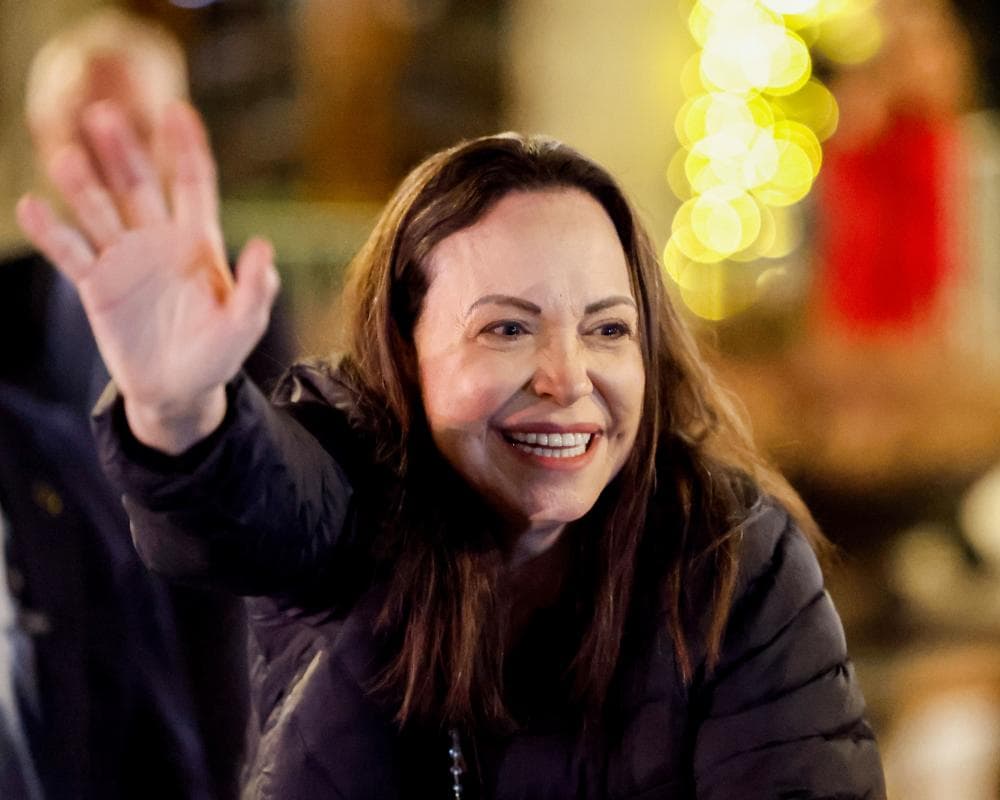
Venezuelan opposition leader and Nobel peace prize winner María Corina Machado has said in her first televised interview since the US military’s weekend raid on Venezuela that she hasn’t spoken Donald Trump since October 2025.
“Actually, I spoke with President Trump on October 10, the same day the [Noble peace] prize was announced, [but] not since then,” she said on Fox News. Machado – widely seen as deposed president Nicolás Maduro’s most credible opponent – left Venezuela last month to travel to Norway to accept the award and hasn’t returned since.
“I’m planning to go as soon as possible back home,” she told Fox when asked about her plans to return to Venezuela.
Trump on Saturday dismissed the idea of working with Machado, saying: “She doesn’t have the support within or the respect within the country.” US media reported on Monday that a classified CIA assessment presented to Trump concluded that senior Maduro loyalists, including interim president Delcy Rodríguez, were best positioned to maintain stability.
Despite this, Machado welcomed the US actions as “a huge step for humanity, for freedom and human dignity”.
In other key developments:
Chuck Schumer, the leader of the Democratic minority in the US Senate, expressed discontent with a classified briefing for Congressional leaders, calling the Trump administration’s “plan for the US ‘running Venezuela’ … vague, based on wishful thinking and unsatisfying”.
Mike Johnson, the Republican speaker of the US House, emerged from the classified briefing insisting that “we are not at war” and “this is not a regime change,” but “a demand for a change of behaviour by a regime”.
The reported appearance of unidentified drones over the presidential palace in Venezuela’s capital on Monday night filled the night sky with the sound of heavy gunfire and tracer fire as the regime’s security forces reacted to what they mistook for another raid.
Trump suggested to NBC News that US taxpayers could fund the rebuilding of Venezuela’s infrastructure for extracting and shipping oil. “A tremendous amount of money will have to be spent and the oil companies will spend it, and then they’ll get reimbursed by us or through revenue.”
White House adviser Stephen Miller reaffirmed to CNN the Trump administration’s position on Greenland becoming a part of the US.
Updated
Keeping with María Corina Machado, the Venezuelan opposition leader also denounced the country’s interim president, Delcy Rodríguez, accusing her of being a key architect of abuses.
Machado told Fox News from an undisclosed location that Rodriguez was “rejected” by the Venezuelan people and that voters were on the opposition’s side.
“In free and fair elections, we will win by over 90% of the votes, I have no doubt about it,” Machado said, quoted by the AFP news agency.
Rodríguez, who was Venezuela’s vice-president under Nicolás Maduro, has signalled her willingness to cooperate with Washington.
As reported earlier, Machado also said she planned to return home “as soon as possible”.
Updated
Venezuelan opposition leader María Corina Machado has said that “a free Venezuela” will become the energy centre of North and South America.
“We will turn Venezuela into the energy hub of the Americas,” the Nobel laureate was quoted as telling Fox News on Monday.
Venezuela is believed to have the largest oil reserves of any country in the world. But according to Donald Trump its oil industry has been “a total bust” for a long time, and he has vowed to take control of it and revive its fortunes with the help of America’s biggest oil companies.
How might this play out, what do experts think about its prospects of success and could it affect the costs motorists pay at the pumps? See our explainer here:
Updated
Greenland prime minister Jens-Frederik Nielsen has pushed back against Donald Trump’s renewed calls to annex the Arctic territory, while Danish prime minister Mette Frederiksen says the US president should be taken seriously when he talks of wanting Greenland.
Here a video we’ve just published taking us through it.
This is Adam Fulton picking up our live coverage
Updated
We are continuing to track the aftermath of Saturday’s US military raid on Venezuela, with little clarity as to what comes next. Here are the latest developments:
María Corina Machado, the exiled Venezuelan opposition leader, who reportedly angered Donald Trump by accepting the Nobel peace prize he had his heart set on, used an appearance on the president’s favorite Fox News show to offer to share it with him.
Chuck Schumer, the leader of the Democratic minority in the US Senate, expressed discontent with a classified briefing for Congressional leaders, calling the Trump administration’s “plan for the US ‘running Venezuela’… vague, based on wishful thinking and unsatisfying.”
Mike Johnson, the Republican speaker of the US House, emerged from the classified briefing insisting that “we are not at war” and “this is not a regime change,” but “a demand for a change of behavior by a regime.”
The reported appearance of unidentified drones over the presidential palace in Venezuela’s capital on Monday night filled the night sky with the sound of heavy gunfire and tracer fire as the regime’s security forces reacted to what they mistook for another raid.
In an interview with NBC News, Trump suggested that US taxpayers could fund the rebuilding of Venezuela’s infrastructure for extracting and shipping oil. “A tremendous amount of money will have to be spent and the oil companies will spend it, and then they’ll get reimbursed by us or through revenue”, the president said.
In an interview with CNN, White house advisor Stephen Miller reaffirmed the Trump administration’s position on Greenland becoming a part of the US.
María Corina Machado, the exiled Venezuelan opposition leader, used an appearance on Sean Hannity’s Fox News show on Monday to assure Donald Trump that she would like to share the Nobel peace prize she won last year with him.
Machado, whose failure to immediately surrender the Nobel prize to Trump reportedly angered the US president, also told Fox News on Monday that she plans to return to her country as soon as possible.
In the aftermath of the US military operation to depose Nicolás Maduro, the Venezuelan president who is widely believed to have stolen the last election from the opposition, Trump dismissed the idea that Machado should run the country. “I think it would be very tough for her to be the leader,” Trump said. “She doesn’t have the support within, or the respect within, the country. She’s a very nice woman, but she doesn’t have the respect.”
Two people close to the White House told the Washington Post that Machado had alienated Trump by accepting the Nobel prize, instead of giving it to him.
Although Machado dedicated the award to Trump, her acceptance of the prize was the “ultimate sin” in Trump’s eyes, one of the people told the Post. “If she had turned it down and said, ‘I can’t accept it because it’s Donald Trump’s,’ she’d be the president of Venezuela today,” this person said.
Speaking to Hannity, Trump’s close ally, Machado was effusive in her praise for Trump, but she admitted that she had not yet offered to give him the Nobel prize. “It hasn’t happened yet,” she said, “but I certainly would love to be able to personally tell him that we believe, the Venezuelan people, because this is a prize of the Venezuelan people, certainly want to give it to him, and share it with him.”
Updated
Agence France-Presse, the French news service, reports that gunfire near the Venezuelan presidential palace on Monday night was a response from local security forces to the appearance of unidentified drones over the Miraflores palace in central Caracas.
A source close to the government said the situation was now under control.
As we noted earlier, the sound of heavy gunfire and images of tracer fire in the sky were captured in video clips uploaded to social media after 8pm local time.
A person who lives five blocks from the palace told the news agency the incident lasted about a minute.
“The first thing that came to mind was to see if there were planes flying overhead but there were not. I just saw two red lights in the sky,” the resident near the palace said.
“Everyone was looking out their windows to see if there was a plane, to see what was happening.”
The Republican House speaker, Mike Johnson, just emerged from a classified briefing by the Trump administration on the US attack on Venezuela insisting that “we are not at war” and “this is not regime change.”
“With regard to the War Powers,” Johnson said, “we are not at war. We do not have US armed forces in Venezuela and we are not occupying that country.”
“The Constitution gives Congress the power to declare war, that is true, but it also vests the president of the United States, with vast authorities as commander-in-chief,” Johnson added.
The speaker said that he was first informed of the military action at 4am Saturday in a phone call from the secretary of state, Marco Rubio.
“This is not a regime change,” the speaker argued. “This is a demand for a change of behavior by a regime. The interim government is stood up now and we are hopeful that they will be able to correct their action.”
The speaker, who relies on Donald Trump’s support to keep his job, then echoed the unproven allegations that the deposed president of Venezuela had directed drug cartel violence and drug trafficking in the United States.
The new government of Venezuela, Johnson said, led by the deposed president’s deputy, “cannot participate with narcoterrorist and very dangerous international criminal organizations that harm and target Americans frankly, and traffic all of these dangerous drugs into our country.”
“We have a way of persuasion, because their oil exports, as you know, have been seized and I think that will bring the country to a new governance”, he continued. “So we don’t expect troops on the ground, we don’t expect direct involvement beyond just coercing the new, the interim government.”
Updated
Lawmakers emerged from a classified briefing with sharply different assessments of the Trump administration’s military intervention in Venezuela. Chuck Schumer, the Democratic minority leader in the Senate, told reporters: “This briefing, while very extensive and long, posed far more questions than it ever answered.”
“Their plan for the US ‘running Venezuela’ is vague, based on wishful thinking and unsatisfying,” he said. “I asked for, I would have liked, I did not receive any assurances that we would not try to do the same thing in other countries.”
“When the United States engages in this kind of regime change and so-called nation building, it always ends up hurting the United States,” Schumer added. “I left the briefing feeling that it would again.”
Shots were fired near the Venezuelan presidential palace in Caracas on Monday night, witnesses and a source close to presidency told Agence France-Presse, the French news service. The news agency reported that a source said the situation was “under control”.
Multiple video clips posted on social media, which appeared to capture the sound of heavy gunfire and images of tracer fire in the sky, were geolocated to an area just north of the presidential compound by Blake Spendley, an open-source investigator for Hunterbrook Media who previously led investigations for the US Navy and Marine Corps.
Updated
In an interview with NBC News on Monday, Donald Trump suggested that US taxpayers could fund the rebuilding of Venezuela’s infrastructure for extracting and shipping oil.
Trump acknowledged that “a lot of money” will need to be spent to increase oil production in Venezuela, but suggested the US government could pay American oil companies to do the work.
“A tremendous amount of money will have to be spent and the oil companies will spend it, and then they’ll get reimbursed by us or through revenue”, the president said.
The US energy secretary, Chris Wright, reportedly plans to meet representatives of Chevron, ConocoPhillips and ExxonMobil at the Goldman Sachs Energy, Clean Tech & Utilities Conference in Miami later this week.
The Wall Street Journal reported that the major oil companies might be much more reluctant than Trump says to invest in Venezuela, despite its large reserve of oil, in part because there’s so much uncertainty about who will be running the country.
“The oil industry is saying that they don’t know what Venezuela’s government is going to look like tomorrow,” the Journal’s Collin Eaton said in a podcast interview on Monday. “They need sort of a long, stable environment to invest in. So while President Trump has sort of come out and said that these oil companies are going to invest a lot of money in Venezuela, the details are unclear, and we may hear some answers this week as the administration continues to talk about this with oil companies.”
Venezuela produces on average about 1.1 million barrels of oil a day, down from the 3.5 million barrels a day produced in 1999 before a government takeover of the domestic industry.
Updated
In an interview with Jake Tapper, White house advisor Stephen Miller reaffirmed the Trump administration’s position on Greenland becoming a part of the US, but didn’t offer any specifics about the role of the US military in seizing the territory.
The United States is the power of NATO, for the United States to secure the arctic region, to protect and defend NATO and national interest, obviously Greenland should be a part of the United States…Nobody is gonna fight the United States militarily over the future of Greenland, it doesn’t make any sense,” Miller told Tapper.
This interview came after Miller’s wife, Katie Miller posted an image of the Greenland with the American flag superimposed onto it to X. The image was captioned, “SOON”. Denmark’s prime minister Mette Frederiksen and the country’s ambassador to the US
Jesper Møller Sørensen has pushed back, arguing that the US has no right to Greenland.
I would therefore strongly urge that the United States stop the threats against a historically close ally and against another country and another people who have said very clearly that they are not for sale,” Fredriksen said in a statement on Sunday.
Updated
Chuck Grassley, the Republican chair of the Senate judiciary committee, and Dick Durbin, the ranking Democrat, released a joint statement protesting the Trump administration’s decision to exclude them from the classified briefing on the arrest of Nicolás Maduro, despite the fact that the justification offered by the White House for the raid was the deposed Venezuelan leader’s indictment on drug trafficking and narco-terrorism charges.
The statement reads:
“President Trump and Secretary Rubio have stated that this was a law enforcement operation that was made at the Department of Justice’s (DOJ) request, with assistance from the Federal Bureau of Investigation (FBI) and the Drug Enforcement Administration (DEA). The Senate Judiciary Committee has jurisdiction over DOJ, FBI and DEA, and all three agencies are led by individuals who our Committee vetted and processed. The Attorney General herself will be present at today’s briefing.
“There is no legitimate basis for excluding the Senate Judiciary Committee from this briefing. The administration’s refusal to acknowledge our Committee’s indisputable jurisdiction in this matter is unacceptable and we are following up to ensure the Committee receives warranted information regarding Maduro’s arrest.”
Updated
The federal judge overseeing the trial of Nicolás Maduro, the deposed Venezuelan president, and his wife, Cilia Flores, is a 92-year-old Clinton appointee who has previously ruled against the Trump administration, blocking its attempt to use the 1798 Alien Enemies Act to deport Venezuelan migrants to El Salvador last year.
The US district court judge, Alvin Hellerstein, ruled last April that alleged Venezuelan gang members facing deportation under the Alien Enemies Act had to get an opportunity to challenge their deportations before being removed from the southern district of New York, where he has served since 1998.
Hellerstein, who was going into his freshman year at the Bronx high school of science when Donald Trump was born in Queens in 1946, also denied Trump’s effort to have his New York state fraud trial, over illegal payments to an adult film actor, moved to federal court.
The Forward, a newspaper that has tracked the fortunes of New York’s Jewish community since 1897, reports that Hellerstein has spoken about “the role his Jewish identity has played in his life and career”. In a 2023 video interview, Hellerstein described his work advocating for Soviet Jews. In 2016, his weekly tennis matches with three rabbis his age was the subject of a New York Times story.
In one case, the Forward noted, Hellerstein “declined to accept a guilty plea from Alejandro Orozco, a Mexican national who had unknowingly transported drugs hidden in a truck he was hired to drive. Hellerstein helped connect Orozco with an immigration lawyer, and the man later obtained US citizenship.”
Updated
An attack by the United States on a Nato ally would mean the end of both the military alliance and “post-second world war security”, Denmark’s leader has warned, after Donald Trump threatened again to take over Greenland.
Fresh from his military operation in Venezuela, the US president said on Sunday the US needed Greenland “very badly” – renewing fears of a US invasion of the largely autonomous island, which is a former Danish colony and remains part of the Danish kingdom. Greenland’s foreign and security policy continues to be controlled by Copenhagen.
Mette Frederiksen, the Danish prime minister, warned on Monday that any US attack on a Nato ally would be the end of “everything”.
“If the United States decides to militarily attack another Nato country, then everything would stop – that includes Nato and therefore post-second world war security,” Frederiksen told Danish television network TV2.
Her comments came after Greenland’s prime minister, Jens-Frederik Nielsen, made a bracingly direct statement in which he urged Trump to give up his “fantasies about annexation” and accused the US of “completely and utterly unacceptable” rhetoric, declaring: “Enough is enough.”
Hakeem Jeffries, the Democratic minority leader in the House, just told reporters in Washington that it was “outrageous” for Donald Trump to claim that his administration was justified in failing to notify Congress of the planned attack on Venezuela to prevent leaks to the media.
The administration had “a responsibility to notify Congress”, Jeffries said, “and in the context of the United States Constitution, it’s the Congress that has the sole power to declare war. So the Constitution isn’t a matter of inconvenience; it is a requirement.”
“There is no Trump exception to the United States constitution,” said the New York congressman, who hopes to be House speaker after the November elections. “And there’s no evidence that the Trump administration has ever presented of congressional leaders being briefed in a classified setting and that information then being leaked in a way that undermined America’s national security interests.”
Updated
Speaking on the Senate floor on Monday, Chuck Schumer, the Democratic minority leader, attacked the Trump administration for having “no plan” for what comes next in Venezuela, and called Donald Trump’s vague statements that the United States will “run” the country a recipe for “chaos”.
“Maduro is a tyrant, nobody mourns what has happened to him,” Schumer said, in reference to that country’s autocratic leader, Nicolás Maduro, who was captured by US forces on Saturday. “But now the crucial question is what comes next for Venezuela and, more importantly, for the United States. Nobody really seems to know. The administration’s story keeps changing by the hour.”
There was, Schumer said, “no plan, no clarity: only chaos.”
“The danger in Venezuela is only beginning,” Schumer added. “Donald Trump has opened a Pandora’s box, and things will get out of hand very quickly. And if Donald Trump tries to do to Colombia and Greenland what he did in Venezuela, the disasters and consequences could compound exponentially.”
Reading from prepared remarks, the Democratic senator from New York tripped over his words several times, at one point referring to “the war in Viet-” before correcting himself to say “the war in Venezuela”.
“The next step for Congress is clear: we must stop Trump’s folly by invoking the War Powers Act,” Schumer said, before pledging to join a push later this week on a war powers resolution that could constrain Trump.
Updated
Senate Republicans celebrated the arrest and detention of Nicolás Maduro. Calling the deposed Venezuelan leader a “known, indicted, narcoterrorist in league with drug traffickers killing Americans for profit”.
In a post on social media, GOP lawmakers in Congress’s upper chamber said that “Maduro didn’t just tolerate the drug traffickers or lose control of his territory—he was one of them.”
“Republicans are glad he’s gone – but Democrats are furious,” they added.
Updated
Following the capture, arrest and detention of Nicolás Maduro, the Trump administration is set to meet with top US oil executives, according to a report from Reuters – citing a source familiar with the matter.
The aim to revitalize oil production comes after nearly two decades of control by Venezuela over US energy operations in the country.
According to Reuters, the three biggest US oil companies – Exxon Mobil, ConocoPhillips, and Chevron – have not yet had any conversations with the administration about Maduro’s ouster, per four oil industry executives familiar with the matter. This contradicts Trump’s statements over the weekend that he had already held meetings with “all” the US oil companies, both before and after the Venezuelan leader was seized.
Updated
Reporting from outside the courthouse in Manhattan:
At a playground across the street from where Nicolás Maduro just pleaded not guilty for drug and weapon charges, Pedro Reyes said that the leader’s capture was welcome news.
Reyes claimed he was kidnapped and shot by Venezuelan military officers in 2014 in Táchira, a mountainous state near the border with Colombia. The Guardian was not able immediately and independently to verify details of Reyes’s account.
“He deserves to be detained and to pay for what his regime did to me, my family and my friends,” said Reyes in Spanish.
After the incident, Reyes said, he migrated along with his wife and first child to Argentina. In 2021, they crossed the US-Mexico border and asked for asylum. They are still awaiting a resolution for their case, Reyes added.
“Let’s be honest, we are happy that Maduro was detained, but this happiness is momentary. There are people still associated with Maduro in Venezuela and as long as they stay, the country will not be free. I already lost family members at the hands of this dictatorship, what guarantees that we will be safe, that my children will be safe if we go back? Nobody,” said Reyes.
The Swiss Federal Government has announced that Switzerland has frozen any “Swiss-based assets linked to Nicolás Maduro”.
In a statement, Swiss authorities said that the Swiss Federal Council had decided to freeze the assets held in Switzerland by Maduro and “other persons associated with him with immediate effect”.
“In doing so, the Federal Council aims to prevent an outflow of assets,” they said. “The asset freeze does not affect members of the current Venezuelan government.”
“Should future legal proceedings reveal that the funds were illicitly acquired, Switzerland will endeavour to ensure that they benefit the Venezuelan people,” the statement continued.
Updated
Lawyers representing Maduro’s wife, Cilia Flores, told CBS News that she is in “good spirits” and that she is “aware that there is a long road ahead and is prepared”.
“We look forward to reviewing and challenging the evidence the government has,” attorney Mark E Donnelly told CBS News in a statement after Flores’ court appearance on Monday. “While we would love to present our side now, we will wait to do so in court at the appropriate time.”
Updated
António Guterres, the UN secretary general, warned on Monday that the capture of Maduro risked intensifying instability in Venezuela and across the region.
He questioned whether the operation respected the rules of international law.
“I am deeply concerned about the possible intensification of instability in the country, the potential impact on the region, and the precedent it may set for how relations between and among states are conducted,” Guterres said in a statement delivered to the council by UN political affairs chief Rosemary DiCarlo.
He urged Venezuelan actors to engage in “inclusive and democratic dialogue” and offered UN support for a peaceful way forward.
Read more about what happened at the meeting here.
Updated
The US faced widespread condemnation for a “crime of aggression” in Venezuela at the emergency meeting of the United Nations security council on Monday.
Brazil, China, Colombia, Cuba, Eritrea, Mexico, Russia, South Africa and Spain were among countries that denounced Donald Trump’s decision to launch deadly strikes on Venezuela and snatch its leader, Nicolás Maduro and his wife, Cilia Flores, to stand trial in the US.
“The bombings on Venezuelan territory and the capture of its president cross an unacceptable line,” Sérgio França Danese, the Brazilian ambassador to the UN, told the meeting. “These acts constitute a very serious affront to the sovereignty of Venezuela and set an extremely dangerous precedent for the entire international community.”
Trump’s UN ambassador, Mike Waltz, defended the attack as a legitimate “law enforcement” action to execute long-standing criminal indictments against an “illegitimate” leader, not an act of war.
Read more about what happened at the meeting here.
Updated
At the United Nations security council meeting earlier today, Samuel Moncada, Venezuela’s Ambassador to the UN, described the US action in Venezuela as an “illegitimate armed attack lacking any legal justification”.
Moncada added that “No state can set itself up as a judge, party and executor of the world order … Venezuela is the victim of this attack because of its natural resources.”
Updated
Reporting from outside the courthouse in Manhattan:
Across the street from the federal court, on the other side of the protest area divided by a group of New York police officers, was Izzy McCabe, 21, who arrived this morning in New York all the way from Seattle, Washington.
McCabe is a member of the Freedom Road Socialist organization founded in 1985.
McCabe attended the International People’s Assembly for Sovereignty and Peace of Our Americas in Venezuela a few weeks ago, along with thousands of delegates from countries around the world.
“I spoke with Venezuelans in Venezuela and they are committed to resisting US imperialism because they love their country. They want to stay in control of the destiny of their country,” said McCabe, an American-born protester.
“I am here to protest against US intervention and to remind that there are international laws that need to be respected.”
Updated
Reporting from outside the courthouse in Manhattan:
As Nicolás Maduro pleaded not guilty to drug and weapons charges at the Manhattan federal court, Alejandro Flores joined other Venezuelans in chants that celebrated the detention of the former Latin American dictator.
Flores, a 34-year-old from Caracas, said he was lucky enough to migrate to the US to pursue an education more than a decade ago, but left behind family relatives who struggled economically. Some of them live today in buildings affected by the US attack that ultimately led to Maduro’s detention, Flores said.
“The fact that Maduro is in court means justice is being served. He is the reason Venezuela saw millions of people leaving their country, looking for something to eat,” said Flores, who now lives in Brooklyn.
“I want to see my country free, I want my Colombian wife to visit my country, I want to have the opportunity to celebrate with my family that still lives there, but if you ask me if Venezuela is free, the answer is: not yet. Venezuelans need to decide who they want as president.”
Updated
The first courtroom sketch of Nicolás Maduro and his wife, Cilia Flores, in the Manhattan courtroom today has come through the wires.
Here it is:
Updated
Delcy Rodríguez, who served as Nicolás Maduro’s vice-president, has just been formally sworn in as Venezuela’s interim president, Reuters is reporting.
According to Reuters, Rodríguez was sworn in by her brother Jorge, who is the head of the national assembly legislature.
Updated
A Reuters poll of 1,248 US adults nationwide, released Monday, has found that public opinion on only 33% of respondents said they approve of the US military action to remove Maduro while 34% said that they do not.
Another 33% of respondents selected the “don’t know/skipped” option of the questionnaire.
The survey, conducted on Sunday and Monday, found that 65% of Republicans said that they supported the military action, while only 11% of Democrats and 23% of independents said they were in support of it.
When asked “Are you concerned the US will get too involved in Venezuela?” 72% of US adults surveyed said yes, including 54% of Republicans and 90% of Democrats.
The US state department has posted an image of Donald Trump on social media overlaid with the words, “This is OUR Hemisphere”.
In an accompanying caption, the state department stated: “This is OUR Hemisphere, and President Trump will not allow our security to be threatened.”
Updated
Earlier today, Nicolás Maduro Guerra, Maduro’s son, delivered remarks before the Venezuelan National Assembly, and pledged his support for Venezuela’s interim leader, Delcy Rodríguez.
“To you, Delcy Eloína: My unconditional support for the difficult task ahead” he said. “Count on me, count on my family, you can count on our resolve to take the right steps in facing this responsibility that now falls to you, and we stand firm in absolute unity to achieve the objective of peace in Venezuela, to move the country forward, and for the return of Nicolás and Cilia.”
He then turned his remarks to his father, and said: “You made all of us in the family strong people, we are here doing our duty until your return” adding that “The country is in good hands, Dad, and soon we will embrace each other here in Venezuela.”
Reporting from Mexico City:
Mexican president Claudia Sheinbaum on Monday doubled down on Mexico’s opposition to the US attack on Venezuela, and rejected the possibility of an American incursion into Mexico after Donald Trump suggested the neighboring nation could be next.
“We categorically reject intervention in the internal matters of other countries,” Sheinbaum said. “Mexico firmly maintains that the Americas do not belong to any single doctrine or power.”
Sheinbaum’s comments, which she read at the start of her daily news conference, echoed a statement made Saturday by the Mexican government condemning the US incursion into Venezuela’s capital to capture Nicolás Maduro.
In the hours after the attack, Trump suggested during an interview with Fox News that, while the Venezuelan attack was “not meant” as a message to Mexico, the country could be Washington’s next target.
“The cartels are running Mexico, [Sheinbaum’s] not running Mexico,” he said. “Something’s gonna have to be done with Mexico.”
Trump’s remarks are the latest in a long series of threats he has made over the last year to send US troops into Mexico to tackle drug trafficking groups, threats which Sheinbaum has repeatedly rejected.
Shortly after returning to power last year, the Trump administration designated several Mexican cartels as foreign terrorist organizations. The designation “allows us to now target what they’re operating and to use other elements of American power, intelligence agencies, the Department of Defense ... to target these groups”, secretary of state Marco Rubio said last August.
When asked about Trump’s latest comments on Monday, Sheinbaum was once again emphatic.
“I don’t believe in an invasion; I don’t even think it’s something they’re taking very seriously,” Sheinbaum told reporters. “On several occasions, [Trump] has insisted that the US Army be allowed to enter Mexico. We have said no very firmly – first because we defend our sovereignty, and second because it is not necessary.”
Still, Sheinbaum was careful to emphasize that Mexico had developed a good relationship with Washington to tackle drug trafficking groups, one based on “mutual respect and confidence, cooperation without subordination”.
The Mexican leader’s response to Trump’s attack on Venezuela was also relatively cautious, particularly when compared to other Latin American countries, according to Tony Payan, a Mexico expert at Rice University’s Baker Institute for Public Policy, reflecting Sheinbaum’s need to both appeal to the base of her party while not upsetting US-Mexico relations.
“She’s stuck between a rock and a hard place,” he said. “Between her own natural tendencies to side with the anti-American authoritarian left and the necessity of Mexico to continue full access to American markets and capital … it’s a way of tepidly protesting something that she knows she can’t oppose.”
Updated
Reporting from the courtroom:
Both Maduro and his wife listened to the proceedings through headphones, as they were provided a live translation from English to Spanish. While the Venezuelan strong-man was deposed in an inglorious US military raid, his larger-than-life persona was striking in Hellerstein’s courtroom.
Asked to confirm his name, Maduro said “I am Nicolas Maduro Moros” but then started ranting about his political position. Maduro insisted at various points that he was the president of Venezuela and said he was “kidnapped” in a military incursion.
The judge told Maduro that there would be a time and a place to make these arguments. Maduro entered a fulsome not guilty plea shortly thereafter—voicing both a soy innocente and a no soy culpable.
Updated
Here are some images that are coming in of the scenes outside of the Manhattan courthouse where Nicolás Maduro and his wife, Cilia Flores, made their appearance today.
Updated
The Senate is back in session today, with the House set to return tomorrow.
Later, top administration officials, including attorney general Pam Bondi, defense secretary Pete Hegseth, and chairman of the join chiefs of staff Dan Caine, will provide a classified briefing for Republican and Democratic congressional leaders about the January military strikes in Venezuela that saw the capture of Nicolás Maduro and his wife, Cilia Flores, according to a source familiar with the upcoming meeting.
Members of the administration will speak with the “Gang of Eight” – the informal name of leaders of both parties in both chambers of Congress, as well as the chairs and ranking members of the Senate and House intelligence committees.
As of Sunday, the lawmakers, who are traditionally consulted on national security issues, had yet to be contacted. “Still haven’t got a phone call,” said Jim Himes, the top Democrat on the House intelligence committee. He told CNN: “I’m a member of the gang of eight, and I have yet to get a phone call from anyone from the administration.”
Congressional leaders on both the House and Senate armed services and foreign affairs committees will also be present at today’s briefing from Trump officials.
My colleague, Victoria Bekiempis, was in the courtroom today, and sends this dispatch:
At 12 pm, Nicolas Maduro and his wife, Cilia Flores, were escorted into Manhattan federal Judge Alvin Hellerstein’s courtroom following their capture early Saturday in Caracas.
Maduro, who was not handcuffed but was in ankle shackles, wore a blue shirt on top of a neon orange shirt, with khaki pants. Cilia’s outfit reflected a similar color-scheme, but there was one notable difference about her appearance: She had two large band-aids on her face. One was on Flores’ temple and the other, her forehead.
One notable point throughout today’s hearing– which is typically a dry procedural affair where the charges are presented to the defendant and they are able to enter their plea – is the extra comments from both Maduro and Flores.
Both attempted to directly refute the Trump administration’s long-held stance that the Maduro’s presidency is fundamentally illegitimate. At one point, the captured leader said that he was “still president of my country”, while Flores identified herself as “first lady of the Republic of Venezuela”.
Updated
Today’s hearing has now concluded, but judge Hellerstein noted that the next hearing will take place on 17 March at 11am ET.
Updated
Lawyers for both Nicolás Maduro, and his wife, Cilia Flores, said that their clients won’t seek bail at this time. The attorneys added that they’ll seek an application at a later date.
After her husband’s plea, Cilia Flores also pleaded not guilty today.
She identified herself as the “first lady of the Republic of Venezuela” and said she is “not guilty, completely innocent” after making her plea.
According to reporters in the room, Maduro told said that he would read the full indictment, but had not seen the full document, and only discussed it “partially” with his lawyers.
The deposed leader of Venezuela, Nicolás Maduro, pleaded “not guilty” to all four counts against him today, including drug-terrorism conspiracy, cocaine-importation conspiracy, and possession of machine guns and destructive devices.
“I am innocent. I am not guilty. I am a decent man,” Maduro told judge Alvin Hellerstein in court today.
Updated
Nicolás Maduro, and his wife, Cilia Flores, are now appearing before district judge Alvin Hellerstein. They are set to be arraigned today.
According to CNN, Maduro is shackled at the ankles. He and his wife are at the same table, both with wired headphones – presumably to hear a translation.
The judge is reading through an abridged version of the indictment against Maduro and Flores.
Updated
Nicolás Maduro Guerra, who is an elected official in Venezuela, appeared before the country’s national assembly today, saying that the US “kidnapped” his father and first lady Cilia Flores.
Mike Waltz, the US ambassador to the UN, addressed the security council today, insisting that there is “no war in Venezuela” after the large scale strikes on the country and the capture of its president and first lady.
“We are not occupying a country. This was a law enforcement operation in furtherance of lawful indictments that have existed for decades,” Waltz added, claiming that there is precedent for this kind of action after the US captured the former leader of Panama, Manuel Noriega, in 1989.
Today, Waltz said that the “overwhelming evidence” of Maduro’s crimes will be “presented openly in US court proceedings”. A reminder that the deposed president is charged with drug-terrorism conspiracy, cocaine-importation conspiracy, and weapons possession.
“Maduro is not just an indicted drug trafficker. He was an illegitimate so called president,” the ambassador said. “I want to reiterate President Trump gave diplomacy a chance. He offered Maduro multiple offerings he tried to de escalate. Maduro refused to take them.”
Updated
At the UN security council’s emergency meeting today, China condemned the military action by the US in Venezuela.
“As a permanent member of the Council, the US has disregarded the grave concerns of the international community, wantonly trampled upon Venezuela’s sovereignty, security and legitimate rights and interests, and seriously violated the principles of sovereign equality,” said Fu Cong, China’s representative to the UN.
“No country can act as the world’s police, nor can any state presume to be the international judge … We demand that the United States change its course, cease its bullying and coercive practices”
China also called for the US to release Maduro, and his wife, Cilia Flores, from detention.
Updated
Outside the Daniel Patrick Moynihan courthouse in Manhattan where Nicolás Maduro and his wife, Cilia Flores, will face a federal judge today, dozens of demonstrators are calling for the release of the deposed Venezuelan leader. Several people held signs that read “Free President Maduro”.
However, a number of protesters also praised the Trump administration’s actions in Venezuela, and celebrated Maduro’s detention.
At the emergency meeting of the UN security council, António Guterres, the UN secretary general, issued a statement that was read out by diplomat Rosemary DiCarlo.
“I am deeply concerned about the possible intensification of instability in the country, the potential impact on the region, and the precedent it may set for how relations between and among states are conducted,” Guterres said.
“The latest developments follow a period of heightened tensions, beginning in mid August, as discussed in this council on two previous occasions, I have consistently stressed the imperative of full respect by all for international law, including the Charter of the United Nations, which provides the foundation for the maintenance of international peace and security. I remain deeply concerned that rules of international law have not been respected.”
International labor union federations are strongly opposing the Trump administration’s military operations in Venezuela.
International Trade Union Confederation (ITUC) and the Trade Union Confederation of the Americas (TUCA) issued a joint statement condemning the actions, including condemning the military intervention, defending the sovereignty of Venezuela, and calling for the release of Venezuela President Nicolás Maduro, his wife, Cilia Flores, and any other citizens detained in the operation.
The ITUC represents 191 million workers in 169 countries and territories and has 340 national affiliates.
“These acts in no way defend democracy; they are clear acts of aggression as part of a militarised foreign policy agenda motivated by unilateral economic interests,” said ITUC General Secretary Luc Triangle in a statement. “Threats of kidnapping and the misuse of the courts to attack a sovereign government undermine the international rule of law and set a precedent of imperial coercion that jeopardises peace everywhere.”
The labor union federation noted it agreed with positions expressed by the governments of Brazil, Mexico, and other countries calling for a return to diplomatic channels and peace.
Rafael Freire, TUCA General Secretary, added, “we defend Venezuela and all of Latin America as a territory of peace. We do not accept invasion and violence against our peoples and territories. The trade union movement, as always, is on the frontline of defending sovereignty and self-determination, democracy and human rights.”
The American Federation of Labor and Congress of Industrial Organizations (AFL-CIO), the largest federation of labor unions in the US, shared the statement in a post on social media, adding “we join the international labor community in condemning President Trump’s unconstitutional actions in Venezuela.”
The UN security council will hold an emergency meeting shortly, following the United States’ rendition of Nicolás Maduro, his wife, and large-scale strikes in Caracas, Venezuela.
Venezuela requested the meeting, with support from two permanent members of the security council – Russia and China.
In its 3 January letter requesting today’s meeting, Venezuela accused the US of carrying out a series of “brutal, unjustified, and unilateral armed attacks” against civilian and military sites in the country. It also accused the US of violating the UN charter.
Minnesota’s Democratic governor, Tim Walz, has announced he will not seek re-election in 2026.
Walz, who was the Democratic vice-presidential nominee in 2024, has been battling a scandal within the state after several Medicaid programs were defrauded of millions of dollars. The incumbent governor initially announced he would seek a “historic” third term in office.
“As I reflected on this moment with my family and my team over the holidays, I came to the conclusion that I can’t give a political campaign my all,” Walz said in a statement today. “Every minute I spend defending my own political interests would be a minute I can’t spend defending the people of Minnesota against the criminals who prey on our generosity and the cynics who prey on our differences.”
Walz added that the Trump administration and Republican lawmakers are “are playing politics with the future of our state”.
He added: “We’ve got the President of the United States demonizing our Somali neighbors and wrongly confiscating childcare funding that Minnesotans rely on. It is disgusting. And it is dangerous.”
A reminder that noted conspiracist, Trump loyalist, and MyPillow founder, Mike Lindell announced he would seek the Republican nomination for governor late last year.
We have the full video of deposed Venezuelan president Nicolás Maduro and his wife, Cilia Flores, being escorted off a helicopter to attend their arraignment at a Manhattan courthouse.
One quick note – Donald Trump has no public appearances today, per his official schedule. He’ll take part in a policy meeting that’s closed to the press.
A reminder that on Air Force One on Sunday, the president doubled down and insisted that “we are in charge” of Venezuela when asked by reporters on board.
Trump said that he had not spoken with Venezuela’s acting president, Delcy Rodriguez, but said that she is “cooperating”.
US vice-president JD Vance has addressed the apparent disconnect between the Trump administration’s military operations in Venezuela and justifications based in part of an effort to curb the trafficking of the synthetic opioid fentanyl into the US.
In a post on X on Sunday, Vance said he wanted to address claims that Venezuela “has nothing to do with drugs because most of the fentanyl comes from elsewhere”.
“First off, fentanyl isn’t the only drug in the world and there is still fentanyl coming from Venezuela (or at least there was). Second, cocaine, which is the main drug trafficked out of Venezuela, is a profit center for all of the Latin America cartels,” he wrote. “If you cut out the money from cocaine (or even reduce it) you substantially weaken the cartels overall. Also, cocaine is bad too! Third, yes, a lot of fentanyl is coming out of Mexico. That continues to be a focus of our policy in Mexico and is a reason why President Trump shut the border on day one.”
Outgoing Republican congresswoman Marjorie Taylor Greene raised the question of why the US was striking Venezuela if part of the purpose was to reduce fentanyl deaths in the US. (The administration said it was moving to list the synthetic opioid as a weapon of mass destruction.)
“The majority of American fentanyl overdoses and death come from Mexico,” Greene said. “Those are the Mexican cartels that are killing Americans. And so my pushback here is if this was really about narco-terrorists and about protecting Americans from cartels and drugs being brought into America, the Trump administration would be attacking the Mexican cartels.”
In his remarks, Vance said he’d seen “a lot of criticism” about oil.
He added: “About 20 years ago, Venezuela expropriated American oil property and until recently used that stolen property to get rich and fund their narco-terrorist activities. I understand the anxiety over the use of military force, but are we just supposed to allow a communist to steal our stuff in our hemisphere and do nothing? Great powers don’t act like that. The United States, thanks to President Trump’s leadership, is a great power again. Everyone should take note”.
Here are some more angles of Nicolás Maduro heading to a Manhattan courthouse in his first appearance before a US federal judge. He’s seen here arriving at the Downtown Manhattan Heliport near Wall Street.
Updated
Here is some more from my colleague Victoria Bekiempis, who is in New York:
David Cardenas, a Venezuelan who said he’s a member of an opposition group, was outside waiting for proceedings.
“We were waiting for this it seems like 20 years ago, 25 years ago – since [Hugo] Chavez.”
Cardenas described Maduro’s capture as a turning of the tables. “He was laughing about me and my group, he said please don’t cry when [they] come for you … who is crying now?”
The indictment alleged Nicolás Maduro and other Venezuelan leaders have, for more than 25 years, “abused their positions of public trust and corrupted once-legitimate institutions to import tons of cocaine into the United States.”
The indictment alleged Maduro and his allies “provided law enforcement cover and logistical support” to major drug trafficking groups, such as the Sinaloa Cartel and Tren de Aragua gang. These criminal organizations sent profits to high-ranking officials who protected them in exchange, the justice department said.
Among other specific acts, Maduro is accused of selling Venezuelan diplomatic passports to known drug traffickers and facilitating flights under diplomatic cover to bring drug proceeds back from Mexico to Venezuela.
Maduro was indicted on four counts: narco-terrorism conspiracy, cocaine importation conspiracy, possession of machine guns and destructive devices and conspiracy to possess machine guns and destructive devices.
The case was brought by the U.S. Attorney’s Office for the Southern District of New York, an office within the justice department known for its aggressive prosecutions.
The same prosecutor’s office returned an indictment against Maduro in 2020, with the same four charges. The updated indictment made public on Saturday adds some new details and co-defendants, including Maduro’s wife, Cilia Flores.
The first lady is accused of ordering kidnappings and murders, as well as accepting bribes in 2007 to arrange a meeting between drug traffickers and the director of Venezuela’s National Anti-Drug Office.
Updated
Nicolás Maduro and his wife, Cilia Flores, have arrived at a Manhattan court building, where the full list of charges against them will be read out later today, the BBC is reporting.
Updated
Hours before Nicolás Maduro’s expected appearance in Manhattan federal court for alleged narco-terrorism, the sidewalk outside this courthouse was busy with press eager to snag a seat in the courtroom.
Just after 7 am, the line of journalists extended one block down Worth Street, a queue comparable to that of other large cases such as the murder proceedings against Luigi Mangione, or the sex trafficking trial against Ghislaine Maxwell.
As of 30 minutes ago, there weren’t any visible demonstrators or even members of the public with signs voicing their opinions about Maduro’s capture. But, it’s also bone chillingly cold.
Updated
We have a picture through on the newswires which apparently shows Nicolás Maduro on his way to the Daniel Patrick Moynihan Manhattan US Courthouse, where he is due to make an initial appearance on drugs and weapons charges in a couple of hours.
The court appearance will be largely procedural, but will start what will probably be a protracted legal battle.
As a criminal defendant in the US legal system, Maduro will have the same rights as any other person accused of a crime – including the right to a trial by a jury of regular New Yorkers.
Maduro’s lawyers are expected to contest the legality of his arrest, arguing that he is immune from prosecution as a sovereign head of state.
Maduro’s wife, Cilia Flores, is also due to make an initial appearance at the Manhattan federal court today.
Updated
The New York Times and Washington Post learned of the US raid on Venezuela shortly before it was due to be launched on Friday night, but did not publish anything immediately to avoid compromising the military operation and endangering American soldiers, Semafor reports, citing two sources.
Along with much of the so-called “mainstream media” Trump has attacked the journalism of both outlets as his administration continues waging an assault on the traditional news industry at a time when it is declining.
But despite the open hostility, both outlets, according to Semafor, postponed publishing their stories for several hours after the Trump administration reportedly said coverage could have exposed US troops performing the operation, which took two hours and 28 minutes to carry out.
Spokespeople for the White House, the Pentagon, and the Washington Post did not offer a comment on discussions between reporters and officials on Friday evening, and a spokesperson for the NYT did not offer an immediate response to an approach by Semafor. We have not yet been able to independently verify its reporting.
Meanwhile, a spokesperson for the German government has said that the US must “explain to the international community on what basis the actions we have witnessed over the last few days should be judged, and this has not yet happened”.
Germany’s foreign ministry has said it has been in close contact with the embassy in Caracas and a travel warning has been issued.
German chancellor Friedrich Merz previously said that Nicolás Maduro had “led his country to ruin”, but called the deadly US military operation legally “complex”.
Updated
China’s foreign ministry has condemned the US’s military actions in Venezuela as a violation of international law and has denounced the use of force against a sovereign country and its president. Beijing has urged the US to release Nicolás Maduro – who will appear in a New York court later today – and his wife, Cilia Flores, immediately.
China’s foreign ministry spokesperson Lin Jian told journalists this morning that Beijing maintains a “positive communication and cooperation” with the Venezuelan government and China has said it is monitoring the situation closely.
Analysts have warned that the US attack on Venezuela could embolden China to strengthen its territorial claims over areas such as Taiwan and parts of the South China Sea.
Updated
Delcy Rodríguez is due to be officially sworn in as Venezuela’s president shortly (at 08:00 local time; 12:00 GMT) after the country’s supreme court designated her as interim president over the weekend.
She had pledged loyalty to Nicolás Maduro on Saturday and condemned his capture as an “atrocity”, but on Sunday called for a “balanced and respectful” relationship with the US, which has warned they might make a fresh military intervention if she does not accommodate their demands.
Speaking to the Atlantic, Donald Trump said on Sunday: “If she doesn’t do what’s right, she is going to pay a very big price, probably bigger than Maduro.”
As my colleague Rory Carroll notes in this story, Rodríguez, 56, is a political veteran who served as Maduro’s vice-president and oil minister and defended the regime against accusations of terrorism, drug-running and election-stealing, yet for now she is Trump’s favoured option to lead Venezuela.
She reportedly has the backing of the military, along with ministers including those in the interior and defence departments.
The British prime minister, Keir Starmer, has been urged by opposition parties and many of his MPs to condemn the US military action in Venezuela.
Starmer, who has a background as a human rights lawyer, has been repeatedly accused of kowtowing to the Trump administration, wanting to keep on side of Washington for economic and security reasons.
He has refused to condemn the military operation, or comment on its legality, saying he needs all the “facts'” at his disposal before coming to a judgment.
Emily Thornberry, a senior Labour MP and chair of the foreign affairs committee told the BBC the attack was “not a legal action”, adding that the UK and its allies should jointly say “we cannot have breaches of international law like this. We cannot have the law of the jungle.”
“We condemn Putin for doing it. We need to make clear that Donald Trump shouldn’t be doing it either,” Thornberry said.
Jason Rodrigues is a researcher and writer in the Guardian’s research department
President Donald Trump has made no secret of the US’s intention to exploit Venezuela’s oil reserves, the largest proven oil reserves of any country in the world.
Reported in the Guardian in 1979 (below), untapped oil from the Orinoco River oil belt was estimated at 500bn barrels by the Venezuelan state owned oil company Petróleos de Venezuela in a paper submitted to a UN energy conference in Montreal.
At the time of the discovery, total global proven oil reserves were thought to be around 600bn barrels.
The significant find was seen by Venezuela as a way out of the country’s long term economic decline, with productivity forecast to drop significantly over the following decade.
This optimism was tempered, however, by oil experts who were keen to point out that huge investment would be required to exploit the Orinoco belt, due to the difficult terrain and the unusually heavy oil, which requires costly refining.
To date, Venezuela has only pumped a fraction of its potential production, say industry experts.
Denmark’s prime minister. Mette Frederiksen, yesterday urged Donald Trump to stop threatening to take over Greenland after the president said the US “absolutely” needs the territory.
On Sunday, Trump, who sees Greenland as strategically important for defence and as a future source of mineral wealth, told The Atlantic magazine in an interview: “We do need Greenland, absolutely. We need it for defence.”
Speaking to reporters aboard Air Force One this morning, the president said he would revisit the topic in a few weeks.
Frederiksen has stressed that Denmark “and thus Greenland” was part of Nato and therefore covered by the alliance’s security guarantee.
France, Norway and Spain were among the European countries who said Donald Trump had broken international rules after US troops carried out the deadly military operation on Saturday morning.
Most European statements followed a predictable line of leaders calling for de-escalation and saying they were following the situation closely, without directly commenting on the legality of the American attack.
Italy’s far-right prime minister Giorgia Meloni was among the outliers who publicly praised the military operation. She said the US’s actions were “legitimate”, despite previously stating that “external military action is not the way to end totalitarian regimes”.
Meloni – who has a close relationship with Donald Trump – has said she had a phone call with Venezuelan opposition leader Maria Corina Machado on Sunday (Machado has been saying for months that the opposition is ready to run the country).
Both Meloni and Machado were said to have agreed that Maduro’s exit would foster the conditions for a peaceful and democratic “transition”.
Meloni’s office said in a statement:
The President of the Council of Ministers, Giorgia Meloni, had a telephone conversation today with Maria Corina Machado on the prospects for a peaceful and democratic transition in Venezuela.
During the call, it was agreed that Maduro’s exit opens a new chapter of hope for the people of Venezuela, who will be able to once again enjoy the basic principles of democracy and the rule of law.
Updated
We have some comments from the Iranian foreign ministry spokesperson Esmail Baghaei who has given his views on the motivations behind the US attack on Venezuela.
The US operation in Caracas – viewed by many observers as an illegal action against a sovereign country – has likely caused anxiety to the government in Iran, against which Donald Trump has expressed enthusiasm for taking radical action.
Tensions are particularly high between Washington and Tehran as Trump has recently threatened to intervene in Iran if its government kills demonstrators taking part in protests over the country’s economy.
During a press conference, Baghaei has been quoted by Al Jazeera as having said: “In the past decades, interventions were justified under slogans such as democracy and human rights. Today, they openly say the issue is Venezuela’s oil.”
“Claims that another country can run Venezuela are unacceptable to any nation, including the Venezuelan people, and reflect a return to colonial-era thinking.”
In our opening post, we mentioned that Cuba said that 32 of its citizens had been killed in the US operation to capture Nicolás Maduro, and his wife, Cilia Flores, in Venezuela and bring them to America. We can bring you a bit more information about this now.
The Cuban government said the 32 people who were killed were members of the Cuban armed forces and intelligence agencies, with two days of national mourning declared.
A government statement read:
Our compatriots fulfilled their duty with dignity and heroism and fell, after fierce resistance, in direct combat against the attackers or as a result of bombings on the facilities.
Cuba, a strong ally of Venezuela, has provided some security for Maduro since he came to power. It was not clear how many Cubans were guarding the Venezuelan president when they died and how many may were killed elsewhere.
Venezuela has not officially confirmed how many people were killed during the audacious US attack on Maduro’s compound in Caracas, the Venezuelan capital, on Saturday.
But the New York Times reported that at least 40 people, including civilians and soldiers, were killed in the attack. The estimate came from a senior Venezuelan official who spoke on the condition of anonymity.
Updated
A UK minister would not be drawn into saying whether his government believes the US capture of Venezuela’s president was influenced by the country’s rich oil reserves.
Asked on Sky News why he thought Donald Trump had captured Nicolás Maduro and said America would “run” Venezuela, Home Office minister Mike Tapp said:
This is for Donald Trump to answer, and I think he has said in his press conference, which I watched with interest around narco-terrorism and that threat.
Pressed by the broadcaster on whether Venezuela’s vast oil wealth may have influenced the operation, Tapp said: “It’s not for me or the British government at this point to go into that detail. It’s for the United States to lay out its legal basis for this operation.”
Tapp also would not say whether the British government believed Washington had breached international law, and said there was a need to have “all the facts” amid the “fog of war”.
Updated
Markets are reacting to the turmoil over Venezuela and the US actions, with investors seeking the safe haven of gold and buying up shares in defence companies. But with Donald Trump making Venezuela’s oil reserves central to his plans for the country, the price of crude is falling. You can follow the market reaction in our business blog with my colleague, Graeme Wearden, here:
Updated
Prosecutors say Nicolás Maduro is the kingpin of a cartel of Venezuelan political and military officials who have conspired for decades with drug trafficking groups and US-designated terrorist organisations to flood America with thousands of tonnes of cocaine.
As Reuters reports, Maduro was first indicted in 2020 as part of a long-running narcotics trafficking case against current and former Venezuelan officials and Colombian guerrillas.
In a new indictment unsealed Saturday, prosecutors allege that Maduro personally oversaw a state-sponsored cocaine trafficking network that partnered with some of the world’s most violent and prolific drug trafficking groups, including Mexico’s Sinaloa and Zetas cartels, the Colombian paramilitary group FARC and the Venezuelan gang Tren de Aragua.
Maduro is charged with narco-terrorism, cocaine importation conspiracy, possession of machine guns and destructive devices, and conspiracy to possess machine guns and destructive devices. He faces decades to life in prison on each count if convicted.
Legal experts said prosecutors face a difficult task, needing to show evidence of Maduro’s direct involvement in drug trafficking to secure a conviction.
Maduro has denied wrongdoing, and it could be several months before he stands trial.
Updated
Nicolás Maduro is set to appear in Manhattan federal court later today to face narco-terrorism charges.
Maduro, 63, and his wife, Cilia Flores, are in jail in Brooklyn after their seizure by US forces.
They are both set to appear at the hearing scheduled for Noon EST (5pm GMT ) before US District Judge Alvin K Hellerstein.
It is unclear if either had obtained lawyers, or if they would enter pleas.
Venezuela’s president was captured, flown to the US and is now facing trial in New York. What does the audacious ouster of Nicolás Maduro mean for the country – and the world?
Find out in our podcast here:
Updated
Colombian president Gustavo Petro has rejected threats by Donald Trump and the US president’s accusations that he is drug trafficker.
Trump on Sunday threatened Colombia with similar military action to the weekend raid against Venezuela, saying Colombia was “run by a sick man who likes making cocaine and selling it to the United States” but that he “is not going to be doing it very long”.
Petro rebuffed the accusations, saying his “name does not appear in court records”.
“Stop slandering me, Mr. Trump,” Petro said on X on Sunday.
That’s not how you threaten a Latin American president who emerged from the armed struggle and then from the people of Colombia’s fight for Peace.
Petro has harshly criticised the Trump administration’s military action in the region and accused Washington of abducting Maduro “without legal basis”, as Agence France-Presse reports. In a later post to X on Sunday, Petro added that “friends do not bomb”.
Updated
European leaders emerged divided and torn as they tried to welcome the ejection of Venezuela’s authoritarian president but still uphold the principles of international law that did not appear to allow Donald Trump to seize Nicolás Maduro, let alone declare that the US will run Venezuela and control its oil industry.
Europe tried to focus on the principle of a democratic transition, pointing out that the continent had not recognised Maduro as the legitimate leader of Venezuela since what were widely regarded as fraudulent elections in June 2024.
But Trump’s rejection of the Nobel prize-winning Venezuelan opposition figurehead, María Corina Machado, was awkward. Trump said she did not have support or respect in Venezuela, but European leaders have embraced her as leading an opposition that deserves power.
You can read the full analysis here:
Donald Trump has threatened a second American strike on Venezuela if remaining members of its government do not cooperate with his efforts to get the country “fixed”.
In comments aboard Air Force One, the president also says the US is now “in charge” of Venezuela and praises the US forces involved in what he called a “very dangerous operation” to capture Maduro.
Updated
Keir Starmer has said when asked if he would condemn the US action in Venezuela that he wants to wait to “establish the facts” and speak to Donald Trump, while insisting the UK would “shed no tears” over the end of Maduro’s regime.
However, some of the British prime minister’s own MPs have been more outspoken, criticising America’s actions as a breach of international law.
Labour MP Kim Johnson questioned whether “we as a country still stand for international law and sovereignty”, while her colleague Richard Burgon described Starmer’s statement as “shameful and reckless”.
Former shadow chancellor John McDonnell said that “effectively our country has been rendered up as a Trump colony”, accusing the government of “prevarication”.
In a post on X, Labour MP Clive Lewis said of the US military operation: “A clear breach of the Nuremberg principles – which the UK helped write.
Now a [Labour government] won’t even defend them. This silence isn’t diplomacy. It’s the moral equivalent of a white flag.
Updated
Hello and welcome to our live coverage after US forces seized Venezuelan president Nicolás Maduro in Caracas and took him to the US to face drug charges.
Donald Trump said after the military operation early on Saturday that the US would “run” Venezuela and warned on Sunday that the US might launch a second strike if the government’s remaining members did not cooperate with his efforts to get the country “fixed”.
Venezuelan vice-president and Maduro ally Delcy Rodríguez has been appointed acting president and offered “to collaborate” with the Trump administration in what could be a major shift in relations between the governments.
In a conciliatory message on Instagram on Sunday she said she hoped to build “respectful relations” with Trump.
“We invite the US government to collaborate with us on an agenda of cooperation oriented towards shared development within the framework of international law to strengthen lasting community coexistence,” Rodríguez said.
In a televised address earlier Rodríguez gave no indication she would cooperate with Trump, saying what was being done to Venezuela was “an atrocity that violates international law”, referring to Trump’s government as “extremists” and maintaining that Maduro was Venezuela’s rightful leader.
But Trump warned later that if Rodríguez didn’t fall in line, “she is going to pay a very big price, probably bigger than Maduro”.
In other key developments:
Rodríguez announced a commission to seek the release of Maduro and his wife, Cilia Flores.
Maduro is in a New York detention centre awaiting a court appearance on Monday on drug charges.
Top officials in Maduro’s government called the seizure of Maduro and his wife a kidnapping. “Let no one fall for the enemy’s provocations,” interior minister Diosdado Cabello said.
Trump’s administration described Maduro’s capture as a law-enforcement mission to force him to face US criminal charges filed in 2020, including narco-terrorism conspiracy. Maduro has denied criminal involvement.
Maduro’s son, Nicolás Ernesto Maduro Guerra, reportedly said his father’s supporters were more resolved than ever to support Maduro and the ousted president would return. “We will take to the streets, we will convene the people.”
Trump suggested Colombia and Mexico could also face military action if they did not reduce the flow of illicit drugs to the US, saying: “Operation Colombia sounds good to me.”
Images of the 63-year-old Maduro blindfolded and handcuffed stunned Venezuelans. The operation was Washington’s most controversial intervention in Latin America since the invasion of Panama 37 years ago.
Venezuelan defence minister Gen Vladimir Padrino said on state television the US attack killed soldiers, civilians and a “large part” of Maduro’s security detail “in cold blood”. Venezuela’s armed forces had been activated to guarantee sovereignty, he said.
The Cuban government said 32 of its citizens were killed during the raid.
The governments of Spain, Brazil, Chile, Colombia, Mexico and Uruguay said in a joint statement the US actions “constitute an extremely dangerous precedent for peace and regional security and endanger the civilian population”.
All EU countries except Hungary issued a statement calling for restraint by “all actors” and respect for the will of the Venezuelan people in order to “restore democracy”.
UK prime minister Keir Starmer said Britain was not involved in the attack but refused to condemn it. British cabinet minister Darren Jones – a close ally of Starmer – called for a peaceful transition of power in Venezuela to be reached “quickly”.
Trump suggested the US would not push for immediate elections to install a new government but rather would work with remaining members of the Maduro administration to clamp down on drug trafficking and overhaul its oil industry. He said US oil companies needed “total access” to the country’s vast reserves.
Hundreds of Chavismo supporters gathered in Caracas on Sunday to demand the release of Maduro and Flores.
With news agencies
Updated