Loading...
Please wait for a bit
Please wait for a bit
Click any word to translate
Original article by Jakub Krupa
The EU’s mutual assistance clause is stronger than Article 5 in Nato, say experts but may not be the answer if the US were to invade Greenland.
Article 42 (7) of the treaty of the EU is generally consistent with Article 5 in Nato’s charter that stipulates that an attack on one member of the alliance should be considered an attack on all.
It has only been activated once so far, when France called for assistance in the wake of the Bataclan terrorist attack while Nato’s Article 5 has also only been used once, following the September 11 attack on New York in 2001.
Speaking at a conference in Sweden (13:48), Kubilius said an invasion of Greenland by the US would be the end of Nato, but member states had to now focus on their obligations under Article 42.7 as part of contingency planning.
Article 42.7 of the treaty on European Union states:
“If a Member State is the victim of armed aggression on its territory, the other Member States shall have towards it an obligation of aid and assistance by all the means in their power”
However, at least one political party in Europe has privately said legally it was not clear if the mutual assistance clause would provide for military assistance that could be needed in the event of an invasion of Greenland.
“Even though it is part of the Kingdom of Denmark, Greenland would need a change of status and to become a Region Outermost of the European Union. This would entail full inclusion in the Union’s legal order, with the adaptations foreseen by the Treaties. Such a process would require the consent of the people of Greenland and a revision of the Treaties,” said one European politician whose party is dubious about the value of the clause.
For more context, Erik Jones, director of the Robert Schuman centre for advance studies at the European University in Florence, said the clause was grounded in language in the 1948 Brussels Treaty Organisation, a political alliance set up by the UK, France, Belgium, Luxembourg and the Netherlands to guard against a resurgent threat by Germany or the Soviets.
“The language is much stronger than that in Article 5. When the US negotiated Nato they decided it was so strong it would not get through the Senate.”
But he added that he wondered what “credibility” Article 42.7 would have if Greenland was to be absorbed into the US.
“Can you imagine Romania coming to the rescue of Greenland? The European response has got to be political. They have to lean into the notion of protection of Greenland’s sovereignty and the integrity of sovereignty to the US.”
Let’s get a little more on that EU treaty article on mutual assistance mentioned by EU defence commissioner Kubilius in the context of Greenland (13:48)…
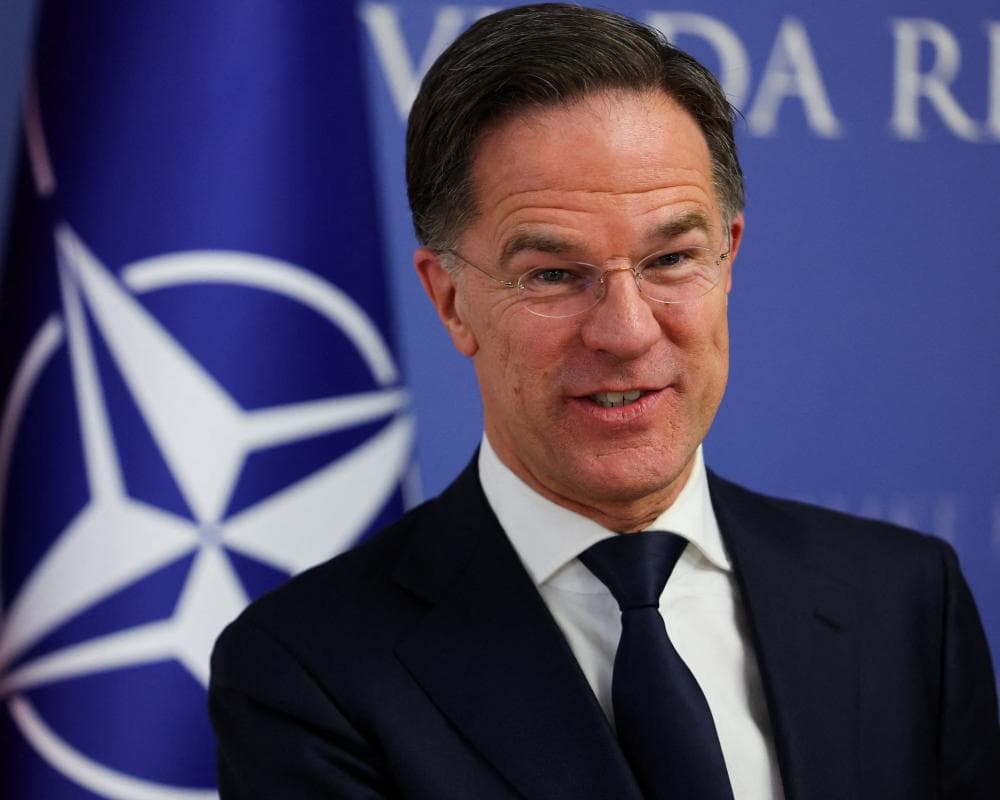
Nato’s general secretary Mark Rutte has just been asked about Trump’s comments on Greenland on his visit to Croatia, where he met the country’s prime minister Andrej Plenković.
Rutte responded to criticism of his charm offensive and repeated flattery of Trump (most famously with his ‘daddy’ comment), as he insisted that “I believe that Donald Trump is doing the right things for Nato by encouraging us all to spend more” in Europe to match the US spending.
He said he was “absolutely convinced” that “without Donald Trump we would never have had that result at the summit in The Hague” last year, increasing the GDP defence threshold to 5%.
“So when I praise somebody, it is based on facts, and I believe the facts are there,” he said.
He did not address the specific question on Trump’s comments on Greenland, but said he welcomed the other allies’ discussion on “come together and work together” and get more involved in the Artic and the High North.
“You have seen some announcements by the Brits and the Germans today, we are working now together to see how we can basically [come] together as an alliance, including our seven members, allies bordering on the high north, on the Arctic, to work together to indeed build that next step, which is crucial.”
He also said that Denmark was “already speeding up their investments when it comes to defence,” including “unique capabilities to defend territories like Greenland.”
“So we are really working together here. And my only worry is, how do we stay safe, against the Russians, against any other adversary – look at what China is doing in rapidly building up its own armed forces, but also North Koreans and others who might wish us ill or not well, at least. Therefore that’s my role, and I think we will get there,” he said.
Updated
The European Commission president Ursula von der Leyen is to travel to Paraquay on Saturday to sign the controversial Mercosur trade deal with a group of Latin American countries this Saturday.
The deal with Brazil, Argentina, Uraguay and Paraguay was adopted by member states on Friday, ending 25 years of negotiation and months of wrangling with member states over the final compromises.
However, farmers protests continued over the weekend with thousands in Ireland and France protesting on Saturday claiming the EU was guilty of a “sell out”.
Farmers in beef and grain sectors fear Europe will be flooded by cheap and substandard meat and cheaper ethanol used in petrol, something the European Commission has consistently said will not be the case.
Brussels argues that it will run extra import checks to ensure compliance with EU standards and imports of beef will be capped at 99,000 tonnes, a fraction of the near 7bn tonnes of beef produced every year in the bloc.
Commission trade spokesperson Olof Gill confirmed that the Mercosur deal could be signed off before ratification by the European parliament.
However, MEPs from countries that voted against the deal including France, Poland and Ireland are likely to attempt to block it in parliament.
“The European Parliament will have the possibility to vote on this, and the European Parliament decides the timing for this. Here in the Commission, we are convinced that this deal is a very, very strong, that it’s very much a essential for our European interests.”
The timing of the vote will be up to parliament, which has for example, still to ratify the US tariff deal agreed last August.
Meanwhile, EU defence commissioner Andrius Kubilius warned that it would be the end of Nato if the US took Greenland by force, as he stressed that EU members would also be under obligation to come to Denmark’s assistance, Reuters reported.
“I agree with the Danish prime minister that it will be the end of Nato, but also among people it will be also very, very negative,” commissioner Kubilius told Reuters at a security conference in Sweden.
Kubilius also said that the European Union Treaty article 42.7 obliged member states to come to Denmark’s assistance if faced with military aggression.
“It will depend on very much on Denmark, how they will react, what will be their position, but definitely there is such an obligation of member states to come for mutual assistance if another member state is facing military aggression,” he said.
Updated
US president Donald Trump also spoke further about Greenland in his New York Times interview published on Sunday ($).
Speaking to reporters in the Oval Office, he insisted that he wanted to resolve the issue “properly” with the US taking ownership of the territory as it was “psychologically needed for success,” saying that “ownership gives you things and elements that you can’t get from just signing a document, that you can have a base.”
He said it was “psychologically important for me.”
“Now, maybe another president would feel differently, but so far I’ve been right about everything.”
When asked if he would move to deploy US troops to Greenland, he said he “didn’t think it’d be necessary,” although earlier he also said he “would have more” troops there if needed.
Updated
We are also getting a line from Switzerland, with the SRF News reporting that the co-owner of the La Consellation bar has been formally remanded in custody over the New Year’s Eve fire that killed 40 people.
The news, confirmed by other Swiss media, says that he has been placed in custody for three months.
He was first detained on Friday, but the arrest had to be formally confirmed by the court, and this is what is reported today.
Former German vice-chancellor Robert Habeck has suggested that Greenland should be offered an EU membership to fend off Donald Trump’s interest in the territory.
Writing for the Guardian with Andreas Raspotnik, the director of the High North Center for Business and Governance at Nord University, Habeck said:
“As debates increasingly revolve around acquiring – or even occupying – the island, Europe’s lack of a counterproposal is striking.
This should be the moment to explicitly offer EU membership to Greenland, and by extension to the Faroe Islands, Iceland and Norway – an idea recently raised in the European parliament.
Greenland withdrew from the then European Communities in 1985 after gaining home rule from Denmark in 1979, but in an entirely altered world, attitudes have changed and Europe should respond accordingly.
A proposal to Greenland could be pragmatic and phased: EU membership by 2026 or 2027; early agreement on key issues such as fisheries, with renegotiation after five to 10 years; a substantial investment package targeting infrastructure and sustainable extraction of critical raw materials; and a clear commitment to preserving Inuit culture, language and local decision-making.”
Chair of the Danish parliament’s Greenland committee, Aaja Chemnitz, told reporters that the planned meeting with US senators was “good news” as it was “important for us to use all the diplomatic connections we have at our disposal.”
Chemnitz, a Greenlandic politician sitting in the Danish parliament, said there were “lots” of incorrect claims about Greenland, and “it is absolutely crucial we get some truths on the table.”
But she declined to give more information about the meeting, saying the details are yet to be fully decided.
Nordic correspondent
in Nuuk, Greenland
In a week that could prove crucial to the future of Greenland, relations between the US, Denmark and Greenland, and the very existence of Nato, there are now two key meetings coming up.
On Wednesday, the foreign ministers of Denmark and Greenland, Lars Løkke Rasmussen and Vivian Motzfeldt, are due to meet the US secretary of state, Marco Rubio, in Washington.
And it was announced last night that a group of US senators, including Alaska senator, Lisa Murkowski, are to visit Copenhagen to meet politicians from the Danish parliament’s Greenland committee.
Murkowski wrote on X on Friday:
“We have a lot to do in 2026. Taking Greenland shouldn’t be on that list.”
Meanwhile, Donald Trump has continued to pile pressure on the situation, saying last night that “Greenland should make an agreement” to avoid Russia or China taking over. He also inaccurately claimed that Greenland’s defence consists of two dog sleds (9:41).
Somewhat unexpectedly, China criticised the US for its interest in Greenland, urging it not to use other countries as an excuse to pursue its own interests, Reuters reported.
“The Arctic concerns the overall interests of the international community,” Chinese foreign ministry spokesperson Mao Ning said at a press conference.
She said China’s activities in the Arctic aim to promote peace, stability, and sustainable development in the region.
Mao also called for respecting the rights and freedoms of all nations to conduct lawful activities in the Arctic.
Europe correspondent
European leaders have strongly defended sovereignty, territorial integrity and the right of Greenland and Denmark to decide on matters concerning them, but there is as yet no clear strategy on how to deter Trump – or respond if he does make a move.
Jon Henley has looked at some of the options, ranging from diplomacy and raising Arctic security through economic sanctions, fast-tracked investment to the deployment of troops.
US president Donald Trump has repeated overnight that the US would take Greenland “one way or the other,” as he mocked its defence as “two dog sleds,” and stressed that otherwise Russia and China would move to claim the territory.
Speaking with reporters aboard Air Force One, Trump said that he was open to making a deal on Greenland in principle, but insisted “one way or the other, we are going to have Greenland.”
“If we don’t take Greenland, Russia or China will, and I’m not letting that happen,” he said, despite no obvious interest in taking complete control of the territory from either of the two countries.
Trump also mocked Greenland’s defence saying it consists of “two dog sleds,” facing Russian and Chinese “destroyers and submarines all over the place.”
Asked about the potential impact on Nato, Trump shrugged it off, saying:
“If it affects Nato, it affects Nato. But you know, they need us much more than we need them.”
He also claimed that he “saved” the alliance by pushing for increased defence spending, and said he was working on ending the Russian invasion of Ukraine.
(Our usual sympathies go to the Danish Trump night watcher, who had to watch this and report back to the country’s authorities.)
His comments came hours after the Danish prime minister, Mette Frederiksen, warned that Denmark is at a “fateful moment” amid Trump’s threats to take over Greenland, accusing the US of potentially turning its back on Nato.
“We are at a crossroads, and this is a fateful moment,” said Frederiksen.
“What is at stake is bigger than what the eye can see, because if what we experience from the Americans is that they are actually turning their backs on the western alliance, that they are turning their backs on our Nato cooperation by threatening an ally, which we have not experienced before, then everything will stop.”
I will bring you all the latest on this as we slowly build up to US state secretary Marco Rubio’s meeting with Danish and Greenlandic ministers on Wednesday. I will also look at the latest in Ukraine and across the continent.
It’s Monday, 12 January 2026, it’s Jakub Krupa here, and this is Europe Live.
Good morning.
Updated