Loading...
Please wait for a bit
Please wait for a bit
Click any word to translate
Original article by Nadeem Badshah (now) and Jakub Krupa (earlier)
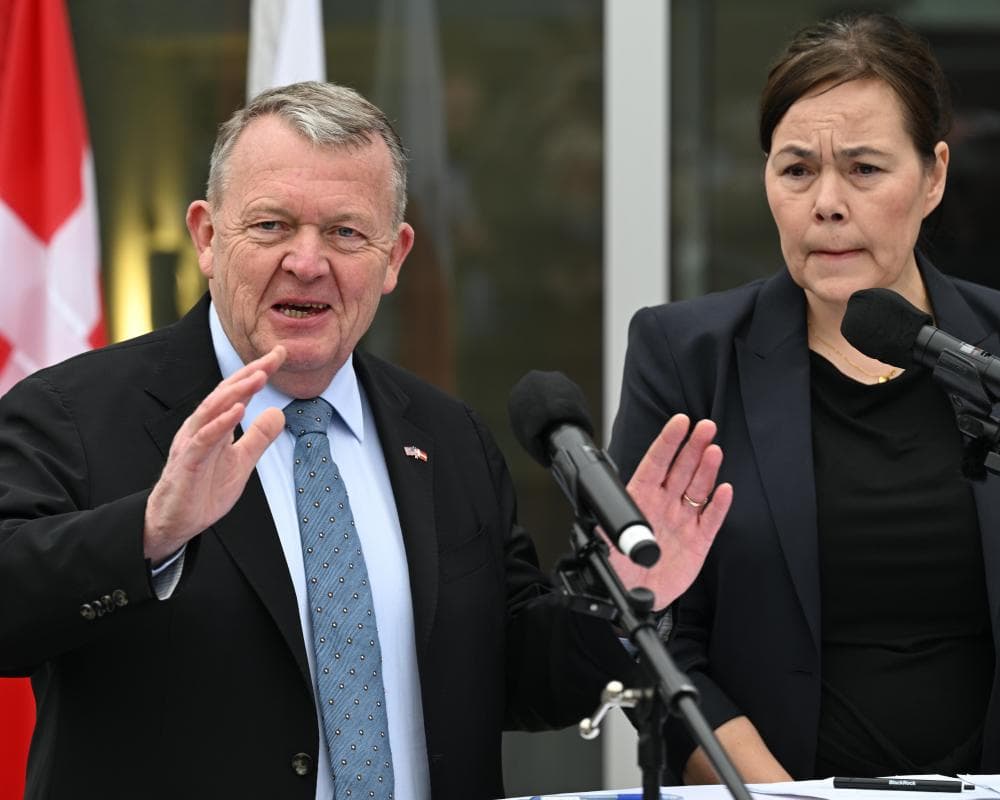
Denmark’s foreign minister Lars Løkke Rasmussen and Greenland’s foreign minister Vivian Motzfeldt met the US vice-president JD Vance for talks in Washington.
Following the meeting, Rasmussen told a news conference: “I know very well that the future is not about the past, but I think it is important to have the past in mind. We are eager to fulfil our promises. Even though our view on the situation right now around Greenland differs from public statements in the US, we want to work closely with the US, but it must be of course a respectful kind of cooperation.”
Rasmussen said the two ministers told their US counterparts that “it is not easy to think innovative[ly] about solutions when you wake up every morning to different threats.”
Rasmussen said it was a constructive meeting with the US, but admitted “we didn’t manage to change the US position” so far. “It’s clear that the president has this wish of conquering Greenland, and we made it very, very clear that this is not in the interest of the Kingdom [of Denmark].”
France is expected to join the new European military mission to Greenland, Agence France-Presse reported.
Germany said it would deploy a 13-strong Bunderwehr reconnaissance team to “explore the framework conditions for possible military contributions to support Denmark in ensuring security in the region”, the German defence ministry said, quoted by AFP.
The European parliament leaders issued a statement declaring their “firm” support for Denmark, Greenland and the rules-based international as they “unequivocally” condemned the US ambition to control the semi-autonomous territory. They stressed that “any attempt to undermine the sovereignty and the territorial integrity of Denmark and Greenland, violates international law and the United Nations Charter.” They added that “the security of the Arctic is a strategic priority for the European Union, and we are firmly committed to safeguarding it,” calling for “reinforcing European defence capabilities” to ensure security in the Arctic region.
Updated
Donald Trump remains intent on “conquering” Greenland, the Danish foreign minster has said, as crucial talks with US officials failed to solve a “fundamental disagreement” that has led to unprecedented tensions between Washington and a Nato ally, write Jon Henley and Andrew Roth.
It is “absolutely not necessary” for the US to seize Greenland, a largely self-governing part of the Danish kingdom, the Danish foreign minster, Lars Løkke Rasmussen, said late on Wednesday. “We didn’t manage to change the American position. It’s clear that the president has this wish of conquering Greenland. And we made it very, very clear that this is not in the interest of the kingdom.”
Rasmussen urged Washington to engage in “respectful” cooperation over the Arctic island that is controlled by Copenhagen.
In a signal of European support, France, Germany and Norway have all said they would contribute troops to a multinational force led by Denmark that would lead to “an increased military presence in and around Greenland, comprising aircraft, vessels and soldiers, including from Nato allies,” the Danish defense ministry has said in a statement.
The two sides did agree to create a working group to discuss ways to work through differences as Trump continues to call for a U.S. takeover of the semiautonomous territory of Nato ally Denmark.
“The group, in our view, should focus on how to address the American security concerns, while at the same time respecting the red lines of the Kingdom of Denmark,” Rasmussen told reporters after joining Greenland’s foreign minister, Vivian Motzfeldt, for the talks.
Updated
And that’s all from me, Jakub Krupa, as I hand over the blog to Nadeem Badshah to bring you further updates this evening.
France is the latest country expected to join the new European military mission to Greenland, Agence France-Presse reported, without further details at this stage.
Updated
In the meantime, Germany has confirmed it would send troops to Greenland along other European countries, as first reported by the Bild newspaper earlier (19:44).
Berlin will deploy a 13-strong Bunderwehr reconnaissance team to “explore the framework conditions for possible military contributions to support Denmark in ensuring security in the region”, the German defence ministry said, quoted by AFP.
Denmark’s foreign minister Lars Løkke Rasmussen has tried to be as diplomatic as he could – as a former prime minister, he has first-hand experience of dealing with Trump during his first term – but there is no escaping the obvious fact that the Danish and the US views on Greenland are still radically different.
Despite some cautiously chosen language on his talks with JD Vance and Marco Rubio and a clear attempt to show where they agree on the emerging threat in the Arctic (20:08), Rasmussen left no doubt that there was no substantive progress in changing the US president Donald Trump’s determination to control Greenland.
Rasmussen conceded that the joint Danish and Greenlandic delegation couldn’t “change the US position” and there was a “fundamental disagreement” over Trump’s “wish of conquering” Greenland (20:01, 20:12).
Later in the presser, he even went further and took a slight swipe at Trump’s social media comments, saying it’s difficult to “wake up every morning to different threats” (20:19).
The top Danish diplomat did what he could, though, to appeal to the US public more broadly, repeatedly stressing Denmark’s longstanding alliance with the US and its readiness to work constructively with the US administration on resolving the legitimate concerns over the Arctic.
But, fearing the worst, he also set out the red lines on territorial sovereignty and the right of the Greenlandic people to decide about their future.
The mere fact that a Danish diplomat felt the need to publicly defend his country’s territorial sovereignty against what is supposed to be its closest ally is remarkably dark.
Updated
Denmark’s Rasmussen says it is “of course very emotional for all of us,” including for Greenlanders and the Greenlandic community in Denmark.
“We look at ourselves as US closest allies,” he says, reminding of Denmark’s support for the US in Afghanistan.
He says diplomatically:
“I know very well that the future is not about the past, but I think it is important to have the past in mind.
We are eager to fulfil our promises. Even though our view on the situation right now around Greenland differs from public statements in the US, we want to work closely with the US, but it must be of course a respectful kind of cooperation.”
But he says that the two ministers told US counterparts that “it is not easy to think innovative[ly] about solutions when you wake up every morning to different threats.”
“It is in everybody’s interest that, even though we disagree, we agree to try to explore whether it is doable to accommodate some of the concerns while at the same time respecting the integrity of the Danish Kingdom’s territory and the self-determination of the Greenlandic people,” he says.
Greenland’s foreign minister Motzfeldt says that “it’s never been so important” to stress that Denmark and Greenland are US allies, have worked with the US for “many, many years,” and want to do so in the future.
She says it’s important to “normalise” the relationship amid escalating rhetoric.
She says it was a respectful meeting to set out the red lines, but she had “hope” for more mutual understanding on this issue.
Updated
Asked about what could be the compromise on Greenland, Rasmussen says it’s not a conversation to be had through the media.
He says this is exactly why Denmark asked for the meeting to avoid a shouting match in the media, and look for a constructive solution where “there is room for nuances.”
But he says that any future solution needs to respect Denmark’s red lines on territorial sovereignty.
He also insists that there are no immediate threats from China and Russia that Denmark and Greenland, and their allies, cannot manage themselves.
He repeats his comment that it was a constructive meeting, but he admits “we didn’t manage to change the US position” so far.
“It’s clear that the president has this wish of conquering Greenland, and we made it very, very clear that this is not in the interest of the Kingdom [of Denmark],” he says.
He also notes that there is no support for any US intervention among the Greenlandic population.
He says “we want to work with our American friends andallies, but it must be respectful cooperation, and it must respect our red lines.”
Responding to questions, Rasmussen once again makes it clear how unusual it is for him to face the US pressure, saying the US president phrased things “quite differently to what I would have done myself,” but says he generally agrees with his security concerns.
He says there is “definitely a new security situation in the Arctic” and the “peace dividend” is over, but notes that it was the US decision to dramatically reduce the number of US personnel based in Greenland from 10,000 to 200 over the years.
“Now the situation is entirely different and of course, we have to respond to this. The big difference is whether that must lead to a situation where, where the US acquires Greenland, and that is absolutely not necessary,” he says.
He also makes a longer comment on how disruptive it is to conduct these discussions through social and other media, and says it was a good opportunity to lower these tensions.
He also says it was a chance to correct some of the claims, as he says “we have not had a Chinese warship in Greenland for a decade or so.”
He stresses that it was a “constructive” meeting that shows a return to dialogue.
Greenland’s Motzfeld strikes a similar tone, saying there’s a conversation to be had about how to strenghten the cooperation with the US, but that doesn’t mean Greenland needs to be owned by the US.
Greenlandic foreign minister Vivian Motzfeldt speaks briefly after Rasmussen, and endorses his comments, while adding a few words to the Greenlandic people.
Rasmussen describes the conversation with US leaders as “frank, but constructive” and says that they discussed “how to ensure the long-term security in Greenland.”
He admits that “our perspectives continue to differ.”
He says that “the president has made his view clear,” and Denmark and Greenland “have a different position.”
He says that Denmark “continues to believe that the long-term security of Greenland can be secured inside the current framework,” and says that Denmark and Greenland found “any ideas that would not respect the territorial integrity of Denmark and the right of self-determination of the Greenlandic people” to be “totally unacceptable.”
“We therefore still have a fundamental disagreement, but we also agree to disagree,” he says.
A high-level working group will be created to explore if the two views can come together.
He says the group will focus on the US security concerns over the Arctic, while respecting the Danish red lines, and will meet first in “a matter of weeks.”
The press conference now gets under way.
Danish foreign minister Lars Løkke Rasmussen says the delegation came to the US following “a number of … remarkable comments about Greenland.”
He says Denmark is definitely “ready willing to do more”, and notes that the US has “wide military access” to Greenland and could ask to increase its presence.
Any such request would be “examined” any such request constructively, he says.
You can watch along here:
Updated
Germany is also reportedly considering sending troops to Greenland as part of the new European exercise in the Arctic, according to the Bild newspaper.
The paper said that “an advance team of Bunderswehr personnel” would be sent first, potentially as early as tomorrow, and could be followed by further troops if deemed needed.
But the paper notes that a spokesperson for the German defence ministry declined to comment on the report, so – as usual – it’s worth keeping a health dose of scepticism until it’s officially confirmed.
Updated
I’m keeping an eye on this elegant white-clothed round table outside the Danish embassy in Washington, as we are still waiting for the ministerial briefing from Denmark and Greenland after today’s talks with the US.
I will bring you all the key lines when it starts.
Meanwhile, the European parliament leaders issued a statement declaring their “firm” support for Denmark, Greenland and the rules-based international as they “unequivocally” condemned the US ambition to control the semi-autonomous territory.
They stressed that “any attempt to undermine the sovereignty and the territorial integrity of Denmark and Greenland, violates international law and the United Nations Charter.”
They added that “the security of the Arctic is a strategic priority for the European Union, and we are firmly committed to safeguarding it,” calling for “reinforcing European defence capabilities” to ensure security in the Arctic region.
“Decisions concerning Denmark and Greenland belong to Denmark and Greenland alone, in accordance with the relevant constitutional arrangements and agreements between Denmark and Greenland,” they said.
“The European Parliament unequivocally condemns the statements made by the Trump administration regarding Greenland, which constitute a blatant challenge to international law, to the principles of the United Nations Charter and to the sovereignty and territorial integrity of a NATO ally. Such statements are unacceptable and have no place in relations between democratic partners.”
The parliamentary leaders also urged the European Commission and the European Council “to define concrete and tangible support to Greenland and Denmark, upholding EU principles and law, international law and the Nato Charter.”
In other news, Ukraine’s president Volodymyr Zelenskyy said that “a state of emergency” will be declared in the energy sector, as the country has to deal with the impact of Russian strikes on its critical infrastructure.
He said the consequences of the attacks were “severe” and posing difficulties as the weather conditions were worsening.
“A permanent coordination headquarters will be established to address the situation in the city of Kyiv. Overall, a state of emergency will be declared for Ukraine’s energy sector,” he said after holding a meeting on the situation in the energy sector.
Norway appears to be joining the Greenland exercises, with newspaper VG reporting comments from Norway’s defence minister Tore O. Sandvik that two Norwegian military personnel will be sent to the territory to “map further cooperation between the allies.”
Updated
We are expecting a press conference with the Danish and Greenlandic foreign ministers to take place at some point in the next hour or so.
We will bring you the latest here.
Nordic correspondent
in Nuuk, Greenland
Having finished high school and voted for the first time last year, Aviâja Korneliussen, 19, is part of a generation that has come of age during this unprecedented time of Greenlandic history in which one of the world’s most peaceful populations has come under repeated threat from a military superpower.
Korneliussen, who is an artist and works at a museum and a bar, says Trump’s threats are dividing society.
“Before all of his claims it was just an easy life. You had no worries, you were friends with everybody,” she says, eating breakfast in her apartment as the morning fog cleared outside to reveal white mountains. “But now someone has a different idea of how Greenland will be and another has a whole different idea and if they clash you cannot be friends.”
She finds the way people talk about Greenland online, as an object to be traded, dehumanising. Amid the global attention, Indigenous Greenlanders are, Korneliussen says, becoming more open to expressing their Inuk identity, including through Inuit tattoos and art, and separating themselves from Denmark: “The whole idea of being Inuk instead of Qallunaaq, Danish.”
If the US was to invade, Korneliussen thinks there would be a lot of protest, but she is not sure how people – herself included – would react.
“I think I would just lock myself inside and find a way out of here,” she says. But at the same time, she does not want to have to leave her life in Greenland. “It is weird to think about because you don’t want to think about that stuff – like the what ifs and what not. Especially if you have people you care about and it is the land you were born and raised in. The culture that you live every day.”
Many Greenlandic people, Korneliussen says, have guns, so people could try to defend themselves. “But at the same time we are not that type of people to go kill one another.”
Meanwhile, the official White House account has posted a visual showing what it believes to be the choice facing Greenland (portrayed as, erm, two dog sleds): it can either side with the US and enjoy a bright future or face a storm portrayed as the combined forces of Russia and China.
It asks:
“Which way, Greenland man?”
And here are the first pictures we are getting from Washington, showing the Danish-Greenlandic delegation departing the Eisenhower Building after their talks with the US.
The US representatives are also out.
Updated
Danish broadcaster TV2 is reporting that the Washington meeting has now concluded, after some 50 minutes.
We should hear more about how the talks went later today.
Danish defence minister Troels Lund Poulsen is currently briefing the media on the Danish exercise plans “in and around Greenland”.
He largely sticks to what was announced in the original press release (15:23, 15:36).
He confirms, however, that there will be a “more permanent” and larger military presence in Greenland, without confirming which other countries will send their troops there (we know about Sweden so far).
He also says he still considers “unlikely” that a Nato country would attack another member state, and says that any question about the US launching an attack on Greenland remained “highly hypothetical.”
Updated
Oh, and here is a photo of the Danish-Greenlandic foreign ministers arriving for their meeting in Washington DC.
Nordic correspondent
in Nuuk, Greenland
If US troops were to arrive in Nuuk tomorrow and lay claim to Greenland, many Greenlanders feel they would be powerless. “What could we do?” says Najannguaq Hegelund. “We are like 20,000 in Nuuk. How are we going to go against American troops?”
Over the past couple of years, Joint Arctic Command (JAC), the Danish military forces tasked with protecting the sovereignty of the kingdom of Denmark in the Arctic, has run a preparedness course for young Greenlanders in response to the region’s heightened security situation. But many say they lack basic information on what to do in case of invasion.
Hedvig Frederiksen, 65, and her daughter, Aviaja Fontain, 40, are so worried that they have taken Greenland’s surveillance upon themselves.
“It’s scary,” says Fontain, who is struggling to focus on her university exams because of the geopolitical tension. “She [Frederiksen] keeps looking at the planes because she has a view and I keep on looking at the harbour because I have a view to the harbour.” Frederiksen, who uses flight trackers, recently got a scare when she said she spotted a Hercules plane leaving Pituffik and thought it was coming to Nuuk to invade.
Meanwhile, Swedish prime minister Ulf Kristersson has confirmed that Swedish army officers have arrived in Greenland today as part of that European allied deployment to the territory for the upcoming exercises “Operation Arctic Endurance” (15:23).
He said the troops are “part of a group from several allied countries,” and that the decision to send them in was made in response to a Danish request.
With a little delay for pleasantries and usual photographs – which I’m sure we will get soon - the proper meeting has now started, Danish broadcaster TV2 said.
Just as the meeting was getting under way, US broadcaster NBC reported that US state secretary Marco Rubio was “tasked with crafting a proposal to purchase the semi-autonomous Danish territory,” which is reportedly seen as “high priority” for US president Donald Trump.
It also carries a $700bn cost estimate, but it’s not entirely clear how it was calculated.
Updated
We now also have a picture of US state secretary Marco Rubio arriving at the Eisenhower Building for the talks, so everyone is in.
Updated
As the talks get under way in Washington DC, we are also getting pictures from a protest outside the US embassy in Copenhagen.
Updated
And here is a snap of US vice-president JD Vance making his way to attend the Greenland meeting.
Nordic correspondent
in Nuuk, Greenland
When she was living in Denmark, the seemingly unshakeable safety of Greenland was a comforting source of reassurance for Najannguaq Hegelund. Whenever there was any instability in the world, she would joke with her family: “Well we will just go to Greenland, nothing ever happens in Greenland.”
But in the past two weeks – during which Donald Trump has repeatedly threatened military action on the largely autonomous Arctic territory the US president claims he “needs” for national security purposes, despite it being part of the Danish kingdom – Hegelund, 37, has realised this is suddenly no longer true.
“Look where we are today,” she says, laughing incredulously. “It’s just so crazy.”
Like many of Greenland’s 57,000-strong population, Hegelund has found herself worrying about evacuation plans in case of US invasion, whether or not to flee to Denmark beforehand and fielding questions from her children about becoming American.
Others said they have been watchful of the skies and seas around Greenland, tracking US planes on flight trackers and even discussing plans on how best to respond if they were captured. Many said they were suffering from anxiety and struggling to sleep.
For a taster of what it feels like to be in Greenland these days, as the territory is on heightened alert over Trump’s repeated intention to take control of it and the key talks are about to kick off in Washington, our Nordic correspondent Miranda Bryant has this latest dispatch from the capital, Nuuk.
The Danish-Greenlandic delegation has just arrived at the Eisenhower Building, neighbouring the White House, in Washington DC for their talks with the US on Greenland, Danish media are reporting.
Danish ambassador to the US Jesper Møller Sørensen posted even a snap from inside the ministerial car.
Updated
Defence and security editor
Donald Trump’s claim on Wednesday that owning Greenland is vital to the White House’s planned $175bn-plus Golden Dome missile defence system (12:44) is notable because it underlines a crude return to cold war style military concerns in the White House.
Denmark’s own 2025 intelligence update notes that “most of Russia’s, China’s and the United States’ ballistic missiles would travel over the Arctic region” in the event of a nuclear war between the countries, a simple fact of geography which has meant the US has had a ballistic missile early warning system at the Pituffik base on the Danish territory since 1961.
The implication of the president’s comments would appear to be that the US wants to host missile interceptors there as an extension to its existing Ground-based Midcourse Defence (GMD) system that has facilities in Alaska and California, though the system has only had a hit rate of 55% in previous tests.
If the US wanted to base missile interceptors at Pituffik, it would be a surprise if Denmark and Greenland were to refuse, though for a large country like the US (which has never come under long range missile attack) having a national missile defence system is expected to be highly expensive, costing considerably more than the stated $175bn.
Whatever the practicalities, Trump’s statement also reveals that a key security concern is the possibility of a future conflict with Russia and crucially China, which has been increasing the size of its nuclear arsenal at the rate of 100 a year, though owning Greenland and expensive and inefficient missile defence systems may not be the most sensible solutions.
Updated
According to the Danish broadcaster TV2, US vice-president JD Vance will be joined in the meeting by his national security adviser, Andy Baker, as well as US state secretary Marco Rubio, and his adviser Michael Needham. The US side will also be represented by the US ambassador to Denmark, Ken Howery, and a senior official Michael Jensen.
Both Danish and Greenlandic representations will have three people each, with their respective foreign ministers accompanied by their senior advisers and ambassadors.
Denmark’s foreign minister Lars Løkke Rasmussen said he wanted to “build” on the historic US-Danish relationship during today’s meeting with the US on Greenland, but stressed “the territorial integrity of the country and the right of the Greenlandic people to self-determination must be protected.”
“We will never compromise on that,” he said.
He said that in a post on Facebook, with a short video showing him and his Greenlandic counterpart Vivian Motzfeldt in Washington, just over an hour before the meeting is set to begin.
The statement, now also issued by Denmark in English, offers a bit more detail on the scope of the exercises.
It says:
“The exercise activities in 2026 could include guarding critical infrastructure, providing assistance to local authorities in Greenland, including the police, receiving allied troops, deploying fighter aircraft in and around Greenland, and conducting naval operations.”
Danish defence minister Troels Lund Poulsen is quoted in the press release as saying:
“The Danish Armed Forces, together with a number of Arctic and European allies, will explore in the coming weeks how an increased presence and exercise activity in the Arctic can be implemented in practice.”
It is not currently clear which European Nato allies will join the exercises.
The Greenlandic government has increased stepping up the military presence “in and around” Greenland as the territory moves to conduct exercises with the Danish and other Nato allies to work on securing the Arctic.
In a statement, published on its website, the government said the aim of the exercises was “to develop skills in the unique conditions of the Arctic and to strengthen the presence of the Arctic community in a way that contributes to security in Europe and the Atlantic.”
The rumours about the deployment started circling earlier today, as the Danish media reported troops movement to Greenland, including an advance military command, as part of a larger expected deployment.
Obviously, the move comes as a demonstration of intent just before the key talks with the US in Washington and amid escalating rhetoric from US president Donald Trump, with Denmark, Greenland, and the European Nato allies determined to show him that they will respond to his warnings about the risk he says is posed by Russia and China.
Meanwhile, Donald Trump keeps posting social media updates on Greenland, ramping up pressure on Denmark and Greenland ahead of the talks.
In the latest post, he told Denmark to counter the alleged Russian and Chinese threat to Greenland – only to conclude that “only the USA can” do this.
“Nato: Tell Denmark to get them out of here, NOW! Two dogsleds won’t do it! Only the USA can!!!”
Trump also linked to a news story about a Danish intelligence report, published last month, which warned that “Russia, China and the United States have diverging interests in the Arctic, but all three countries seek to play a greater role in the region.”
The report warned that “the intensifying great power competition in the Arctic has brought significant international attention to the region, particularly with the growing US interest in Greenland and its implications for US national security.”
“The United States’ growing strategic interest in the Arctic reflects an increased prioritization of regional defence. In recent years, it has stepped up military activities and conducted exercises with allies in the region, including Denmark. For the United States, the Arctic represents the first and most crucial line of early warning in the event of a great-power conflict with Russia or China. The radars at Pituffik Space Base play a central role in detecting hostile missiles heading towards the US mainland.”
The report warned that while Russia faces some pressure over its involvement in Ukraine and worsening economic outlook, “its core capabilities in the Arctic remain largely intact,” and it “retains the capability to rapidly deploy fighters and bombers to its Arctic bases,” which would make it “capable of striking western targets across much of the Arctic and the North Atlantic at short notice.”
It said:
“In response to increase US and western activity in the Arctic, Russia will attempt to demonstrate its strength – including in new ways. Russia is expected to act in an increasingly unpredictable and confrontational manner. This could include aggressive responses to western military exercsies in the region, such as hazardous navigation or simulated attacks.”
It also warned that “while China currently has no military presence in the Arctic, it aims to develop an independent capability to operate both surface ships and submarines in Arctic waters within five to ten years.”
“Russia and China are expected to expand their Arctic cooperation in the coming years, despite conflicting interests in the region,” it said.
“The two countries may conduct joint exercises in the Russian Arctic in 2026. For both countries, joint exercises both inside and outside the Arctic would also serve as strategic signalling to the United States and the West. Russia’s willingness to hold joint exercises with China in the Arctic will thus depend on its relationship with the United States.”
The high-level meeting between US vice-president JD Vance, US state secretary Marco Rubio and the foreign ministers of Denmark and Greenland has been reportedly moved out from the White House and into the neighbouring Eisenhower Building, which houses Vance’s ceremonial offices, the Danish media reported.
Danish broadcaster TV2 speculated that the move could be seen as an attempt to lower the tensions by moving it further away from the president, particularly after his latest explosive comments.
The meeting is expected to start at 10.30am Washington time (3.30pm UK time, 4.30pm CET).
Greenland’s prime minister said now was “not the time” to talk about the Arctic island’s future independence and jeopardise its right to self-determination, as Trump ramps up threats to take control of it, AFP reported.
“I don’t think this is the time to talk about it. We shouldn’t gamble with our right to self-determination when another country is talking about taking us,” prime minister Jens-Frederik Nielsen said in an interview with Greenlandic media.
“That doesn’t mean we won’t want something different in the future. But here and now, we are part of the (Danish) kingdom, and we stand with the kingdom. That is particularly important in this serious situation,” Nielsen added.
US president Donald Trump has doubled down on his rhetoric on getting control of Greenland, insisting that the US “needs Greenland for the purpose of national security.”
In a social media post, Trump claimed that “Nato should be leading the way for us to get it,” and “if we don’t, Russia or China will, and that is not going to happen!”
“Militarily, without the vast power of the United States, much of which I built during my first term, and am now bringing to a new and even higher level, Nato would not be an effective force or deterrent - not even close! They know that, and so do I.”
“Nato becomes far more formidable and effective with Greenland in the hands of the United States. Anything less than that is unacceptable,” he said.
He also said the territory was “vital for the Golden Dome that we are building.”
His comments are likely to irk Danish and Greenlandic leaders just hours ahead of their crunch talks with vice-president JD Vance and US state secretary Marco Rubio at the White House.
Updated
If the sovereignty of a European country and ally was affected, the knock-on effects would be unprecedented, French president Emmanuel Macron said during a cabinet meeting, referring to the US president Donald Trump’s push to take control of the Arctic territory, Reuters reported.
“We do not underestimate statements on Greenland,” Macron said, quoted by French government spokesperson Maud Bregeon.
The European Commission president Ursula von der Leyen has backed Greenland amid growing interest from US president Donald Trump, saying the territory “belongs to its people” and insisting she was in contact with Denmark over the issue.
“Greenland belongs to its people, so it’s up to Denmark and Greenland, and only to them, to decide on matters that are concerning Denmark and Greenland. That’s point number one, that’s very important,” she said.
She added that the EU was in contact with the Danish government “also to listen to what their needs are.” She also stressed that Greenland was part of Nato.
“There is a strong, existing relationship between the European Union and the Greenlanders. For me it’s important that the Greenlanders know and they know this by the deeds, not only by the words, that we respect the wishes of the Greenlanders and their interests and that they can count on us,” she told a press conference in Brussels.
Meanwhile, a new poll shows that just 17% of Americans approve of president Donald Trump’s efforts to acquire Greenland, and substantial majorities of Democrats and Republicans oppose using military force to annex the island.
47% of respondents to the Reuters/Ipsos poll disapproved of US efforts to acquire Greenland, while 35% said they were unsure.
Only 4% of Americans – including just one in 10 Republicans and almost no Democrats – said it would be a “good idea” for the US to use military force to take possession of Greenland from Denmark, Reuters said.
66% of respondents, including 91% of Democrats and 40% of Republicans, said they were worried US efforts to acquire Greenland will damage the Nato alliance and US relationships with European allies.
Meanwhile, Poland’s president Karol Nawrocki declined to comment on the US ambitions for Greenland, saying it was a matter for the two countries to discuss between themselves.
Speaking to the BBC Radio 4 Today programme as part of his visit to the UK:
“I think that the discussion about Greenland should first of all remain the matter between the prime minister of Denmark and president Donald Trump.
On one hand, we are seeing the military aggression of the Russian Federation. On the other hand, we can see economic competition between the United States and China, and this is the context, the lens through which we are looking at Greenland.”
As a close Trump ally in Europe, he was asked if he was telling European leaders to not be worried about the US president’s ambitions, and he replied:
“I’m not able to predict the future.”
in Madrid
Spain’s foreign minister José Manuel Albares refused to be drawn on whether a US invasion of Greenland would spell the end of Nato, but told El País newspaper:
“We’ve made our position clear: like sovereignty, territorial integrity is part of international law. And this is not merely an intellectual construct; it’s the honourable way in which states relate to one another, cooperate, and move forward together peacefully.
If any ally believes that Arctic security is not sufficiently well protected, just as Spain raised the issue of the southern flank at the Nato summit in Madrid, there is no problem in discussing it and working together to address any security gaps that may exist.
But the territorial integrity of any state, especially if it is an EU partner … Denmark certainly has our full support.”
In other reactions, German defence minister Boris Pistorius said that any move by the US to take control of Greenland would be an unprecedented situation for Nato, echoing earlier warnings from the EU defence commissioner, Andrius Kubilius.
“The least we can say is that it would be a real unprecedented situation in the history of Nato and in the history of any defence alliance in the world,” he said at a press conference in Berlin yesterday.
Denmark will “strengthen” its military presence in Greenland after US criticism over its defence investment in the territory, the country’s defence minister Troels Lund Poulsen said.
In a statement to AFP news agency, Poulsen said:
“We will continue to strengthen our military presence in Greenland, but we will also have an even greater focus within Nato on more exercises and an increased Nato presence in the Arctic.”
He added that Denmark was involved in “an ongoing dialogue with its Allies about new and increased activities in 2026.”
Meanwhile, France has announced plans to open a consulate in Greenland next month, with the country’s foreign minister Jean-Noël Barrot saying it was meant to send “a political signal” amid US president Donald Trump’s growing interest in the territory.
Barrot told French RTL broadcaster that the decision to open the consulate was taken last summer, when president Emmanuel Macron visited Greenland in a show of support, AFP reported.
“For my part, I went there at the end of August to plan the consulate, which will open on 6 February,” he said.
“It’s a political signal that’s associated with a desire to be more present in Greenland, including in the scientific field.”
“Greenland does not want to be owned, governed... or integrated into the United States. Greenland has made the choice of Denmark, Nato, (European) Union,” he said.
The US president, Donald Trump, has sparked fresh concerns about the future of Greenland after he dismissed the territory’s prime minister’s defiant rejection of the US, saying “I don’t know anything about him, but this is going to be a big problem for him.”
Asked about Jens-Frederik Nielsen’s statement saying Greenland would choose Denmark over the US, Trump said:
“I disagree with him. I don’t know who he is. I don’t know anything about him. But, that’s going to be a big problem for him.”
His comments come hours before key talks in Washington between the Danish and Greenlandic foreign ministers and the US vice-president, JD Vance, and the US state secretary, Marco Rubio.
The growing tensions between the two historical allies also have very tangible effect on their relations, including on tourism.
According to the lastest data from travel industry group Rejs, the number of trips booked by Danish citizens to the US has dropped by half in 2025.
“We have never seen this before. It is completely extraordinary. We have never seen such a big drop in a major destination,” director Niels Amstrup said, quoted by DR.
I will bring you our coverage on the US meeting and European reactions to Greenland, as well as the latest updates on Ukraine and other key European issues.
It’s Wednesday, 14 January 2026, it’s Jakub Krupa here, and this is Europe Live.
Good morning.