Loading...
Please wait for a bit
Please wait for a bit
Click any word to translate
Original article by Tom Ambrose
We’re closing this live blog now, thanks for reading.
A full report of the day’s events can be found here:
Reuters is now reporting that the talks have ended for the day:
The second day of US-brokered talks between Ukraine and Russia in Abu Dhabi has ended, a source with knowledge of the matter told Reuters on Saturday.
Russian attacks on Ukraine killed at least one person and wounded 23 overnight into Saturday, as negotiators from Ukraine, Russia and the United States were set to meet in Abu Dhabi for a second day of talks to end Russia’s nearly four-year full-scale invasion. One person was killed and four wounded in Russian drone attacks on the Ukrainian capital, Kyiv, according to Kyiv City Military Administration head Tymur Tkachenko.
US-brokered talks between Ukraine and Russia resumed on Saturday in Abu Dhabi, a source familiar with the situation told Reuters. The rare trilateral talks to end the nearly four-year war began in the UAE on Friday.
Ukraine’s foreign minister accused Russian president Vladimir Putin on Saturday of “cynically” ordering a massive missile strike while delegations from Ukraine, Russia and the US were in Abu Dhabi for Washington-brokered peace talks. Andrii Sybiha wrote on X: “Cynically, Putin ordered a brutal massive missile strike against Ukraine right while delegations are meeting in Abu Dhabi to advance the America-led peace process. His missiles hit not only our people, but also the negotiation table.”
Before Saturday’s bombardment, Kyiv had already endured two mass overnight attacks since the New Year that knocked out power and heating to hundreds of residential buildings. Ukraine’s deputy prime minister said on Saturday that 800,000 people in Kyiv - where temperatures were around -10 Celsius - had been left without power after the latest Russian assault.
Russia’s large overnight strike on Ukrainian energy facilities showed that agreements on air defence made with US president Donald Trump in Davos this week must be “fully implemented,” president Volodymyr Zelenskiy said on Saturday. Zelenskyy and Trump met at the World Economic Forum on Thursday and discussed air defence support for Ukraine, although afterwards neither leader specified what was agreed.
The Russian defence ministry said on Saturday its forces had completed the takeover of the village of Starytsya in Ukraine’s northeastern Kharkiv region. Moscow’s troops also carried out a massive strike overnight on Ukrainian long-range drone sites and energy facilities, the ministry said.
Danish prime minister Mette Frederiksen on Saturday slammed US president Donald Trump for saying Nato allies had shied away from the front line in Afghanistan. “I fully understand that Danish veterans have said no words can describe how much this hurts,” she said on Facebook.
India and Europe hope to strike the “mother of all deals” when EU chiefs meet prime minister Narendra Modi in New Delhi next week, as the two economic behemoths seek to forge closer ties, AFP reports. Facing challenges from China and the United States, India and the European Union have been negotiating a massive free trade pact – and talks, first launched about two decades ago, are nearing the finishing line.
Germany is facing calls to withdraw its billions of euros’ worth of gold from US vaults, spurred on by the shift in transatlantic relations and the unpredictability of Donald Trump. Germany holds the world’s second biggest national gold reserves after the US, of which approximately €164bn (£122bn) worth – 1,236 tonnes – is stored in New York.
Updated
Danish prime minister Mette Frederiksen on Saturday slammed US president Donald Trump for saying Nato allies had shied away from the front line in Afghanistan.
“I fully understand that Danish veterans have said no words can describe how much this hurts,” she said on Facebook.
“It is unacceptable that the American president questions the commitment of allied soldiers in Afghanistan,” she added.
The Danish Veterans Association earlier said it was “at a loss for words”.
Before Saturday’s bombardment, Kyiv had already endured two mass overnight attacks since the New Year that knocked out power and heating to hundreds of residential buildings.
Ukraine’s deputy prime minister said on Saturday that 800,000 people in Kyiv - where temperatures were around -10 Celsius - had been left without power after the latest Russian assault.
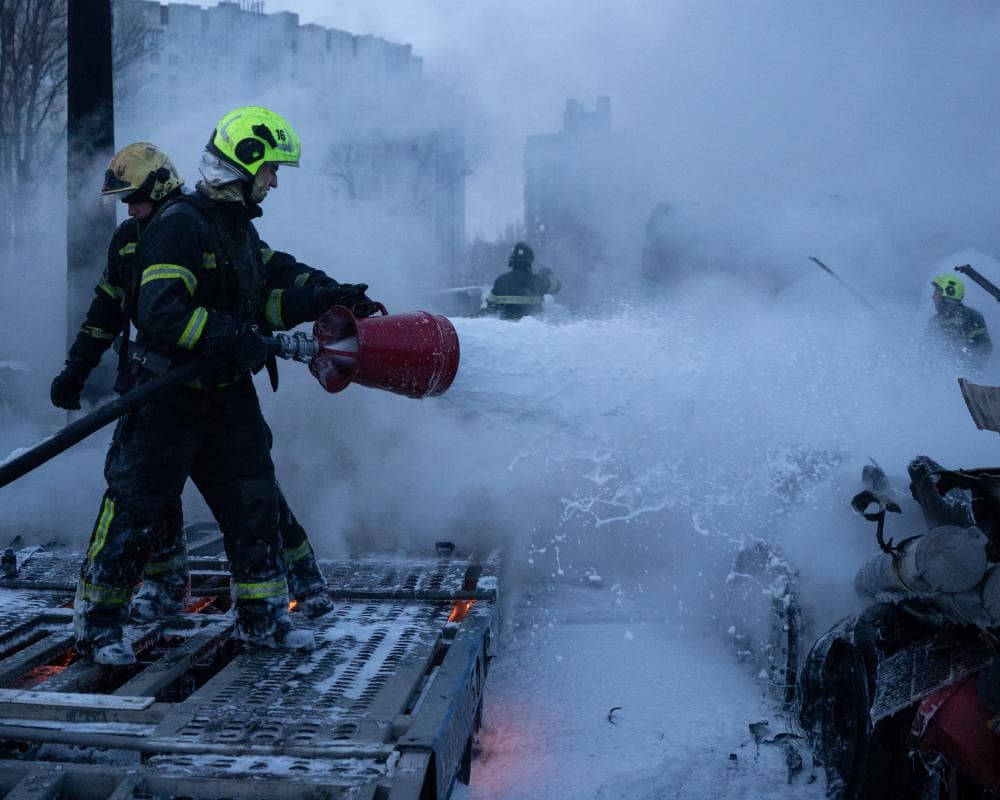
Ukrainian rescuers working at the site of a Russian attack in Kyiv, Ukraine, earlier today.
India and Europe hope to strike the “mother of all deals” when EU chiefs meet prime minister Narendra Modi in New Delhi next week, as the two economic behemoths seek to forge closer ties, AFP reports.
Facing challenges from China and the United States, India and the European Union have been negotiating a massive free trade pact – and talks, first launched about two decades ago, are nearing the finishing line.
“We are on the cusp of a historic trade agreement,” European Commission president Ursula von der Leyen said this week.
Von der Leyen and European Council president Antonio Costa will attend Republic Day celebrations Monday before an EU-India summit Tuesday, where they hope to shake hands on the accord.
Securing a pact described by India’s commerce minister Piyush Goyal as “the mother of all deals”, would be a major win for Brussels and New Delhi as both seek to open up new markets in the face of US tariffs and Chinese export controls.
But officials have been eager to stress there is more to it than commerce.
“The EU and India are moving closer together at the time when the rules-based international order is under unprecedented pressure through wars, coercion and economic fragmentation,” the EU’s top diplomat, Kaja Kallas said Wednesday.
Just hours before the three-way talks began, Putin discussed a Ukraine settlement with US president Donald Trump’s envoys Steve Witkoff and Jared Kushner during marathon overnight talks.
The Kremlin insists that to reach a peace deal, Kyiv must withdraw its troops from the areas in the east that Russia illegally annexed but has not fully captured.
Germany is facing calls to withdraw its billions of euros’ worth of gold from US vaults, spurred on by the shift in transatlantic relations and the unpredictability of Donald Trump.
Germany holds the world’s second biggest national gold reserves after the US, of which approximately €164bn (£122bn) worth – 1,236 tonnes – is stored in New York.
Emanuel Mönch, a leading economist and former head of research at Germany’s federal bank, the Bundesbank, called for the gold to be brought home, saying it was too “risky” for it to be kept in the US under the current administration.
“Given the current geopolitical situation, it seems risky to store so much gold in the US,” he told the financial newspaper Handelsblatt. “In the interest of greater strategic independence from the US, the Bundesbank would therefore be well advised to consider repatriating the gold.”
Stefan Kornelius, the spokesperson for Friedrich Merz’s coalition government, said recently that withdrawal of the gold reserves was not currently under consideration.
But Mönch is only the latest in a string of economists and financial experts to argue that such a move would be in keeping with the greater strategic independence that Europe’s largest economy has been seeking from the US in recent months.
US-brokered talks between Ukraine and Russia resumed on Saturday in Abu Dhabi, a source familiar with the situation told Reuters.
The rare trilateral talks to end the nearly four-year war began in the UAE on Friday.
Ukrainian president Volodymyr Zelenskiy said senior representatives from Ukraine’s armed forces and military intelligence would join the talks on Saturday.
Updated
Here are some dramatic photos from Russia’s drone and missile strike in Kyiv last night:
The Russian defence ministry said on Saturday its forces had completed the takeover of the village of Starytsya in Ukraine’s northeastern Kharkiv region.
Moscow’s troops also carried out a massive strike overnight on Ukrainian long-range drone sites and energy facilities, the ministry said.
In the Benedikt cafe in the Ukrainian port city of Odesa, one wall is covered by a giant map with countries and territories cut out of lacquered wooden pieces, with Greenland at its apex.
The waiter has not been following news of the Greenland crisis and Donald Trump’s desire to annex the Danish territory. But the echoes of the Russian president, Vladimir Putin’s imperial land grab of the waiter’s own country are clear to him. “They’re crazy. The pair of them.”
For those paying more attention in Ukraine, amid Russian airstrikes, the freezing cold and power cuts, the correspondences are not only clear, but often alarming – even if for now Trump has switched from sabre rattling to trying to rationalise a vague and incoherent deal he thinks he struck for the territory with Nato.
“There are three basic problems,” said Oleksandr Merezhko, the chair of the Ukrainian parliament’s committee on foreign policy and inter-parliamentary relations and an expert on international law.
“Firstly, it is a distraction from the situation we are in now. And any distraction among our European partners weakens the coalition supporting us. It weakens Nato, and it weakens transatlantic solidarity.”
Then there is the question of how Trump’s demands and actions undermine the post-second world war international rules-based order.
“As an international lawyer, one of the key principles is that territorial integrity is sacrosanct. We support the territorial integrity of Denmark. And what I am afraid of is [that the Greenland issue plays into] Putin’s idea of dividing the world into spheres of influence.”
Russia’s large overnight strike on Ukrainian energy facilities showed that agreements on air defence made with US president Donald Trump in Davos this week must be “fully implemented,” president Volodymyr Zelenskiy said on Saturday.
Zelenskyy and Trump met at the World Economic Forum on Thursday and discussed air defence support for Ukraine, although afterwards neither leader specified what was agreed.
Ukraine’s foreign minister accused Russian president Vladimir Putin on Saturday of “cynically” ordering a massive missile strike while delegations from Ukraine, Russia and the US were in Abu Dhabi for Washington-brokered peace talks.
Andrii Sybiha wrote on X:
Cynically, Putin ordered a brutal massive missile strike against Ukraine right while delegations are meeting in Abu Dhabi to advance the America-led peace process. His missiles hit not only our people, but also the negotiation table.
Two of the largest cities, Kyiv and Kharkiv, shook from loud explosions. Dozens of ballistic and air ballistic missiles were used, as well as hundreds of drones.
He added:
This barbaric attack once again proves that Putin’s place is not at the board of peace, but at the dock of the special tribunal.
Russia launched waves of air strikes against Ukraine’s two largest cities Kyiv and Kharkiv early on Saturday, with one person killed and at least 23 injured.
He added: “Peace efforts? Trilateral meeting in the UAE? Diplomacy? For Ukrainians, this was another night of Russian terror.”
Ukraine’s air force said Russia had launched 375 drones and 21 missiles in the strikes, which once again targeted energy infrastructure, knocking out power and heat for large parts of the capital.
Updated
Hello and welcome to the Europe live blog. My name is Tom Ambrose and I will be bringing you all the latest news lines.
We start with news that Russian attacks on Ukraine killed at least one person and wounded 23 overnight into Saturday, as negotiators from Ukraine, Russia and the United States were set to meet in Abu Dhabi for a second day of talks to end Russia’s nearly four-year full-scale invasion.
One person was killed and four wounded in Russian drone attacks on the Ukrainian capital, Kyiv, according to Kyiv City Military Administration head Tymur Tkachenko.
In Ukraine’s second-largest city, Kharkiv, drone attacks wounded 19 people, Kharkiv mayor Ihor Terekhov said.
The attacks came as envoys were expected to meet in the United Arab Emirates for a second day of talks on Saturday. The talks are the first known instance that officials from the Trump administration have sat down with both countries, AP reports.
The UAE’s foreign ministry said the talks are part of efforts “to promote dialogue and identify political solutions to the crisis.” The White House described Friday’s first day as productive.
There has been a flurry of diplomatic activity in recent days, from Switzerland to the Kremlin, even though serious obstacles remain between both sides.
While Ukrainian president Volodymyr Zelenskyy said in Davos, Switzerland, on Thursday that a potential peace deal was “nearly ready,” certain sensitive sticking points - most notably those related to territorial issues - remain unresolved.
Just hours before the three-way talks began, Russian president Vladimir Putin discussed a Ukraine settlement with US president Donald Trump’s envoys Steve Witkoff and Jared Kushner during marathon overnight talks.
The Kremlin insists that to reach a peace deal, Kyiv must withdraw its troops from the areas in the east that Russia illegally annexed but has not fully captured.
You can read my colleague Peter Beaumont’s report from Kyiv here: