Loading...
Please wait for a bit
Please wait for a bit
Click any word to translate
Original article by Jakub Krupa
in Brussels
Here in Brussels talks between senior EU diplomats are under way in the latest attempt to overcome Greece’s opposition to the bloc’s sanctions against Russia.
Greece is the last remaining obstacle to the EU’s 21st round of sanctions against Russia, as it seeks to block a ban on transporting oil that would affect a large shipping company, Dynagas, owned by billionaire George Prokopiou.
Dynagas, which specialises in transporting liquefied natural gas in sub-zero temperatures, has invested in icebreakers to transport energy from Russia’s Yamal peninsula in Siberia to non European countries.
But amid great fanfare, the EU agreed last year that the “the purchase, import or transfer, directly or indirectly” of Russian LNG will cease from 1 January 2027.
Athens is now holding up the 21st package, as it seeks an exemption on this previously agreed measure. The 21st round of sanctions includes measures targeting crypto companies, banks and oil traders helping Russia evade sanctions. It would maintain a price cap on Russian oil at $44 to prevent the Kremlin gaining from rising crude prices, following the closure of the Strait of Hormuz
The stand-off has already necessitated an emergency prolongation of the EU’s oil price cap on Russia. Without further agreement., the oil price cap will go up automatically later this summer. EU ambassadors meeting in Brussels on Wednesday have given themselves until tomorrow to resolve the impasse.
A ban on imports of Russian cod has already been dropped, amid opposition from Portugal and Germany, the latter fearing the impact on the price of fish fingers.
A proposed ban on Russian combatants entering the EU looks set to be delayed, following opposition from France and Italy, two member states that grant large numbers of visas to Russian tourists.
The unraveling of the package has prompted some insiders to ask if the EU’s sanctions policy is reaching its limits.
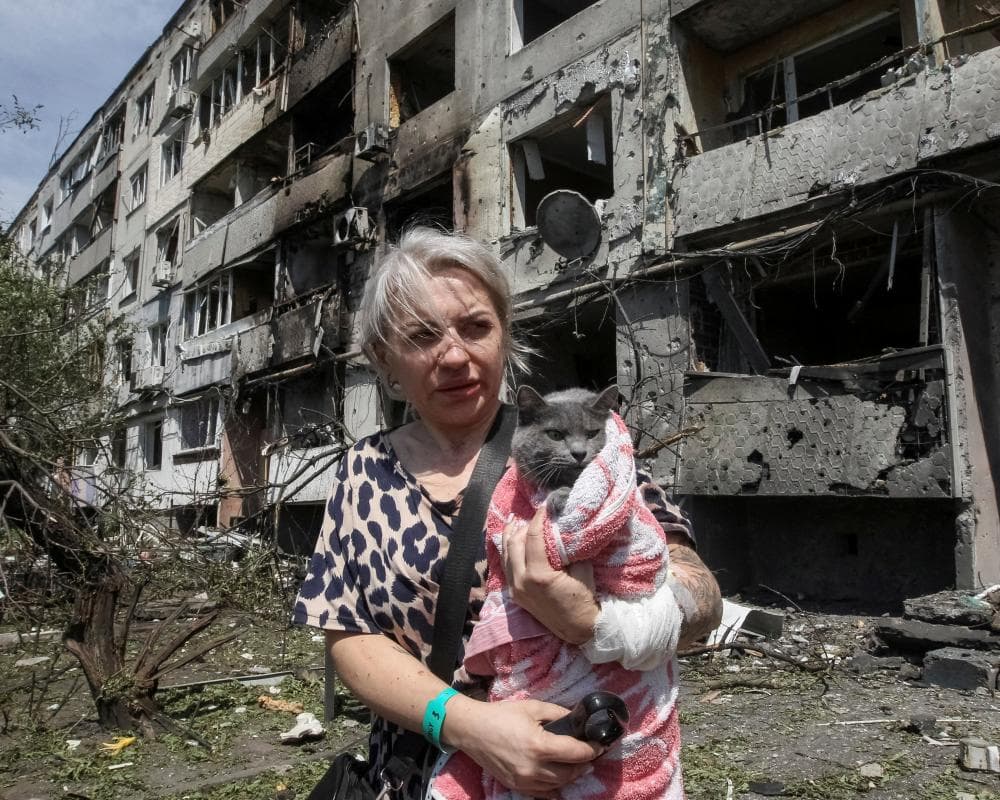
But Ukraine, which is enduring an intensification of Russian attacks that have increased the numbers of civilians killed and injured, argues the EU can still do more to pressure Russia.
Writing on X, Ukraine’s sanctions envoy Vladyslav Vlasiuk wrote:
“Is it fair that while many [EU] companies left the [Russian] market and accepted the cost, others stayed, earned windfall profits, and now seek exemptions?”
Updated
And sticking to that topic, Ukraine’s president Volodymyr Zelenskyy said major general Ihor Skybiuk would replace Andrii Hnatov as the head of Ukraine’s General Staff, as he continued reshuffling the military.
“He is a highly experienced officer who defended Ukraine shoulder to shoulder with the new Commander-in-Chief. It is important that all components of our Armed Forces continue to function in complete coordination.,” Zelenskyy said on X.
Meanwhile, responding to the top military brass reshuffle in Ukraine, the Kremlin said these changes will not affect the situation on the frontline, AFP reported.
“I don’t think this will lead to any changes on the frontlines,” Kremlin spokesperson Dmitry Peskov said, adding that Moscow intends to continue pressing in its almost four-and-a-half-year offensive.
Rubio gets asked about his plans to meet Russia’s foreign minister Lavrov tomorrow.
He says “the war in Ukraine, I think, has in many ways impeded the ability of Russia and the US to find areas of agreements on other topics,” but the US can still cooperate with Moscow in some areas.
He says the US “would like to see that war come to an end,” and “it would be good for Russia if that war came to an end,” so “we will raise it.”
“The US remains open and willing to play a constructive role in bringing that war to an end if that opportunity presents itself,” he says.
He says the talks between the US and Russia didn’t make much progress in recent months, but “perhaps there are now new conditions in place that will allow that conversation to happen and it is one of the things we will explore tomorrow.
Updated
Right on cue, US secretary of state Rubio is speaking to reporters in Manila now.
He’s, perhaps understandably, mostly getting questions about Iran, but I am listening in for any lines on Europe, Ukraine or Russia ahead of his Lavrov meeting later this week.
Updated
Russian foreign minister Sergei Lavrov just told reporters that he will be meeting US secretary of state Marco Rubio on the sidelines of a regional Asean (that’s the Association of Southeast Asian Nations) forum in Manila this Thursday.
One to watch.
The Venice Biennale said it would challenge a European Union decision to withdraw a €2 million grant in response to the return of Russia to its 2026 edition, despite continuing aggression on Ukraine, Reuters reported.
The Italian government sharply criticised the move, while the European Commission warned it would suspend or terminate funding if the Russian pavilion returned.
The European Commission confirmed on Tuesday that it had decided to revoke the funding following legal advice and a recommendation from Brussels.
“Cultural events financed with European taxpayers’ money should safeguard democratic values and promote dialogue, diversity and freedom of expression, values that are not respected in present-day Russia,” said Commission spokesperson Thomas Regnier, according to Italian media.
And after this quick round up of news from across Europe, let’s get the latest on Ukraine and related news.
Updated
Greece is expected to experience its hottest day of the year on Wednesday, with temperatures reaching up to 43C according to meteorologists, and several regions placed on alert due to the risk of wildfires, AFP reported.
Outdoor work bans have also been announced during the warmest hours of the day for health reasons.
The civil protection authority has placed the greater Athens area, central Greece and the Peloponnese on maximum wildfire alert for the first time this season.
A court order directing the French government to ban companies from trading or investing in the Palestinian occupied territories is being sought today, in a novel action by five human rights organisations that tests the enforceability of international law.
The legal request to France’s highest administrative court argues the French government has failed to implement an advisory opinion issued two years ago by the International Court of Justice (ICJ), that declared the Israeli occupation of the Palestinian territories was unlawful and countries should not do anything to aid the occupation.
The five NGOs taking the action are the International Federation for Human Rights (FIDH), Jurists for the Respect of International Law (JURDI), the International Centre of Justice for Palestinians (ICJP), La Ligue des Droits Humains (LDH), and Law for Palestine.
The French foreign minister Jean-Noël Barrot on Monday called for “the end of imports of products from illegal settlements into the European Union”. The human rights groups argue however that France has a national legal obligation and cannot simply wait for the creation of a consensus inside the EU, where there is an impasse on the issue.
The ICJ, in a landmark ruling in July 2024, found that all states are under an obligation not to recognise the Israeli occupation of the Palestinian territories as lawful nor to aid or assist it.
The UN general assembly in September 2024 also resolved that countries had an obligation to distinguish between the territory of the state of Israel and the Occupied Palestinian Territory, in order to “take steps to prevent trade or investment relations that assist in the maintenance of the illegal situation created by Israel in the OPT“.
In other news, Hungary’s former nationalist prime minister Viktor Orbán confirmed that prosecutors had taken his Fidesz party’s servers during a raid on Tuesday, as we reported on Europe Live.
Orban, who was ousted in an election in April, also told a briefing that officials to be elected by the new Tisza government would be “illegitimate” and Fidesz would use all peaceful means to fight against what he called was tyranny by prime minister Péter Magyar’s government.
Much more to come on this, no doubt.
A Ukrainian artist, writer and cultural manager from Mariupol, and the founder of Platform TU, an independent cultural initiative now operating in exile after Russia’s full-scale invasion.
Over the years of working with western colleagues, I had learned to accept that they don’t fully understand what war feels like from the inside. They would ask me to find someone in occupied Mariupol for an interview, or seem genuinely puzzled that I couldn’t just log on at a time that suited them. I made my peace with this long ago – they don’t have to understand. But this time, it was a Ukrainian who asked.
It was winter, the kind where every online meeting had to be carefully scheduled around power outage timetables – and sometimes around shelling timetables, as we had already begun to joke among ourselves in that dark way. The question about rescheduling the meeting came from a colleague who had left for Europe in 2022, and it hit me almost physically, precisely because she was the one to say it. That innocent query had no business feeling like an accusation – and yet it did. For a long time, I couldn’t understand why.
We knew that war would bring pain and rupture. But there are ruptures no one warned us about – ruptures that are quiet and slow, and for that reason the most devastating. One of them runs not between Ukraine and the world, but through Ukrainians ourselves – between those who left and those who stayed. Almost no one talks about it. But it’s there, and with every passing month it grows wider.
Ukraine has agreed to export drones to the United States to participate in the Pentagon’s Drone Dominance programme, a source told Reuters.
Six Ukrainian companies have received permission to export about 100 drones each, the source said.
There was no official confirmation from Kyiv or Washington so far.
in Dnipro
Some much-awaited changes in the way the Ukrainian army is organised will kick in today, after president Volodymyr Zelenskyy fired Ukraine’s commander-in-chief Oleksandr Syrskyi and offered a “prominent position” to the defence minister he sacked last week in a move that sparked nationwide protests.
In a late-night TV address, Zelenskyy said he was appointing Mykhailo Drapatyi, a popular and innovative general, as the new head of Ukraine’s armed forces. Drapatyi would oversee a reorganisation of the army’s command structure, Ukraine’s president said.
Zelenskyy said he was bringing Mykhailo Fedorov back into government after his removal as defence minister prompted thousands of people to demonstrate in Kyiv and other Ukrainian cities, in one of the biggest political crises since Russia’s 2022 invasion.
Ukraine’s president paid tribute to Syrskyi and credited him with leading the defence of Kyiv and launching a counter-invasion of Russia’s Kursk province in summer 2024, in which foreign tanks rolled on to Russian territory for the first time since the second world war.
“We have come a long way. The defence of Ukraine continues. And every soldier deserves to be treated with respect,” Zelenskyy said, adding that he was grateful to Syrskyi and to “every one of our soldiers” fighting on the frontline.
Zelenskyy will be hoping that his radical reshuffle of the army’s leadership will assuage protesters who have taken to the streets demanding Syrskyi’s removal. They had given a deadline of Friday for Fedorov to be reinstated and promised “indefinite protests” if their request was ignored.
Ukraine’s president Volodymyr Zelenskyy praised the overnight attack on “logistics hubs involved in supplying the Russian army with drone component, navigation equipment and other gear.”
“We are, quite justly, bringing the war back home – to Russia. Peace is needed, and Ukraine has presented the Russian side with every proposal. They must be forced to turn to diplomacy.”
EU ambassadors are meeting in Brussels today in a bid to sign off on the 21st package of sanctions against Russia after previous attempts ended with no success.
Lithuania’s ambassador to the EU, Nerijus Aleksiejūnas, told the Lithuanian media that he was sensing a growing fatigue with the sanctions amid concerns that some measures could actually pose difficult questions for some of the member states.
“The argument heard most often is that sanctions should not harm European countries and their economies compared with Russia,” he said, as reported by LRT.
As a result, the EU dropped proposed restrictions on Russia’s fishing sectors, a proposed ban on Russian soldiers entering Europe (as France, Italy, and Spain issued the highest number of visas to Russian citizens last year, LRT said), and on sanctions against Russian Orthodox patriarch Kirill. Greece continues to oppose proposed restrictions on Russian LNG supplies.
It’s far from given whether the ambassadors will be able to sign off on the 21st package today, before they break for summer holidays. I will keep an eye on this. The meeting starts 10am local time (9am UK).
In the meantime, Ukraine continues long-range strikes inside Russia as it hit more warehouses of Russia’s largest online retailer, Wildberries, overnight. Eight people were reportedly injured.
Elsewhere, I will keep an eye on developments across Europe for you, as we are expecting updates from France, Hungary, and Italy, among others.
It’s Wednesday, 22 July 2026, it’s Jakub Krupa here, and this is Europe Live.
Good morning.