Loading...
Please wait for a bit
Please wait for a bit
Click any word to translate
Original article by Jakub Krupa
in Brussels
Moises Galan Santano, a wildfires expert at the EU’s Emergency Response Coordination Centre, stressed that more needed to be done to prevent wildfires, which he said would be a task for many years.
“The [emergency] response is not only the answer. It’s the last answer. But it’s not all the answer. We need to focus on prevention.”
Officials said prevention encompassed many policies, such as early-warning systems, more animal grazing (to reduce vegetation) and changes to forest management.
Earlier this year a policy paper from the European Commission set out how European countries could better prevent and recover from wildfires that are expected to become bigger and more damaging across the continent.
It promoted measures, such as more extensive grazing, the restoration of wetlands, rivers and floodplains, better data on forest fires and raising public awareness of risky behaviour and safe evacuation.
in Brussels
The European Union’s crisis-management team is expecting difficult weeks ahead, fearing a further outbreak of wildfires in Italy and Greece as the summer goes on.
Maria Zuber, a senior official at the EU’s Emergency Response Coordination Centre in Brussels, said the next few days will be “very difficult” for France, where firefighters are battling to contain the massive fire in the Gironde region near Bordeaux amid a spike in temperatures on Wednesday.
The ERCC is the EU’s crisis-management centre, which monitors disasters around the world and coordinates the dispatch of firefighting planes, equipment and teams to countries that have asked for help.
Speaking to reporters, Zuber said Greece had so far been spared, but “now we see it will go to Greece” and forecast an intensification of fires in Italy from early August. Her colleague, ERCC wildfires expert Moises Galan Santano, also raised concerns about Portugal.
One “new” and “worrying” factor, the ERCC sees uniting the massive fires in France and Spain is their proximity to major cities. Around 220,000 people have been evacuated in the Bordeaux region alone. Over the weekend residents in eight towns near Toledo were forced to leave their homes.
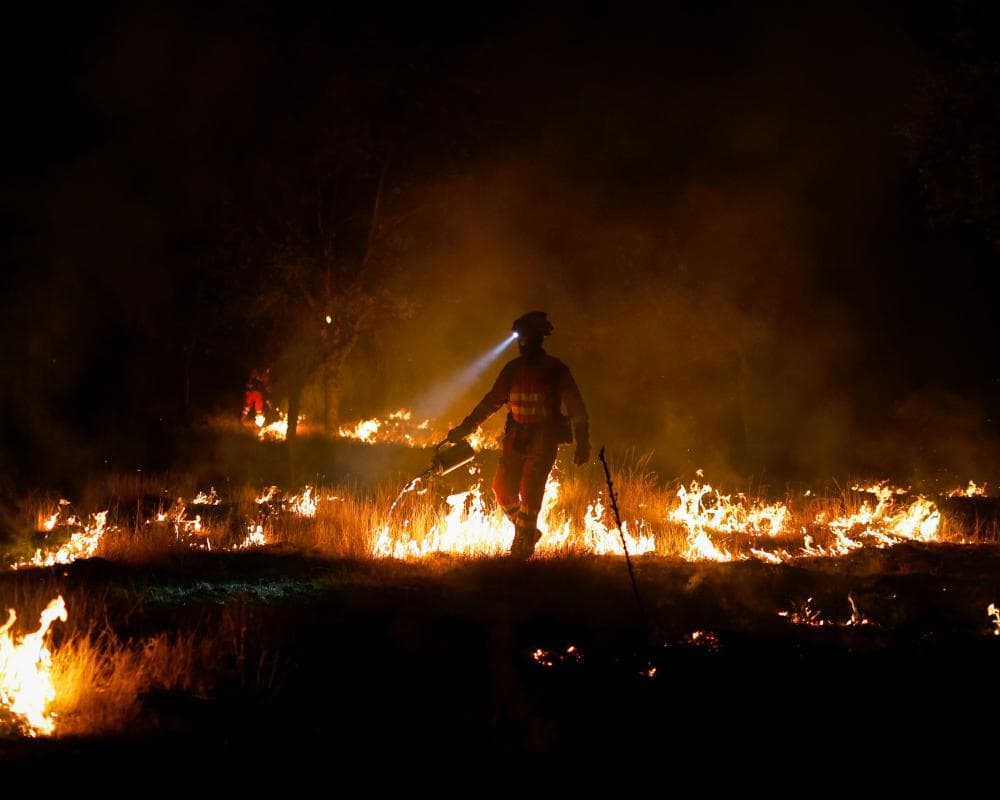
That means firefighters cannot put all their energies into extinguishing the flames, because they have to protect people and property.
Zuber said:
“A firefighter will focus on protecting people. They will focus on protecting houses, protecting a business, a company, because this is something that matters for all our society. And indeed, sometimes by focusing on that, they cannot extinguish fire, [as] they would do it if it would be just forest.
So this is new, this is worrying. And of course also, this means that we need to adapt our methods of fighting the fires.”
Authorities in the Gironde region said the blaze had not spread overnight, but rising heat and afternoon winds could revive smoldering hotspots, carry embers across firebreaks and open new fronts beyond crews’ reach, AP reported.
At the command center in Lège, firefighters bent over maps spread across a car hood, tracking three danger zones: northern Cap-Ferret; the wooded corridor around Marcheprime, Cestas and Saint-Jean-d’Illac; and a military site near Martignas, where a major outbreak forced a large deployment.
PA said that nore than 2,200 firefighters and over 20 aircraft remained mobilized, backed by crews from across France and European partners.
“We strike quickly and strike hard at any new smoke emissions,” Gironde fire commander Matthieu Jomain said.
The advance of major fires in the Landes and Var regions have been halted. That left Gironde as France’s biggest remaining wildfire battle, interior minister Laurent Nuñez said.
We are getting some heartbreaking pictures showing people returning to their homes near Madrid and finding their homes completely destroyed by the blaze.
While the situation near Madrid is gradually improving, the Spanish media are reporting that a separate fire near The Vall d’Uixó in the Castellón province is still spreading uncontrollably.
RTVE reported that it remains out of control after burning nearly 10,000 hectares across 81 kilometers, forcing authorities to evacuate some 10,000 people.
Updated
Spanish prime minister Pedro Sánchez has been speaking in the last ten minutes on his visit to a command post in Navalcarnero.
He said the current situation remains “favourable,” but the next 12 hours will be “decisive” in consolidating and securing the progress made by the firefighters as temperatures rise and create new risks.
Sánchez also asked those displaced by fires for trust and patience, as he said these decisions are not political, but taken on scientific advice as to when these returns are safe.
As is customary in the last few days, he also warned people against believing hoaxes and conspiracy theories spread on social media.
In Spain, thousands of people have been allowed back to their homes last night near Madrid, even as emergency services still continue to fight the blazes.
24,000 evacuees returned to the area, with another 20,000 released from stay at home orders.
More progress have been made overnight too, but local authorities urged caution as the new heatwave is set to hit the area.
“Efforts will focus on securing the perimeter, monitoring for new hotspots and cooling the areas to keep control of the fire,” a statement said.
Météo-France’s weather forecast shows temperatures up to 39C near Bordeaux – just where the largest wildfire continues to blaze – 38C in Lyon, 37C in Paris and Toulouse.
Over in Spain, it will be even hotter, with Aemet expecting 42C in Pamplona, 41C in Cordova and Saragossa, 40C in Ciudad-Real and Toledo, and 37C in Madrid.
The French prime minister, Sébastien Lecornu, has delayed going on holiday and stays in Paris to manage the wildfire crisis, BFMTV reported.
Despite clear progress made in tackling the blazes, there are continuing concerns over the potential impact of the latest heatwave, starting today.
France and Spain are braced for the fourth heatwave of the summer to hit just as they were making progress battling destructive wildfires, with temperatures once again expected to cross into high 30s and low 40s celsius later today.
Sophie Brocas, the prefect of Gironde and the Nouvelle-Aquitaine region, said overnight that the fire remained contained this morning, with several flare-ups quickly brought under control.
“We will win this war,” the communications director for the French Firefighters Federation, Éric Brocardi, told broadcaster BFMTV.
But the return of high temperatures puts authorities on high alert for new potential fires. Sixty-five French departments were put on a high fire risk warning.
Over in Spain, the government’s regional representatives in Madrid are warning of “extreme” fire danger in parts of the region. But, encouragingly, the main forest fire near the capital remained stable overnight, with no significant flare-ups.
I will bring you all the updates here.
It’s Wednesday, 29 July 2026, it’s Jakub Krupa here, and this is Europe Live.
Good morning.