Loading...
Please wait for a bit
Please wait for a bit
Click any word to translate
Original article by Tom Ambrose (now); Yohannes Lowe and Adam Fulton (earlier)
Lebanese president Joseph Aoun said on Monday that a security deal and an end to Israeli attacks were needed before any meeting with Israeli prime minister Benjamin Netanyahu, sought by Washington.
Aoun’s office said in a statement that the president “reiterated his view that the timing is not appropriate now for a meeting” with Netanyahu, and quoted Aoun as saying: “We must first reach a security agreement and stop the Israeli attacks on us before we raise the issue of a meeting between us.”
Hezbollah said its forces clashed with Israeli soldiers on Monday in south Lebanon near the border where its troops are still operating, despite a ceasefire since 17 April.
Hezbollah in a statement said that after Israeli troops attempted to advance near the town of Deir Seryan – which is inside the Israeli-declared “yellow line” where Lebanese residents have been told not to return – its fighters “opened fire on the enemy force and engaged in heavy clashes with them”.
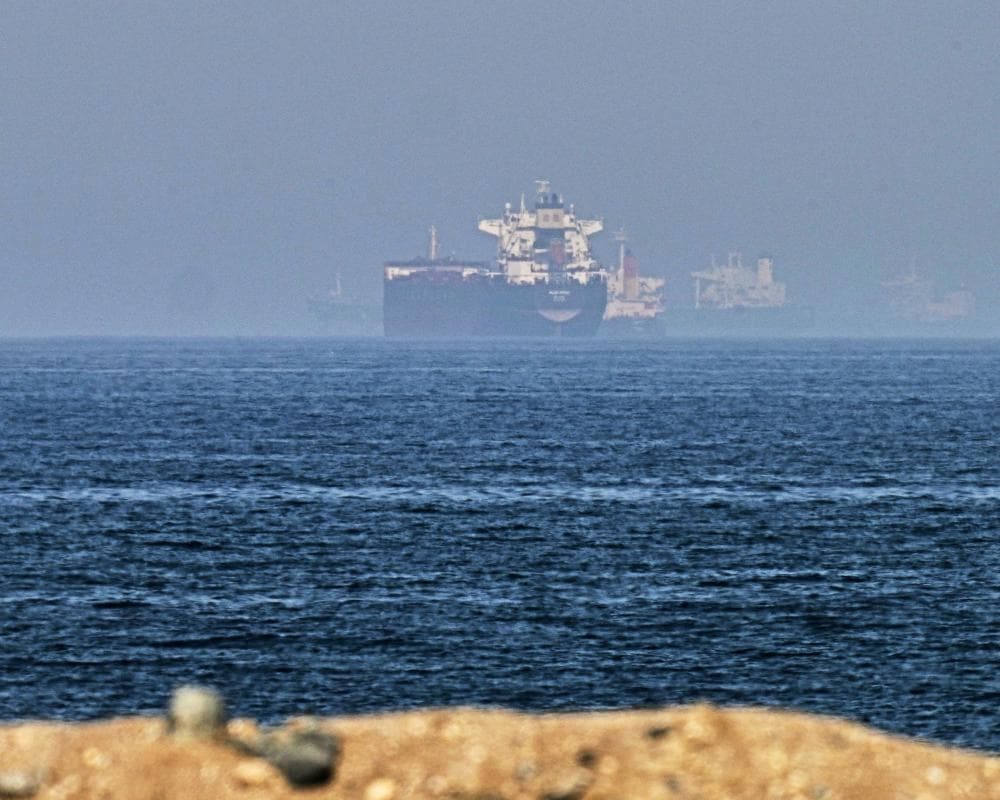
Seoul said on Monday that an “explosion and fire” had struck a South Korea-run ship in the strait of Hormuz, the crucial Middle Eastern waterway effectively blocked following US-Israeli attacks on Iran.
The foreign ministry said that, at around 8.40pm in Seoul, “an explosion and fire occurred on a vessel operated by a South Korean shipping company... anchored in waters near the United Arab Emirates inside the strait of Hormuz”.
There had been “no casualties to date” among the 24 crew members on board, who include six South Koreans and 18 foreign nationals, the ministry said in a statement.
“The cause of the explosion and fire, as well as the specific extent of the damage, are currently being investigated,” it said.
The vessel involved, the HMM Namu, is a cargo ship of almost 180 metres (590 feet) sailing under the flag of Panama, data from tracking site MarineTraffic showed.
Updated
The US secretary of state, Marco Rubio, will travel to Rome and the Vatican between 6 and 8 May, according to a department spokesperson.
The spokesperson said the trip was aimed at advancing “bilateral relations” and to “align on global challenges”.
“The secretary will meet with Italian government counterparts and Holy See leadership to discuss topics including Middle East developments and shared security interests.”
The US treasury secretary, Scott Bessent, has been speaking to Fox News as the US Central Command (Centcom) said two US-flagged merchant vessels have “successfully transited” through the strait of Hormuz. Some key takeaways from the interview:
Gas prices are affecting Americans but they are expected to come down quickly once the war ends, Bessent claimed.
He urged China, one of Iran’s major trading partners, to join the US in supporting the reopening of the strait of Hormuz.
The US president, Donald Trump, and his Chinese counterpart, Xi Jinping, have discussed Iran in their phone calls together, Bessent said.
He said the US has absolute control of the strait since its naval blockade of Iranian ports.
Updated
South Korea’s foreign ministry has confirmed to the Guardian that a vessel operated by South Korean shipping company HMM, the HMM Namu, suffered an explosion and fire inside the strait of Hormuz at 20:40 Korean time.
The Panama-flagged ship was carrying six South Korean and 18 foreign crew members. No casualties have been reported. The cause is under investigation.
Updated
The UAE diplomatic adviser Anwar Gargash has condemned the targeting of a tanker affiliated with the Abu Dhabi National Oil Company (Adnoc) as it transited the strait of Hormuz (see this post for more details).
“The Iranian aggression continues unabated, with acts of maritime piracy targeting a national tanker affiliated with Asnoc as it transited the strait of Hormuz,” he wrote in a post on X.
“The UAE’s stance remains steadfast in rejecting aggression and upholding freedom of navigation in this vital international passage. These attacks underscore that the Iranian threat to the security and stability of the region persists and cannot be ignored.”
Iran has executed three men charged in connection with political protests this January, authorities said, the latest in a wave of hangings against the backdrop of the war against the US and Israel.
Iranian authorities have carried out executions on a near-daily basis in recent weeks, in what activists have denounced as a bid to instil fear in society at a time of international and domestic tension.
Mehdi Rassouli, Mohammad Reza Miri and Ebrahim Dolatabadi, all considered political prisoners by human rights organisations, were executed after being convicted over unrest in the eastern city of Mashhad in January, the judiciary’s Mizan news agency announced on Monday.
It was not specified when or where they were executed. But the US-based Human Rights Activists News Agency (Hrana) said Rassouli, 25, and Miri, 21, were hanged at dawn on Sunday at the Vakilabad prison in Mashhad.
The protests began in December, partly as a result of grievances over the Iranian economy but intensified into nationwide rallies against the Islamic regime, peaking as mass demonstrations on the nights of 8 and 9 January.
Rights groups say thousands were killed in a crackdown by security forces; while authorities have blamed “rioters” whom they claim were backed by the US and Israel.
Mizan said Rassouli and Miri had been responsible for the death of a member of the security forces and described Dolatabadi as one of the “instigators” of the unrest in Mashhad.
Two US-flagged merchant vessels have crossed through the strait of Hormuz as US Navy guided-missile destroyers operate in the gulf, US Central Command said on Monday.
“American forces are actively assisting efforts to restore transit for commercial shipping,” it said in a statement.
Hezbollah’s leader condemned Israel’s operations in Lebanon amid a fragile ceasefire, repeating the group’s rejection of direct negotiations between the Israeli and Lebanese governments.
Israel has kept up deadly strikes on Lebanon despite the 17 April ceasefire that sought to halt more than six weeks of war between its military and Hezbollah, with both sides accusing the other of violating the truce, AFP reported.
In Lebanon’s south near the Israeli border, the Israeli army has also demolished buildings and prevented residents of dozens of towns from returning.
“There is no ceasefire in Lebanon, but a continuous Israeli-American aggression,” Hezbollah leader Naim Qassem said in a written statement broadcast by the al-Manar TV channel, which is affiliated with the Iran-backed militant group.
“Lebanon is the victim of aggression, and it is Lebanon that needs guarantees for its security and sovereignty” from Israel, he added.
The UAE has strongly condemned an Iranian drone attack on an Adnoc oil tanker in the blockaded strait of Hormuz, as the US was due to start guiding ships through the waterway.
Two drones hit the MV Barakah off the coast of Oman but no one was injured, according to Adnoc, the UAE state oil giant, adding that the ship was not loaded.
“Targeting commercial shipping and using the strait of Hormuz as a tool of economic coercion or blackmail represents acts of piracy by Iran’s Revolutionary Guard Corps,” the UAE’s foreign ministry said.
Updated
More than 850 ships are estimated to have been trapped in the Gulf since the US and Israel launched their attack on Iran on 28 February. Iran imposed a blockade on foreign shipping using the strait of Hormuz soon afterwards and Trump imposed a counter-blockade of ships using Iranian ports on 13 April.
A Pakistani-brokered ceasefire, announced by Trump in early April, stopped hostilities but failed to open the strait.
An estimated 20,000 sailors are stuck on the tankers, bulk carriers, container ships and other vessels, and there are growing concerns for their welfare. Trump said the US had been approached by countries for help.
Iran’s military-backed Fars news agency had quoted a senior official as saying a return to all-out conflict was “likely”, weeks after the ceasefire was brokered. Pakistani efforts to rekindle peace talks in Islamabad, after a first round ended without agreement, have so far failed as each side set preconditions that the other refused to fulfil.
Here is a recap of the latest developments in the US-Israeli war on Iran:
US Central Command (Centcom) denied that one of its warships trying to pass through the strait of Hormuz had been struck by Iranian missiles.
Centcom said no US Navy ships have been struck, adding that US forces are continuing to enforce the naval blockade on Iranian ports.
The denial came after unverified claims in Iranian media that Iran had stopped a US warship from passing through the strait of Hormuz after two missiles were reported to have hit the vessel near Jask island after it ignored Iranian warnings.
The Fars news agency said the ship was hit as it was sailing through the strait “in violation of traffic and shipping security”.
The US has launched an operation to “guide” ships trapped in the Gulf by the war through a southern route of the strait of Hormuz, even as Tehran insists that any such transits will have to be coordinated with its armed forces.
Iran earlier threatened any foreign military force attempting to enter the strait.
Iran’s foreign ministry spokesperson Esmail Baghaei said officials were reviewing a US counter-proposal to end the US-Israeli war on Iran. He suggested that the US has to reduce its “excessive” demands if progress is going to be made in peace talks which have reached an impasse.
The French president, Emmanuel Macron, said on Monday that the only way to reopen the strait was “a coordinated reopening by the United States and Iran”.
Updated
The US Central Command (Centcom) has also dismissed the claim in Iranian media that Iran’s Islamic Revolutionary Guard Corps had hit a US warship with two missiles trying to pass through the strait of Hormuz.
Instead, Centcom claimed in a post on X that the “truth” was that “no US Navy ships have been struck” and that US forces are continuing to enforce the naval blockade on Iranian ports.
Centcom has said it would support an effort, announced by Donald Trump over the weekend, to “guide” stranded ships out of the strait of Hormuz with the backing of 15,000 personnel and over 100 aircraft.
Iran has rejected this plan, warning that “any foreign military force, especially the invading American army” will be attacked if they attempt to approach or enter the strait.
Updated
Axios’ global affairs correspondent, Barak Ravid, has posted on X to say that a senior US official denies the American ship was hit by Iranian missiles.
Iran’s Fars news agency is reporting that a US warship intending to pass through the strait of Hormuz was turned back after ignoring a warning from Iran’s navy, citing “news sources in the south”.
The report, which we have not yet been able to independently verify, said that two missiles hit a US navy frigate sailing through the waterway in what Iran deemed a violation of “traffic and shipping security” near Jask island.
Iran’s military has warned the US navy to stay out of the strait after Donald Trump said the US will “help free up” ships stuck in the strategic waterway from today.
The US president called the operation a “humanitarian gesture”, with many of the vessels running low on food. But Tehran said it would be seen as a breach of the ceasefire.
Iran imposed a blockade on foreign shipping using the strait soon after the war began with a US-Israeli attack on 28 February which killed the country’s former supreme leader. Trump, who is under growing domestic pressure to get the waterway reopened, imposed a counter-blockade of ships using Iranian ports on 13 April.
Updated
The Guardian’s diplomatic editor, Patrick Wintour, has published some interesting analysis on whether Iran’s escalating economic crisis (soaring prices, high unemployment, high inflation, currency devaluation, supply chain disruption) could weaken its negotiating position with the US.
Iran’s economy was already crippled by years of US and international sanctions but the US-Israeli war has only made things worse. Here is an extract from Patrick’s analysis:
Trump made his prediction that Iran would choke on the basis that the country would soon run out of oil storage space because of the US naval blockade. On 26 April, he predicted that Iranian wells would “explode” in a “very powerful” destructive process starting in three days.
Behind this prediction was a belief that the US naval blockade launched on 13 April would prevent Tehran’s tankers from reaching the strait of Hormuz, depriving the Iranian regime of at least $175m (£129m) a day in oil export revenue.
Once the oil was stuck inside the country, Iran would soon run out of storage, forcing it to close the taps. Such a closure would irreparably damage the wells.
Although it is true Iran is now producing more oil than it can export, it appears for the moment enough tankers are making it through the US naval blockade, while remedial steps such as flaring means storage space has not run out. Independent estimates, including from the Center on Global Energy Policy at Columbia University, suggest that Iran has up to three weeks of free useable storage capacity.
Updated
The Iranian foreign ministry spokesperson, Esmail Baghaei, has been speaking to journalists in a media briefing. According to Al Jazeera, he confirmed officials were reviewing a US counterproposal to end the US-Israeli war on Iran.
“The US message was received through Pakistan, and I will not discuss the details of the issues raised at this time because these issues are still under review,” Baghaei said. It is not clear what terms the US demanded Iran accept in its counterproposal.
“The issues raised about enrichment or nuclear materials are purely speculative and, at this stage, we are not talking about anything other than stopping the war completely, and the direction we will take in the future will be determined in the future.”
Iran’s foreign ministry spokesperson Esmail Baghaei has suggested that the US must reduce its “excessive” demands in negotiations if the US-Israeli war on Iran is to be brought to an end.
“At this stage, our priority is to end the war,” he said in a briefing broadcast by state television. “The other side must commit to a reasonable approach and abandon its excessive demands regarding Iran.”
Iran has reportedly received a US response to its latest peace proposal, which is said to have focused on an initial agreement to open the strait of Hormuz, for the US to withdraw its forces from near Iran’s borders, pay compensation for its attack on Iran and for Israel to end its war on Lebanon.
The US president, Donald Trump, claimed on Sunday that his representatives were having “very positive” discussions with Iran but also reportedly told Israel’s Kan News on the same day that the Iranian proposal was unacceptable to him.
The US has repeatedly said it will not end its war without an agreement that prevents Iran from ever obtaining a nuclear weapon. The regime in Tehran insists the programme is for civilian purposes and it has no intention of making a nuclear weapon.
It is possible that an agreement for the strait of Hormuz to reopen is reached before Iran’s nuclear programme is discussed at a later stage of negotiations but, as my colleague Julian Borger notes in this story, there is growing speculation over the possibility of another round of US airstrikes against Iran aimed at forcing concessions faster.
Updated
The internet blackout in Iran has entered its 66th day, according to internet monitoring group NetBlocks. It said in a social media post:
It’s now the 66th consecutive day of Iran’s internet blackout with the censorship measure surpassing 1560 hours.
Despite the distribution of some international access via pro-regime channels, metrics confirm that there is still no restoration of service to the general public.
Certain journalists, businesses and politicians are allowed access to the internet. But the vast majority of Iranians have been completely cut off. There was an earlier internet shutdown in January during nationwide protests, which helped obscure extreme violence against Iran’s population.
We have a bit more of the statement from Maj Gen Ali Abdollahi, the commander of Iran’s Khatam al-Anbiya central headquarters, who said earlier that the US or any other foreign armed forces would be attacked if they entered the strait of Hormuz (see post at 07.39 for more details). Abdollahi also said:
We will maintain and vigorously manage the security of the strait of Hormuz with all our might, and we inform all commercial ships and tankers to refrain from any attempt to transit without the coordination of the armed forces stationed in the strait of Hormuz, so as not to jeopardise their security.
Israel has also established a “yellow line” in southern Lebanon where Israeli troops are active, comprising at least 55 villages. They have continued to demolish homes there and the establishment of what is framed as a security zone has stoked fears of a long-term occupation.
The renewed Israeli war on Lebanon started when Hezbollah launched missiles at Israel on 2 March after the US-Israeli bombing of Iran in late February.
In its latest update, the Lebanese health ministry said since 2 March Israeli attacks have killed at least 2,679 people in Lebanon, including many women and children.
The Israeli military’s subsequent evacuation orders covering huge swathes of southern Lebanon and the southern suburbs of Beirut displaced over a million people, and many have not been able to safely return despite diplomatic efforts from the Lebanese government. Israel’s forced displacement of civilians in Lebanon is a possible war crime, according to the UN and Human Rights Watch.
Updated
The IDF has said it has begun a wave of airstrikes on what it claimed was Hezbollah infrastructure in southern Lebanon, after issuing evacuation warnings for four villages in the south.
The ceasefire in Lebanon came into effect on 17 April after the US requested Israel come to the negotiating table with the Lebanese government, in an apparent attempt to ensure peace talks with Iran were not disrupted by the renewed Israeli invasion of Lebanon.
But since then Israel has been accused of violating the agreement many times, with strikes killing civilians and homes continuing to be demolished despite the military saying it is only targeting Hezbollah sites.
Lebanon’s national news agency said Israeli forces carried out bombing operations in Khiam and Qantara in southern Lebanon overnight.
Israel has said its attacks are in response to what it describes as violations of the deal by Hezbollah, the Iranian-backed Lebanese militant group and political party, which was not involved in the ceasefire agreement.
Hezbollah, which has been striking Israeli troops in Lebanon, says it will not cease its attacks on Israeli troops inside Lebanon and on towns in northern Israel as long as Israel continued its ceasefire violations. Under the agreement’s terms, Israel retains its “right to take all necessary measures in self-defence, at any time, against planned, imminent, or ongoing attacks”.
Updated
The US has evacuated 22 crew members held aboard an Iranian container vessel to Pakistan and will hand them over to Iranian authorities on Monday, Pakistan’s foreign ministry said, calling the move a “confidence-building measure”.
“The Iranian ship will also be backloaded to Pakistani territorial waters for return to its original owners after necessary repairs,” the ministry said in a statement cited by Reuters.
Updated
The head of the Iranian military’s unified command has said US or any other foreign armed forces will be attacked if they enter the strait of Hormuz.
The command warned US forces to stay out of the strait and said its forces would “respond harshly” to any threat, telling commercial ships and oil tankers to refrain from any movement in the absence of coordination with Iran’s military.
Ali Abdollahi, head of the forces’ unified command, said in the statement quoted by Reuters:
We have repeatedly said the security of the strait of Hormuz is in our hands and that the safe passage of vessels needs to be coordinated with the armed forces.
We warn that any foreign armed forces, especially the aggressive US army, will be attacked if they intend to approach and enter the strait of Hormuz.”
Updated
Iran’s military is reportedly saying US forces will be attacked if they enter the strait of Hormuz.
Iran has warned the US navy against entering the Hormuz strait, according to a statement from the unified command of Iran’s armed forces reported by state media.
The warning came after Donald Trump announced the US would start an effort on Monday to free ships stranded in the waterway.
The Iranian statement, cited by Reuters, added:
We have repeatedly said the security of the Strait of Hormuz is in our hands and that the safe passage of vessels needs to be coordinated with the armed forces.
Updated
The Joint Maritime Information Centre says the maritime security threat level in the strait of Hormuz remains critical due to ongoing regional military operations.
The centre’s advisory note – posted on X by the United Kingdom Maritime Trade Operations centre – said on Monday that mariners were advised to coordinate with Omani authorities via VHF channel 16 and should consider routing via Oman territorial waters south of the traffic separation scheme, where the US has established an enhanced security area.
The note said:
Transit via or in close proximity to the Traffic Separation Scheme should be considered extremely hazardous due [to] the presence of mines that have not been fully surveyed and mitigated.”
Updated
A tanker reported being hit by “unknown projectiles” in the strait of Hormuz soon after Donald Trump announced the US would help trapped ships through the waterway.
The United Kingdom Maritime Trade Operations agency said all crew were reported safe in the incident, which occurred 78 nautical miles north of Fujairah in the United Arab Emirates.
Authorities were investigating, it said, adding that vessels were advised to “transit with caution”.
Welcome to our live coverage of events in the Middle East.
Donald Trump has said the US will start an effort on Monday morning to free ships stranded in the strait of Hormuz as a “humanitarian gesture” to aid neutral countries in the US-Israeli war against Iran.
The US president provided few details about the plan, which he said would aid ships and their crews that have been “locked up” in the strait and are running low on food and other supplies as Iran blocks access through the crucial waterway.
“We have told these Countries that we will guide their Ships safely out of these restricted Waterways, so that they can freely and ably get on with their business,” Trump said in a post on his Truth Social site on Sunday.
He threatened that any interference with the US operation would “have to be dealt with forcefully”.
It was not immediately clear which countries the US operation would aid or how the operation would work. US Central Command said support would include guided-missile destroyers, more than 100 land- and sea-based aircraft and 15,000 service members.
A report from Axios later claimed the navy would not necessarily escort ships through the strait.
In other key developments:
Iran said on Sunday it had received a US response to its latest offer for peace talks a day after Trump said he would probably reject the Iranian proposal because “they have not paid a big enough price”. Iranian state media reported that Washington had conveyed its response to Iran’s 14-point proposal via Pakistan, and that Tehran was now reviewing it.
“At this stage, we do not have nuclear negotiations,” state media quoted Iran’s foreign ministry spokesperson Esmaeil Baghaei as saying, an apparent reference to Iran’s proposal to set aside talks on nuclear issues until after the war has ended and the foes have agreed to lift opposing blockades of Gulf shipping. Iran has been blocking nearly all shipping from the Gulf apart from its own for more than two months. Last month the US imposed its own blockade of ships from Iranian ports.
Israel on Sunday ordered thousands of Lebanese people to leave 11 towns and villages in southern Lebanon, an escalation of a war between Israel and Iran’s Hezbollah allies there that has run in parallel to the Iran war and could further complicate wider peace efforts.