Loading...
Please wait for a bit
Please wait for a bit
Click any word to translate
Anti-government protesters in Israel have filled the Dizengoff fountain in Tel Aviv with red dye as part of events across the country calling for an independent state inquiry into the failures that led to the 7 October attack and demanding accountability.
Families of victims and hostages also gathered outside the Knesset to observe a minute of silence and hold signs accusing the government of abandoning those affected by the Hamas onslaught three years ago.
Gal Goren, whose parents Avner and Maya were killed on 7 October 2023, addressed protesters outside Israel’s parliament.
“How do you write three years of longing? How do you talk about 1,097 days that are actually one day that never ended? What do you say about three years of guilt, shame and regret?” he said, according to the Israeli newspaper Haaretz.
“What have we not cried out about in front of this cursed place and everywhere else? What did we not warn about? What did we not demand? What did we not lose?”
Israel’s defence minister, Israel Katz, said he had put the military on high alert yesterday, a day before the third anniversary of the 7 October attack.
Without providing evidence, his office said the instruction came “in light of intelligence regarding Hamas’s intentions to attempt to carry out attacks and terror operations against our forces in Gaza on that day”.
“If, heaven forbid, our forces are harmed, the ones who will pay the heavy price will be Hamas and the population of Gaza – beyond all proportion,” the statement added.
Benjamin Netanyahu has contended that Israeli security chiefs collectively failed to foresee the surprise Hamas attack three years ago, while his critics argue that the Israeli prime minister, who has resisted an independent public inquiry into what happened, should personally answer for the security failures.
Israeli citizens will have their first chance since the deadly attack to pass judgment on Netanyahu, who is seeking an unprecedented seventh term, in the crucial general election on 27 October.
A new book by Haaretz reporters suggests Netanyahu was personally alerted by the UAE president that Hamas was planning a large-scale offensive against Israel a week before the attack, but failed to act on the warning.
The Guardian’s senior international correspondent, Peter Beaumont, has more details in this story:
The claim, which comes amid a crucial election campaign, prompted Israeli opposition leaders to describe the prime minister as “unfit” for office, even as Netanyahu denounced the report as an “absolute lie” and denied he spoke to the Emirati leader at that time.
Haaretz said the Hamas leader Yahya Sinwar, later killed by Israel, had warned a former Palestinian official that the militants were preparing “a terrifying operation” which he described as an “earthquake”.
According to the report, the UAE president, Mohamed bin Zayed Al Nahyan, spoke to Netanyahu a week and a half before the attack, and told him Hamas was planning a major operation.
Read more:
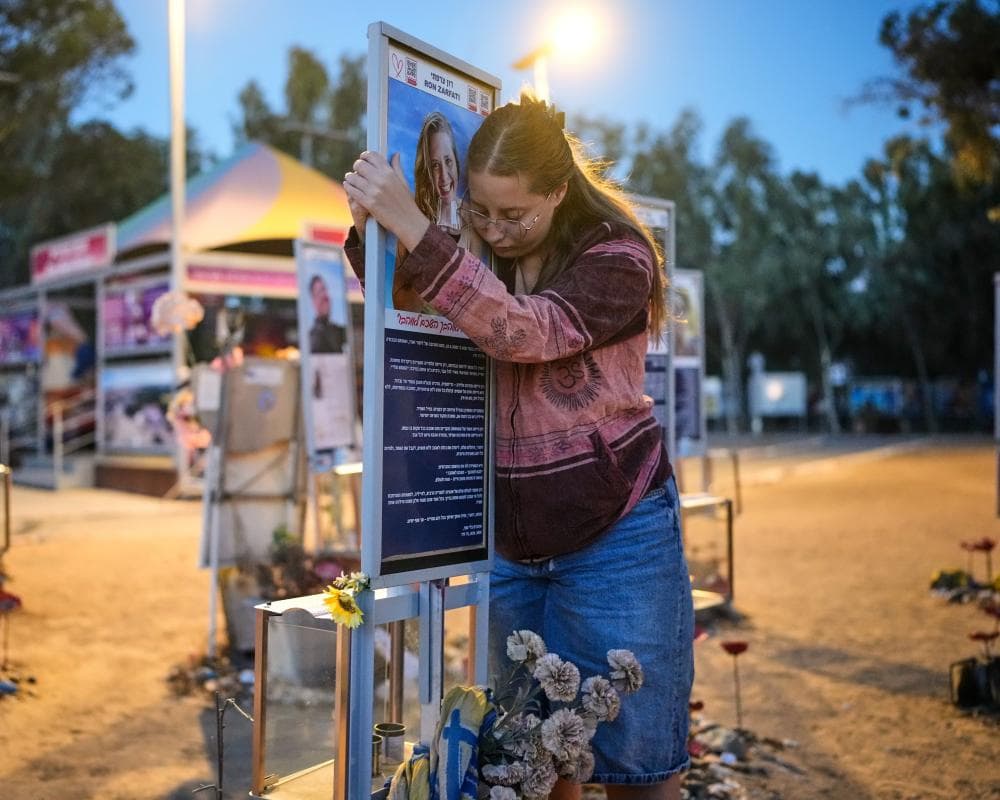
Here are some of the latest images from Israel, as the country marks three years since the 7 October attack:
Keith Siegel spent many of his long hours in Hamas captivity in Gaza etching everything that happened after 7 October 2023 into his memory. For 484 days, he recited to himself every place he was held, the dates he was moved and every attack or humiliation he endured or witnessed.
He aimed to store intelligence that could help Israeli forces free other hostages if he was released, to keep track of time as the days slid by and be able to tell his family what happened to him. Now his body is free, but he cannot loosen those memories.
“I’m living a kind of dual life,” he said in an interview in Tel Aviv. “I’m here for some of the time, and I’m in Gaza some of time. It’s very challenging to convey in words what it was like.”
Siegel and his wife, Aviva, were among 251 people taken captive to Gaza on the deadliest day in Israel’s history, when Hamas militants broke across the border to launch a wave of attacks on kibbutzim, border towns, military bases and music festivals.
“What happened to me in Gaza, what happened with Keith in Gaza, it’s there all the time,” said Aviva.
“I understand that it’s going to be a process of healing. There’s always things that remind me, and if I don’t remember, then he reminds me. If I’m cooking lunch or making a cup of tea and I turn around and see Keith with tears in his eyes, because he just read something or let himself feel.”
Read more:
Updated
We are starting our live coverage on the third anniversary of the Hamas-led 7 October attack on southern Israel, in which about 1,200 people were killed and another 251 taken captive to Gaza.
Israeli communities shattered by the massacres, torn between rebuilding their lives and remembering lost friends and relatives, have spoken to my colleague Emma Graham-Harrison about their experiences.
Israel responded to the attack by launching a devastating war on Gaza, during which at least 74,243 people have been killed, according to the territory’s health ministry, whose figures are considered reliable by the UN.
In 2025, a UN commission found that Israel is committing genocide in Gaza, citing tens of thousands of civilian deaths and massive destruction. Israel denies accusations of genocide, but the war, which is continuing despite a nominal ceasefire, has left it isolated on the world stage.
Israel held a national memorial day on Monday for the victims of the Hamas attack and also remembered the soldiers who lost their lives fighting in Gaza.
Flags were lowered to half-staff at the Israeli parliament – the Knesset – and the president’s residence in the morning, while two state ceremonies were held at the Mount Herzl military cemetery in Jerusalem.
Many Israelis are still grappling with the trauma of the 7 October attack, the deadliest in the country’s history, with the memory of the assault and its aftereffects continuing to loom large and feature heavily in political debate.
Updated