Loading...
Please wait for a bit
Please wait for a bit
Click any word to translate
Original article by Jakub Krupa
Ukraine’s president Volodymyr Zelenskyy has just responded to the strike on Kyiv.
In a post on X, he said:
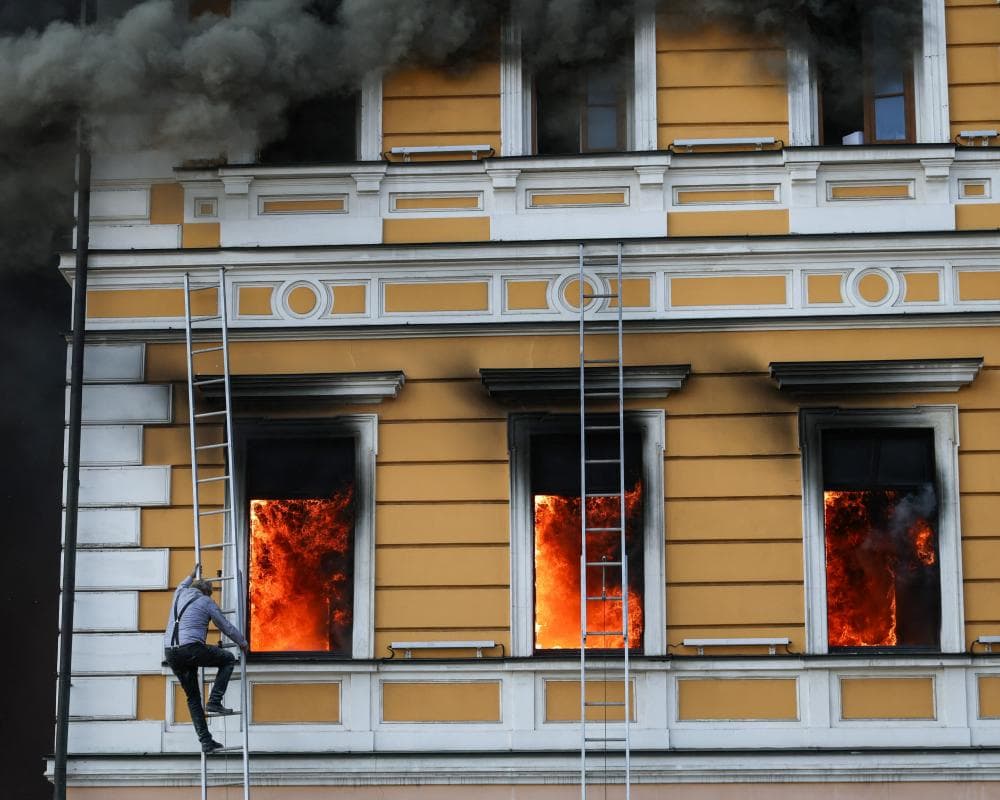
“A Russian strike against the building of the National Academy of Sciences of Ukraine. A rescue operation is underway: crews are putting out the fire and searching for people who may have been trapped inside. All services are deployed.
Today in Kyiv, a pharmaceutical company and gas stations were also attacked; in Dnipro, a business center; and in other cities and regions, civilian facilities, businesses, and communications infrastructure were targeted as well. Sadly, people have been killed… My condolences to their families and loved ones.
Russia will definitely face a response to this.
And every one of Ukraine’s partners must see from this terror, from these strikes, that supporting Ukraine means truly supporting people’s lives – supporting the principle that terror must never be normalised, anywhere. Russia must be held accountable for all of this and face real consequences. I thank everyone who helps Ukraine!”
Kyiv mayor Vitali Klitschko said one person was killed and at least three were injured in the strike.
Just as Kallas was speaking, Reuters snapped on “a loud explosion” in the central part of Ukraine’s capital Kyiv, which the city administration said was caused by a Russian drone.
AFP identified the building hit as the National Academy of Sciences, stressing it was “the latest in a series of escalating attacks on the Ukrainian capital.”
“The site is in the very centre of Kyiv – usually well protected from Russian attacks – close to the German embassy, a famed cathedral, the national opera and government buildings.”
EU’s foreign policy chief Kaja Kallas has warned that “Europe needs to rearm more quickly and more effectively to meet our target of 2030,” with a “decisive change” in its approach to defence (12:55).
Briefing reporters after talks with EU defence ministers, Kallas also said they started having discussions on a new “emergency security protocol” which could help coordinate response to any incident falling below the Article 5 of Nato, amid growing concerns about acts of sabotage or aggression from Russia (12:58, 13:02, 13:16).
Kallas also said that Russia’s behaviour following talks with German foreign minister last week shows that “Russia is really not interested in peace at all.” (13:07).
Kallas also gets asked about what the new proposed “emergency protocol” would actually mean or do that isn’t already covered by the EU’s Article 42.7 or Nato’s provisions in Articles 4 and 5.
She says that she is in touch with Nato’s Mark Rutte to make sure there is “no duplication.”
She explains that Nato’s Article 4 (where countries can request a discussion “whenever, in the opinion of any of them, the territorial integrity, political independence or security of any of the Parties is threatened”) is “just consultations” with no specific actions, while Article 5 (“an armed attack against one or more of them in Europe or North America shall be considered an attack against them all”) is “very clear” on its military implications.
The new protocol would focus instead on “what tools can be used at the moment of aggression that is not armed aggression, and is under the threshold of Article 5,” she says.
And that ends the press conference.
Kallas also gets asked about the dire situation in the Russian-occupied Ukrainian city of Oleshky.
She says:
“It clearly shows what happens to the people in the occupied territories.”
She says the EU is “trying to get the humanitarian aid in,” and working to “help Ukraine to defend itself and its people,” including through work on “the largest listing of sanctions” to date.
Updated
EU’s Kallas also responds to German foreign minister Johann Wadephul’s talks with Russia’s chief diplomat, Sergei Lavrov on the margins of the UN week.
She says there was many countries outside Europe that seem to believe that simply talking to Russia would resolve all problems.
“These talks show that Russia is really not interested in peace, at all. Otherwise you don’t treat your negotiation partner … this way,” she says in response to Lavrov’s comments ridiculing Germany after the meeting.
She continues:
“Russia needs to show, by stopping the attacks on civilians, that they are interested in peace, which they are not.
And then they need to talk to Ukraine because it’s between, Ukraine and Russia. Everybody else can facilitate this process, but in the end, they need to agree.”
Asked about the details of the new protocol, Kallas says it was “the first discussion on it, very initial,” with further talks needed.
“So, clearly, there were some who were saying that, that we need some kind of mechanism for anything under the armed aggression threshold, which is Article 42.7 [of EU treaties], but many stressed that it has to be absolutely complimentary with Nato, so we do not create anything additional; this has to work hand in hand.”
Kallas also says that Russia’s “sustained acts of sabotage, airspace and airspace violations persist,” prompting the EU to “look into what more we can do.”
Defence ministers discussed a new “emergency security protocol,” which could “provide a coordination mechanism to respond to grey zone attacks” and “complement” existing arrangements.
She also says there was some discussion on the situation in the strait of Hormuz and the Middle East more broadly.
Updated
Kallas is speaking now – and her comments are in stark contrast with the message of Pope Leo earlier (no value judgment here)
She talks about the EU’s efforts for strengthening its “defend readiness,” and says “Europe needs to rearm more quickly and more effectively to meet our target of 2030.”
“Europe needs decisive change in the scale and pace of defence investment, capability development, innovation and industrial capacity,” she says.
She also talks about the need to help Ukraine with missile productions and air defence to protect itself from attacks by Russia.
We will be pivoting away from Pope Leo’s visit to France as he moves on to the final few elements of his programme (and further talks with Macron) before leaving for Rome later tonight.
Meanwhile in Brussels, EU foreign policy chief Kaja Kallas is about to speak about this morning’s meeting of the bloc’s defence ministers in which they discussed a few things, including the growing threat from Russia.
I will keep an eye on what she says.
Updated
Pope Leo has urged young Europeans to “not give in to the mentality of violence and oppression” as Europe is “entering a new stage in its long history,” responding to unprecedented migration and the return of war to the European continent (12:18, 12:21).
He reiterated his compassionate message on migration, calling for “legal and safe pathways” and fight against traffickers, and called for “patient dialogue” and “courage in negotiations” to end wars.
His comments are likely to attract attention with a direct call to be “willing to give up some positions for the greater good of peace,” without offering more detail on what he meant by that.
Celebrating Europe’s postwar integration, Pope Leo also urged European leaders to push back against the culture of “boasting of lies and deceit” by drawing on its history based on “the respect for others that it has learned to cultivate and preserve,” as he warned that relations between people and states were “increasingly uncivilised.”
Throughout the speech, the pope also drew on Europe’s Christian heritage, arguing for its contemporary relevance and rediscovery in “new and creative ways” in the ever-changing world.
Updated
Pope Leo ends his speech with a direct call to younger Europeans, as he says:
“Do not give in to the mentality of violence and oppression. Love life at every moment and do not be afraid of the future. Don’t be afraid to start a family, to bring children into the world, to defend the dignity of every person. From the moment of conception to natural death. Do not be afraid to work tirelessly for the good of your communities, including through political engagement. …
Europe, firmly rooted in its heritage, will continue to flourish and to inspire the whole world.”
He gets a standing ovation.
Pope Leo continues by talking about the need to rediscover Europe’s roots, before moving to current issues.
He says “contemporary Europe is now entering a new stage in its long history, … with the arrival on the continent of so many men and women fleeing war and persecution, or seeking a better life.”
Turning to migration, he recalls his comments during a recent trip to Spain as he said that “human dignity demands legal and safe pathways, rescue and assistance, real cooperation against traffickers, effective protection for victims, serious processes of reception and integration.”
He then says that “today, sadly, war has returned, even to Europe,” with “a new senseless slaughter claiming countless civilian lives every day.”
He calls for “patient dialogue” and “courage in negotiation,” and to “be willing to give up some positions for the greater good of peace.”
Not entirely sure what he means by that in practice, though.
He then repeats his warning – first expressed on Friday – against “the illusion that rearmament is the answer,” as he says “promoting peace is an active task.”
In his regular criticism of world leaders, Pope Leo also warns that “relations between people and states are becoming increasingly uncivilised.”
“The value of keeping one’s word is dismissed. Instead, people boast of lies and deceit. Europe can help break this cycle through the respect for others that is learned to cultivate and preserve.”
He adds:
“Over the last 80 years, Europe has amply demonstrated that it is possible to articulate diverse opinions, divergent opinions, claims and interests through encounter rather than conflict.”
In a key recurring theme of his speech, he says:
“Europe will not be made once, nor according to a single master plan of construction … We must never lose our confidence in our ability to move forward, even when the steps we take are small and almost unnoticed.
The modern desire to have everything right away does not fit with European history and culture, which instead teaches the value of time and patience is through small steps that we can bring to life.”
Updated
Pope Leo begins by paying tribute to Robert Schuman, which he says “drew the inspiration to help shape the Europe of today and tomorrow.”
He says he wants to talk about “a journey that begins from the roots of Europe, moves through the present and looks toward the future.”
He says “Europe gradually developed a sense of its own identity over the course of the historical periods of Hellenistic civilisation, the Roman empire, and then the spread of Christianity, integrating over time new cultures, including the Germanic and Slavic culture, expanding to encompass ever larger regions.”
“Europe must therefore be understood as a cultural and historical reality before a geographical one.”
He says that through its “long and turbulent” history, Europe has always “flourished and progressed,” learning from its experience.
He then extensively talks about Christian roots of Europe, speaking about the values of fraternity, respect for the law inherited from previous generations, and the love of beauty refined over the centuries.
Updated
Pope Leo’s speech is preceded by a short video on the postwar reconciliation and the EU’s history, as the orchestra plays the EU’s anthem.
He’s up to speak now.
Updated
Macron talks about the history of European integration presenting it as a response to the horrors of the second world war and the Holocaust.
But he also notes that European integration was a process “built upon another principle cherished by the Church’s tradition: the principle of subsidiarity.”
He says:
“This is a principle of freedom that protects the capacity of the smallest entity to act, while requiring the larger entity to respect that autonomy and provide support when the smaller one’s own resources are no longer sufficient. It is a principle that defines the true nature of our Europe: not a power that obliterates nations, but a force that extends and enhances their capacity to act.”
He says for two millennia “Europe dreamed of unity” and hails the EU as “a unique invention” that is “more essential than ever” as “the world has changed,” with the Russian invasion of Ukraine and “the resurgence of empires.”
“Schuman wrote that world peace cannot be safeguarded without creative efforts commensurate with the dangers threatening it. Now that the scale of these dangers has shifted, our efforts for peace must rise to the challenge,” he says.
He says the EU’s continued support for Ukraine should be seen in this context.
The French president also speaks about the need to “rise to the challenges” the continent faces, including on Europe’s competitiveness and its response to the dangers of technology, including AI (and he elegantly recalls Pope Leo’s encyclical on this topic).
He ends on this note:
“Here in Metz, we are delighted to welcome you, Holy Father, to hear you and to learn from you. For here lies the age-old heart of Europe – a Europe that protects, unites, and takes action; a sovereign and democratic Europe driven by a vision of peace and prosperity; a Europe that must rediscover the courage of its founders.
The courage to become the power for peace, independence, and democracy that it is meant to be; the courage to resist turning inward, hating the other, and succumbing to the resurgence of divisive nationalism.”
Cardinal Jean-Marc Aveline, head the Bishops’ Conference of France (CEF), speaks next.
I will skip his speech, but come back to it when Leo stands up to speak.
Updated
With a bit of delay, the event finally gets under way, and Macron – looks like he will be with Pope Leo all day long, after all! (10:33) – is now delivering the formal welcome.
He talks about Metz’s special place in European history (10:12):
“It was on this part of Lorraine, scarred by history, a land long contested, conquered and reconquered, that the French Franco-German reconciliation was built, becoming the cornerstone of European integration.”
He says that with more and more countries willing to join the EU, “there is surely no greater endorsement of our European Union than this desire to belong to a shared area of peace, security, democracy and prosperity.”
“75 years on, our Europe has taken firm root. It has weathered crises and always managed to confront them through a renewed sense of unity emerging from them, greater and stronger.”
Back to Metz, we are still waiting for the main part of the event to begin – with Emmanuel Macron now welcoming guests outside the venue.
Former commission president Jean Claude Juncker gets a big hug on arrival.
Updated
Nordic correspondent
The Left party has responded to the Social Democrats announcement this morning that they were standing down from coalition talks, saying it was “hasty”.
The party’s spokesperson, Ida Gabrielsson, said they had been “very clear that they were never going to vote for anyone other than Magdalena Andersson”.
She added: “It feels like something that is very hasty.”
The Left party’s decision to vote for a Moderate speaker in parliament was for “completely different reasons”, she said, adding that parliament needed stability during this time.
Nordic correspondent
Swedish coalition talks have been thrown into disarray this morning after the Social Democrat leader, Magdalena Andersson, abruptly announced that she was giving up on trying to form a government.
In a last minute press conference, held hours before the parliament was due to reopen for the first time since the election earlier this month, Andersson said she was ending her exploratory mission to form a government, adding: “At the moment there is no possibility for me to form a government.”
Her surprise announcement comes two weeks after her party, the Left, the Greens and the Centre party won a narrow majority in the general election over the governing right-leaning parties known as Tidö.
Afterwards, the Moderates leader Ulf Kristersson stood down as prime minister but warned of difficult talks ahead and appeared to leave the door open to potential collaboration.
But over the weekend, the Left party said they would be voting for the Moderates choice of speaker. Given the narrow balance of power, this would have resulted in the Social Democrats losing the vote for speaker, despite being the biggest party.
“Now the Left party have chosen to collaborate with the Moderates as far as I know in the election for speaker,” said Andersson.
“Given that in Sweden we have a very long tradition that the biggest party in the government that holds the speaker position, it is therefore reasonable now that this collaboration should also be tested to build a government.”
She denied that she was trying to increase pressure on other parties.
Asked whether she had given up on becoming prime minister, she was less direct:
“At the moment I assess that there are not the conditions for it. Later how things develop under the coming weeks, is yet to be seen.”
Given the left-leaning parties’ small majority and internal difficulties within the bloc, particularly between the Left and Centre parties, it was universally predicted that coalition talks would be anything but straight forward. And yet today’s announcement from Andersson was in many ways a surprise. She was widely expected to continue talks for another week.
But given the tone, content and delivery of today’s message, this does not necessarily spell the end for Andersson’s hopes of forming a government.
Whether she was calling the Left party’s bluff or forcing the right-leaning parties into what they have previously refused to do – work with the Left party – she is definitely shaking up coalition talks and making it clear which party she sees as to blame. Down the line though, the left-leaning coalition’s inability to show a united front could make the unity of the Tidö parties more appealing to some voters.
If, when in the coming weeks parliament votes for a prime minister candidate, more than half say no, then the speaker must find a new candidate. If there are four failed votes there will automatically be a new election.
In the meantime, today at 11am local time the new parliament will meet for the first time since the election and vote for a speaker and Swedish voters are accustomed to long-winded coalition talks. In 2022 it took 37 days to form a government and in 2018 it took 134 days.
Meanwhile, let’s go to our Nordic correspondent Miranda Bryant for a further update on the situation in Sweden (9:57).
There is also an interesting sidenote: after skipping the mass in Paris on Saturday, France’s Emmanuel Macron is now expected to attend tonight’s mass in Metz.
On Friday, it was explained that Macron skipped the mass in line with laïcité, the French principle state secularism – even as his wife, Brigitte, and France’s prime minister, Sébastien Lecornu, attended.
It’s an interesting change of mind from the French president, with the French media speculating it may have something to do with the overall success of the visit, and the pope attracting hundreds of thousands of people everywhere he showed up.
But the official line appears to be that the pair wants to continue their discussions from Friday in private, franceinfo and BFMTV reported.
“The President of the Republic and the pope had a very good exchange on Friday. They discussed AI, Europe, peace, Lebanon… And His Holiness let the President know that he would be pleased to continue their conversation. That’s why the President changed his schedule,” a source told BFMTV.
Macron will now attend the mass and then the official farewell ceremony at Metz airport.
Back to Pope Leo, he is now in Metz.
Apart from the personal connection with Robert Schuman, the city is specifically located which makes it a very apt place for a speech on united Europe: it’s just 43 kilometres away from the Schengen triple border point where France, Germany, and Luxembourg meet.
But before his speech on Europe, Pope Leo will take part in an interfaith meeting. I will pick it up again when he’s back for the main speech.
Elsewhere, Sweden’s Social Democratic leader Magdalena Andersson said she had failed to form a government with the three other parties in the left-wing bloc following the country’s 13 September general election.
“Based on the discussions I have had, I can conclude overall that there is currently no possibility for me to form a government,” she told reporters.
Her announcement comes as the new parliament meets for the first time today.
The speaker of parliament will be elected later today, and the first sign of trouble emerged as over the weekend the Left Party said it would vote for a centre-right incumbent, Andreas Norlén.
Andersson pointed to this decision as the evidence of the talks failing, SVT reported.
The new (or the reappointed) speaker will be expected to task another party leader, likely outgoing prime minister Ulf Kristersson, with trying to form a government.
Updated
On the way to Metz, the aircraft carrying Pope Leo was accompanied by two French air force Dassault Rafale C fighter jets.
Pope Leo even chatted with them on the radio briefly, the French media reported.
Updated
A list published by the French media says that former European Commission president Jean Claude Juncker will be among those attending the speech, alongside the Luxembourgish PM Luc Frieden.
Josep-Lluis Serrano Pentinant, bishop of Urgell and the co-prince of Andorra (the other co-prince being France’s Emmanuel Macron, now that’s a fact for your next pub quiz) will also be there.
No word on representatives of other countries as of yet, though.
Pope Leo is expected to deliver a major speech on Europe’s role in the world as he wraps up his four-day trip to France, which attracted hundreds of thousands of people in Paris and Lourdes over the weekend.
On Saturday,
“Hundreds of thousands of people lined the Avenue des Champs-Élysées in Paris on Saturday to attend an open-air mass with Pope Leo, on the second day of his visit to France.
The Vatican estimated 700,000 people turned out for the outdoor mass with the 71-year-old American pope – about 100,000 more than the number of people who had registered to attend.”
On Sunday, he “has called on the Catholic church to heal ‘deep wounds’ and ‘painful errors’, before meeting survivors of child sexual abuse.”
“Leo met seven survivors of child sexual abuse by French clergy privately on Sunday after leading an open-air morning mass at Lourdes, one of the most popular Catholic sites for pilgrims and reputed as a place of healing.
The survivors said the pope had listened to them, was informed of their cases and said more work was needed to respond to the scandal.”
On his final day in France, Leo is now expected to take part in a meeting “At the Roots of Europe for Peace and Unity” at the Robert Schuman Centre in Metz.
A former French foreign minister and a devout Catholic, Schuman was one of the key European leaders and founders of what has now become the European Union, after his 1950 Schuman declaration brought to life a European Coal and Steel Community. There are regular calls for his beatification, with Pope Francis putting him on the path – a very long path – in 2021.
The pope is expected to talk about Europe’s history, the need for peace in Ukraine, and warns against rising nationalism. France’s Emmanuel Macron invited representatives from all EU member states to attend, although it’s not clear who will actually be there in the audience.
I will bring you all the key lines here.
Elsewhere, I will bring you all the updates from EU defence ministers meeting in Brussels, Ukraine and across the continent.
It’s Monday, 28 September 2026, it’s Jakub Krupa here, and this is Europe Live.
Good morning.
Updated