A year after South Korea’s martial law crisis, the president urges unity, but the wounds are still raw
Click any word to translate
Original article by Raphael Rashid in Seoul
South Korea’s President Lee Jae Myung has marked the anniversary of an attempt to impose martial law by declaring that those behind the bid to topple its democracy must face justice, while adding that the fight to secure the country remains unfinished.
“Investigations and trials of those who participated are still ongoing,” Lee said in a televised address. He pledged that “righteous unity” would be possible only once accountability was delivered.
However, on a typically crisp winter’s afternoon in Seoul that belied the significance of the day, that sense of unity appeared as distant as ever.
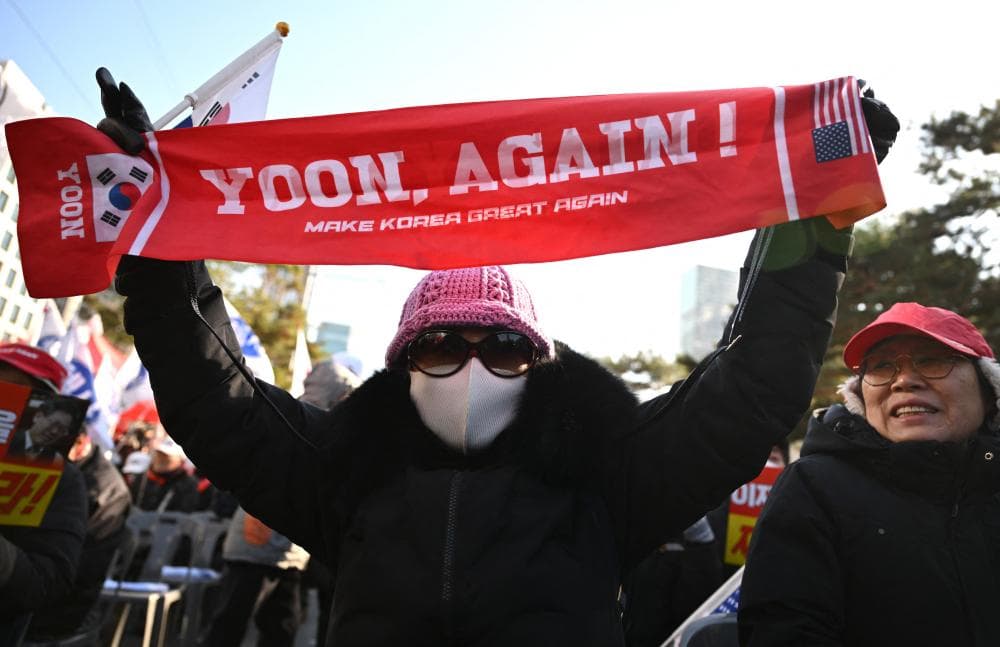
Several hundred supporters of ousted president Yoon Suk Yeol – the instigator of the ill-fated martial law attempt – gathered near the national assembly, waving Korean and American flags alongside banners defending his martial law as justified and shouting “Yoon Again”. Meanwhile, workers strung lights and set up sound systems for the evening’s much larger pro-democracy celebrations, where thousands were expected to gather.
Wednesday’s anniversary commemorates one of the most dramatic nights in South Korea’s history. On 3 December 2024, then-president Yoon Suk Yeol declared martial law, claiming “pro-North anti-state forces” and election fraud threatened national security.
The command aimed to ban political activities, authorise warrantless arrests and deploy 280 armed troops to the national assembly.
Within six hours, however, the move had collapsed. As thousands of citizens rushed to the parliament building – some helping MPs scale its walls to reach the chamber – 190 lawmakers voted unanimously to overturn the decree.
Lee on Wednesday described the event as a “self-coup”, saying that Korean citizens deserved a Nobel peace prize for overcoming “an unprecedented democratic crisis in world history” without the use of force.
In the days that followed, ordinary Koreans adopted colourful K-pop concert lightsticks as symbols of peaceful resistance, gathering nightly in what was dubbed the “revolution of light”.
Yoon was impeached four months later and removed by the constitutional court, triggering a snap election that brought Lee to power.
The former president, now in detention, faces trial on charges of leading an insurrection and an unprecedented count of aiding an enemy for allegedly provoking North Korea to justify emergency rule. His lawyers have denied the allegations against him.
Prosecutors allege Yoon ordered drone flights near Pyongyang in October 2024 in the hope that a retaliatory response could serve as a pretext for martial law.
Former prime minister Han Duck-soo and former defence minister Kim Yong-hyun are also on trial over allegations they played roles in the attempt. Verdicts are not expected until early 2026.
Despite Lee’s calls for unity, the political and social fractures exposed during the crisis remain raw.
“These divisions existed well before the martial law incident, but they have become more politicised and intensified,” said Hannah Kim, professor of international studies at Sogang University.
“Deepening polarisation raises serious concerns about the long-term health of Korean democracy.”
The crisis has also fuelled the rise of a radical rightwing movement. In January, dozens of Yoon supporters stormed a courthouse after a judge approved his arrest warrant, smashing windows in scenes that shocked the country.
The riot drew on conspiracy theories that had taken hold during Yoon’s presidency, including false claims that elections were “stolen” and that China had assisted in manipulating votes.
These narratives have since broadened into a wider wave of anti-China sentiment in parts of the right. Over the past year, youth-led groups have held regular rallies in central Seoul with slogans such as “China out”.
The conservative People Power party, which Yoon was once part of, issued a rare apology on Wednesday. Its floor leader, Song Eon-seog, acknowledged “heavy responsibility” for failing to prevent the crisis.
But the party remains deeply split over whether to break with Yoon and his supporters. Its latest approval rating stands at 37%, below that of President Lee’s Democratic party’s 45%.
Lee’s government, meanwhile, has launched a sweeping review and a nationwide investigation into over 700,000 civil servants is under way, partly relying on anonymous tipoffs and searches of mobile phones that have raised concerns about invasions of privacy and overreach.
Police on Monday issued their own apology, with acting commissioner Yoo Jae-seong admitting officers unlawfully blocked lawmakers from entering parliament on the night of the martial law attempt.
“Due to [the] wrong judgment by some leadership,” he said, “police caused great disappointment and pain to the people.”
In its editorial on Wednesday, the conservative Chosun Ilbo wrote that “punishment for martial law is inevitable”, but accused the Lee administration of an unprecedented “rampage and tyranny” in the way it has governed since taking office.
The liberal Hankyoreh, by contrast, warned that sluggish investigations and stalled court proceedings risk enabling insufficient accountability.
Addressing foreign correspondents on Wednesday, Lee said he hoped South Korea’s “beautiful and peaceful citizen revolution” and the restoration of democracy could stand as a model for other countries.
Lee also announced plans to designate 3 December as “National Sovereignty Day”.
On Wednesday evening, he was scheduled to join crowds again carrying lightsticks in central Seoul, returning to the same streets where last year’s crisis unfolded.
But the country’s political healing will take far longer, said Hannah Kim from Sogang University.
“Genuine reconciliation and meaningful reforms will be necessary to address the root causes,” she said. “The trauma of the martial law episode has left lasting scars.”