Loading...
Please wait for a bit
Please wait for a bit
Click any word to translate
Original article by Eromo Egbejule in Abidjan
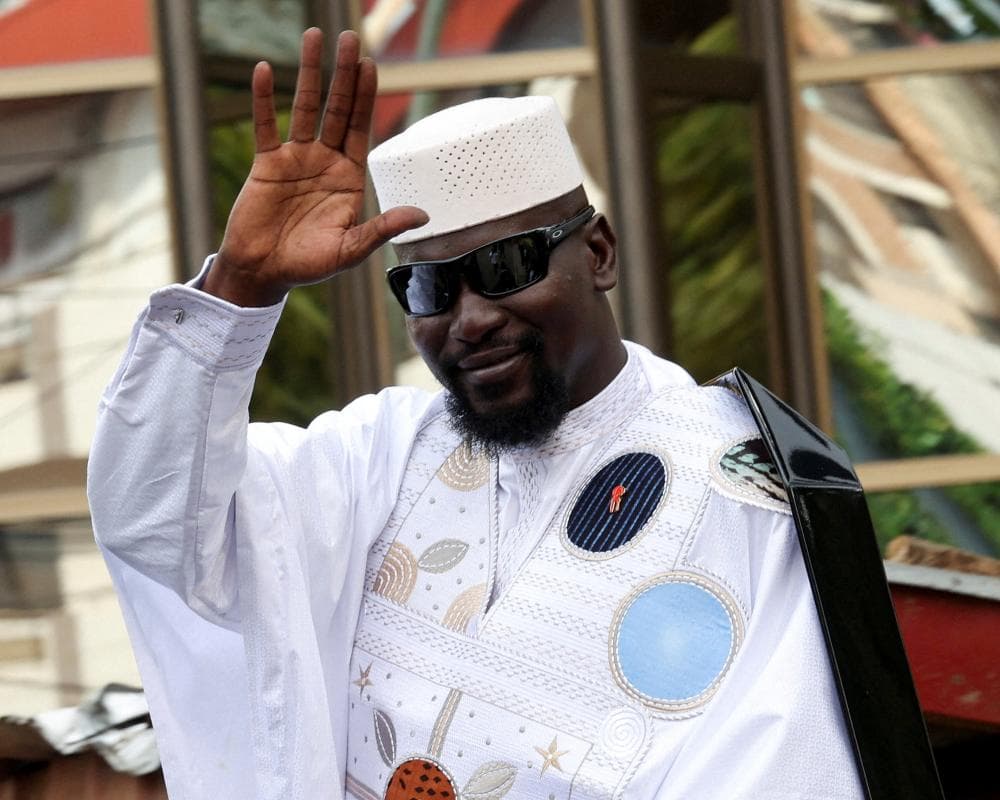
In September 2021, a tall, young colonel in the Guinean army announced that he and his comrades had forcibly seized power and toppled the longtime leader Alpha Condé.
“The will of the strongest has always supplanted the law,” Mamady Doumbouya said in a speech, stressing that the soldiers were acting to restore the will of the people.
Not long after, Doumbouya announced a 36-month timeline for transition to civilian rule in the resource-rich west African nation on the Atlantic coast, shrugging off pressure from the Economic Community of West African States (Ecowas), which wanted a swifter return to democracy. His actions triggered widespread protests and criticism from opposition groups and civil society, most of whom doubted his vow not to personally run for office.
On Sunday, 6.7 million eligible voters in Guinea will head to the ballot box for the first presidential election since the 2021 coup. Among the nine candidates are the former minister Abdoulaye Yéro Baldé of the Democratic Front of Guinea and the former junta supporter turned critic Faya Millimono of the Liberal Bloc party.
But thanks to a controversial referendum in September that led to the adoption of a new constitution allowing him to run and extending presidential terms from five to seven years, the clear frontrunner is Doumbouya.
The opposition coalition Forces vives de Guinée has called his candidacy a betrayal. “The man who presented himself as the restorer of democracy chose to become its gravedigger,” it said in a statement last month after Doumbouya officially deposited his intent to run with the supreme court.
Political upheavals have been a recurring feature in west Africa, a region that has earned the moniker of “coup belt” after seven successful coups and several unsuccessful attempts since 2020. While Guinea has remained under the Ecowas umbrella, fellow juntas in Burkina Faso, Mali and Niger, angered by its post-coup sanctions, have split from the regional bloc to form the pro-Russian Alliance of Sahel States (AES). If it holds, the Guinean election will be the first in any of the junta-run states since 2020.
Within Guinea, many believe the general’s victory is a foregone conclusion, given his consolidation of power since ascending to the presidency and promoting himself to a general. Even now, the presidential race is notable not for those who are on the ballot, but for those who are not.
The biggest opposition parties remain suspended, and their most prominent leaders have been detained, barred from running or – like the former prime minister Cellou Dalein Diallo of the Union of Democratic Forces of Guinea, are in exile. Many say a climate of fear pervades the country due to the junta’s crackdown against its critics, with several dissidents in jail.
Conversely, Doumbouya pardoned the former dictator Moussa Dadis Camara who was given a 20-year sentence for his role in one of Guinea’s most serious human rights atrocities: the 2009 massacre and mass rape of protesters at a stadium in Conakry. The pardon, granted before the final hearing, prompted several human rights groups to write a joint open letter to the junta leader alongside families of victims, urging him to reconsider. That process is now in limbo.
Ahead of the vote, Doumbouya has been accumulating goodwill.This month, the shiny new Simandou mine, which has the world’s largest untapped reserve of iron ore, was launched after nearly three decades of delays caused by political instability and corruption. Doumbouya’s government is touting the project as a bridge to prosperity for Guinea and a sign of incoming development, despite mass job losses and environmental complaints.
The election stakes are high: in the coming years, the multi-layered Simandou mine project – which also includes the construction of ports and a railway – is expected to transform the economy of Guinea, where half of the population lives on below $2 a day. Given existential concerns around transparency, many are waiting to see what the winning government does after the election.
“Our salvation lies in a return to the [proper] constitutional order,” said Abdoulaye Koroma, a presidential candidate for the Rally for Renaissance and Development party.
The best public interest journalism relies on first-hand accounts from people in the know.
If you have something to share on this subject, you can contact us confidentially using the following methods.
Secure Messaging in the Guardian app
The Guardian app has a tool to send tips about stories. Messages are end to end encrypted and concealed within the routine activity that every Guardian mobile app performs. This prevents an observer from knowing that you are communicating with us at all, let alone what is being said.
If you don't already have the Guardian app, download it (iOS/Android) and go to the menu. Select ‘Secure Messaging’.
SecureDrop, instant messengers, email, telephone and post
If you can safely use the Tor network without being observed or monitored, you can send messages and documents to the Guardian via our SecureDrop platform.
Finally, our guide at theguardian.com/tips lists several ways to contact us securely, and discusses the pros and cons of each.