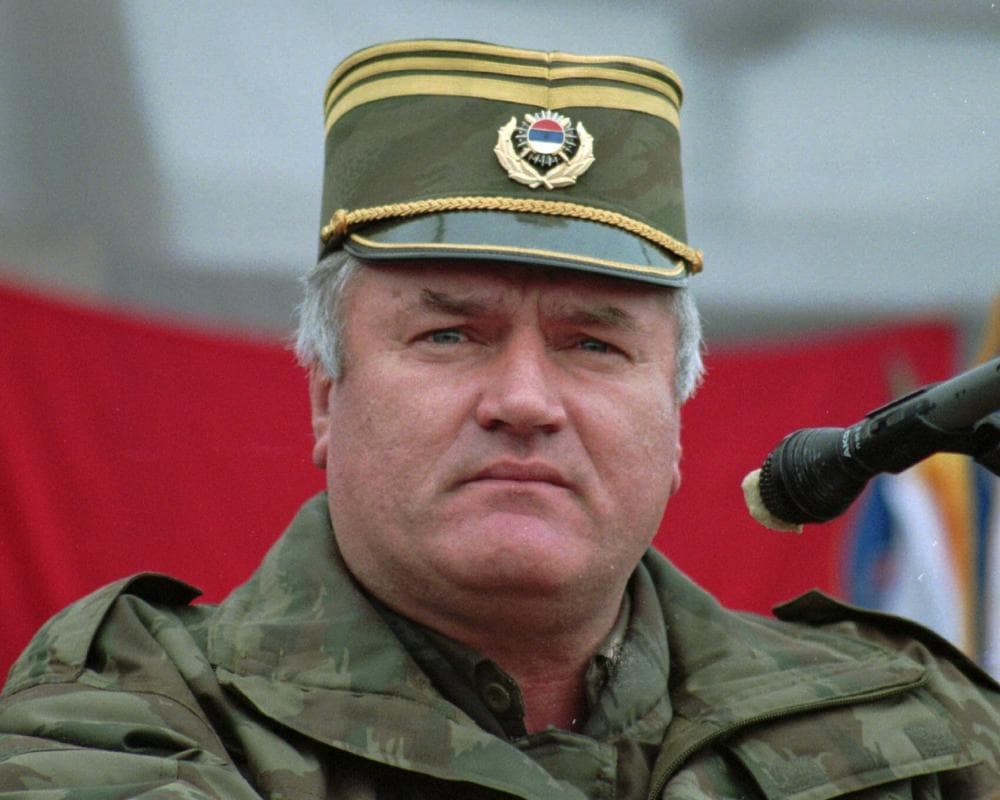
Ratko Mladić, the ‘Butcher of Bosnia’, dies in The Hague
Click any word to translate
Original article by Peter Beaumont Senior international correspondent
Ratko Mladić, the infamous Serbian general who was serving a life sentence for genocide committed during the Bosnian war, has died in prison in The Hague.
Mladić had been one of the main architects of the policy of ethnic cleansing during the Bosnian war. He was convicted of genocide for orchestrating the 1995 killing of at least 8,000 Muslims in the UN-designated “safe area” Srebrenica, the worst massacre in Europe since the second world war.
Mladić, who was nicknamed the “Butcher of Bosnia”, had been in ill health after having a series of strokes.
A UN international tribunal confirmed Mladić’s death, saying he had died in hospital in The Hague earlier in the day.
“Mladić passed away today while hospitalised in The Hague,” the International Residual Mechanism for Criminal Tribunals said in a statement, adding that judge Graciela Gatti Santana had ordered “a full inquiry into the circumstances” of his death.
Described by the former UN rights chief Zeid Ra’ad al-Hussein as “the epitome of evil” after his conviction, Mladić was one of the most notorious figures of the war that killed more than 100,000 people and left more than 1 million homeless.
He commanded his troops to “scorch the brains” of Bosnian Muslim people and had boasted of being a “Serbian god”.
The news of Mladić’s death was first broken on Serbian state television after his son, Darko, had spoken earlier about his father’s declining health.
Mladić was sentenced by a UN tribunal to life imprisonment in 2017 over genocide and war crimes committed during Bosnia’s 1990s war. He was arrested in Serbia in 2011 after 16 years on the run.
The slaughter in Srebrenica was the culmination of a brutal war that had lasted more than three years, during which Mladić oversaw the siege of Bosnia’s capital, Sarajevo, which was pounded daily by artillery, tank and sniper fire, killing 10,000 people.
The goal of the Serbian leadership, which Mladić was tasked with implementing – as determined by the UN’s international criminal tribunal for the former Yugoslavia (ICTY) – was the forcible expulsion of Bosnian Muslims, Croats and other non-Serbs to clear Bosnian land for the creation of a greater Serbia.
The tribunal found that Mladić, together with the late Serbian president Slobodan Milošević and the Bosnian Serb political leader Radovan Karadžić, were part of a criminal conspiracy to implement the plan.
“I do not recognise this court,” Mladić said at an ICTY hearing on his case in 2014. When he was sentenced, he shouted: “This is all lies, you are all liars!”
The Serbian campaign culminated in the horror of Srebrenica when, after the withdrawal of Dutch UN peacekeeping forces, thousands of Bosnian men and boys were rounded up, killed and their bodies bulldozed into mass graves.
Mladić had the siege filmed to show him praising his “lads” and haranguing the UN peacekeepers who misguidedly accepted his solemn word that the inhabitants would be safe in his hands.
“We give this town to the Serb people as a gift,” Mladić said to the camera, claiming the victory as revenge against Muslim Turks, who had once held the area as part of the Ottoman empire.
The next day, Mladić’s forces were filmed handing out sweets to children, promising their safe passage. Meanwhile, thousands of men and boys were being readied for slaughter.
When Nato tried in 1995 to rein in his forces with the threat of limited airstrikes, his troops seized UN peacekeepers as human shields, chaining them to likely targets.
The son of a second world war partisan fighter killed in 1945, Mladić was, according to his family, born in March 1943 in the tiny Bosnian village of Bozinovici, putting his age at death at 83 (though official documents recorded his date of birth a year earlier, in 1942).
Mladić was an officer in the communist Yugoslav People’s Army (JNA) when Yugoslavia’s disintegration began in 1991.
When Bosnian Serbs rose in 1992 against Bosnia’s Muslim-led secession, Mladić was chosen to command the new Bosnian Serb army that swiftly overran 70% of the country.
Dozens of towns were besieged with heavy weapons that once belonged to the JNA and villages were burned down, as 22,000 troops with the UN Protection Force stood by, more or less helplessly, under orders not to take sides.
A combination of western pressure, Nato strikes and covert US arms and training for Croats and Muslims gradually turned the tide against Mladić’s army. After the war, Mladić went into hiding, with the reformists ruling post-conflict Serbia not daring to move against a man who was a hero to a core of nationalist Serbs.
Mladić continued to insist he was “a simple man” chosen to protect his people. When he was finally arrested in 2011, he put up no resistance. He had a heart attack in 2013 and seemed older than his years. By his own account, he felt like a frail old man.
This month, a UN doctor said Mladić’s death “may occur at any time”, possibly within weeks, but his application for release was again rejected.
Munira Subašić, from the Mothers of Srebrenica group, said she deplored that Mladić’s crimes were still being denied by many Bosnian Serbs. “Today, a major war criminal died, the criminal of the Balkans,” Subašić said. But while 31 years later mothers of victims were “still carrying the pain in our souls … we are still listening to denials, we are still listening to how Ratko Mladić was a hero for the Serbs”.
Elizabeth Evenson, the international justice director at Human Rights Watch, said: “The death of Ratko Mladić, the former Bosnian Serb army commander found guilty of genocide, including the massacre of up to 8,000 Bosnian men and boys after the fall of Srebrenica, Bosnia, in July 1995, is a reminder of the ongoing need for justice, truth, and reparations in the western Balkans.
“Full accountability for such terrible crimes, in Bosnia and elsewhere, demands commitment by governments to justice, even decades after the events themselves.”