Loading...
Please wait for a bit
Please wait for a bit
Click any word to translate
Original article by Jason Burke and Sufian Taha in Sebastia
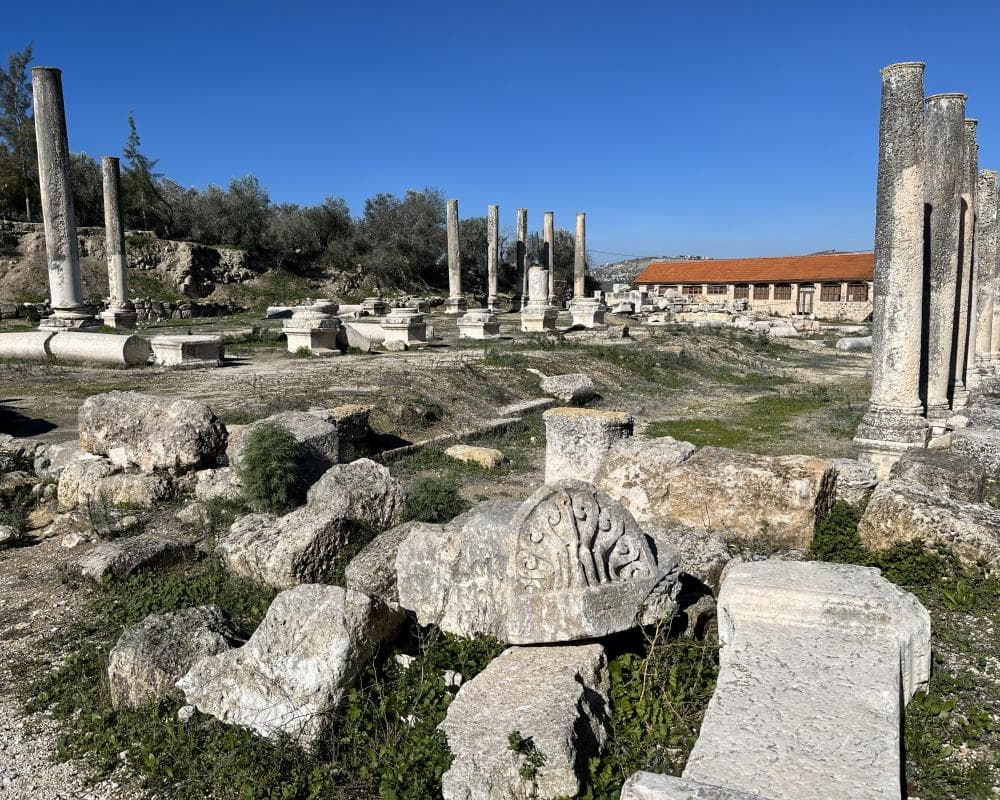
The Byzantine-era church lies half hidden in the shade. Roman columns rise from among the olive trees, even older ruins linked to Israelite kings are overgrown. To the west, the Mediterranean is just visible on the horizon. To the north and south are the hills of the occupied West Bank.
In the small town of Sebastia, a hundred metres or less east of the ruins, everyone is very worried.
In November, Mahmud Azem, the mayor of Sebastia, received a notice from Israeli authorities announcing the seizure of the whole of the sprawling hilltop archaeological site next to the town.
Though there have been reports of an Israeli government project to develop the site for several years, the notice came as a shock. Most of the 3,500 Palestinian residents depend on either tourism at the site or their olive trees for their livelihoods.
The current plans for development of the site involve a visitors’ centre, a car park, and a fence that will separate the ruins from the rest of the town, cutting residents off from the ruins and any olive orchards that survive.
“Unfortunately Sebastia has gone into a dark tunnel,” said Azem, 50. “It is an aggression against Palestinian landowners, against olive trees, against tourist sites and it is a violation of the history and the heritage of Palestine.”
The expropriation of 182 hectares (450 acres) at Sebastia is the largest ever seizure of land for an archaeological project since Israel occupied the West Bank after its victory against Syria, Egypt and their Arab allies in 1967.
Supporters of the project in Israel say the site has been undeveloped for decades. They say too that Sebastia has been identified as the capital of a northern Israelite kingdom known as Samaria between the 9th and 8th centuries BC.
Critics say the heritage project is part of a surge of expansion of Jewish settlements across the West Bank that has been forcefully promoted in recent years by Israel’s ruling coalition government, and any historical significance is merely a pretext for a massive land grab. Much of the area marked for expropriation by Israeli authorities is privately owned, setting another new and dangerous precedent, according to campaigners.
Alon Arad of Emek Shaveh, an Israeli NGO that aims to maintain ancient sites “as public assets that belong to members of all communities, faiths and peoples”, said archaeology was being “weaponised”.
“What is planned for Sebastia is … really unprecedented in its scale. And it is very cynical … It is not about history, it is really just about land and annexation,” Arad said.
The multimillion-dollar project to redevelop Sebastia is being driven by members of the far-right ultranationalist Otzma Yehudit party, which is part of Israel’s coalition government, the most rightwing the country has ever had.
A new access road to the site will bypass Sebastia entirely, allowing tourists to arrive directly from Israel, with expansion of a large Jewish settlement just a kilometre or so from the site expected too.
Amichai Eliyahu, the Israeli minister of heritage, is a member of Otzma Yehudit, lives in a settlement in the West Bank and is an outspoken advocate of annexation of the entire territory.
“Sebastia is one of the most important sites in our national and historical heritage … Our desire is to breathe new life into the site and make it an attraction for hundreds of thousands of visitors a year, which will strengthen the connection between the people, their heritage, and their country,” Eliyahu said in a statement last year.
The complex and multilayered past of Sebastia revealed by excavations over the last century has allowed partisans on both sides to selectively emphasise the significance of the sites’ history.
Leaders of the settlement movement in Israel have accused the Palestinian Authority, which exercises partial authority over parts of the West Bank, and local representatives in Sebastia of seeking to erase the site’s biblical significance, and its connection to Jewish history. Israel now refers to the occupied West Bank by the names of the two iron age kingdoms that ruled over its approximate extent: Judaea in the south and Samaria, or Shomron in Hebrew, in the north.
The new site in Sebastia is to be known as the Shomron national park, according to plans.
Wala’a Ghazal, the curator of a small museum set in the courtyard of a 13th-century mosque in the town, said that to emphasise just one moment in Sebastia’s complex story was wrong. The mosque, rebuilt by the Ottomans, was once a Crusader cathedral which itself was originally a Byzantine church. It houses the tomb of John the Baptist.
“There has been continual habitation … It is not right just to focus on one or other period. Samaria happened in the iron age but there were people living here before then,” she said.
The kingdom of Samaria was destroyed when the Assyrians invaded in 722BCE, archaeologists believe. Later, Alexander the Great destroyed another settlement there, which was then rebuilt by King Herod and renamed in honour of Emperor Augustus. Over subsequent centuries, Sebastia came under Byzantine, Islamic, Crusader, Ottoman and British rule.
Other Israeli government-backed archaeological projects elsewhere in the West Bank and in East Jerusalem have also been criticised as motivated more by ideology than a search for knowledge.
One major dig in a Palestinian neighbourhood in Jerusalem very close to the holy sites of the Old City is managed by the City of David Foundation, an Israeli government-funded archaeological park in Jerusalem. It is run by Elad, an Israeli settler group accused of displacing Palestinian families from Jerusalem by buying Palestinian houses and using controversial laws that let the state take over Palestinian property.
An EU report in 2018 said Elad’s projects in parts of East Jerusalem were being used “as a political tool to modify the historical narrative and to support, legitimise and expand settlements”.
International law prohibits an occupying force from developing or otherwise interfering with archaeological locations. Sebastia has been inscribed since 2012 on Unesco’s tentative list of world heritage sites for the State of Palestine.
Few tourists have visited Sebastia since the war in Gaza broke out in October 2023 but residents have been hoping for a return of the hundreds who came daily before.
Mahmud Ghazal lives adjacent to the remains of the Roman-era basilica and forum. His home, gift shop and restaurant straddle the line that is set to be the new, uncrossable fence around the site, overlooking the tumbled columns and marble ruins. The 63-year-old is pessimistic. “This [development plan] will destroy Sebastia. They will take everything from us,” Ghazal said.