Loading...
Please wait for a bit
Please wait for a bit
Click any word to translate
Original article by Tural Ahmedzade, Harvey Symons, Oliver Holmes and Dan Sabbagh
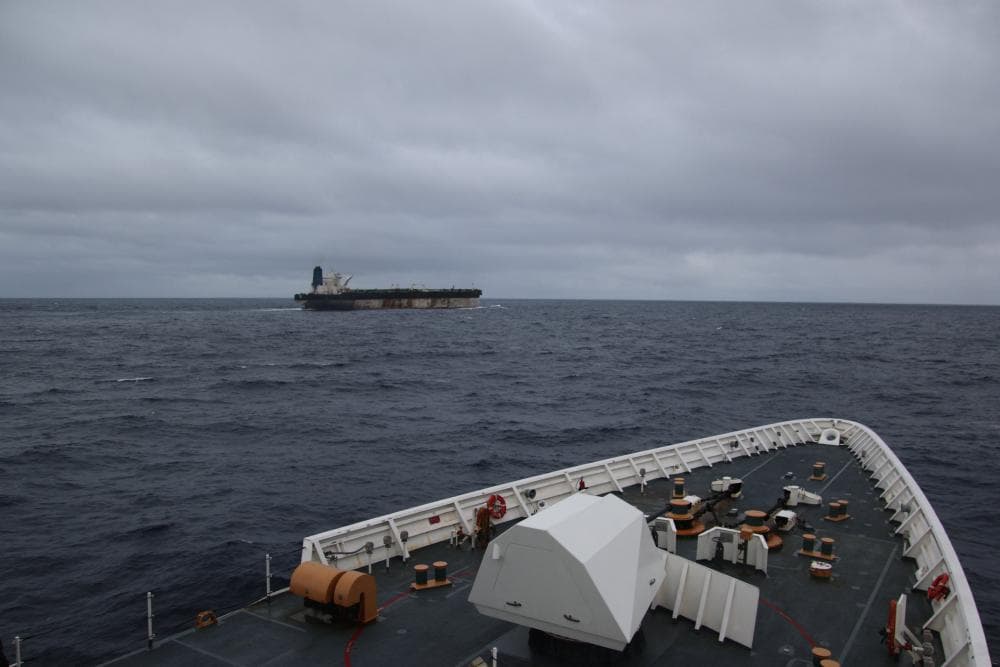
A massive, rusty crude oil tanker floating north through the Atlantic has become the centre of global interest after it was followed for days and eventually seized by US forces while Russia’s military rushed towards it.
Despite not carrying any oil, the 300-metre-long ship is clearly of value. Theories for why range from speculation that high-value Russian weapons are hidden in the hull, to the ship’s potential to become a symbolic trophy in a transatlantic power struggle between Washington and Moscow.
Currently called the Marinera, the ship is alleged to be part of the shadow or “ghost” fleets used by Russia, Iran and Venezuela to avoid western sanctions. For years these vessels have moved cargo and cheap fuel around the globe, including to China.
Washington and its European allies have long sought to crack down on the illicit maritime trade. Those efforts reached a critical point last month after Donald Trump imposed a naval blockade on sanctions-busting tankers operating near Venezuela, home to the world’s largest oil reserves and a key destination for shadow fleet vessels.
The Marinera is among the dozen or so oil tankers that have been trying to escape the blockade. It evaded capture in the Caribbean Sea in December, changed its name from Bella 1 and switched course towards northern Russia before being boarded on Wednesday as it sailed in the frigid Atlantic.
The Marinera has been under sanctions from the US treasury since June 2024 over accusations of carrying illicit cargo for Hezbollah, an Iranian-backed Lebanese militant group.
The US Coast Guard attempted to board it in the Caribbean in December as it headed for Venezuela, but the ship’s crew refused.
There is precedent for the US boarding shadow fleet ships. Last month, US special forces rappelled from helicopters to board the Skipper, a tanker off Venezuela that the US treasury had placed under sanctions in 2022. On Wednesday, US Coast Guard members were seen boarding a tanker in international waters near the Caribbean.
But doing the same on the Marinera is very different and has much higher stakes. While the Skipper was sailing under the flag of Guyana, the Marinera is Russian registered and flagged.
That is a recent development: the tanker’s crew hurriedly painted a Russian flag on the hull last month. Moscow later lodged a formal diplomatic protest demanding that Washington halt its high-seas pursuit.
It is not the only tanker operating in Venezuelan waters to be reflagged under the Russian banner in recent weeks. By putting its own flag on some former shadow fleet tankers, Moscow has in effect moved shadow fleet vessels out of the shadows, in an open challenge to the west.
Craig Kennedy, an associate at Harvard University’s Davis Center for Russian and Eurasian Studies, said the decision by Moscow to register the ship could have been an attempt to gain leverage by circumventing the US oil blockade on Venezuela.
“To seize a Russian-flagged ship on the high seas is to disregard Russia’s claims of exclusive jurisdiction over the vessel,” said Kennedy, adding that Moscow may have assumed the US would not board a Russian-flagged vessel.
But the Kremlin miscalculated how far Trump would go, Kennedy said. Last weekend, US forces carried out a pre-dawn capture of Venezuela’s president, Nicolás Maduro, and his wife, Cilia Flores, who are now on trial in New York.
“This was Russia trying to gain leverage by intervening in the US blockade,” Kennedy said. “And then it backfired.”
Other theories suggest there may be something of value to Moscow within the ship. While it is empty of oil, the route it previously took between Iran and Venezuela is suspected of being a path for illicit trade, including for weapons.
Upping the stakes, Russia this week dispatched naval assets, including a submarine, to escort the tanker, according to the Wall Street Journal. That was reported hours before US forces boarded the ship, when Washington announced the ship had been seized for “violations of US sanctions”.
For days, US surveillance planes had been monitoring the ship, and a British Royal Air Force spy plane appears to have flown over its path. Flight-tracking platforms showed an RAF RC-135W Rivet Joint surveillance plane leaving the Waddington airbase in Lincolnshire on Tuesday towards the same area of the Atlantic as the ship.
The UK military said it provided “pre-planned operational support, including basing”. And in recent days tracking data and spotters had shown a sudden influx of US military, including the C-17 Globemaster III, which can carry helicopters, raising speculation about an imminent special operations mission against the Marinera.
Speaking before US forces boarded the ship, John Foreman, a former UK defence attache to Moscow, said the scale of the US monitoring of the tanker and apparent preparations for its seizure by moving aircraft to the nearby UK was eye-catching.
“Why have the US put all these assets into the UK just for some oil tanker?” said the former official, now a defence analyst. “Could it be Russian arms going to Venezuela?”
