Loading...
Please wait for a bit
Please wait for a bit
Click any word to translate
Original article by Peter Walker Senior political correspondent
Keir Starmer has told Donald Trump he is wrong to threaten tariffs against Nato allies to try to secure Greenland, as part of a flurry of diplomatic calls intended to tackle the crisis.
The UK prime minister spoke to the US president on Sunday, as well as to Mette Frederiksen, the Danish PM, whose country’s territory includes Greenland; Ursula von der Leyen, the president of the European Commission; and Mark Rutte, the Nato secretary general.
“In all his calls, the prime minister reiterated his position on Greenland. He said that security in the high north is a priority for all Nato allies in order to protect Euro-Atlantic interests,” a Downing Street summary of the calls said. “He also said that applying tariffs on allies for pursuing the collective security of Nato allies is wrong.”
The firm stance could place Starmer on a collision course with the US after Trump said he would place sanctions on eight European nations, including the UK, that have deployed troops to Greenland in response to US threats over its future.
A joint statement by the affected countries on Sunday said Trump’s threats “undermine transatlantic relations and risk a dangerous downward spiral”.
On Monday, Starmer will use an emergency Downing Street statement to reiterate the UK’s disappointment at the threat of US tariffs.
Calling off a planned event outside London focused on the cost of living, the prime minister was instead due to fully line the UK up with European opposition to Trump’s plan, which has caused shock waves throughout the EU and Nato.
At a Downing Street press conference on Monday morning, Starmer will echo the sentiment with robust language of his own. But he is not expected to push for reciprocal tariffs or other retaliatory measures.
Starmer is also expected to stress the importance of UK ties with allies like the US, with officials hoping his unexpectedly good relationship with Trump thus far, which has seen the UK evade some earlier US tariffs, could help instigate a climbdown by the White House.
Every major UK party has condemned Trump’s threat to apply 10% tariffs from 1 February on the UK, France, Germany, Denmark, Norway, Sweden, the Netherlands and Finland, rising to 25% on 1 June if a deal to buy Greenland has not been reached. This includes Nigel Farage’s Reform UK, which is most closely aligned with the US president.
But Starmer will face pressure to push back harder against Trump, in an acceptance that a normal relationship with his administration is effectively impossible.
The Liberal Democrats are pushing for an emergency Commons debate and for the scrapping of a pharmaceuticals deal with Washington, while some Labour MPs want a more overtly Europe-leaning stance.
Lisa Nandy, the culture secretary, who was the government minister tasked with media interviews on Sunday, refused to be drawn on the prospect of responses like retaliatory tariffs, saying that rather than “shout and yell”, the aim was to have serious but private talks with the US administration.
But she said there would be no climbdown on the central point: “Our position on Greenland is non-negotiable. We’ve made that very clear and we’ll continue to make that clear. President Trump’s position on Greenland is different. Notwithstanding that, it is in our collective interest to work together and not to start a war of words.”
Asked to confirm that the UK would never accept the US idea of annexation, Nandy told Sky News: “Yes, of course. The prime minister was very clear that we believe that this decision on tariffs is completely wrong. The future of Greenland is for the people of Greenland and the people of the kingdom of Denmark to determine and for them alone.
“We’ve been consistent about that. That is a view that we’ve expressed to our friends and allies in the American administration.”
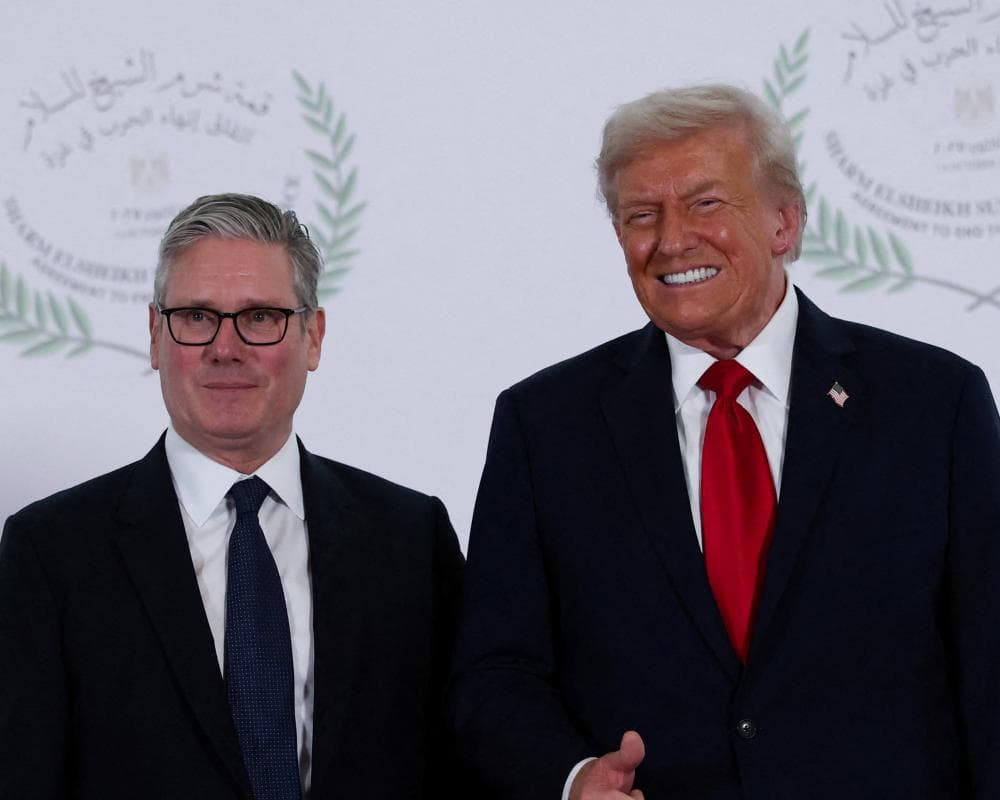
Starmer has consistently sought to engage with and, if needed, openly court and flatter Trump, most notably in early 2025 when he used a visit to the White House to offer the US president an unprecedented second state visit to the UK.
He has subsequently met Trump at several global summits and fielded numerous calls from him, some seemingly made on the spur of the moment by the US president. Trump regularly says he likes Starmer, an affection the prime minister privately admits he cannot fully explain.
UK officials insist this has brought benefits, in terms of trade arrangements with the US and also in allowing Starmer to act as a bridge between Washington and other Nato members over Ukraine and the importance of US support and security guarantees against Russia.
But there has been an awareness that the capricious US leader could blow up relations at any point.