Loading...
Please wait for a bit
Please wait for a bit
Click any word to translate
Original article by Tiago Rogero South America correspondent
As the harsh reality sets in that Venezuela’s authoritarian regime remains essentially unchanged even without Nicolás Maduro, activists who have spent years fighting for the country’s return to democracy are unsure about what the next steps should be.
They agree that the country should very soon either hold new elections or install the retired diplomat Edmundo González – widely believed to have won the 2024 election – but neither option appears to be on the White House’s agenda at the moment.
After capturing Maduro and taking control of Venezuela’s oil, Trump could have chosen to install González – whose victory the opposition has demonstrated through collected tally sheets – but instead decided to leave the former dictator’s entire cabinet in charge of the country, claiming it would now operate under White House oversight.
Yet despite US assertions that the acting president, Delcy Rodríguez, has so far been playing along repression continues.
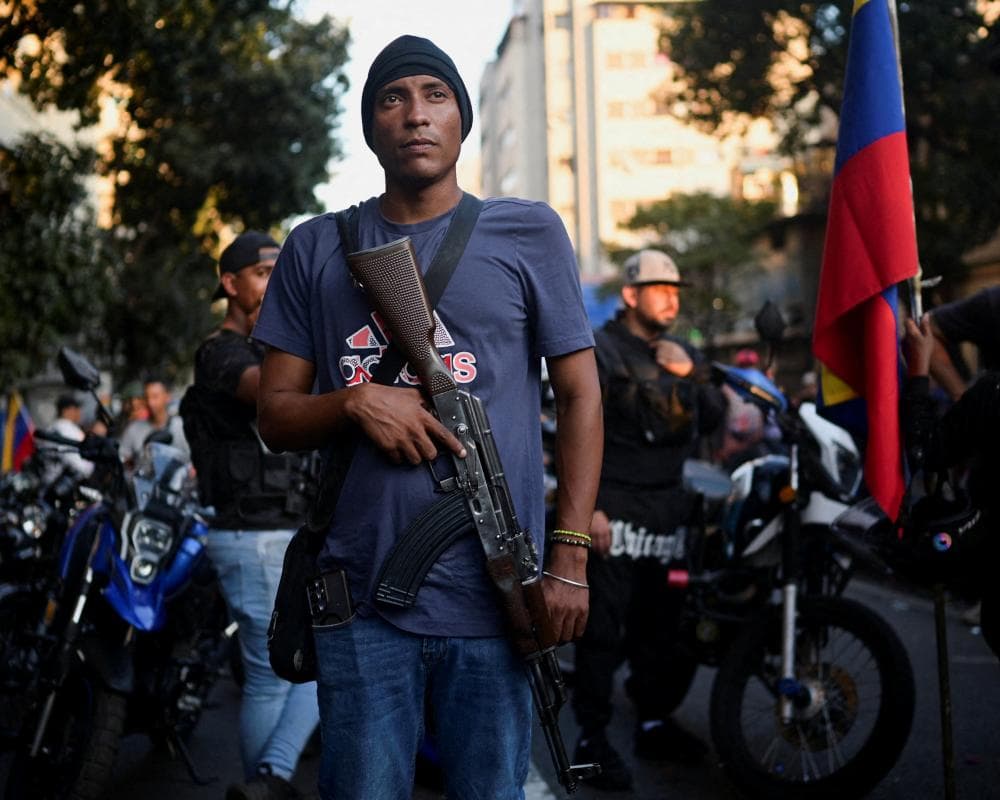
Armed militias continue to patrol the streets and search people’s mobile phones; a group of teenagers was detained for allegedly celebrating Maduro’s capture and only released a week later; and despite the regime’s promise of a “mass” release of political prisoners, nearly 1,000 people remain behind bars for having dared to criticise or protest against the regime.
The sociologist and activist Rafael Uzcátegui, co-director of the NGO Laboratorio de Paz, describes the current moment as just the latest iteration of the movement launched by Maduro’s mentor, Hugo Chávez. With a government led by Rodríguez, her influential brother and congressional president Jorge , and other figures such as the feared interior minister, Diosdado Cabello, Venezuela is now seeing “Chavismo 3.0”, he said.
“So far, state terrorism remains in place,” said Uzcátegui. “I still have doubts about the route towards a democratic transition. So far, the signals are very weak,” he added.
Like many other activists, Uzcátegui was forced to leave Venezuela to avoid arrest or death: between 2016 and 2019 alone, police and other security forces killed more than 19,000 people under Maduro, according to Human Rights Watch.
The work of civil society organisations inside the country has been further undermined since the approval of the so-called “anti-NGO law” after the 2024 elections, which requires organisations to be authorised by the government to operate. Only a handful of groups continue to work directly there, most of them focused on humanitarian issues, such as supporting the families of political prisoners.
Uzcátegui is among many who argue that, under the constitution, a new election should be called, with debate over whether it should happen within three or six months. He fears that the Rodríguez siblings’ plan is to remain in power until the 2030 elections, when some economic recovery driven by the reopening of relations with the US would “give them a chance of winning”.
Trump has said the US must first “rebuild” Venezuela and that Venezuelans “wouldn’t even know how to have an election right now”, but pro-democracy campaigners point out that Venezuela’s opposition was able to mount an effective – and victorious – campaign during the last election in 2024 – even if that vote was then stolen by regime.
“Elections should not be at the end of the transition, but at its beginning,” said Uzcátegui, adding, however, that there was an “issue to resolve” among organisations, because “some believe that calling new elections would undermine the significance of the results of 2024”.
The swearing-in of González has also been demanded by the main opposition leader and Nobel peace prize winner, María Corina Machado, who chose González to run in her place after the regime barred her.
Deborah Van Berkel, from the NGO Ideas por la Democracia and now living in exile in the US, said that among activists there was “a combination of a certain hopeful expectation, but also a great deal of caution, because … the regime remains in internal control of the country through repression”.
For new elections to take place new conditions would need to be put in place, including a truly independent electoral council, unrestricted access for international observers, a free press and, afterwards, “conditions of democratic governability” for the elected government, she said.
Another exiled activist, Griselda Colina, director of the Global Observatory for Communication and Democracy, stressed that there was not a single public institution that is not dominated by Chavismo, and said the long-awaited democratic transition would unfortunately not be swift, given that democracy “has been dismantled for more than 20 years”.
“This struggle is not new, but if Venezuelans have learned anything, it is that we know how to manage hope,” she said. “We are a people who refuse to live under dictatorship, a people who carry a democratic reserve in our minds and aspirations – and that has not disappeared.”