Loading...
Please wait for a bit
Please wait for a bit
Click any word to translate
Original article by William Christou in Deir el-Zour
The Syrian government and Kurdish forces agreed to extend a ceasefire on Saturday, according to Syrian diplomatic sources, temporarily staving off a looming war between the two sides in the north-east of the country.
Sources told Agence France-Presse the ceasefire would be extended for “a period of up to one month at most”, citing the need to facilitate the transfer of suspected members of Islamic State from Syria to Iraq.
The two sides had announced a temporary ceasefire earlier in the week, halting an offensive by the Syrian government which brought its army to the door of the Kurdish Syrian Democratic Forces (SDF). The announcement quelled concerns the offensive would restart on Saturday and gave more space for diplomacy, but did not solve the root cause of the conflict between the two sides.
Fighting over three contested neighbourhoods in Aleppo in early January led to a sweeping government offensive in which the SDF lost the majority of its territory in the country in a matter of days.
The ceasefire was meant to give time for the SDF to implement a 14-point plan with the Syrian government under which the Kurdish militia would disband and its soldiers integrate into the Syrian army.
If the SDF did not implement the agreement, Damascus would resume its offensive and push toward the last strongholds of the SDF in Hasakeh, and the Kurdish-majority areas of Qamishli and Kobane.
The two sides spent the ceasefire preparing for the eventuality of a full-scale war.
SDF forces built up in Kurdish-majority areas while its leaders called for a general mobilisation among residents there, distributing weapons to those willing to take up arms.
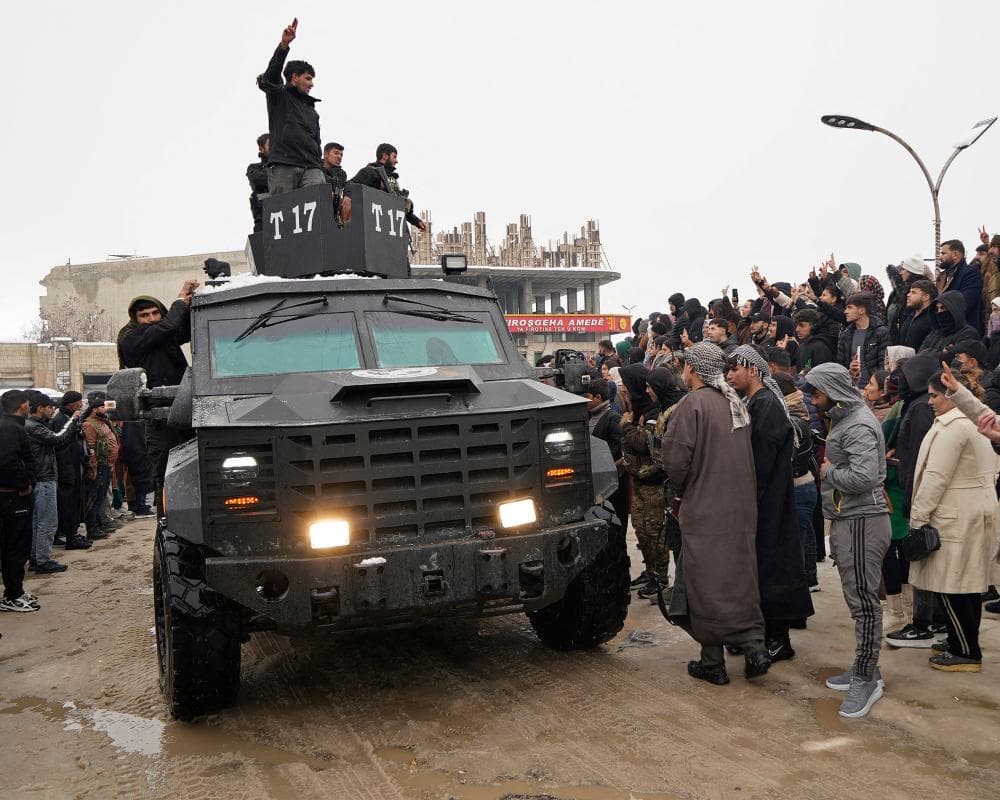
Syrian government soldiers and tanks streamed towards the frontline, hoping to bring the north-east under the control of Damascus. “Soon we will be in Hasakeh and then Qamishli, God willing,” a soldier said on Thursday while standing guard as logistics convoys moved towards the Hasakeh front.
As soldiers waited on the battlefield, Syrian officials and regional powers were engaged in a bout of diplomacy to avoid resuming the war. The SDF leader, Mazloum Abdi, went to Iraqi Kurdistan for the second time, where he met the US envoy for Syria, Tom Barrack, who has been mediating talks between the SDF and Damascus.
Abdi also spoke on the phone to the Syrian foreign minister, Asaad al-Shaibani, which was followed by an agreement allowing the safe transfer of SDF fighters from a besieged prison in Syrian government-controlled territory.
“Ideally, the transfer of Daesh [Islamic State] prisoners from Syria should take place. While this is happening, the existing non-conflict environment needs to be maintained,” the Turkish foreign minister, Hakan Fidan, said on Friday, referring to the US-facilitated transfer of more than 7,000 suspected IS members and fighters from Syria to Iraq.
Disputes between the two sides remain even with the ceasefire extension. The 14-point plan would bring an end to the autonomous Syrian Kurdish project, and Kurdish leaders seemed to struggle to come to terms with their losses over the last two weeks, which has left them with little leverage.
The SDF went from controlling nearly a third of the country, including its oil fields, breadbasket and key infrastructure, to just a few cities. The deal on the table would turn the Kurdish force, which not so long ago boasted of being 100,000 strong, into essentially a municipality overseeing a local police force running a few Kurdish cities in the north-east of the country.
Abdi, long known as a pragmatic figure among the SDF, has signalled he would be willing to implement the deal.
He is struggling, however, to gain consensus within the SDF.
If he is unable to unify the SDF and implement the agreement with the government, then the alternative would be war. Damascus has made it clear it would no longer tolerate non-state armed groups and is determined to unify the country under its flag, either through negotiations or force.
The US, which has backed the Kurdish force for the past decade, has made its support for Damascus clear, with Barrack saying the SDF’s role as the anti-IS force in Syria had now been filled by the Syrian government.
The US military has already began transferring IS prisoners from Kurdish territories to prevent any escapes ahead of a renewed war with Damascus. Once IS prisoners are secured, there will be little strategic interests left for a US military presence in north-east Syria.
Even if Damascus has the military advantage and regional backing, it is still hoping to prevent a war. Its offensive so far has led to relatively few casualties, as the SDF has opted to withdraw from Arab-majority areas such as Raqqa and Deir el-Zour rather than confront the Syrian government.
Fighting in Kurdish-majority areas is likely to be more bloody.
There is fear among Kurdish civilians of the Syrian government fighters, after government-backed massacres in Druze-majority Suweida province and in the Alawite-majority Syrian coast last year.
Many residents in Kurdish-majority areas have armed themselves. Kurdish forces have dug in, having prepared for this fight for years, creating a vast subterranean tunnel network to facilitate guerrilla fighting against a better armed force.
Damascus is aware that even if it wins the war, it could drive away the Kurds, push the SDF underground and create a insurgency similar to that of the Kurdistan Workers’ Party (PKK) in Turkey for years to come.