Loading...
Please wait for a bit
Please wait for a bit
Click any word to translate
Original article by Deborah Cole in Koblenz; photographs by Bernd Hartung
After four decades together, Tatiana and Steffen Missbach still write each other love letters. “A good love letter is specific – not only declaring your feelings but also, you know, ‘good luck at music practice, I’ll be thinking of you’,” said Tatiana, 66, a retired personnel manager. “If he’s leaving early on a work trip, I like waking up and finding one at the breakfast table waiting for me.”
Steffen, 68, a car appraiser, said it was his way of giving Tatiana “something to hold in her hands for the time that I’m not there, when I can’t be here to speak the words”.
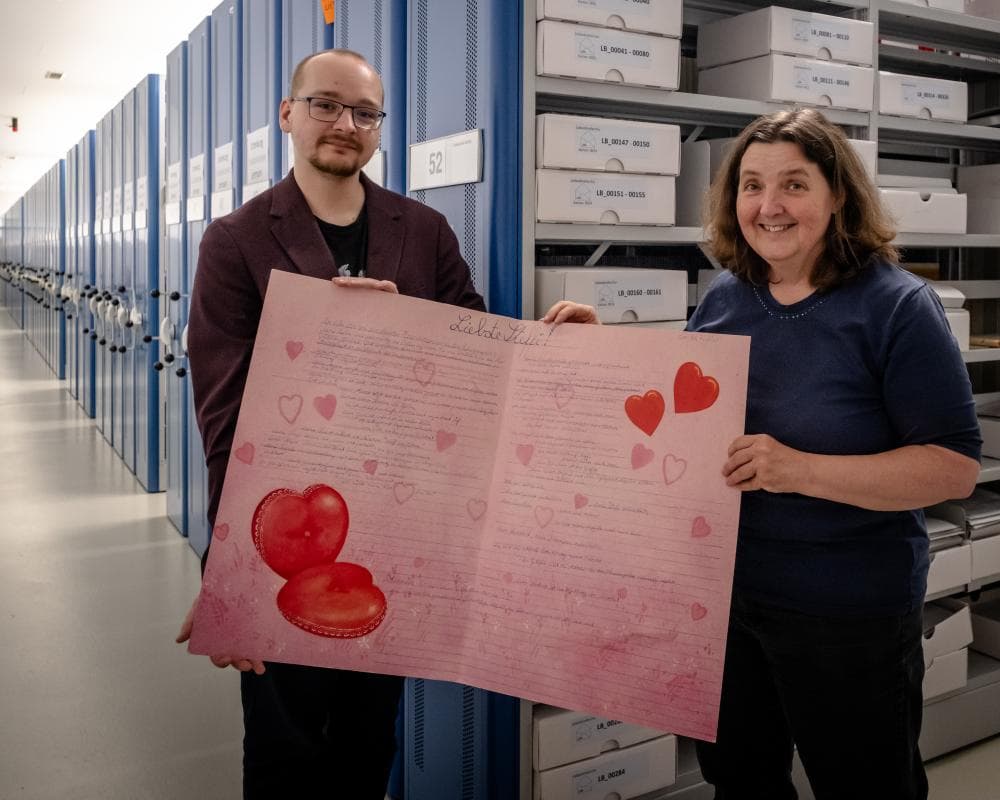
The Missbachs have joined a unique programme at the University of Koblenz, in western Germany, marrying citizen science with one of the largest archives of love letters in Europe, filled with sweet nothings dating back to the 1700s.
Founded by Eva Wyss, a Swiss linguist, the archive now comprises more than 60,000 letters, with more arriving by the day, almost all donated from private collections. Each speaks to the intimate life of a couple but also holds keys to understanding eras of history and the evolution of language.
In Wyss’s vast trove of devotion, some of the paper is yellowed, or covered in drawings of a beloved, or stained by ancient pressed flowers, or tucked in envelopes sealed with red wax stamps or lipstick kisses.
To preserve the letters and make them searchable in a database, Wyss and her team have embarked on an ambitious drive to digitise the correspondence at their disposal, together with colleagues at the Technical University in Darmstadt.
In a clever workaround for the limited resources of academia, they have inspired a small army of volunteers such as the Missbachs to help with tasks such as sorting and transcribing the handwritten letters, still beyond the capabilities of AI.
One of the sweeteners offered to the volunteers is a monthly stammtisch, or regular gathering, where the group discuss a selection of letters from a specific era. On a recent warm spring evening, correspondence between lovers in communist East Germany was the focus.
Over drinks and snacks, the Missbachs, who both grew up in the German Democratic Republic (GDR) but now live in the west, joined a lively discussion of six anonymised letters with other participants from both sides of the iron curtain.
After reading each one out loud, the group, along with two of Wyss’s researchers, Carla Seibert and Dominik Taubert, debated the state of the writers’ relationships – what social pressures they may have encountered, whether self-censorship may have been in play to evade official repression, and whether the authors may have been informing to the Stasi secret police, based on a certain cageyness in their prose.
“It’s really fascinating, especially when you can see parallels to your own life and love stories,” Steffen said. “We start talking about the letters and end up talking about that time in our lives.”
Wyss’s labour of love began in Zurich in 1997 when she put out a call for letter donations from the public and got an overwhelming response, from the contents of family attics and estate sales to clandestine stashes from the recipients themselves that had never been seen by anyone but the paramours.
“Within two or three months, I had more than 2,000 letters,” Wyss said. “I knew I was on to something.”
Coming from linguistics and inspired by British advances in cultural studies, Wyss said she wanted to explode the then narrow notion of whose writing was academically significant.
“There was a big bias in German studies about what a love letter even was,” she said. “It was highly idealised and focused mainly on men writing at the peak of their passion to their beloved – we’re talking in the 18th and early 19th century.
“The more workaday letters – ‘how are you?’ ‘Have you recovered from your illness?’ ‘How are the children?’ – these expressions of more ordinary concern and care which are also expressions of love, often from women, tended to be cast aside by German philology in favour of the ‘great poets’. So it was a rich area for new research,” she said.
For every “darling”, “honey” and “angel”, there is boundless linguistic creativity to be found in the dusty pouches of her growing archive. Wyss cited a favourite from 1930: “Du Sapperlotslausbübischtolltrolliges Wesen Du!” (“You darndest cheeky elfin creature you!”), written by a “Spitz” to his Lisel.
A young man in the 1990s harnessed the zeitgeist to convey passion for his flame with a string of evocative metaphors fit for the techno age: “We’ll never part; you’re always by my side, sitting in my head, striking poses and changing, and every now and then tapping the top of my skull with a broomstick. And you dance in my heart around a mighty fire to a systolic breakbeat, swinging from one coronary artery to the next and administering nothing but love drugs intravenously.”
Inside the archive, Taubert opened a large box with a three-decade-long exchange of nearly 3,000 letters between a Berlin prison inmate and his parole officer, who had a passionate, hush-hush love affair.
“He was in and out of jail on drug offences and she ended up losing her job,” Taubert said. “The letters give us unique insight into daily life behind bars and how their love and sexuality could be lived out under the circumstances, at a time when Aids was spreading in the prison. They got married when he was finally released for good.”
Wyss said she personally found the greatest beauty in simplicity, citing another favourite: “S., you’re my everything, and I want it to stay that way for quite some time to come.”
She and her fellow scholars have over the past three decades produced dozens of studies looking at myriad aspects of how human beings express affection, longing, desire, jealousy, betrayal and loss in written form.
“The rise of the bourgeoisie in the 18th century played a key role in establishing a vocabulary of emotions,” Wyss said. “It’s not just about the gallantry found in aristocratic letters or their cheeky, humorous flirting, but also about this exchange of deep feelings you start seeing.”
In the 19th century, sweethearts who were engaged would have to assume that their families would read the letters aloud, lending the writing a certain stiff formality. But with the rise of early 20th-century feminism, language too was emancipated, unleashing playful humour and sometimes frank eroticism.
“Under the Nazis, there is a backlash against explicit sexuality that only returns in the later postwar decades – by the 1980s you start seeing pretty brazen sex drawings in the letters,” Wyss said.
She said fears that the digital age would kill the love letter – and research about romantic correspondence – had been unfounded. “The rise of the telephone was a much bigger threat,” she said. “Email and texting marked the return to writing about love.”
A more expansive idea of love letters takes in the fleeting detritus of modern life, from a Post-it note left on a pillow to a WhatsApp message stuffed with the gamut of heart emojis.
“The possibility to be in constant contact doesn’t mean it suits every couple,” Wyss said of phone messaging. “Some like to speak, some leave each other voice notes, some leave their communication entirely to swapping pictures. Some get upset if their partner forgets the kiss emoji. Every couple now needs to find what works for them, or doesn’t, online.”
The emotional vulnerability of the sexes during wartime, the etymology of pet names derived from animals and foods, the strategies of baby-come-back pleas and the bouquet of common sign-offs to a beloved have all formed the basis of research by Wyss and her collaborators.
She said the inclusion of citizens such as the Missbachs in the project not only served the practical purpose of expanding and fine-tuning the database but had also opened her eyes to fruitful new avenues to explore.
“The citizens can see what interests us, while we can also see what the citizens find interesting in the letters,” she said. “It gets us out of a bubble and into a dialogue. The subject is so big and there’s still so much to learn.”