Loading...
Please wait for a bit
Please wait for a bit
Click any word to translate
Original article by Peter Beaumont, Callum Jones, and Kate Connolly in Berlin
European countries have pushed back against Donald Trump’s decision to ease some US sanctions on Russian oil amid Iran’s blockade of the strait of Hormuz, insisting the international community should maintain pressure on Moscow over its war against Ukraine.
The UK has joined Germany, France and Norway in rejecting the move, with the foreign secretary, Yvette Cooper, decrying what she said was Russia and Iran’s attempt to “hijack the global economy”.
Friedrich Merz, the German chancellor, described Washington’s move to temporarily waive sanctions on Russian oil stranded at sea as “wrong”, as the Trump administration attempted to counter a surge in oil prices.
Merz said: “We believe it is wrong to ease the sanctions. Unfortunately, Russia continues to show no willingness to negotiate. We will therefore, and must, further increase the pressure on Moscow.”
The chancellor insisted that support for Ukraine should continue despite the conflict in the Middle East. “We will not allow ourselves to be deterred or distracted from this by the war with Iran,” he said.
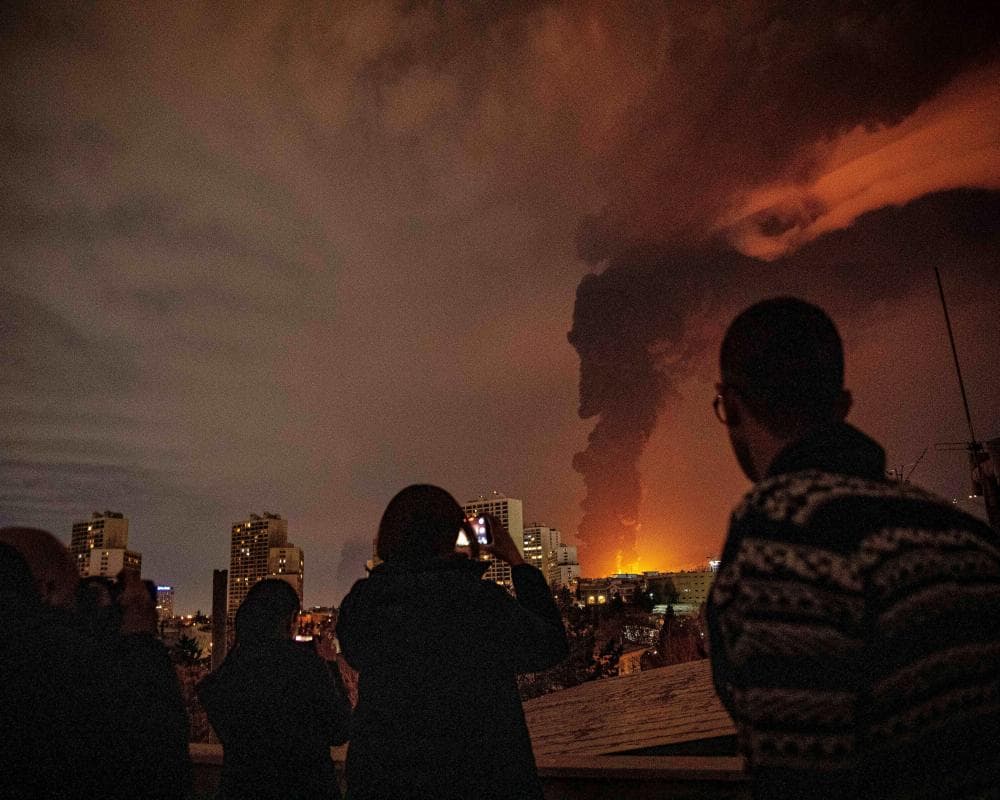
The decision came as US and Israeli jets continued to pound Iran and Lebanon in a deepening regional conflagration that has choked global oil supplies.
The Middle East conflict has all but closed the strait of Hormuz, one of the most important arteries in global trade, through which about a fifth of the world’s oil and seaborne gas tankers pass.
The pushback from Europe came as Trump admitted for the first time that Russia had been assisting Iran during the conflict, in an interview with Fox Radio.
“[Putin] might be helping a little bit, yeah, I guess,” said Trump. “And he probably thinks we’re helping Ukraine, right?” Trump said, referring to reports by several US media outlets that Russia had provided targeting information to Iran for attacking American forces during the ongoing conflict.
As the war in the Middle East approached its third week without any signs of de-escalation, Trump added that American forces would continue to strike Iranian targets in the coming days, signalling an intensification of the US-Israeli campaign. “We’re going to be hitting them very hard over the next week.”
Merz’s comments follow similar remarks from the French president, Emmanuel Macron, who said after a call with other G7 leaders over the economic ramifications of the war in Iran that the paralysis of the strait of Hormuz “in no way” justified lifting sanctions on Russia.
Moscow, however, claimed on Friday it was “increasingly inevitable” that Washington would lift the sanctions. The US was “effectively acknowledging the obvious: without Russian oil, the global energy market cannot remain stable”, Russia’s economic envoy, Kirill Dmitriev, wrote on Telegram.
Amid rapidly spreading global shocks from the conflict, Ukraine’s president, Volodymyr Zelenskyy, said on Friday that the war in the Gulf was “not good for Ukraine”.
“There is nothing good for Ukraine in the war in the Middle East. It’s understandable that the attention of the world moving to Middle East. It’s not good for us,” Zelenskyy told students in Paris.
As the Wall Street Journal reported that the Pentagon was deploying a marine expeditionary unit to the Gulf, Trump’s chaotic geopolitical moves appeared to have left allies increasingly confounded as he also rejected Ukraine’s offer of help in countering Iran’s drones.
Brent crude, the international benchmark, remained above $100 a barrel during early trading on Friday, despite this latest measure designed to soothe concerns around the economic impact of the war.
While the Trump administration has repeatedly promised to escort vessels through the strait, activity has yet to recover. The Iranian regime has declared that it will not allow “one litre of oil” to be exported from the region while US and Israeli attacks continue.
The Trump administration last week permitted Indian refiners to temporarily buy Russian oil for 30 days. A month earlier, Trump claimed India had agreed to stop buying it, in a shift that he said would “help END THE WAR in Ukraine” by cutting off a vital source of funds for Russia.
Lloyd’s List, which issues information on global maritime and shipping logistics intelligence, said on Friday that tankers carrying Russian oil were being immediately rerouted to India, due to sanctions having been lifted. Analysts for Lloyd’s List said the Kremlin would benefit financially from the move.
The International Energy Agency, the world’s energy watchdog, had already ordered the largest release of government reserves in its history, when its 32 members unanimously agreed to release 400m barrels of emergency crude.
But continuing strikes across the Middle East have overshadowed these efforts, as Iran stepped up retaliatory strikes on economic targets in the region. It goaded the US to “get ready for oil to be $200 a barrel” after Trump’s attempt to topple the regime in Tehran.
Iran started to lay mines on Thursday in the strait of Hormuz, the New York Times reported, citing US officials.
Trump has tried in recent days to play down concerns about high oil prices. “The United States is the largest Oil Producer in the World, by far, so when oil prices go up, we make a lot of money,” he wrote on social media.
“BUT, of far greater interest and importance to me, as President, is stoping [sic] an evil Empire, Iran, from having Nuclear Weapons, and destroying the Middle East and, indeed, the World. I won’t ever let that happen!”
As November’s midterm elections loom, however, higher fuel prices could pose a challenge for Trump, with his Republican allies defending their small majorities in the Senate and House of Representatives.