Loading...
Please wait for a bit
Please wait for a bit
Click any word to translate
Original article by Sam Jones in Madrid
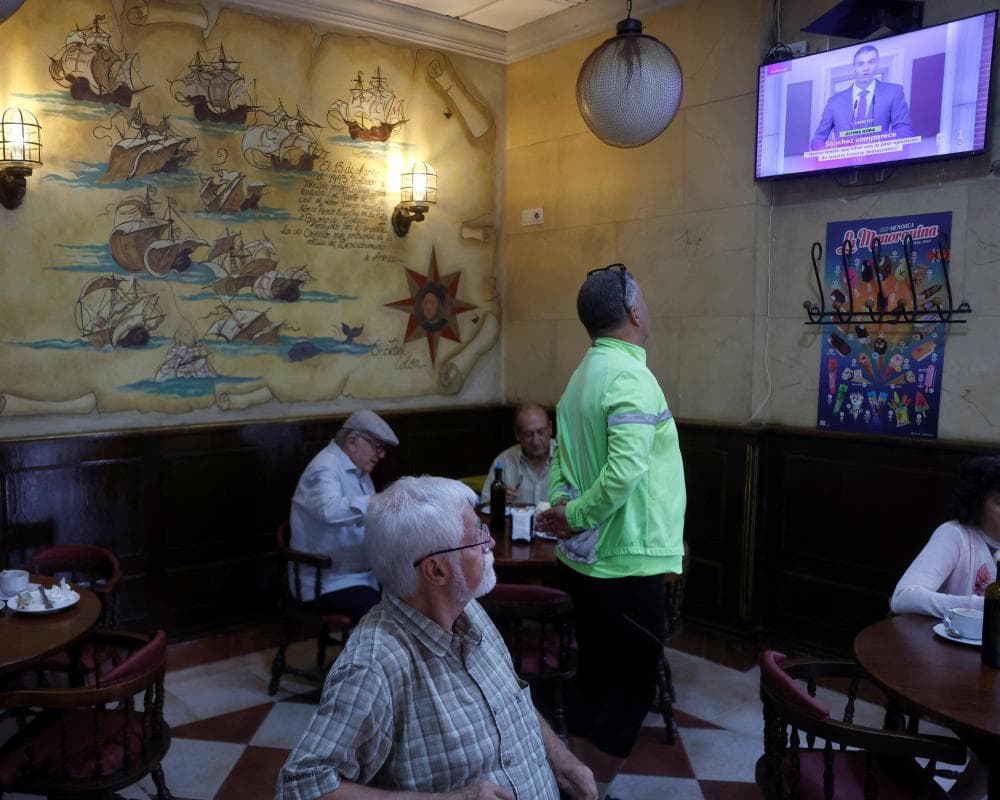
Spaniards will head to the polls on 29 November – months before schedule – after the country’s socialist prime minister, Pedro Sánchez, announced a snap general election on Monday morning. The vote, which will be Spain’s fifth general election in 10 years, is likely to be dominated by growing anger over the housing crisis
Although the next general election was due to be held sometime before the end of next summer, Sánchez has decided to gamble by bringing it forward in the hope that widespread anger over Spain’s housing crisis could work to his advantage and allow him to shore up his fragile mandate.
The eviction last month of Maricarmen Abascal, an 87-year-old woman who was removed from the home in Madrid where she had lived for 70 years, unleashed huge protests. Sánchez’s minority coalition government responded by putting together emergency measures that were put before congress at the end of last week. Despite the evident strength of public feeling, the conservative People’s party (PP), the far-right Vox party and the rightwing, pro-independence Catalan party Junts voted down the measures, infuriating housing campaigners and many ordinary Spaniards.
Sánchez, who has a well-deserved reputation for pragmatism, risk-taking and improvisation, has seen his chance. While his critics argue that his eight years in office should have given him time to address Spain’s housing problems, both the protests and the rightwing opposition to his emergency measures offer Sánchez the chance to leverage the issue for electoral ends.
Not great for Sánchez’s Spanish Socialist Workers’ party (PSOE), which has been trailing the PP for months. Although the PP is firmly in the lead, it doesn’t appear to be on course for an absolute majority, meaning it would be forced to rely on the support of Vox to govern – possibly in a coalition.
If Vox were to take office with the PP, it would be the first time that a far-right party has governed Spain since the country’s return to democracy after the death of Francisco Franco in 1975.
The PP, which repudiated Vox in 2020, accusing them of being demagogues who practised a politics based on “fear, anger, resentment and revenge”, has since bitten its tongue and repeatedly entered into pragmatic regional coalitions with the far-right party. The price for Vox’s backing in those regions recently has been the adoption of the party’s hard line on immigration, including its “national priority” policy that insists Spanish-born people receive priority over those born abroad for housing and public services.
The prime minister only just scraped his return to office in the last general election in July 2023 after he won the backing of Catalan pro-independence parties by promising a controversial amnesty law to those involved in the failed, illegal push for independence from Spain in 2017. Sánchez’s minority coalition government with the smaller, leftwing Sumar alliance, has struggled to get legislation through a fraught congress and has not passed a budget since 2023. Junts, which offered him conditional support three years ago, has attempted to extract maximum benefits from the government, only to abandon it when it feels so inclined, as it did with the emergency housing measures.
Nor do his problems end there. The government has also been fiercely criticised over its handling of the crisis in Spain’s north African enclave of Ceuta, which was sparked when about 70,000 people crossed into the territory from neighbouring Morocco in the space of 48 hours.
Last, but by no means least, Sánchez’s administration, party and inner circle have been mired in corruption allegations over the past two years, which have proved acutely embarrassing for a prime minister who took office vowing to be a scourge of sleaze and graft.
Faced with all that, it’s not hard to see why the prime minister may have decided that an early election was preferable to several more months of legislative deadlock, mud-slinging and uncomfortable headlines.
Sánchez, a politician with an almost feline allocation of lives, will be hoping that his efforts to tackle the housing crisis will contrast sharply with those of his rightwing opponents and thereby mobilise disenchanted voters. He was also careful to remind people in his address on Monday that he has been one of the few political leaders to stand up to Donald Trump, to repeatedly criticise Israel over its actions in Gaza, and to warn of the death and destruction caused by the climate crisis.
Perhaps unsurprisingly given what’s at stake, the prime minister is once again pushing to characterise this latest election as a simple choice between progressive and reactionary politics.
“You, the men and women of Spain, must decide whether you want to join the far-right wave that drives regression wherever it governs, or to ensure that Spain remains a bastion of openness, social justice, and environmental responsibility,” he said on Monday morning.
Sánchez’s opponents, meanwhile, will be hoping that, after eight long years, the public has grown tired and disillusioned, and that the great survivor of Spanish politics has finally lost his lustre.