Death on the road to Rafah: the night the IDF targeted World Central Kitchen aid workers
Click any word to translate
Original article by Julian Borger and Matan Cohen in Jerusalem
On the evening of 1 April 2024, a team of aid workers from World Central Kitchen (WCK) stood on Gaza’s Mediterranean shore overseeing the unloading of a barge full of desperately needed food on a makeshift jetty made of sand and rubble.
The Gaza war had been raging for six months and Israel’s closure of land crossings had left the whole territory facing the threat of famine. WCK and local Palestinian contractors had constructed the jetty out of everything they could lay their hands on, including debris from the bombed house of one of the contractors, so that the pallets of humanitarian assistance could be delivered by boat from Cyprus.
A consignment of 200 tonnes of rice, flour and other proteins had arrived two weeks earlier, the first sea shipment to dock in Gaza since 2007. This was the second shipment and it was even bigger, with enough food to prepare more than 1m meals, as well as a Ramadan gift of dates from the United Arab Emirates.
The choreography of the delivery had been coordinated over several days with the Israeli army, and an officer was on the jetty to observe the proceedings. In the midst of a devastating bombing campaign after the Hamas attack on Israel in October 2023, this humanitarian effort was supposed to be carried out under internationally agreed military protection.
The shipment had been unloaded by 8.30pm but despite the lengthy planning, there was a delay in receiving final Israeli security clearance for the eight hired trucks and two WCK escort vehicles to leave the jetty. By the time the green light came from local Israeli commanders and the convoy began to move south, night had fallen.
There was no initial overhead surveillance but two drones joined somewhere along the route to the first stop, a WCK welcome centre 6 miles to the south. Those drones were assigned to the Israel Defense Forces’ (IDF) Nahal brigade, which had not been fully briefed on the aid convoy’s itinerary.
A special adviser assigned by the Australian government to assess the case (in the interests of justice for the Australian victim Lalzawmi Frankcom), found that “specific details about the pre-coordinated WCK aid mission had not been passed down from higher levels of Southern Command to the brigade and UAV [unmanned aerial vehicle] operator”.
Local guards
At the WCK welcome centre, a few local men hired as guards were waiting, at least one of them armed. At a time of widespread hunger, many food convoys had been mobbed by desperate crowds as well as organised gangs, some of whom may have had been linked to Hamas, though Hamas never had the grip on food deliveries alleged by the Israeli authorities.
Using local security for aid deliveries was not unknown in Gaza, but it was directly against WCK policy to use armed escorts. The WCK says it is unclear why the local team on that night agreed to accept armed guards. The official Israeli version of events suggests it was “due to the convoy’s delayed departure, during night-time hours,” and noted it “was not coordinated with IDF authorities”.
The official Israeli version does not say how many armed men were waiting for the convoy (unofficial versions vary between two and four), but drone footage reportedly showed one of them climb on top of the cabin of one of the trucks and fire a shot in the air shortly afterwards, for reasons that remain unknown.
The Nahal brigade officers and the drone operators assigned to them concluded it was a Hamas hijack, based in part on the false assumption that such hijackings were commonplace.
“The troops also identified vehicles surrounding the trucks in a manner that, in their assessment and based on accumulated operational experience, corresponded to a scenario in which the Hamas terrorist organisation had taken control of the convoy,” the official account says.
The Israeli military prosecutor’s version of events, published last month to justify his decision not to pursue criminal proceedings, does not mention the breakdown in communication between the army’s coordination and liaison administration, which handles humanitarian needs in the territory, and the Nahal brigade controlling that sector of the Gaza Strip.
Furthermore, the prosecutor’s version says efforts by IDF personnel to contact WCK were unsuccessful. But according to WCK sources and the Australian report on events, contact was established that night with WCK headquarters in the US, which in turn got in touch with an employee in Gaza.
According to the Australian report, the WCK worker on the ground told headquarters staff the guards only had “fake guns”. It remains unclear what the basis for that claim was, but the WCK assured the IDF that it had not lost contact with the convoy and it had not been hijacked.
Arrival at destination
It is unclear whether this exchange with WCK was relayed to the Nahal brigade before the strikes. But even if it was not, the fact that the convoy of eight food trucks continued on its journey and arrived at its intended destination, the WCK warehouse in Deir al-Balah, should have been ample proof that the aid had not been seized by Hamas.
The military prosecutor’s summary acknowledges that the “convoy arrived at the designated warehouse and unloaded the aid” but does not address the seemingly straightforward conclusion that it had therefore not been diverted. The IDF has yet to release audio recordings of military communications that night.
After the trucks entered the warehouse, the WCK workers and the local guards stayed outside by their own vehicles for about 10 minutes. That short period, observed by operators of Israeli drones, appears to have helped seal the aid workers’ fate. As far as the Nahal brigade’s chief of staff, reserve Col Nochi Mendel, was concerned, they were “mingling” with Hamas.
Under the very loose procedures of “incrimination” that delegate much to the discretion of field commanders like Mendel, the WCK workers became unwitting targets as they celebrated the completion of a successful delivery of aid, because they were in the proximity to armed men.
“There was incrimination. The incrimination was according to the rules,” Mendel said. “There were armed men there with certainty. With certainty, they [the aid workers] had mingled with armed Hamas men.”
Other IDF officers have confirmed to the Guardian that such a process of guilt by association is used widely to determine targets, though different field commanders use different standards in making decisions. The Israel military prosecutor, in making his assessment on criminal responsibility, did not address the practice of incrimination in targeting.
Parting of ways
After the brief pause outside the WCK warehouse in Deir al-Balah, the guards and the WCK workers went in separate directions. “The WCK vehicles departed together west towards the coast. Concurrently, the vehicle containing the locally contracted security personnel, including the previously identified gunmen, drove north,” the Australian report says. It also makes clear that the IDF was aware of this parting of the two groups.
“One UAV tracked the locally contracted security vehicle heading north for approximately three minutes until it arrived at another warehouse where up to four gunmen were identified exiting the vehicle and entering the building,” the report says. “A decision was made to discontinue targeting them due to the time available before they entered the northern warehouse.”
The military prosecutor’s version makes no mention of this drone or the fact that the suspected gunmen were seen driving off in a different direction and entering a separate building. It claims instead that “several individuals mistakenly … identified as armed persons” were observed getting into WCK vehicles.
That is at odds with the Australian report and the accounts of Israeli officers familiar with the investigation. They said a bag was spotted by a drone operator being put in a WCK car, and that the operator mistook it for a gun, though sources briefed on the drone video said that later analysis showed no sign of a suspicious bag.
Whether or not it was a gun was irrelevant as far as Mendel was concerned. He saw his task as carrying out the government policy of crushing Hamas governance in Gaza, which included stopping its seizure of aid deliveries.
“If a Hamas operative takes over a truck and after that he sells it and that’s how he recruits more people, then what does it matter if he’s armed or not?” Mendel said.
***
In its economical, dry prose, the Australian report describes what happened next as the WCK workers left the warehouse at about 11pm. “The WCK vehicles proceeded west to the coast. Due to the time delays encountered, rather than return to the WCK welcome centre as planned, a decision was made to return directly to the accommodation in Rafah,” the report says.
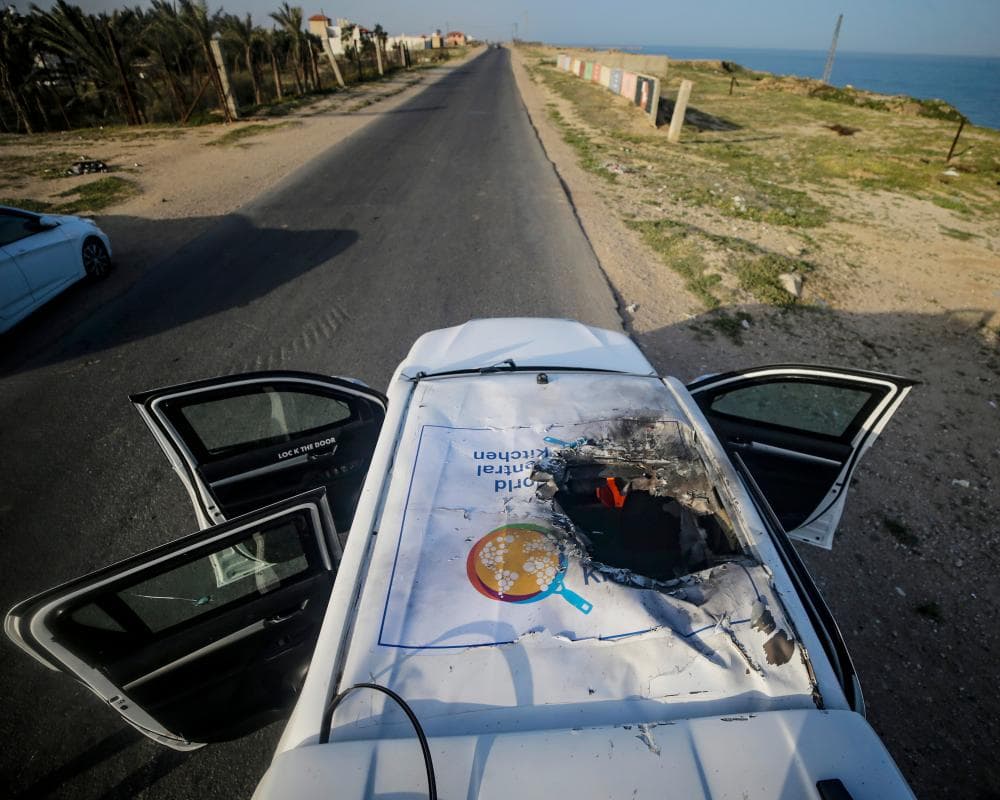
“After turning south on to the coast road, the three WCK vehicles were struck in relatively quick succession, each strike being approximately two minutes apart. There were two survivors from the strike on the first (up-armoured) vehicle who quickly moved to the second vehicle, then two survivors from the second (up-armoured) vehicle who moved to the third vehicle. There were no survivors from the third (soft-skinned) vehicle. Over the four-minute period 23:09 – 23:13, the seven WCK workers were killed – likely one in the first vehicle, two in the second and four in the last.”
The seven victims of the IDF drone strikes were from the UK, Australia, Poland, Palestine and the US. The Britons John Chapman, James Kirby and James Henderson were working as security consultants. Saifeddin Issam Ayad Abutaha, a Palestinian driver and translator, was the youngest killed, at 25. Frankcom, Damian Soból, a Pole, and Jacob Flickinger, a US-Canadian dual citizen, were humanitarian workers for WCK.
The military prosecutor claimed that in turning south towards Rafah, the WCK workers were “deviating from the route that the organisation had coordinated in advance with the IDF”, giving weight to the Nahal brigade’s mistaken impression that “Hamas operatives had taken control of the convoy”.
Mendel also mentioned this “deviation” as a mitigating factor. However, the Australian report found that the fact that the WCK workers had changed their route only became known after they were killed, and “as such it did not play a factor” in the decision to open fire.
The official Israeli version of events says Mendel and his brigade fire support commander ignored an order on the night of the airstrike from a superior officer to cease any attacks on humanitarian convoys, but Mendel has said the order is a fabrication.
“It never happened, never existed,” Mendel said. “No operational directive reached the brigade to cease the strikes … We checked it a thousand times.”
In explaining his own decision-making, Mendel stressed he was carrying out Israeli government policy by stopping Hamas taking control of food deliveries. He had been lauded by his superiors for ordering strikes on several earlier alleged Hamas attempts to hijack aid. In his mind, the events on the night of 1 April 2024 fitted the same pattern.
“I didn’t plan to kill the aid workers,” Mendel said, but added: “They were not innocent because they were connected to Hamas.”
Justifying this conclusion, he said: “They were mixed together with Hamas operatives …near them, talking, playing, hanging out and so on.”
In a written statement, WCK said: “It is extraordinary to learn now that some in the IDF considered our humanitarian work to be enemy activity based on the flimsiest evidence, or no evidence at all.
“This undefined, unjustified and unlawful view is a mortal threat to all humanitarians. The IDF’s shifting excuses and explanations for these unlawful airstrikes are precisely why we continue to demand an independent investigation with the full release of the IDF’s evidence.”