Loading...
Please wait for a bit
Please wait for a bit
Click any word to translate
Original article by Tom Ambrose (now); Taz Ali, Kate Lamb and Nadeem Badshah (earlier)
An Israeli soldier’s photo of a Palestinian man from Gaza stripped to his underwear, blindfolded and bound face-down to an iron rod corroborates extensive reporting on Israeli torture of Palestinians in detention and itself may constitute a war crime, rights groups have said.
The image was shared on a now-deleted personal social media account, with the Hebrew-language caption “good morning”. It was brought to wider public attention by a Palestinian writer and activist who goes by Tamer.
“Both abusive treatment of detainees and the public sharing of humiliating or degrading images of them can constitute war crimes,” said Oneg Ben Dror from the prisoner and detainees department at Physicians for Human Rights Israel (PHRI).
The photo “confirms what thousands of testimonies from Palestinian detainees have exposed, and what we and other organisations have been reporting for nearly three years now,” she added. “Israeli detention facilities are torture camps for Palestinians.”
Israel’s military confirmed the authenticity of the photo. “The incident does not align with IDF values and regulations,” a spokesperson said, adding that an inquiry was under way.
Trump has suggested the US could reimpose its blockade of Iranian ports, which had been lifted as part of the interim ceasefire deal.
The president said:
We may put it back, the blockade, and it’ll only be a blockade for Iran. Anybody else can have whatever they want.
Of course, they’ll drop some mines if they can, you know, if they can do it.
He added:
But we have mine sweepers.
He also referred to the UK and France-led mission to safeguard the strait of Hormuz.
Trump said:
They’re sending mine sweepers. We don’t need them now.
Trump threatened to “take over Kharg Island”, a critical hub for Iran’s oil exports that lies in the Gulf, and warned he may reinstate the US naval blockade of Iranian ports.
Trump also appeared to have confused the president of Ukraine, Volodymyr Zelenskyy, with Vladimir Putin.
While gesturing towards Zelenskyy, who is seated next to the US president at a press conference at the Nato summit in Ankara, Trump asked reporters: “Do you have a question for president Putin please.”
His comment attracted laughter in the room, and after realising his mistake Trump appeared to make light of the situation. “Do you have a question for president Putin, not Zelenskyy,” he joked while pointing at the Ukrainian president, who nods and smiles.
Trump appeared to have confused Iran with Japan as he spoke of the effectiveness of US Patriot missile systems.
“We had 111 missiles shot by the Islamic republic of Japan,” he told reporters at the Nato summit in Turkey.
“They were shot at the aircraft carrier [USS Abraham Lincoln] over a period of about one hour. Hundred and eleven missiles going to a very expensive ship, and every one of those missiles was knocked down, pretty much most by patriots, but by other means also.”
Donald Trump warned the US is preparing to launch more strikes against Iran, after he said he considered the US-Iran truce to be “over”.
“I’ll give a little warning – we’re going to hit them hard tonight,” the US president told reporters at the Nato summit in Turkey.
Earlier, when asked by a reporter about the status of the memorandum of understanding signed last month by the US and Iran, Trump responded: “I think it’s over.”
Updated
President Donald Trump told a Nato summit that the United States wanted to “remain” with the alliance, a source at inside the closed-door session said, despite his earlier anger at European allies over the Iran war.
Trump told the meeting: “We want to remain with you,” the source told AFP, speaking on condition of anonymity.
Syria’s president Ahmed al-Sharaa has arrived in Ankara, where he was due to meet US president Donald Trump on the sidelines of the Nato summit.
The summit of the military alliance, which closes on Wednesday, has brought together 36 heads of state, as well as several representatives from Gulf countries.
Al-Sharaa was invited by Turkey’s president Recep Tayyip Erdogan.
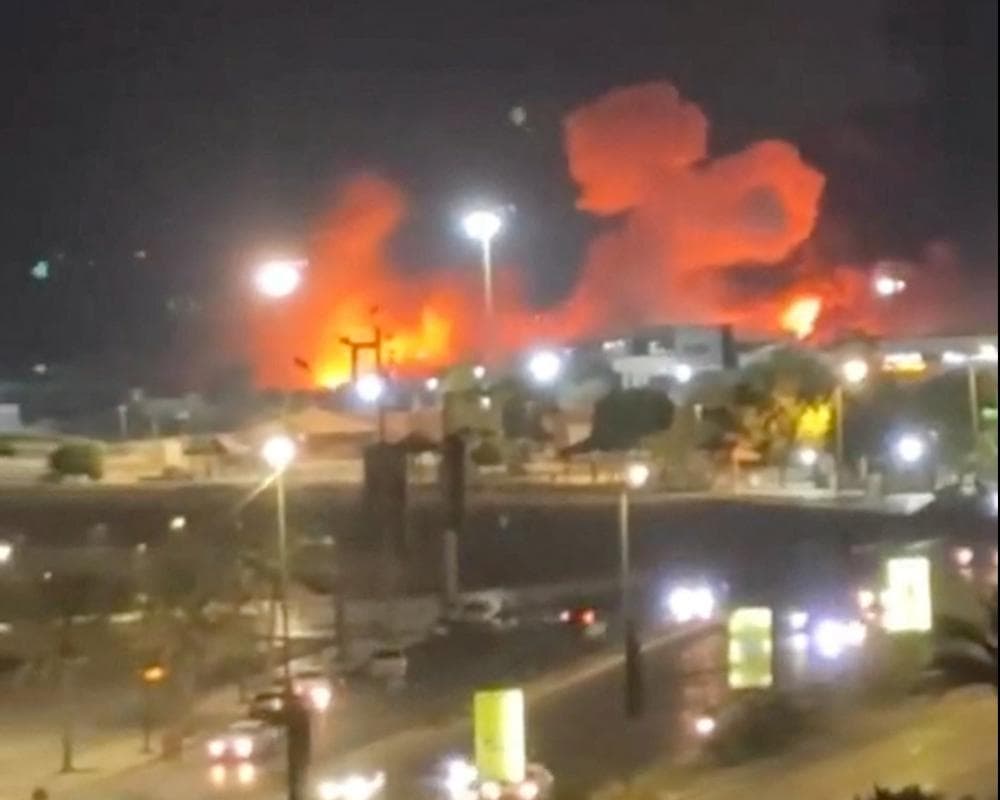
Iran’s southern region was rocked by a wave of US strikes, with state media reporting explosions in the cities of Bandar Abbas and Bushehr along the Gulf coast.
The Pentagon said the strikes were in response to Iranian attacks on three commercial ships in the strait of Hormuz. Iran did not directly claim responsibility for the attacks on shipping in the strait.
According to Iranian media, a member of Iran’s Islamic Revolutionary Guard Corps (IRGC) had been killed in a US drone attack in the port city of Bandar Mahshahr.
The US Central Command (Centcom) said its forces had struck more than 80 targets, including Iranian air defence systems, coastal radar sites and 60 IRGC small boats.
Updated
Brent crude jumped more than 6% to a daily high of $79.26 a barrel after Donald Trump said he considered the interim deal to end the war with Iran to be “over”.
Read more:
Updated
Arsenio Dominguez, the secretary general of the International Maritime Organization (IMO), said nearly 6,000 seafarers are stranded in the strait of Hormuz, as he called for “maximum restraint and de-escalation” after US and Iran exchanged attacks in the region.
Condemning Iran’s attacks on ships transiting the strait, he said:
These reckless attacks have again placed innocent seafarers in grave danger. No seafarer should have to risk their life simply for doing their job.
As long as the safety and security of crews cannot be assured, I urge flag states, shipowners, operators and all relevant authorities to avoid exposing seafarers to unnecessary danger by transiting the strait.
The situation in the region remains volatile. These attacks further intensify the fear, uncertainty and psychological strain already being endured by the nearly 6,000 seafarers who remain stranded on board vessels unable to depart the Persian Gulf safely.
I call on all states concerned to exercise maximum restraint, de-escalate the situation without delay, and facilitate the safe departure of the ships still trapped in the Gulf since the crisis began.
The safety of seafarers must remain our foremost priority.”
Updated
In this morning’s episode of Today in Focus, the Guardian’s diplomatic editor, Patrick Wintour, reports from the funeral of Ali Khamenei as the Iranian regime puts on a show of confidence and resilience.
Iran is holding a multi-day funeral for its former supreme leader in a show of defiance and resilience after its war with the US and Israel.
“I’m just one dot on those numbers you’re seeing from helicopters,” says Patrick. “When I was in the mosque yesterday, it was absolutely rammed, packed, and people couldn’t get into the mosque. There were clearly more than 50,000, 60,000 there.”
Khamenei had ruled for 36 years until he was killed in the first day of airstrikes in February. After such a shocking start to the war, it seemed as though Iran was facing an existential threat. Instead, explains Robert Malley, a US special envoy for Iran during Joe Biden’s presidency, the ceasefire deal being negotiated is in Tehran’s favour.
You can listen to the episode here:
The Iranian president, Masoud Pezeshkian, has likened the US’s conduct as co-host of the World Cup to its foreign policy approach, in that it’s “bending rules, bullying rivals, creating obstacles, and cheating”.
“This is their MAGA playbook. Iran rejects such games. We stand firmly for our rights,” he wrote on X.
The Israeli newspaper Haaretz has reported that Pete Hegseth, the US secretary of defence, has cancelled a planned trip to Israel as violence escalates in the Middle East.
Hegseth was expected to meet Israeli prime minister Benjamin Netanyahu and defence minister Israel Katz, according to reports. It would have been his first trip to the country as US defence secretary.
CNN, which first reported the visit, said it was cancelled this morning even as preparations were already under way.
Updated
Kuwait’s armed forces has issued an update on the Iranian attacks against the country this morning, saying it had intercepted two ballistic missiles and 13 drones that breached Kuwaiti airspace at dawn.
“The incident resulted in no material damage or casualties,” it added in a statement.
Oil prices have risen by more than 3% after fresh strikes from the US and Iran tested a fragile truce.
Brent crude climbed $2.49 to $76.65 a barrel, up 3.4%.
Richard Hunter, head of markets at the trading platform interactive investor, said: “Reports of an Iranian attack on a liquefied natural gas tanker in the strait of Hormuz was followed by retaliatory US strikes in the region, leading to a spike of more than 3% in oil prices.
“The US also reimposed crude oil sales sanctions on Iran, all of which casts real doubts on the longer-term outlook for peace in the Middle East.”
For more updates on the financial markets and world economy, you can follow our business live blog here:
Madrid is downplaying Trump’s renewed threat to cut all trade with Spain.
Spanish government sources said they were greeting the US president’s latest broadside calmly, adding: “Our country maintains an excellent social, cultural, and economic relationship with the US, and we have no intention of changing that.”
They also suggested people would do well to reflect on three things:
“One, that the US has a trade surplus with Spain (meaning it benefits more from this relationship than we do).
“Two, that the EU is a trading union in which no member state can be singled out (as the commission itself has emphasised on several occasions).
“And three, that economic ties are forged by private companies, not governments. The bilateral relationship between the US and Spain is beneficial for both countries, both in the commercial and defence spheres.”
And let’s remember that we’ve been here before. In March, Trump threatened to cut all trade with Spain after it refused the US permission to use jointly operated bases in southern Spain to continue its attacks in Iran.
“Spain has been terrible,” Trump said at the time, adding that he had told the Treasury secretary, Scott Bessent, to “cut off all dealings” with the European country.
The Spanish government has issued a statement in response to Donald Trump’s order to cut off trade with Spain, which the Spanish newspaper El País reported was prepared in case the US president attacked the country at the Nato summit.
The statement by the Spanish prime minister’s office said: “Spain receives these statements calmly and normally.
“Our country maintains an excellent social, cultural, and economic relationship with the US, and it is not our intention for that to change.”
It added: “Economic ties are forged by private companies, not governments. The bilateral relationship between the US and Spain is beneficial for both countries, both in the commercial and defence spheres.”
The EU foreign policy chief, Kaja Kallas, said the new attacks by the US and Iran have complicated talks to end the war.
In a post on X, she said:
The exchanges of fire between the US and Iran further complicate already fraught talks to end the war. Iran’s attacks on Bahrain and Kuwait are unacceptable.
Under the memorandum, Tehran committed to reopening the strait of Hormuz. Its recent attacks on ships near the strait violate that commitment and threaten to disrupt the resumption of energy supplies. Freedom of navigation must be unimpeded.”
Trump repeats that he is “not happy with Nato because of what they did with Greenland” and its refusal to help with Iran.
He says he spoke to several countries who didn’t help.
But he particularly lashes out against Spain, saying he “does not want to do anything” with the country, as he instructs officials to “cut all trade with Spain”.
Spain is a terrible partner in Nato. They don’t participate, they don’t pay, I don’t want anything to do with Spain. Cut off all trade with Spain, including visits. We don’t want anything. Watch them come running back, oh, they will come running back.”
While he says he believes the interim agreement with Iran is “over”, Trump tells reporters at the Nato summit that negotiations with Tehran can continue.
As far as I’m concerned, it’s over. I’ll speak to our negotiators. They want to negotiate. They’re good people, Steve Witkoff, Jared Kushner, but they have to come back to me. As far as I’m concerned, it’s just a waste of time dealing with them [Iran].
Updated
Speaking at the Nato summit, Trump says the memorandum of understanding (MoU) with Iran is “over” because “I do not want to deal with them any more, they are scum”.
They are sick people, they are vicious, violent people.”
He then adds:
As far as I am concerned, it’s just a waste of time dealing with them. They are liars. … There is something wrong with them. They are cuckoo. As far as I am concerned, it is over.”
The Iranian foreign ministry said earlier that US attacks on Iran, plus other “violations” of the MoU, have rendered it “ineffective” (see post at 8:10).
Donald Trump is speaking alongside Nato secretary general Mark Rutte at the alliance summit in Ankara, Turkey.
He says they had “some great meetings” last night, particularly praising the Turkish president Recep Tayyip Erdoğan.
Speaking about the Nato summit, he says “something has been determined, and some haven’t frankly”. God knows what that means.
He briefly turns to Iran, he says they are “very dangerous” and “sick” for “shooting rockets at ships, and so we hit them very hard last night”.
He says the Iranians are “dirty players” who “go after everyone, probably including me”, as he calls them “scum”.
“They are evil people,” he says.
My colleague Jakub Krupa over on the Europe live blog is covering the Nato summit in Ankara, where Donald Trump is due to speak. You can follow the updates here:
While the volley of strikes continue in the Middle East, mourners are marching through the Iraqi city of Najaf for the funeral of Iran’s supreme leader Ayatollah Ali Khamenei, who was killed in a US-Israeli strike on the first day of the war on 28 February.
It is part of a days-long funeral procession that began on Saturday in Tehran.
Reuters reported Najaf holds significance importance for Shia Muslims as the burial place of Imam Ali, the cousin of the prophet Muhammad. Khamenei’s coffin will be returned to Iran to be buried tomorrow at the Imam Reza shrine in the north-eastern city of Mashhad, where he was born, according to the Associated Press.
The IRGC said a member of its navy was killed this morning in a US drone attack in the southern Iranian port city of Bandar Mahshahr, Iran’s semi-official Tasnim news agency reported.
The Iranian foreign ministry has accused the US and Israel of violating the memorandum of understanding (MoU) between Tehran and Washington to end the war.
It said the “repeated” US attacks against Iran, Washington’s decision to reimpose sanctions on Iranian oil exports, American interference in Tehran’s arrangements for the strait of Hormuz and Israel’s continued strikes on Lebanon have rendered the MoU “ineffective”.
The ministry also warned other countries in the region to not allow their territory to be used by the US to launch attacks on Iran. This is likely a warning aimed at Bahrain and Kuwait, which the Iranian military has targeted in retaliatory strikes this morning.
In a statement carrried by Iran media, the ministry said:
The repeated illegal attacks against Iran, along with last night’s decision by the US Treasury to revoke the licence for the sale of Iranian oil – to which the US government is committed under Article 10 of the Memorandum of Understanding – the violation of Iranian arrangements in the strait of Hormuz, and the continuation of the Israeli regime’s military aggressions and terrorist acts against Lebanon, have rendered important and fundamental parts of the Memorandum of Understanding on the End of the War ineffective. The responsibility for the dangerous consequences of this escalation of tensions lies with the renegade American regime.
The Ministry of Foreign Affairs also strongly notes the international legal obligation of all states, especially neighbouring countries located on the southern shore of the Persian Gulf, to prevent the aggressors from using their territory and facilities to carry out aggressive acts against the Islamic Republic of Iran, and emphasises that any cooperation in committing the crime of aggression against Iran constitutes complicity and participation in the crime.
Updated
The Kuwaiti foreign ministry has issued a statement, saying it expresses “condemnation and denunciation, in the strongest possible terms, of the repeated Iranian attacks” on its soil this morning.
In a statement on X, it added: “The continuation of these blatant attacks, at a time when regional and international efforts aimed at de-escalation are under way, constitutes a systematic undermining of these de-escalation efforts and flies in the face of the international will supporting this course of action.”
Iran said it had targeted American military sites in Kuwait in response to US attacks on its southern provinces.
Meanwhile, Iranian media report explosions in the south of the country in Bushehr, a port city along the Gulf coast.
Iran’s semi-official Mehr news agency said there were also reports of an attack on Kharg Island, a strip of land in the Gulf that handles about 90% of Iran’s oil exports.
News agencies report air raid sirens sounding in Bahrain for a third time this morning as Iran continues to launch attacks in the Gulf in retaliation against US strikes.
The Iranian army said it carried out drone strikes on US forces at Sheikh Isa airbase in Bahrain in response to Washington’s attacks on southern Iran.
“Following the hostile aggression by the American enemy against military and civilian areas in the south of the country and the violation of the 14-point memorandum, the attack drones of the Islamic Republic of Iran army, from dawn today, have attacked the concentrations of American hostile forces at the ‘Sheikh Isa Base’ in Bahrain,” the army said in a statement carried by Iran’s official IRNA news agency.
“This is the consequence of the blatant and repeated violation of the ceasefire by the criminal American government, and all US bases in the region will be legitimate targets for the army’s drones.”
Earlier, Iran’s Islamic Revolutionary Guard Corps (IRGC) said it targeted 85 US military facilities in Bahrain and Kuwait.
Weeks after signing an interim MoU to end the war, the United States and Iran have struggled to maintain their fragile truce, with the fight over the control of the strait of Hormuz flaring again today.
The US on Wednesday launched fresh strikes against Iran in retaliation for what it said was Iranian strikes on three commercial vessels a day earlier.
Iran responded by targeting dozens of US military facilities in Kuwait and Bahrain. The country has sought to leverage its control of the strait, effectively allowing it to force a stalemate with the world’s most powerful military.
If you are just getting up to speed, here is the latest.
The US military launched a series of strikes against Iran on Wednesday, US Central Command confirmed. A US official said those strikes targeted Iranian air defense systems, port facilities, coastal surveillance systems, ground-to-air missiles as well as launch sites for anti-ship cruise missiles and drones. This marks the first known US military strikes against Iran since late last month, when there were several days of strikes and counterstrikes between the two.
The US said the strikes were in response to Iranian attacks a day earlier on three commercial vessels that were transiting the strait of Hormuz. “Iran’s demonstrated aggression was unwarranted, dangerous, and a clear violation of the ceasefire,” a US military statement said.
Prior to the attacks, the US also revoked a temporary sanctions waiver for Iranian oil with the US Treasury cancelling a license that had allowed Iran to produce, sell and deliver crude oil and related products through 21 August. Some have described the move as a potentially major blow to the agreement.
Iran responded by targeting dozens of US military facilities in Bahrain and Kuwait, with sirens sounded in both countries. “In an initial response to this aggression, the IRGC Navy and Aerospace Force carried out a joint missile and drone operation, striking 85 key US military facilities” in the two countries, while also shooting down an MQ-9 drone, the statement said.
Iran’s foreign ministry also lashed out against the US, vowing to “take whatever measures it deems necessary to safeguard its national interests and security”. The ministry accused the US of “treacherous action” and “major violations” of the MoU. “The era of bullying and extortion is over,” Iran’s Parliament Speaker Mohammad Bagher Qalibaf wrote on X. “It leads nowhere. We don’t fold.”
Referring to the US strikes, Iranian media said six projectiles hit the area of Taheroui pier in Sirik in southern Iran. No civilian deaths were reported, but several people were injured by shrapnel from an “enemy projectile” that hit a commercial pier in Sirik, according to an Iranian state TV reporter. The reports said strikes also hit fishing piers in Sirik and in Bandar Abbas, where several fishing boats were set ablaze.
The benchmark US oil contract increased more than 2.5% when markets opened Wednesday, as Middle East tensions rose with new US attacks on Iran. West Texas Intermediate crude, one of the two major global benchmarks, was up 2.63% at $72.29 per barrel. It rose 2.76% on Tuesday.
The new attacks by the US on Iran were “absolutely necessary”, Nato secretary general Mark Rutte said on Wednesday. When you have a ceasefire and Iran is basically violating the ceasefire, I think it is totally crucial that the U.S. forcefully react,” Rutte told reporters before a summit of Nato leaders in Ankara.
The new attacks by the US on Iran were “absolutely necessary”, Nato secretary general Mark Rutte said on Wednesday.
When you have a ceasefire and Iran is basically violating the ceasefire, I think it is totally crucial that the US forcefully react,” Rutte told reporters before a summit of Nato leaders in Ankara.
Updated
At least four oil and gas tankers have turned back from attempting to transit the strait of Hormuz, ship-tracking data showed, as renewed attacks on vessels in the critical waterway heightened safety and security concerns, according to Reuters news agency.
The diversions come after a Qatari liquefied natural gas tanker and a Saudi-flagged crude oil tanker were damaged near the strait on Tuesday following reports that Iran fired missiles at ships in the waterway, prompting maritime authorities to raise the threat risk for transiting vessels to “severe”.
LNG tankers - Al Ghariya, Duhail and Al Ruwais - have all been inching westward towards the strait of Hormuz before changing course to turn away late on Tuesday, showed data from analytics firms Kpler and LSEG. All three tankers controlled by QatarEnergy were empty and heading towards Qatar’s Ras Laffan export facility to load cargoes.
Meanwhile, LSEG and Kpler data also showed an Indian-flagged tanker, carrying 2 million barrels of Kuwaiti crude loaded late last week, made a U-turn off the tip of Oman at the strait of Hormuz on Wednesday.
Updated
A quick update: more sirens sounding in Bahrain.
If you are just tuning in, here is our wrap-up of today’s events:
Iran’s Revolutionary Guards (IRGC) has said they targeted dozens of US military facilities in Bahrain and Kuwait in response to the US strikes on Wednesday, in a statement carried by state broadcaster IRIB.
“In an initial response to this aggression, the IRGC Navy and Aerospace Force carried out a joint missile and drone operation, striking 85 key US military facilities” in the two countries, while also shooting down an MQ-9 drone, the statement said.
The US did not comment on the Iranian claims that facilities in Bahrain and Kuwait had been hit – or on whether a drone had been shot down.
The Kuwaiti army has said it is responding to missile and drone attacks, after Iran threatened retaliation for a wave of US strikes.
Kuwaiti air defenses are currently engaging hostile missile and drone attacks.
The General Staff of the Army notes that any explosions heard are a result of air defense systems intercepting hostile attacks.”
Iran’s Revolutionary Guards say they targeted 85 US military sites in Bahrain and Kuwait ‘in response to US ceasefire violation’.
We’ll keep you updated as more comes in.
Updated
Iran’s Revolutionary Guards say they have downed a US MQ9 drone in the country’s south, according to Iran’s Press TV.
Sirens are also now sounding in Kuwait.
The Kuwaiti army says air defences are now confronting ‘hostile’ missile and drone attacks.
More to come.
Updated
Iran’s parliament speaker and top negotiator Qalibaf has commented on today’s US strikes on Iran, saying on X:
The era of bullying and extortion is over. It leads nowhere. We don’t fold.”
An update on air sirens in Bahrain:
“The siren has been sounded,” the ministry said on X, without giving details of the apparent threat. “Citizens and residents are urged to remain calm and head to the nearest safe place.”
Sirens have sounded in Bahrain, according to the country’s interior ministry.
We’ll keep you posted with more details as they come in.
US Central Command also said that it had struck “more than 60 Islamic Revolutionary Guard Corps small boats in and near the strait,” in addition to Iranian defense systems, command and control networks, coastal radar sites, anti-ship missile capabilities.
Iran’s top joint military command, Khatam al-Anbiya Central Headquarters, said on Wednesday that Iranian armed forces would deliver a “crushing response” and warned that Tehran would not allow US interference in the management of the strait of Hormuz.
It said that the only safe passage for commercial vessels and oil tankers through the waterway was the route determined by Iran.
US forces completed a new round of strikes against Iran, hitting more than 80 targets, US Central Command says.
The comments come as Iran’s top joint military command says US army targeted parts of southern Iran in “blatant aggression” and vowed to give a “crushing response”.
Updated
Some background on the latest escalation:
Iran’s clerical rulers aim to install a permanent system to collect fees in what would amount to a huge shift of the balance of power in a region where Washington has long acted as guarantor of security.
At home, the leadership has used the mourning for Khamenei that began last week to show its control after Khamenei was killed with his daughter, granddaughter, son-in-law and daughter-in-law on the war’s first day.
Iranian president Masoud Pezeshkian, who was in Iraq to participate in the funeral ceremonies, left for Iran after the US strikes on southern Iran, state television reported.
The ceasefire was intended to provide a 60-day window for negotiations on a permanent agreement, but indirect talks in Qatar ended last week with no sign of headway.
President Trump has repeatedly threatened to resume bombing, most recently on Monday when he told reporters in the Oval Office: “We’re either going to make a deal or we’re going to finish the job... We can knock down their bridges in one hour, we can knock out their energy supply.”
US president Donald Trump is currently in Turkey, where he met with Turkish leader Recep Tayyip Erdoğan ahead of the Nato summit in Ankara.
Trump has criticised Nato’s abilities to function without American leadership and power, expressing disappointment at the refusal of some Nato allies to join the Iran war he launched alongside Israel without consulting them.
Iranian Press TV says there are reports of renewed explosions on Qeshm island, and several blasts heard on Kharg island.
We’ll continue to provide updates as they come in.
Qatar has blamed Iran for attacking commercial vessels in the strait of Hormuz on Tuesday, including the huge Qatari liquefied natural gas tanker, the Al Rekayyat, which was reportedly struck overnight by a drone that caused a fire in its engine room. The crew were safe and being evacuated.
A Saudi-flagged crude oil tanker, believed to be the supertanker Wedyan, was also damaged off Oman, maritime security sources said. The cause was not immediately clear.
Qatar’s foreign ministry said it had summoned Iran’s deputy ambassador and handed him a protest note after the attack on the tanker.
Iran’s foreign ministry said Qatar’s accusations were perplexing and that Tehran was diligently fulfilling its commitments but asserted that commercial vessels faced risks for using routes not coordinated with Iran.
A second US official, speaking on condition of anonymity, said initial indications were that Iran had fired at three commercial vessels.
Weeks after signing an interim MoU to end the war, the United States and Iran have struggled to maintain the fragile truce, with the fight over the control of the strait of Hormuz catalysing continued retaliatory actions.
A day after Iranian strikes on three commercial vessels, the US has today launched fresh strikes on Iran.
If you are just getting up to speed, here is the latest.
The US military launched a series of strikes against Iran on Wednesday, US Central Command confirmed. A US official said those strikes targeted Iranian air defense systems, port facilities, coastal surveillance systems, ground-to-air missiles as well as launch sites for anti-ship cruise missiles and drones.
The US said the strikes were in response to Iranian attacks a day earlier on three commercial vessels that were transiting the strait of Hormuz. “Iran’s demonstrated aggression was unwarranted, dangerous, and a clear violation of the ceasefire,” a US military statement said.
Prior to the attacks, the US also revoked a temporary sanctions waiver for Iranian oil with the US Treasury cancelling a license that had allowed Iran to produce, sell and deliver crude oil and related products through 21 August. Some have described the move as a potentially major blow to the agreement.
Iran’s foreign ministry lashed out against the US, vowing to “take whatever measures it deems necessary to safeguard its national interests and security”. The ministry also accused the US of “treacherous action” and “major violations” of the MoU. Kazem Gharibabadi, Iran’s deputy foreign minister, insisted Iran would “take decisive actions to safeguard its national interests and security”.
Iranian media said six projectiles hit the area of Taheroui pier in Sirik in southern Iran. No civilian deaths were reported, but several people were injured by shrapnel from an “enemy projectile” that hit a commercial pier in Sirik, according to an Iranian state TV reporter. The reports said strikes also hit fishing piers in Sirik and in Bandar Abbas, where several fishing boats were set ablaze.
This marks the first known US military strikes against Iran since late last month, when there were several days of strikes and counterstrikes between the two. It comes a day after huge crowds mourned Iran’s slain Supreme Leader Ayatollah Ali Khamenei in the holy city of Qom.
The benchmark US oil contract increased more than 2.5% when markets opened Wednesday, as Middle East tensions rose with new US attacks on Iran. West Texas Intermediate crude, one of the two major global benchmarks, was up 2.63% at $72.29 per barrel. It rose 2.76% on Tuesday.
A US official said earlier that negotiators continued to work in good faith toward a final agreement with Iran. But control of the strait has given Tehran immense leverage, effectively allowing it to force a stalemate with the world’s most powerful military. Analysts say Tehran uses attacks on ships to underscore that leverage as it negotiates a long-term peace deal with the US.
Updated
The benchmark US oil contract increased more than 2.5% when markets opened Wednesday, as Mideast tensions rose with new US attacks on Iran.
West Texas Intermediate crude, one of the two major global benchmarks, was up 2.63% at $72.29 per barrel. It rose 2.76% on Tuesday.
The rise came after US forces launched strikes on Iran after three commercial vessels were attacked in the strait of Hormuz, according to the US military.
Iranian state media reported numerous explosions around the strait, including six on the island of Qeshm, seven in the city of Sirik and more in the major port city of Bandar Abbas.
Oil prices are still well below the peaks they shot up to as the war began in late February and Iran largely shut down the strait of Hormuz.
The US revoked a temporary sanctions waiver for Iranian oil after three tankers were struck in the strait of Hormuz. The move came before fresh US strikes on Iran today.
The US Treasury on Tuesday cancelled a licence that was announced in June that had allowed Iran to produce, sell and deliver crude oil and related products through 21 August.
“Iran’s actions in the strait were wholly unacceptable to the United States and will be met with consequences,” a US official told Agence France-Presse.
The official, speaking on condition of anonymity, said the US-Iran memorandum of understanding was “entirely performance-based,” warning that Tehran would see benefits only if it showed “good behavior.”
British maritime security agency UKMTO said an “unknown projectile” hit a tanker overnight, causing a fire, before two more vessels were struck, at least one by a drone.
All three vessels were struck close to Oman, which had proposed a temporary transit corridor hugging its coastline – an initiative opposed by Iran as it seeks to impose fees on ships using the narrow waterway.
Fresh US strikes on Iran are expected to last for hours, a US military official has told the Associated Press.
Another official said the US military was targeting Iranian air defense systems, coastal surveillance systems, ground-to-air missiles as well as launch sites for anti-ship cruise missiles and drones. Iranian port facilities are also being targeted, that official added.
Iran’s Fars news agency, citing a port official, said black smoke behind Bandar Abbas fish market caused by “enemy projectiles” has set fire to several civilian fishing boats.
Earlier on Tuesday, three civilian vessels were hit in the strait of Hormuz – the most in a single day since late April, according to UN International Maritime Organisation figures.
The renewed hostilities threaten to again disrupt shipping transiting the Gulf channel.
Ending Tehran’s stranglehold on the strategic waterway, which disrupted global oil and gas supplies and drove up fuel and food prices, had been a key demand in previous negotiations.
However, the initial deal reached between the US and Iran – known as the Islamabad memorandum of understanding – only secures safe, toll-free passage of the strait for 60 days, pending the outcome of a final agreement on Tehran’s disputed nuclear plans.
The pact also leaves it to Iran and Oman, in conjunction with other Gulf states, to “define the future administration and maritime services in the Strait of Hormuz”.
In the meantime, Iran has continued to try and exert leverage over the channel, including demanding ships seek permission to transit and raising the spectre of future charges.
This has included claims by Tehran that only it is permitted to carry out mine clearance in the strait under the terms of the interim agreement, after Oman agreed to work with Britain and France to make sure the sea route remained open.
US strikes in Iran targeted their air defense systems, coastal surveillance systems, surface-to-air missiles, anti-ship cruise missiles, drone launch sites, an unnamed US official told Reuters.
Updated
Kazem Gharibabadi, Iran’s deputy foreign minister for legal and international affairs, said the US Treasury’s earlier decision to revoke a license that had authorised the sale of Iranian oil, was a “blatant violation” of Article 10 of the Islamabad Memorandum of Understanding.
He added the subsequent strikes “constitute a serious violation” of Articles 1 and 2 of the agreement, which was signed last month.
Gharibabadi insisted Iran would “take decisive actions to safeguard its national interests and security”.
Updated
Iran’s foreign ministry has accused the US of “major violations” of the Islamabad Understanding which had been signed by the two sides last month.
In a statement, the ministry vowed to “take whatever measures it deems necessary to safeguard its national interests and security”.
It said: “The Ministry of Foreign Affairs of the Islamic Republic of Iran strongly condemns the treacherous action of the United States in revoking the suspension of sanctions on Iranian oil sales, which constitutes a violation of Paragraph 10 of the ceasefire understanding dated 28 Khordad 1405 (18 June 2026), and holds the US government responsible for the consequences of this breach of commitment.
“Over the past 20 days, the United States has repeatedly committed both minor and major violations of various provisions of the understanding, either directly or through the actions of the Zionist regime against Lebanon.
“The Ministry of Foreign Affairs of the Islamic Republic of Iran, while warning against the consequences of the United States’ breaches of commitment, declares that it will take whatever measures it deems necessary to safeguard its national interests and security.”
Updated
There have been explosions in several areas in the south of Iran, according to local media.
Several explosions have been reported in the port city of Sirik, near the Strait of Hormuz, while six projectiles reportedly struck the area of Taheroui Pier.
Explosions were also heard in Qeshm Island, the largest island in the vicinity of the Strait of Hormuz, and Bandar Abbas.
Earlier in the day, Qatar warned Iran it will bear full legal responsibility after three tankers, including a Qatari LNG vessel, were struck within hours in the strait of Hormuz.
All three were hit close to Oman, which had suggested a new shipping corridor close to its coastline – a proposal Iran opposes as it wants to charge ships to use the waterway.
Iran blamed the US for the incident, saying Washington’s efforts to open up new routes through the strait constituted a breach of the memorandum of understanding the two parties had signed.
Tehran claims the memorandum is specifically worded to leave it, in consultation with Oman, to manage the reopening of the strait with the aim of commercial traffic returning to prewar levels within 30 days.
At a briefing in Tehran, foreign ministry officials insisted Iran had a right to impose fees on all ships using the strait.
The US military has launched a series of strikes against Iran, US Central Command said Tuesday, adding that the strikes were in response to what it said were Iranian attacks on three commercial vessels that were transiting the Strait of Hormuz.
“U.S. Central Command forces have begun launching a series of powerful strikes against Iran to impose heavy costs for targeting and attacking commercial shipping,” a US military statement said. “Iran’s demonstrated aggression was unwarranted, dangerous, and a clear violation of the ceasefire.”
It was unclear what specifically the U.S. targeted but Iranian media said six projectiles hit the area of Taheroui pier in Sirik in southern Iran. This marks the first known US military strikes against Iran since late last month, when there were several days of strikes and counterstrikes between the two.
Updated